Off The Grid News Better Ideas For Off The Grid Living

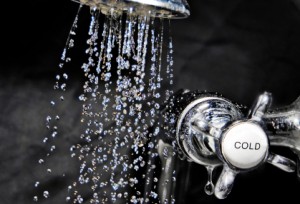
It’s been called the “Scottish Shower.” Ian Fleming’s title character, the memorable James Bond, often took this shower, which began with hot water and ended with brisk and invigorating icy, cold water, not in the movies, but in the novels themselves.
Perhaps mention of this unique shower had something to do with Fleming’s Scottish background … or, perhaps not. We’ll never know. What I do know is that I was a huge fan of James Bond and of the first actor to play him, Sean Connery. I loved the books, too, and read all of them, and that’s how I learned about the cold showers. In an off-the-grid situation, heating up water for a shower might not be a priority, so I thought this might be a topic to cover for the newsletter.
Naturally, as a fan – a young and awestruck fan – I had to emulate my new hero, so I started taking cold showers and even gave them a name – the “James Bond shower.” My youth and good health enabled me to withstand the temperature change when the water, which began hot ,ended cold. My heart was able to cope with the shock, and the feeling of the cold water on my skin was invigorating.
That cascading cold water woke me up each morning and helped to carry me through the day. It became habit, too, that has continued through all of my adult years … right to this very day. Interestingly, I learned, over the years, that cold showers and baths have a long history in many cultures. In fact, they’ve been used for centuries as a way to treat serious ailments.
What’s more, modern studies by respected medical professionals seem to bear out the fact that there is real health benefits connected to this type of treatment. That would help explain why they have been used for such a long, long time.
Here’s a Brief History of the Cold Water Shower.
The great James Bond was by no means the first human or even fictional character to enjoy the healthful effects of cold water on the body. The practice began in ancient times, for good reason. The people back then did not have access to hot water unless they lived near hot springs. If they didn’t, and most lived nowhere near hot springs, they had to bathe in cold water.
Of course, there were no showers to speak of at that time so most people bathed in lakes, rivers … any body of water. The ancient Greeks, by the way, were able to develop heating systems for their public baths, but actually preferred to bathe in cold water for the perceived health benefits associated with cold water.
In the first century, the cold-weather Finns began their personal cleansing in a sauna (to open the pores), then completed the bath with a heart-stimulating jump into a frigid river or snow bank. Ancient Russians also took flying leaps into icy cold rivers for health and spiritual cleansing. And Japanese followers of Shinto, in ancient and modern times, have been known to stand rigidly under a freezing waterfall in a challenging ritual known as misogi.
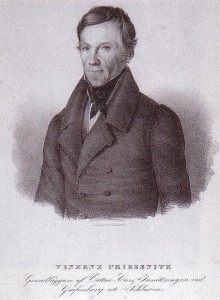
Drawning of Vincent Priessnitz (1799-1851), supporter of hydrotherapy.
Clearly, there has been an extensive history attached to the cold water shower or its predecessor, the icy, cold bath. The high water mark for this type of bathing, however, didn’t occur until the 1920s when an enterprising German farmer, Vincenz Priessnitz, developed and marketed a new medical treatment he called hydrotherapy.
Priessnitz sold the concept of using cold water to cure everything from broken bones to erectile dysfunction (and many other ailments, as well) and achieved almost instant success. In fact, he had to convert his farm into something he called a “sanitarium” and, virtually overnight, the rich and famous of the time became avid fans and clients.
In fact, Priessnitz was soon helping dukes, duchesses, counts, countesses and even some princesses with his cold water hydrotherapy treatments, a practice that quickly spread to most other parts or Europe and, ultimately, to the United States, as well.
Hydrotherapy won instant acclaim in America and hydrotherapy clinics and sanitariums opened their doors to clients in every corner of the country. As a point of interest, one of the first – if not the first – successful hydrotherapy sanitarium in the United States was opened in Battle Creek, Michigan by a man named John Harvey Kellogg. Perhaps his last name rings a bell. He invented Corn Flakes®.
As the 20th century moved along, the popularity of hydrotherapy began to decline and falter when medical professionals began to rely more on drugs to treat illnesses. However, the use of hydrotherapy as a viable medical treatment never completely stopped.
The truth is that many professional athletes currently take ice baths to help speed recovery from strained muscles, muscle pulls or tears, broken bones and other sports-related injuries. While medical technology has advanced rapidly and new, more powerful, drugs constantly hit the marketplace, it seems fair to say that hydrotherapy, or cold water baths or showers, will never completely disappear.
And that’s a good thing. The cold water shower can help you therapeutically. That’s probably why it, or a variation of it, has been used by people for countless centuries. Here are just some of the ways that you can benefit from a cold water shower:
- Enjoy the benefit of improved circulation. Good blood circulation, unimpeded by clots or other obstructions, is vital for your cardiovascular health. Moreover, when your blood flows freely, you are better able to recover quickly from strenuous exercise and work. The cold water shower, which starts off with warm or hot water and then turns cold, can dramatically stimulate your circulatory system. And that, of course, is good for you.
- Get quick relief for depression. Recent research at the Virginia Commonwealth University School of Medicine indicates that “a short, cold shower can stimulate the brain’s blue spot” by actually increasing production of a chemical called noradrenaline that can work quickly to help you overcome the debilitating effects of depression.
- Keep your skin and hair remarkably healthy. Hot water dries skin and hair, and may even lead to irritations and the itches that always follow. Cold water has the opposite effect. It closes your pores and cuticles and makes you look great.
- Strengthen your immune system. According to a study conducted in 1993 by the English Thrombosis Research Institute, it was discovered that people who took daily cold showers were able to fight off viruses and colds much more effectively than those who took hot showers.
- Increase your testosterone levels. Studies have proven that cold water showers increase testosterone levels in men, heighten the libido, and build energy and strength. (And you have probably always believed that a cold shower had the opposite effect!)
Here’s how you can get started taking cold showers.
There is no mystery to this process and no special instructions. What you do need to know is this: start slowly. Lower the water temperature in your showers gradually, over a short period of time, to give your body the chance to adjust and to avoid shocking your system. Of course, if you suffer from heart disease, high blood pressure or are feverish, cold water showers are not for you. They are too dangerous.
If you have no serious health issues, get started now. There is nothing like a cold water shower to make you feel great!
If you liked this article you may be interested in this product from our sponsor.