Successful Wood Burning
Feb 7th, 2011 | By John | Category: Energy, Wood | Print This Article
Well, it’s not like it’s exactly rocket science, is it? You get some wood, cut it to length, split some of it, leave some whole, and burn it. Pretty simple and straightforward.
Well … yes and no. The key to successful wood burning is proper planning for laying in your supply, storing it properly, and seasoning it well. Pieces that are not seasoned right will not burn efficiently, will deposit creosote that can build up and lead to a dangerous fires, and will be all around frustrating to deal with.
I’m not going to get into cord length, fractional cords, or anything like that. If you don’t own a chainsaw and can’t cut your own wood, then ask friends and family for some recommendations for people who sell firewood. Don’t buy over the phone. Go to where the wood is stored and inspect it there.
Take a tape measure with you and make sure the wood will fit your application. Don’t buy wood with a bunch of dirt and mud on it. If possible, have it delivered in the spring so that you can stack and season the wood yourself, and know that it’s properly done.
What’s the best type of wood to burn?
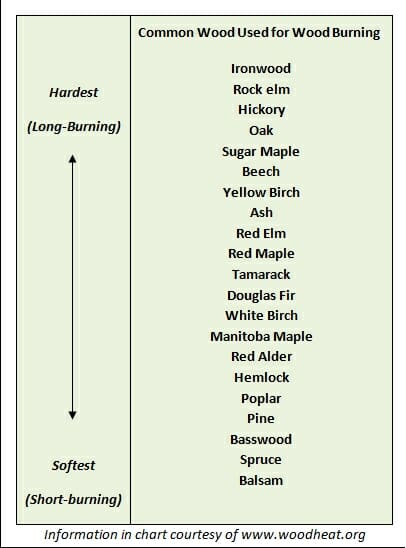
All wood is similar. It’s the moisture content of the wood and the density of the wood that determines how slow or fast it burns. Ideally you want wood that is less than 20% moisture content. Your harder woods are going to burn longer, hotter, and produce more coals. Your softer woods will have a shorter duration of burning and not be quite as hot a fire. However, we don’t have the luxury of choosing the trees that grow in our areas, and the newer efficient wood-burning stoves, fireplaces and furnaces can overcome shortcomings in the wood itself.
You’ll want to make sure that your wood is cut to the right length and diameter for your appliance. Pieces that are too long can be hard to move around, position, or stoke. It’s recommended that your wood be cut 3 inches shorter than the firebox for stoves and furnaces. 14 to 18 inches seems to be the best length.
Use a variety of different size diameter pieces to get your fire burning steadily. Smaller pieces will light quickly, and the larger pieces will burn steadily.
Storing Your Firewood
Your wood is going to need air circulation and sunlight to properly cure. Stacks that are placed too close together, covering up the sides of the firewood, and stacking firewood on the ground will keep your firewood from properly curing. Softer woods that you stack in the spring should be ready by fall, but harder woods may need a year or more to cure out. Drying also takes longer in damp conditions.
So how do you tell if your wood is dry enough? There’s several ways:
• Split a piece. If the wood is moist and damp on the inside, it’s not cured. It’s still too wet to burn.
• Dry wood weighs much less than wet wood,
• The wood changes color, from a white or cream color to a gray or yellow color
• Bang two pieces together –dry pieces have a hollow sound, while the wetter pieces have a more solid thud to them when tapped together.
After your wood has dried you should move it to a dry and sheltered storage area for the winter. Storing your wood inside your house is not recommended. Not only can mold grow on the wood, but it’s the perfect spot for insects and pests to hide.
©2013 Off The Grid News


I can say, DO go to where the wood seller is, so you can inspect the wood. We got caught up in this and although the wood may have sat, it sat outside in the rain till it was delivered to us. We’re still drying it, while having to buy lesser grade bundles to use as starter for the few pieces we find dry. Always better if you can go get your own (check your local forest service office for permits), cut it and know when it should be ready and the quality of storage of it. Don’t fall for the idea large companies are better to buy from, they are no better than the smaller guys trying to make a quick buck on lesser grade wood stored improperly, get references from people who have bought from them successfully.
I store my wood out in the open air . I stage the wood from open air, to outside celler entry, to two stacks inside. This allows a constant rotation to ensure that I have dry wood. Also, if I can’t move wood for some reason, I always have enough to burn for a week or so. I don’t know if you have space for this sort of rotation but thaought I would share. I started this rotation because of my work and Army Reserves schedule since I would miss a weekend every month and did not have time during a normal work day to move fire wood.
Cheers and happy burning!
I’ve experienced the good, bad and ugly of putting up firewood. I have the luxury of several 40′s and just to keep the windfall cleaned up gives me enough for every winter. I’ve discovered that the ‘junk’ wood is just as good as the Ironwood and Oak…just have to be in attendance more regularly. It burns fast and hot. I prefer the large hardwood chunks for the night time or when gone for half a day shopping. I damper it down so I have good coals in the morning. Some less than dry wood makes it into my pile; a hot fire usually takes care of it. As far as creosote build up I’ve discovered that an application of **regular feeding of aluminum cans does as good of a chemical trick as the expensive logs. Feed the cans when it’s HOT. My annual inspection shows me that it works and I’ve never had a chimney fire. Not sure what the environmental people think of that…
Do you literally put cans in your fire to burn? Aluminum? As in beer cans?
Part and parcel with wood burning is clean up after burning. Get the flue cleaned by a professional
and have them recommend how often to clean based on the wood you burn. My parents had a flue
fire and it scared the H*LL out of them. Rural location = loooooong wait for the volunteer fire fighters
to arrive. Fortunately the house didn’t catch fire. They have now converted to a propane ‘wood’stove……
i burn for my heat and did as a kid at home. i recently 2 years ago moved back out to the county so now are on 2nd winter burning again. i sold a nice big pile that i harvested last winter this winter.i heated my house and 5 more. i sold wood by the cord 8 by 4 by 4 high 128 cubic ft. and deliverd it and helped unload and stack for 100 dollars.i used a 8 long by 5 wide trailer and stacked it in front to back 4 ft high by using a sheet of osb on each side to serv as a guide and side rails.the money that i made paid for all the fuel and oil that i used to cut and split the wood deliver the wood and i essentialy heated my house for free. i heated 5 houses this winter.because all my customers knew what a cord was and how i stacked it in the trailer they all will buy the wood from me next winter. and they have told theire friends about me and i sold some pick up loads on occasion. morel of the story is that if you cut ahaed and season and sell it fair and be there to stack without trying to get rich you will be succesfull. i had all different kinda wood i do not know the difference in a lot of wood species so i make sure i get enough. that is the key enough.i even made sure to make the suggestions of showing how i mixed the wood when i was burning it. so definatly look around and ask friends who they got the best deal from also understand that if you buy a load that is nothing but the top choice it will be a lota money and if everyone done that you may as well pay a gas bill because it would not be long that the choice would be very scarce and 1000 bucks a cord. just my 2 cents
I love wood burning and have a couple of tips for the new wood stove owner. Select a reputable company to buy from and install. If they sub contract the installation it will be impossible to make anyone accountable for any mistakes at a later date. This is worth the extra. When selecting a stove make sure that there is a flat top, useful for cooking should the need arise. Have a reputable flu cleaning company clean the flu and while they are at it do an annual inspection at the same time of your equipment, this could save a heart ache. There are always people getting rid of wood for whatever reason, all you have to do is pick it up. I guess this is simply put, scavenging, always a worthy exercise . A ceiling fan in the room with the stove is a nice extra for very little extra electricity. While many people I know in the Northwest are paying over 2-3 hundred for monthly utilities, I will pay about half or less.
I use wood as my primary heating source and my oil furnace as a backup. Each winter a lot of birches either come down or bend over from the snow and ice, Those I cut up in addition to oak, Maple and beech. Once in a while I will burn Hemlock but ONLY if it is dried for two years. It does light quickly and has a good aromur. If you need to buy wood, the least expensive is buy truck loads of green oak from logging companies. Of course you will need a chain saw to cut to length and be good at splitting but it is all good excercise.
Good article and first comment.
I have a smaller stove (Vogelsang Frontiersman), and the best length for wood is 15 – 17 inches. A rick of longer pieces would be a pain, and I would wind up cutting the pieces up, leaving lots of short and unmanageable scraps. Fortunately, I found a local guy who already had one repeat customer who needed “short” wood, so now he has two. I wrote about installing my stove on my blogsite, Center of Mass
http://tomcox.wordpress.com/2010/02/02/a-wood-stove-getting-that-warm-feeling/
Stay warm, all!
I want to add a tip: You should stake your wood in one row of possible, build a square structure at each end of the stack by laying two or three pieces cross ways on top of each other, alternating direction so that you build up sort of a “tower”. This keeps the wood in a nice, neat stack.
Also, a good adage for the spaces between the split logs: “Make sure the spaces are large enough for a squirrel to sneak through, but not large enough for the cat that’s chasing it.”
I always loved to burn coal when I was in the Northeast. Slightly off topic I know but had to say what a wonderful thing it was. It was cheap, took up little space and burned all night long. And I never had to clean the flue!
Coal burns with a blue.indigo flame playing over the top, and once I started the stove in the winter, it never got shut down until late spring.
Had a wood stove for a long time, but once I went black, I never went back.
I have not made it quite off the grid yet and am trying toget my home sold so that I can get the transition going… however has anyone mentioned using a dehumidifier at all. If you have really wet wood then a Dehu will kill that out quite quickly or is that to fast so to say.
colorado woodburner:
Where would cedar and pinyon be classified ?
I understand fruit wood is hard wood.
I have used a wood stove as primary heat since 1985. No furnace. Passive solar sun is great. Had to have baseboard electric, or could bot get bank loan; but it is rarely used.
I have a Vermont made soapstone stove…still works well
You pinyon pine and cedar are going burn alot like regular pine and basswood. Since 1985, huh? Bravo!
Passive solar thermal is wonderful stuff! I’ve had really good success with some demountable passive solar I use seasonally. It’s 9 degrees outside and my passive solar is sitting at 125 and I’m sitting in shirtsleeves.
I am 81 years old and still cut and split all my own wood for winter use. I have never bought firewood in the
26 years we have lived here in the NE Georgia mountains. Fortunately I have nearly 6 acres of mature and
regenerating hardwoods. We have about 7 varieties of oak here, and all but one (Chestnut oak) are just great for stove burning, along with dogwood, beech and maples. ( I do not care to split hickory as it is cross grained and very difficult to split ) All wood harvested is “dead and down”.
Our acreage is quite sufficient to provide the “D&D” over the period of a year with storms, wind and time bringing down more than enough to provide the +/- 5 cords used each winter. I have a Federal Air-tight stove with a catalytic converter which lasted about 10 years, and now I use just the stove with no converter. As a long term Forester I consider myself very fortunate to have found this corner of Heaven to retire in.
How can one burn coal in their woodstove? Is it possible? And what about Russian Olive. It seems to burn all night for me.
Coal burns fine in woodstoves; in fact, in the past in coal-rich regions, even fireplaces were built to use it. Just remember that it starts small and needs air circulation just like any combustible.
I would play around with an expanded-metal grate with smaller holes (maybe 0.75 inch to 1.5 inch) and see how it works. If you have access to welding skills, they may be a great help in building something durable. Such a grate isn’t absolutely necessary, but it will help get it going and keep it going.
With coal, you won’t need as much soild fuel — but it will stink pretty bad until it “cokes up,” or burns away the impurities. You can mix fuels and you’ll develop a feel for it quickly.
This is our first year burning wood in our stove. We bought a vermont casting “encore” Stove and love it! We have a 2400 SF upstairs and end up opening windows most of the time. It has a cookstove top and even has mittenwarmers on the side for those nights after skiing. We purchased rounds of red fir and had a teen split it for us. Lazy I know but I personally would rather ski than split wood. Steamers on top are very helpful, I put in orange rinds, and cinnamon for a nice smelling house…
I have heated my home for many years with wood stoves. I would highly recommend you add the ” Magic Heat ” waste heat circulator to your stove, above all other brands! This unit is worth every penny! It is AMERICAN MADE in Sioux Rapids, IA. by the Nelson Products Co. I currently use the Model MH-6 on my Osburn wood stove. Please do yourself a favor and check this out! You will save enormous $$$ because of less wood usage & you will definately experience greater heating comfort. No, I am not a salesman, only a very satisfied consumer that wants to share a great product !
I bought mine at Northern Equipment, but if you check with NELSON PRODUCTS CO. they can probably tell you where to purchase the unit in your area. (800) 826-8751. E-MAIL: info@nelsonproductsco.com
Please do NOT use a ‘Magic Heat” on with a modern airtight wood stove. If your stove is not good enough to provide the heat you need, get a new stove. Stealing heat from a chimney will eventually cause you big problems. I haven’t heard of anyone recommending those devices in years ( other than those that make them or sell them).
Thanks for all your comments I wanted to find out if I could burn coal in my stove because I want to prepare for inflation or disaster. I needed to find out the best way to store and stack wood.. i just had a chimney fire. I had cleaned it myself with my neighbors store bought sweep and found out from the professional their equipment is differant the brisols are made stonger than store bought. They did alot checked the linner fixed a stone inside and came all the way down the flume that I needed reach the length can fool ya. The fire and noise really scared me three fire trucks came with local voulenteers they checked the attic and found a piece of cardboard agaist the pipe. The house is 27 years old and it must have been there the whole time. Check the area around the pipe.
Have been burning wood for 14 years now. I don’t have to buy any wood in Michigan. Nature has taken care of that with the Emerald Ash Bore Bug. We have so much standing dead firewood in our area that it’s actually sad to see these beautiful trees being wiped out by this little bug. I have had one chimney fire a couple of years ago and that was my fault. I got lazy toward the end of the burning season, and broke my own rule. I sweep my chimney no less than every 6 weeks and in the heart of the winter, when burning is at it’s peak, I try to do it once a month (plus I throw one of those Rutland Kwik-Shot soot stopper tubes into my fire every Friday.) These are available at Tractor Supply Stores for about $2. I usually buy enough for the winter because they tend to run out at the store late in the burning season. When I started using these, I did see a difference in my chimney build up between sweeps, that’s why I have kept using them. All in all, cutting, collecting and splitting wood is great exercise not to mention the constant restocking in the house through out the winter. At 60 years old, it helps to keep me very active most of the year. So, I really think it is an effective exercise program and also, helps keep my heat bills very low. FOOTNOTE: when I had my chimney fire, the Fire Department put it out using a dry chemical extinguisher to spray up the stack from the clean out plate at the bottom. It was very quick and effective. Needless to say I have one of these extinguishers in my home readily available. But proper regular sweeping should make this a dust collector!!
About 3 years ago, I moved back into the city,(BIG MISTAKE), after 1 year I moved back onto my property outside of a small town in Arkansas.
I checked with the local propane/butane distributor and he told me that it would cost about $2 to $2.50 a gallon for the gas.
I went down to a local hardware store and spent $300 on a wood stove and since I live on 20 wooded acres the only expence that I have to burn wood is the fuel/time involved.
It has been 4 years now that I do not have to depend on others for my heat, and I love it!
Ok people…bare with me when I say this has to do with wood/coal burning in whatever method…fireplace or type of “box-heater” that works for you wherever location,resources,skills…etc…towards “YOUR” bottom line… please allow me to pass on a lesson of wisdom / common sense, taught to me by my “PEOPLE”. My Elders as stewards of the land, said no matter where you homestead, whichever the four-corners your roots hold firm too, pray for”‘ HIS” grace and blessing as together…To the South, Plant all your Vines in gentle slopes —- a sign of Peace with all your Hopes. To the East, Plant Apples and Cherries where Dogwood flourish— whose pies and jellies for us will nourish. To the West, Plant Peaches, Pears and Plums where Caneberries thrive— later to taste sweented Honey from the Hive. To the North, Grow Nuts where the Hardwoods grow— sweetest Meats fit for the Soul. So plant your vineyard and orchard with Care— for only GOD sees fit to Water there. NOW!! Back to burning/heating …. do remember to finish the cycle of the wood/charcoal pcs.to ash. Make an 8″ wood square frame w/ rabbit mesh-wire bottom. Sift the debris into 3 categories. Coarse,medium and fine. Coarse pcs. over 5″ can be reused/ returned as starter fuel for the next fire. Medium pcs. under 5″ can be set aside for outdoor grilling…saves a ton of$$$$$…store these tidbits in a “cleaned”55 gal.oil drum w/lid stored safely away from buildings. Fine ash is very useful for your compost as it will break down quicker and easier for your fruit/vegetable/flowers to utilize…. and it’s ORGANIC…!!!!!!! Waste Not….Want Not! People should be taking notes…ya’ll are about to be tested. Until next time I see you guys “jawing”….be assured I’ll pass on some wisdom and a little common sense at ya. “Jack Rabbit Running Through WildFire Playing” will be helping when I can…..GOD BLESS AMERICA!!!!!!!!!
An easy way to start a fire in your wood burner is to use 8 brickets of easy lite charcoal and stack your wood over it. A single bag of charcoal will start many fires.
Another way is to use a cup of wood pellets soaked in lamp oil. I take a mason jar and fill it 3/4 with wood pellets and add the lamp oil and shake or twist it.
I bought a St Croix corn burner(Waco, Ne) several years ago and like the ease of handling. No dangerous chainsaws for the kids/grandkids to handle and far less trouble handling. Yes, the price of corn is going up and electric heat is now cheaper but there is nothing quite as relaxing as watching a fire dance behind the glass and a small 2kw honda genset on idle will supply the electricity to run it for 10 hours and heat my 1700 sq/ft home in SD in any storm.
I noticed that a couple of woods were not mentioned in your list: Sweet Gum, Magnolia and Cedar are all here in the South. I’ve moved to heating and cooking with wood in my fireplace. And I love the wood fires. Ash isn’t dirty!! It’s great for the garden and low spots in the yard. And, a suggestion: Keep those long limbs until you need to cut them to fireplace lengths. They’ll keep their moisture longer. Cordially, JJ
Wood Storage: Always cut next year’s wood, this winter. I have burned wood for heat, for the last 30 years. I have seen people go to extremes to stack wood off of the ground. Not necessary. If you burn the wood the next year, only the bottom row will be effected at all by direct contact with the ground. Depending on the kind of wood, it may not be effected.
Wood Stoves: If your stove vents off of the top, you can readily burn any type of wood, without worrying about creosote build-up. Even green wood will burn, though not as well. If your stove vents off of the rear, near the top, it is undoubtedly a more efficient stove, as heat and smoke will heat the top of the stove before exiting through the flue. Burning green wood or “trash wood” in a rear vented stove is asking for trouble. The cooler smoke and gases exiting the stove will allow creosote to build rapidly. Still not a big deal if you clean the chimney routinely. I clean my chimneys one a month. I have a top venting stove in my shop and a rear venting stove in my home.
Wood: I will literally burn anything that will burn in the shop stove. Cottonwood on up. The rear venting stove in my home gets only seasoned hedge. The correct name for hedge is osage orange. It is a very dense, long burning wood. It is very hard and will last for many years. Many fence posts in the area, are hedge. Some of the posts have been in place for 100 years or more. Hedge gets harder with age. It is very hard on saws, bars, and chains, to cut old dried hedge. The sparks will fly. Hedge grows everywhere in southeast Kansas. It has thorns that will puncture and cut if you are not properly dressed. It is well worth the effort however, as the wood is phenomenal, and will keep until you need it.
Chinmey Fires: If your stove and chimney are properly installed, they are designed to handle a chimney fire, without damage to the chimney or your home. If you don’t know what you’re doing, hire a professional to install it. Having said that, it is best to avoid chimney fires. They are hot, stinking, and will definately raise your pulse rate. The noise alone will have you making several trips up the ladder to see what is going on.
Clean the chimney. When in doubt, clean the chimney. It only takes, about 10 minutes. Did I mention, Clean The Chimney?
Just an observation, when living in south Texas lived in a 125 yr old house that had a fire place and wood stove, we were never sick and the ash when spread around the house and at the base of the trees helped to move the fire ants away from the yard and the fire ants were terrible.
well i grew up burning wood and said when i built my house that i wouldnt burn wood again but with the price of heating oil the way it is this spring i put in a wood stove and went out and bought 12 cord of 4foot hard wood for fire wood ive got oak, beech,rockmaple,ash and cherrywood to burni cut up half of it this summer and im working on splitting the bigger stuff but im still going to use some heating oil this winter but im thinking that 6 cord should last my house a year easy sence when i build this place i went double wall on all outside walls and have 12 inches of insulation in the walls and 3 feet of blown in cellouse in the attic the house is 24×32 two story it heats welll with my oil boiler but im thinking that with the woodstove i should get threw the winter on one tank of oil instead of 3 and a half tanks it uses now and incase you are thinking about how much oil is in a tank full its 275gals and i got my wood for 80 a cord delivered
We have heated with wood since we moved to the country seven years ago. Initially we had one of those old cast iron stoves and went through wood like crazy but bought a good soapstone stove and barely burn three cords to heat a 2,400 sq ft log home. Here in New Hampshire its close to $250 a cord but we have 40 acres of hardwood so we just cut down trees every summer and stack the stumps and every year we are left with 4 cords of wood, free of charge.
Yes you can use unseasoned wood to burn in a fireplace or stove. Make sure you mix it with seasoned wood. In fact, it will make your fire hold overnight and still have hot coals in morning to readily start a am fire. It may not be has hot of a fire as seasoned wood fire, but will hold fire longer. Burning just seasoned wood itself is like burning paper. Just make sure you keep an eye on your chimney to keep it clean.
We to usually burn a mix of green and seasoned wood here in the Ozarks. Produces good heat and holds an overnight fire pretty darn well. One needs to watch the flue for creosote build up, but that’s just good common sense when burning wood for heat. We don’t have much trouble with creosote or soot residue due to our stove and chimmney design and trying to stick to burning hardwoods. In a pinch though, about any kind of firewood goes in the fire box. I’ve burned a lot of elm, soft maple, sycamore, etc. with decent results, they just don’t hold a fire as long. Right now a rick of seasoned oak is going for $45 delivered around here, not a bad price.
A good source of seasoned oak wood is broken pallets that people will give you for free…. just got to remove the nails when you dump the ash.
the Col
This design is wicked! You most certainly know
how to keep a reader amused. Between your wit and your videos, I was almost moved to start my own blog (well, almost.
..HaHa!) Wonderful job. I really enjoyed what you had to say, and more than that, how you presented it.
Too cool!
Here is my web blog – drivers education
I just like the valuable info you provide for your articles.
I will bookmark your blog and take a look at once more right here frequently.
I’m somewhat certain I will be informed many new stuff proper here! Good luck for the next!
Visit my web page: jobs melbourne