As we discussed in last week’s article, canning the food we harvest is among the oldest of ways to preserve our fruits, vegetables, and other foods so that our families can be fed during the long cold winters and right through the spring to the next year’s harvest. Some of us may never have canned a single jar of our bountiful harvests, so I have attempted to put together a series of articles to help you get started. This week we’re discussing the water bath canner and process a little more in-depth.
Preparing the Food
- Select only the best fruit for canning—firm and not overripe. Prepare only enough for one canner full at a time. Wash under cold, running water. Peel fruit, if desired. (An easy way to peel tomatoes and peaches is to place them into a pot of boiling water for 60 to 90 seconds, and then put them into cold water for several minutes. When you remove the fruit from the cold water, the peels will practically rub right off.)
- Some fruits (apples, peaches, apricots, pears, etc.) will darken when canned. You can soak them in a dish pan filled with a solution of 2 tablespoons each of salt and vinegar to a gallon of water for 10 – 15 minutes before canning to prevent this discoloration. Place your washed, peeled, and cored fruit into the prepared solution.
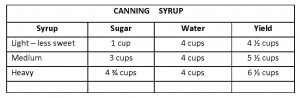
- If a sugar syrup is desired, prepare according to the chart below:
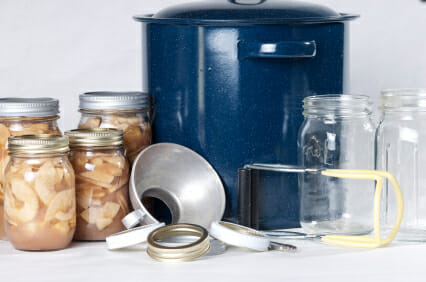
- Prepare your jars by thoroughly washing them in hot soapy water. Rinse well. Leave them filled with clear hot water until you’re ready to use them. You can also wash them in your dishwasher. If you have a “Sterilize” cycle, use that. Prepare your lids by placing them in a pot of simmering (not boiling) water. You only want the rubber seal to soften. Boiling the lids breaks down the rubber and your jars may fail to seal.
- Pack fruit tightly into your prepared jars leaving ½ inch of headspace at the top of the jar.*Some fruits will need to be precooked before you pack them into your jars. This method is called “hot packing.” To hot pack your fruit, you will bring them to a boil in the liquid (juice, syrup, or water) that you will fill your jars with. Cook it briefly (2 to 3 minutes) and pack the fruit into your jars and fill with the boiling liquid. Hot packing will prevent floating fruit in your jars.
- Fill the jars with boiling fruit juice, water, or syrup, still leaving that ½ inch of headspace. Run a plastic knife or spatula around the inside of your jars to free any trapped air bubbles. Wipe jars with a clean wet cloth around the top and threads to remove any spilled juices and to help prevent poor sealing.
- Place hot sealing lids on the packed jars, rubberized side toward the glass, and screw on the ring band until just tight. Don’t over-tighten. You want it hand tight.

Processing
- Bring the water in the canner to a boil if using the hot pack method. If you’re using the raw pack method, the water in the canner should be hot, but not boiling. Placing cool jars into boiling water can break them.
- Place the rack into the canner and then place the covered jars on the rack. They should be positioned far enough apart to allow the water to circulate and the water should be 1 –2 inches over the jars.
- Begin timing when the water returns to a rolling boil. Keep the canner covered during processing. Make sure water always covers the jars by adding boiling water during the process.
- After processing is completed, remove the hot jars and place on a towel or cooling rack. Don’t set them in a drafty area, or one where an air conditioning register is directly overhead. Allow them to cool completely. If a jar has not sealed after 12 hours, either put it in the refrigerator and use it first, or put a new lid on and reprocess for the full length of time again.
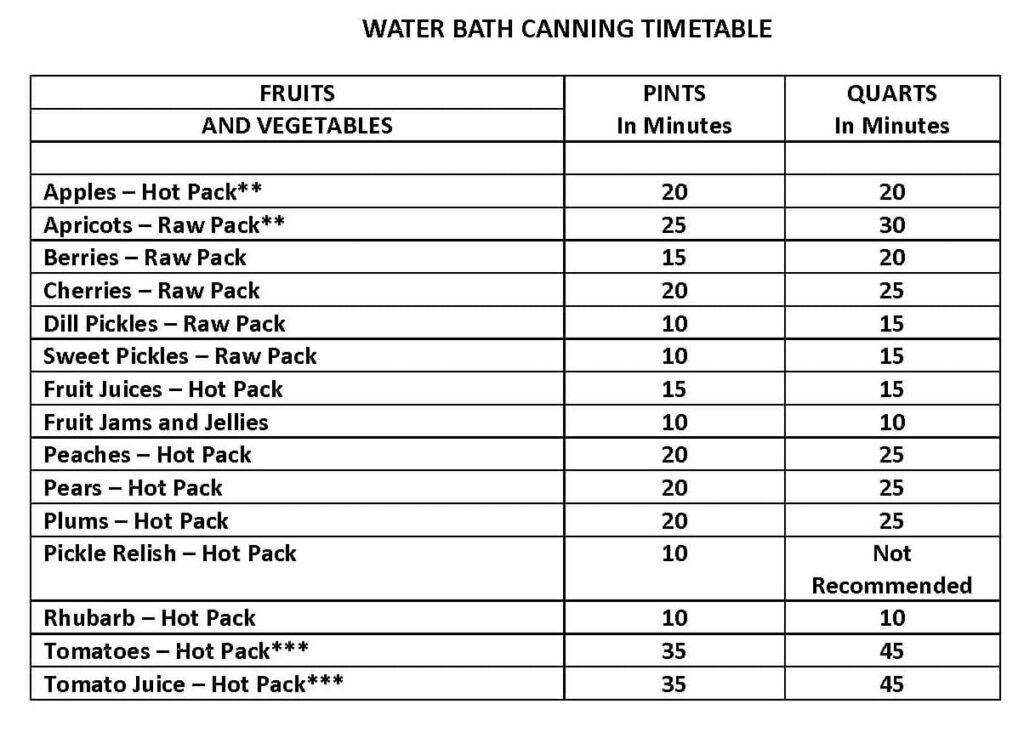
- Time your food according to the chart below:

** Hot packed fruit is heated before placing in jars. Raw packed fruit is not heated but is still covered with boiling liquid
*** Tomatoes are usually thought of as an acidic food, however many varieties have ph levels above 4.6. Therefore if tomatoes are to be canned as an acidic food lemon juice needs to be added – 2 tablespoons per quart or 1 tablespoon per pint.
Testing the Seal
There are several ways to test if your jars are properly sealed, they are:
- Hear the seal – Hear the “clink” as the lid sucks in.
- Observe the seal – If the center of the lid on the jar is dipped in or depressed, then it is sealed.
- Press the seal – press the center of your jar’s lid after it has cooled. If it doesn’t move then the jar is sealed.
- Gently tug on the lid – if you gently try to pry the edge of the lid up, using your fingers, and it doesn’t move, the lid is sealed.
**Caution: Never eat food from a jar that has an unsealed or swollen lid or that shows any signs of spoiling.
_____________________________________________________________
______________________________________________________________
Off The Grid News Better Ideas For Off The Grid Living


Not to take anything away from an excellent article…..An excellent book to purchase from the Cooperative Extension of the University of Georgia can be found at http://www.soeasytopreserve.com. The cost of this book is $18.00 and well worth the investment if one is serious about canning.
another “canning bible” is the “blue book of preserving” by ball. the same people who make most of your canning jars. You can pick one up at your local tractor supply or hardward for about 11 dollars
Excellent series of articles. I would say one thing however about just washing the jars and then just leaving hot water in them until ready to use. I grew up watching my grandmothers and aunts canning everything under the sun. They would be appaled at that suggestion. In order to properly sterilize the jars they would, of course, wash them as directed however, they would then place them in another large stock pot, fill the stock pot with water and bring this to the boil and pull them out one at a time when ready to fill. Then proceed as directed above. I have been doing this as well for the last 20 years and to date I have had no problems. I don’t know, perhaps I am just uber cautious when home canning. But I would much rather take this additional time to absolutely ensure a sterilized jar.
I agree. better to be safe then be sorry with you families well being. I clean my jars in the dishwasher then keep in a low boil/simmer water bath untill ready to fill. Also the 1 to 2 inches over the tops is important depending on where you live. I live by the ocean so it is not as much a problem for me compared to someone who lives in the mountains. Contact you LOCAL Ag Dept they will have good FREE books on canning for your area.
My waterbath canner is not tall enough to allow for the recommended inch of water above the jars. Even with the shorter widemouth jars, I can barely cover the lids. Is there any way I can still use this canner with quarts? (ie remove the rack and just put a screen or something on the bottom, or lay a wet dishcloth over the top of the jars) Or is it OK to can just leaving the jars barely covered?
I also don’t have a 1 inch space above my cans. I have canned successfully for years with less than 1/2 inch above the cans. I just keep an eye on it and make sure that is is always covered by some water as it is boiling. The cans seal every time!
I am looking forward to information concerning an alternative power source for starting &/or running a water pump for well water.
Gasoline-powered pumps are available so you can get water out of your well in the absence of electricity. Models are available that will lift water over 150 feet. Depending on where you are, you may have to go to a contractor’s or industrial supply house to find one.
Yes!!!! using Solar panels, Grundfos DC pump, DC charge control box, etc I use this system for my landscape irrigation, 2 acres of citrus/stone fruit trees, etc….works great but there a few minor design requirements. Hope I can help Dennis
Pat, my husband is installing an air pump in our well that will work without electricity.
Read my comment above.
Is there any way for diabetics to can? Any substitute for sugar?
I am diebetic and I can all sorts. I use Splenda, where it calls for sugar.
Niffty2,
A better ingredient to can with would be xylitol instead of the artificial sweeteners. Xylitol is a naturally occuring sweetener from the bark of the birch tree. It does not have the same glycemic index that sugar does. In other words, it does not raise your blood sugar level. It measures like sugar, looks like sugar and does not have an after taste. It actually has good health benefits which you can research on line. I have not found one negative thing about it and my family has been using it for a while now.
All artificial sweeteners are made of chemicals or modified from foods in such a way that our bodies don’t recognize them as being food. Since your body doesn’t know what to do with this non-food item which is actually toxic, it can actually store it as fat, to keep those harmful toxins away from important organs. There are numerous other harmful effects of artificial sweeteners which can also be easily found on line.
Hope this helps.
Linda
I am really enjoying these excellent articles. I too, however, am a little leary about just leaving hot water in the jars to sterilize. I’ve been canning for 40 years and the method I use is from our home economist’s extension office. Any jars, lids and rings where the food will be hot water bathed for 30 minutes or more, automatically sanitizes the jars and lids. I wash them first either by hand or in the dishwasher. Some of the processing times for certain things can actually be processed for 30 minutes without being overprocessed, for instance sauces, apple butters, even some jams. Pickles will not work doing this. This sure saves alot of time and work. Also, a little warning, just because something seals does not mean all the bacteria is killed by not processing it in the right way.
Hey Joel, we Canadians have to stick tgoteher! Especially the Ontarians among us. Thanks for the advice, I’ll definitely do that.
I used to can some things for my dad who was diabetic. I used stevia or raw agave nectar to sweeten fruits and butters. After some research into arificial sweeteners, I found these to be safer than splenda. I especially liked to use stevia. Fruit juice concentrate also works really well but needs to be figured into your carb count.
ONE OF MY FONDEST MEMORIES AS A CHILD WAS WALKING INTO MY GRANDMOTHERS PANTRY AND SEE ALL THE JARS OF FOOD LINED UP VERY NEATLY. WE WERE VERY POOR BUT NEVER HUNGRY
THANK YOU FOR THIS INFORMATION TO REFRESH MY MEMORY AS WELL AS FURNISH MY GRAND
CHILDREN & GREATGRANDCHILDREN HOW TO EAT WELL WITHOUT RUNNING TO THE STORE FOR
EVERYTHING. MAYBE THEY WILL APPRECIATE THE TASTE OF REAL FOOD THAT IS HEALTHIER FOR
EVERYONE.
THANK YOU VERY MUCH, DOT SHAFFER (79)
From what understand the water bath canner is not safe for all types of food and therefor I would also like to see the total method of pressure canning, as no doubt there are many ways of pressure cannig in a safe way and doing down foods that retain their colour as well, as that is very difficult to achive.
Thank you, respectfully,
Bob
Bob,
Next in line are a couple of articles on pressure canning. We’re just starting off with the basics and moving our way upward!
I have been water bath canning for a few years and just purchased a pressure canner. I am looking forward to the articles!
What about canning meats, stews, and such.
just about any book on canning, Balls “blue book on preserving”
Water bath canning is only for high-acid foods. You’ll need a pressure canner for meats and low-acid vegetables.
Meats, stews & such would be pressure canned, not water bathed
not to be a killjoy (just to save your life! ha) i agree with pittung the jam in the fridge; it’s not going to be shelf stable unless the jars are full. no worries tho! you’ll want to eat it really quick anyway, i promise! you’ll find yourself pittung it on EVERYTHING! it looks delicious! this is our 4th year to be in our csa and we love it! you won’t regret it. it’s so cool that you’re walking so much and love your new home(town).
Hi, I love to cook & bake, & I’m not young, I just don’t want to sound stupid, but, would you please put in your next newsletter a book where I can read up on canning high-acid & low- acid foods. I read all the articles & look forward to reading the comments.
I live in high altitude. The best idea I have heard for sterilizing is, after boiling, hold them in a 250 degree oven until ready to fill. Our boiling water may not reach 212 degrees, but the oven sure will. (Yep, my water boils at 200 degrees and at my last address it boiled at 198 degrees.) Hope that works for you.
Where is a good place to buy canning jars? Is there a manuel available giving directions on the best ways to can food?
I prepare my jars for canning by setting the washed jars upside-down on a cooling rack in a 9×13 pan with about an inch of water simmering on the stove. The steam does a good job of sterilizing the jars, but I did like the suggestion of heating them in the oven, therefore freeing stovetop space. I plan to try that this year. i also use the “Blue Book,” and get ideas from the Internet.
I have a smooth electric stove top and am not able to do the hot-water bath canning on it. I saw a 1,000 watt electric burner at a local store in the canning section. I wonder if I could use that for my canning pot. I used to can on an electric stove-top with the coil burners, and this is pretty much the same thing. I’m just wondering if the wattage would handle canning jams and fruits. Thanks for any help on this.
Leaf Peeper, as long as it will get your water bath canner to boiling, it will work. Everything I’ve skimmed through says a 1,000 watt eye is more than sufficient, but they are talking tea kettles, not canners. If you can find one that’s a little higher in wattage, it will take some of the cooking time out of the equation. Another option you have is a propane cooker, like the ones used for deep fry pots to cook fish or turkey in. The Crisis Cooker by Solutions From Science is another great option in that it’s possible to use almost any type of fuel in it. It has a propane regulator to hook up to a gas bottle (and thus you can regulate the flame), and you can burn charcoal or wood in it. It’s very sturdy, and that’s one very important consideration when looking at stand alone appliances. Is the electric cook top you’re looking at sturdy? Does it appear that it will support the weight of a canner full of jars and water? It could be dangerous is the whole unit collapsed under the weight of the canner!
Hello,
I paid for a subscription to Grit, I hope this is not what I’m gettting online, because if it is I’ve deleted a lot!
I was expectiing a magazine by mail.
Please let me know if this is what I’m paying for or will I be getting Grit by mail.
Pat
If anyone is interested in an excellent canning book you can get one at Back Woods Home Magazine and it was written by Jackie Clay who is a homesteader and gardens and grows most of her own food and cans it. The book also has recipes for using the canned food. She has been doing this for 40 years or more. She cans and grows everything. If you want to read her blog go to Back Woods Home Magazine and along the left scroll down and find her name and click on it. Her blog is excellent and worth spending the time to read and you can ask her questions. I agree with those that steam their cans before they use them for 2 reasons: 1-steaming kills a lot of germs& keeps jars hot and 2-it is less likely to break when putting hot food in it and then putting it into hot water in the caner and the food gets up to the correct temperature for killing off any of the bad stuff in the food. I have had jars break although very few over the years but it can happen. The food has to reach a certain internal temperature to kill any germs in the food.
WalMart has the canning books tool kits and jars, at least thats where I got mine…
I work by day as a medical lab tech and can tell you that these jars are for stnniiag glass slides. They are filled with various stains and the slides are kept upright between the flutes.They are probably somewhat vintage in this day of disposable everything. I use these jars on a daily basis and love the heaviness of the glass. Fun find!