Off The Grid News Better Ideas For Off The Grid Living

In an extended survival scenario, food will become a primary concern; however, plants can be used more than just food. This article talks about a potentially more pressing concern in a survival situation: medicine. Medicinally, wild plants can be helpful during extreme situations and even prove to be life saving.
Remedies for common concerns:
Jewelweed: Poison ivy, poison oak, and poison sumac can all be eased with jewelweed, a plant that grows in many locations. Unfortunately, there are so many varieties that it is difficult to describe a variety that might be near you. Look at a field guide or consult local guides to determine where and how jewelweed grows in the areas you will be traveling. Jewelweed can be used as a fungicide and as a remedy for contact dermatitis. Of course it has its opponents as well; many will say that no major test shows considerable benefit from the usage of jewelweed on these ailments, but thousands upon thousands of people have seen the benefits of this treatment.
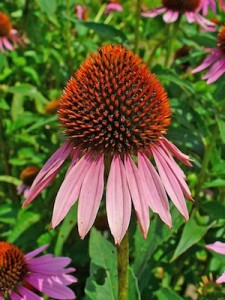 Purple Coneflower (Echinacea): Echinacea is a plant within the daisy family that seems to be the panacea for many concerns. It seems to increase immune response in the body in several ways, including increasing (theoretically) the absorption of infection by t-cells. Echinacea grows virtually everywhere and can easily be recognized. The petals are white, pink, yellow, or purple. The daisy-like structure is covered in the middle by a “spiny” core that has individual spines growing out from the flower’s center from green to yellow to magenta; it also has white tips. The center cone is probably the most known and recognizable feature.
Yarrow: This plant is perhaps one of the most widely used plants throughout the ages for medicinal purposes. In Greek mythology, the Achilles carried yarrow to soothe wounds and treat injuries. Regardless of the mythos of it, the plant carries with it certain major benefits in treating abrasions (wounds of all kinds, really). It can be used for mild allergic reactions (sinus and mucus-related mostly) by extracting the vapors through steam, and essential oils coming from the plant have anti-inflammatory properties when applied to the skin. It has fever-reduction capabilities due to some of the compounds contained within the plant and can be used internally or externally for its properties. It seems also to have a substantial effect on bruising and slowing blood flow to surface skin, and it should certainly be considered in your wilderness medicine cabinet. The clotting effects are perhaps the most important element of the yarrow and should be used when possible. The plant grows to about three feet tall and has erect angular leaves that connect directly to the stem (a red and green color with a fine whitish hair). The leaves alone can grow to ten inches or so. The top of the stem ends in a head of flowers during the spring and summer months, usually white and growing in a relatively tight bunch, much like cauliflower at first glance, but not nearly as stiff or compact.
Garlic: This plant has many uses, including as an antiseptic. The long-term effects of garlic is well documented, but in the wild, use garlic to help with inflammation and open wounds, but don’t expect the wound too feel much better immediately, as it’s more of an astringent. The antiseptic qualities can be incredibly helpful in a longer-term survival scenario where a simple infection can cause death.
Willow Bark: Quite simply, this is just the bark from the willow. It has the fever reduction and inflammation properties of aspirin, as well as being able to reduce symptoms from cold and flu.
Aloe Vera: Aside from being edible and having some good long-term effects from heart health and anti-inflammation to glucose and insulin regulation when taken, this plant can help with first and second degree burns. Sunburn and discomfort from abrasions and dry skin, including cracked lips and fingertips, can all be helped with a bit of aloe vera.
Witch Hazel: The astringent nature of the witch hazel’s compounds make it a good choice for treating hemorrhoids, bites, bruises and skin conditions stemming from moisture variances, like psoriasis and eczema. In the winter, the plant’s flowers are bright and heavy in yellows, oranges, and reds; the basic structure ranges from a shrub to a full-blown tree, even up to thirty-six feet or so. The leaves tend to be a bit in the modified oval shape and usually are quite large (generally four to five inches long and two to three inches wide). The key indicator for the plant is often that the flowers, the emerging buds for next year’s blossoms, and the fruit all appear together at the same time. The pods that house the seeds (the area in which you can find the best relative concentrations of witch hazel compounds) are shiny, dark maroon to black, and about half a centimeter across. The fruit has two segments which each house a seed.
Mint: For digestion and calming of anxiety, mint can be an excellent wilderness medicine. It has anti-nausea properties and can break a fever by causing perspiration. Mint also can be an effective anti-itch medicine. The bright mint green color is one unique to the plant, and its symmetrical leaves, very consistent size and shape, surface texture, and distinctive smell should give this plant away in most settings.
The plants listed all contain useful compounds to help alleviate health concerns, but they are not the only ones. If you have interest in learning the benefits of wilderness medicine, it is strongly encouraged that you attend a local workshop or learn from those who study the local area at length. Medicine should always be looked at with scrutiny, and one should have a good base of knowledge about the physiological responses in the body, as well as a good understanding of your specific needs and the way your body handles certain things. If you are ever in doubt, don’t risk worsening the conditions.
Wilderness medicine is no replacement for good planning and solid execution, as well as modern medicine for emergency situations. In the end, the best answer for wilderness medicine is not getting into a problem in the first place and being prepared with ancillary items to help if you do; survival medicine derived from plants is a backup plan.
©2012 Off the Grid News