 Print
Print
The Field Where Faith Gets Its Hands Dirty
By now in this Four Fields journey, we’ve walked across a good bit of ground.
We’ve looked behind into the field of inheritance, where the seeds planted by fathers, mothers, grandparents, churches, and whole generations still rise from the soil. We’ve also looked inward, into that hidden field of thought and understanding where every outward act first takes root.
There’s another important field that needs rigorous tending.
It’s the outer field… the place where things actually happen.
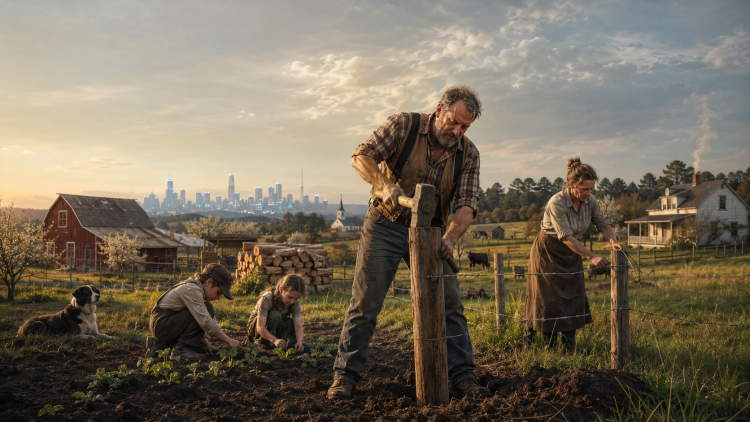
This is the ground of barns and gardens, marriages and children, neighbors and churches, laws and governments. It’s where choices strike wood, dirt, metal, flesh, and time. It’s where prayers and convictions either become fences, food, forgiveness, and faithfulness… or evaporate like woodsmoke into chilly evening air.
In a world increasingly built around virtual drama, artificial digital conflict, and carefully staged lives, the outer field keeps insisting that reality is real. A roof either sheds rain or it leaks. A crop either feeds somebody or it doesn’t. A promise is either kept or broken. A child is either loved and taught or left to be raised by strangers and screens.
The outer field doesn’t care how convincing your online life looks.
It asks what you have built.
Where Ideas Meet the Fence Post
There is a sharp difference between true drama and mere entertainment. True drama begins when two different times collide… when an old world meets a new one in the life of a man or woman willing to stand in the gap.
Athanasius stood there. Martin Luther stood there. Above them all, Jesus Christ stood there. Each carried the weight of something the old order couldn’t understand, and each paid dearly because the world they confronted couldn’t yet see what was coming.
Now, the clashes on a homestead may look smaller, but they’re no less real to the people living through them. When a family breaks with generations of debt and decides to live within its means, an old time collides with a new one. When a man raised in chaos chooses to build a peaceful, Christ-centered home, the sins of yesterday push hard against the obedience of tomorrow.
Likewise, when a couple surrounded by convenience and consumption quietly begins growing food, preserving harvests, teaching their children, and helping their neighbors, another way of life suddenly appears. They don’t need a stage or a spotlight. Their garden rows, paid-off tools and equipment, crowded supper table, and open front door tell the story.
That’s real drama.
It happens when debt is paid, roofs are patched, gardens are planted, neighbors are served, and vows are kept after the warm feelings have worn thin. It happens when a person’s beliefs leave the safety of his head and start costing him something in the world.
Most of what gets called drama today is something else entirely. It’s noise dressed up as meaning. The hero never really rises above his age, nothing permanent changes, and everyone ends up trapped inside the same tired way of thinking. It may keep people staring at a screen, but it rarely sends anyone outside to build.
The outer field needs men and women who will change something… not merely perform their feelings about change.
A World Full of Buildings and Starved for Life
Modern people are awfully good at building big shells. We raise towers full of desks, theaters full of special effects, church campuses full of expensive equipment, and data centers full of blinking machines. Yet too often, there’s precious little human life growing inside them.
Folks will donate millions for brick, glass, lights, and a name carved over the door. It’s much harder to find someone willing to support the slow, costly work of a pastor sitting beside a hospital bed, a teacher opening a child’s mind, a craftsman training an apprentice, or a family taking in someone who has nowhere else to go.
The same crooked thinking can sneak onto the homestead. It’s easier to sell a man a shining solar array than to teach him how to live well on less electricity. It’s easier to put up a massive pole barn than to build the habits and gather the people required to tend animals, stack hay, repair gates, and keep that barn alive year after year.
In the same way, it’s easier to admire a beautiful farmhouse kitchen than to prepare three meals a day, wash the dishes, welcome company, and teach children to be useful beside you. The room may be handsome, but without service, laughter, correction, prayer, and bread rising on the counter, it’s still only a room.
Architecture without living people becomes a shell. A skyscraper stuffed with desks is little more than a stack of boxes in the sky. A church building without a living church is a hollow monument. And a homestead arranged for photographs rather than people is just another stage set.
So the question isn’t simply, “What are you building?”
The better question is, “What kind of life will this help people live?”
The Land Needs Hands… Not Hashtags
For decades, technocrats and clever planners have designed classrooms, cities, workplaces, entertainment, and even family life from faraway offices. They know how to draw a system on a whiteboard. They know how to measure output, move pieces, gather data, and make everything look efficient.
But they rarely stop to ask whether the people inside those systems are becoming wiser, stronger, kinder, more faithful, or more fully human in God’s world.
The outer field pushes back against that kind of bloodless thinking. Chickens need somebody to feed them and shut the coop before the raccoon comes hunting. They don’t care how many rustic-living posts you shared that afternoon. Children need parents who will read, pray, discipline, forgive, listen, and stay; a carefully curated family page won’t hold a frightened child at midnight.
Likewise, small churches need shepherds who show up at kitchen tables, gravesides, and hospital rooms. They need more than a polished performance under stage lights once a week. Likewise, the land needs calloused hands, muddy boots, sharp tools, watchful eyes, and the patience to do the same necessary job again tomorrow.
Real work needs real people.
The outer field also refuses to let a human being shrink into a job title. A man who believes he is only a doctor, farmer, artist, manager, or content creator has locked himself in a box too small for the life God may ask him to live. Tomorrow may call him to become a caregiver, teacher, neighbor, protector, peacemaker, or grieving friend.
Storms don’t check résumés before tearing off shingles. Sickness doesn’t care what appears beneath your name in an email. A child’s hard question, a neighbor’s empty pantry, or a marriage in trouble may demand a kind of faithfulness that no professional certification ever taught.
That’s why working the outer field means remembering the larger names God has given us: steward, neighbor, spouse, parent, citizen, and believer. Those aren’t decorative titles. They carry duties, and those duties have weight.
Are You Ahead of Your Time… or Hiding Behind It?
Tragedy and comedy can both unfold in the outer field, and the difference between them is worth understanding.
In tragedy, the hero stands ahead of his time. He sees what others can’t yet see, embodies a truth the old order won’t accept, and suffers because yesterday refuses to loosen its grip. In comedy, the fool stands behind his time. He clings to dead habits and faded assumptions long after reality has passed him by.
Tragic courage appears when someone becomes the first in a long family line to repent of abuse, addiction, deceit, or cowardice. It appears when a business owner decides that workers are neighbors made in the image of God, not disposable parts in a machine. It appears when a farmer treats soil, animals, water, and future generations as gifts entrusted to his care rather than resources to be stripped and abandoned.
People like that are often misunderstood. Family members may mock them. Friends may call them foolish. Institutions might punish them because living obedience exposes the comfortable lies holding the old order together.
That’s the cost of carrying tomorrow into today.
Comedy shows up when a man refuses to notice that the world around him has changed. The prepper dreams of an untouched 1950s America while digital control quietly reaches down his gravel road. The nationalist imagines his country can seal itself off from every famine, war, market shock, and moral duty beyond its borders. The homesteader boasts that technology and global trade don’t affect him while his seed, diesel, fertilizer, feed, tools, weather forecasts, and markets remain tied to systems he barely understands.
Living off-the-grid doesn’t mean living outside reality.
In fact, real off-grid thinking demands clearer eyes. It means reducing needless dependence where you can, understanding the systems you still rely upon, and refusing comforting fantasies about either the past or the future.
So every now and then, a person working the outer field ought to stop at the fence line and ask a hard question: Am I ahead of my time in a way that calls for courage, or behind my time in a way that calls for repentance?
Wisdom is knowing the difference.
When Busyness Becomes Another Kind of Emptiness
Our age is full of motion without direction, movement without meditation. Music becomes noise. Painting becomes a private joke. Buildings become storage bins for bodies. Stories can spin in circles until nothing happens except one wounded person explaining his feelings to another.
The same loss of purpose can infect work on the land.
A farm can grow thousands of acres of cash crops and still leave the family table dependent on a supermarket. A business can move money all day without serving one truly human need. A household can stay frantic from dawn until bedtime and never make room for affection, conversation, Scripture, prayer, or rest.
When that happens, motion has replaced meaning. Everybody’s tired, but nobody can say what all the weariness was for.
The cure is to reconnect work with its place in time. Good work receives something from the past, answers a need in the present, and leaves something useful for the future. It also fits within God’s created order instead of trying to bulldoze through it.
On a homestead, this means designing life around actual human rhythms: cooking and eating, labor and rest, worship and learning, seedtime and harvest, birth and burial. It means choosing projects that serve the household and neighbors instead of feeding vanity. It means letting both the seasons of the land and the seasons of worship set the pace.
Then a fence is more than a fence. It protects an animal, marks a responsibility, and may still be standing when your grandchild takes over the chores. A garden bed is more than a patch of vegetables. It becomes a place where hunger is answered, patience is learned, and abundance is shared.
The outer field becomes healthy when work circles back to the love of God and neighbor. Efficiency has its place. Beauty has its place. But neither one is the final purpose.
Why Sunday Clothes and Sharp Tools Still Matter
Think about it: There’s something deeply human about ritual and liturgy. The clothes we wear, the tools we maintain, the tables we set, and the days we set apart tell people that certain moments carry weight.
That’s why old homesteading families often had chore clothes, town clothes, and Sunday clothes. You didn’t wear a clean shirt to church because God was fooled by pressed cotton. You wore it because worship mattered, the people beside you mattered, and presenting yourself with care was one small way of saying so.
The Liturgy Of Life and Work
The same principle lives in the barn and workshop. A weed whip kept sharp, a shovel hung in its place, and a workbench swept clean aren’t signs of fussiness. They show respect for the work and consideration for the next person who reaches for the tool.
Even ordinary meals can carry this dignity. A family that pauses, gives thanks, and waits for everyone before eating turns food into more than fuel. A Sabbath meal, a harvest supper, an anniversary, or a funeral dinner covers common bread and conversation with memory, gratitude, and love.
The outer field can’t survive on bare function alone. Human beings need beauty and a nice bit of ceremony because survival isn’t the whole point of being alive.
Still, every generation is tempted to throw away needful ritual and liturgy. Youth naturally leans toward the future, often believing anything old must be useless. But a life with no inherited forms soon becomes thin and weightless, forever chasing the next thing and never receiving the riches already handed down.
Working the outer field well means recovering rituals that bind labor to worship and memory. Pray before planting. Give thanks at the table. Mark marriages and deaths. Honor elders while they can still hear you. Teach children why the first ripe tomato, the first split log of winter, and the first hymn on Sunday morning belong to a life larger than themselves.
These things keep work from turning into a grind. They make love, respect, and gratitude visible.
Stop Buying Pictures of the Life You Want
One of the saddest images of modern life is the commuter who spends hours riding into the city, more hours sealed inside a tower, and then hours riding home. Along the way, he buys books, magazines, and scrolls feeds promising “life,” “time,” adventure, food, land, beauty, and freedom… because his own life has been emptied of nearly all of them.
From a gravel road, the tragedy is easier to spot.
People watch adventures because they’ve forgotten how to walk outside. They consume cooking shows while supper arrives in a plastic bag. They spend night after night watching other families milk cows, split firewood, bake bread, and raise children because they no longer believe their own reality can change.
Of course, not everyone can buy forty acres and disappear beyond the power lines. That isn’t the point. Off-grid thinking begins long before any land deed. It begins the moment a person stops renting out his imagination and starts reclaiming a piece of actual life.
Grow herbs in a window or tomatoes along a fence. Learn to repair the chair instead of replacing it. Cook one meal from scratch and share it with someone. Trade an hour of screen time for an hour with a kid, a neighbor, an aging elderly friend, or a neglected Bible.
You may never become big online. You may never own the postcard-perfect homestead. But you can become faithful on the patch of earth, in the household, and among the people God has actually given you.
Working the outer field is rarely glamorous. It comes with sweat beneath your collar, splinters in your palm, mud on the kitchen floor, setbacks in the garden, and jobs that need doing again before anyone notices you did them the first time.
Yet it produces something no magazine, streaming service, or social platform can sell: the quiet satisfaction of knowing your life has substance.
The Place Where All Four Fields Come Together
The field behind you taught you to face your inheritance honestly… to receive what was good, repent of what was crooked, and stop pretending the past has no claim on the present.
Then the inner field taught you to guard the soil of your mind from trivia, manipulation, and make-believe. It taught you that every outward collapse begins with a lie believed inwardly, and every faithful rebuilding begins with truth taking root.
Now the outer field asks whether any of it will bear fruit and become visible.
Will your convictions shape the way you spend money, raise children, treat land, conduct business, serve neighbors, and worship God? Will your household become a place where inherited wisdom meets fresh obedience? Will your faith remain a set of words, or will it grow hands, feet, scars, and calluses?
This field doesn’t ask you to rebuild the Twin Towers, rescue every institution, or untangle the whole global economy before supper. It asks you to take responsibility for the ground within reach.
There’s probably a gate sagging somewhere in your life. It may be made of oak and wire, or it may be a strained relationship, a neglected duty, an undisciplined habit, or a promise you keep pushing into “someday.” You already know where it is.
So begin there.
Put your hand on something real. Mend what is broken. Plant what can feed somebody. Tell the truth. Ask forgiveness. Keep your vows. Start the habit that turns belief into obedience, then get up tomorrow and do it again.
That’s how the outer field bears fruit.
And in a world drowning in make-believe, that kind of real life may be one of the most radical things left.