 Print
Print
The Old Roman Road Running Straight Through Your Chore List
Every principle worth handing down to our kids eventually turns out to be older than the people selling books about it.
Napoleon Hill built a career around one such principle. After studying men like Andrew Carnegie, Charles Schwab, and Frank Woolworth — along with people such as William Durant’s employee Carol Downes — Hill noticed a habit they seemed to share. They routinely rendered more and better service than they were paid for… and they tried to do it with a good attitude.
Hill called the habit Going the Extra Mile.
He was onto something.
He just wasn’t first.
Long before anybody wrote a business book about it, the principle showed up on a dusty road in Roman-occupied Judea. Under Roman authority, a soldier could compel a civilian to carry his equipment for a prescribed distance. Jesus took that hated image of forced service and turned it upside down:
“And whosoever shall compel thee to go a mile, go with him twain.” (Matthew 5:41)
The first mile was compelled.
The second mile was chosen.
That’s what makes Christ’s command so powerful. During that first mile, somebody else is deciding what you will do. But when you voluntarily step across that first-mile marker and keep walking, something has changed. The Roman may still have the sword, but he no longer owns your willingness.
In the second mile, you own the road.
That is a lesson worth teaching your children, because it may be worth more someday than anything you can stuff into a bug-out bag.
Out Here, The Second Mile Has Mud On Its Boots

Off-grid life already teaches the shape of this principle whether we give it a name or not.
Nobody pays you extra for spreading another few inches of mulch around the tomatoes. Nobody hands you a bonus for labeling the canning jars, coiling the garden hose, filling the generator before the storm arrives, or splitting one more rank of firewood during an August heat wave because you know February is coming.
The grid-tied world can often run on quitting time.
A homestead runs on consequences.
That’s one of the great advantages parents and grandparents have out here. Our children can actually see what sloppy work costs. Feed the chickens carelessly, and something may go hungry. Leave the gate half-latched, and the goats will conduct a three-o’clock-in-the-morning theology lesson concerning the doctrine of consequences.
Suddenly, “Whatsoever thy hand findeth to do, do it with thy might” (Ecclesiastes 9:10) isn’t an inspirational saying hanging above somebody’s desk.
It’s a hay bale.
It’s a gate latch.
It’s stacking firewood before snow covers the chopping block.
But look, land by itself won’t plant the habit. The homestead supplies the lesson, but Mom, Dad, Grandma and Grandpa have to give that lesson a name.
That’s the assignment described in Deuteronomy 6:6-7: teach God’s words diligently while sitting in the house, walking by the way, lying down and rising up. That’s not merely a curriculum. It’s a running commentary on ordinary life.
And ordinary life gives us plenty to talk about.
A Farm Kid Understands The Law Of Sowing
Hill argued that going the extra mile eventually “pays compound interest.” Ralph Waldo Emerson expressed a similar thought when he wrote about serving an ungrateful master and putting God in your debt.
Scripture says it older, plainer, and quite a bit better:
“Be not deceived; God is not mocked: for whatsoever a man soweth, that shall he also reap.” (Galatians 6:7)
To a kid who has actually worked dirt, that’s more than a metaphor.
Your daughter has pushed a seed into black soil with her own finger. She knows the strange bargain involved. You bury something valuable, cover it with dirt, walk away and receive absolutely nothing in return that afternoon.
For days, it looks like you wasted your time.
Then one morning there is a green shoot where yesterday there was nothing.
A farm child learns early that the harvest doesn’t arrive the same week as the labor. That’s an enormously important lesson because delayed reward is one of the main reasons people stop sowing good things in the first place.
Paul’s next words belong at the end of a long garden row:
“And let us not be weary in well doing: for in due season we shall reap, if we faint not.” (Galatians 6:9)
Teach your children the delay.
That’s the hard part.
Nearly everything in a screen-fed culture teaches children to expect payment within seconds. Tap the screen. Get the picture. Click the button. Hear the sound. Order the thing. Watch the package move toward your house.
But neither the farm nor the garden work that way.
Neither does the woodpile, the milk pail, the orchard, a marriage, a reputation, a business, a friendship, or the second mile.
They pay late.
And sometimes they pay heavy.
“The liberal soul shall be made fat: and he that watereth shall be watered also himself” (Proverbs 11:25).
The Most Important Question Is Who You’re Working For
Hill’s version of the extra mile usually had an employer standing at the end of it.
Carnegie notices. Durant promotes. Schwab sends the bonus. The boss sees who stayed late and remembers that name when a better position opens.
There’s truth in that, and it’s worth explaining to a fifteen-year-old before his first summer job.
But it’s too thin a foundation to build a life on.
Children are especially good at spotting thin motives. Tell a kid, “Work hard because the boss might notice,” and sooner or later he’ll discover something adults already know:
Sometimes the boss doesn’t notice.
Sometimes the boss is a fool.
Sometimes somebody else gets the promotion.
Sometimes nobody says thank you.
And sometimes you do beautiful work in a place where absolutely nobody is watching.
That’s where the Christian doctrine of work becomes much sturdier than a success principle:
“And whatsoever ye do, do it heartily, as to the Lord, and not unto men; knowing that of the Lord ye shall receive the reward.” (Colossians 3:23-24)
It’s worth remembering who those words addressed. Paul was speaking into a household world containing servants… people who weren’t climbing a corporate ladder and didn’t have much leverage over the person assigning their work.
Yet they were still told to work heartily.
Why?
Because excellence wasn’t merely an investment strategy.
It was worship with a tool in its hand.
That’s about as close as you’ll get to an off-grid theology of labor in one sentence.
The quality of your fence line says something about God even when the neighbors never see it. The way you clean a borrowed chainsaw before returning it matters when nobody is handing out medals. The last shovel of manure matters because God isn’t only Lord of Sunday morning.
He’s Lord of Tuesday afternoon behind the barn.
“Whether therefore ye eat, or drink, or whatsoever ye do, do all to the glory of God” (1 Corinthians 10:31).
Teach a child that and you’ve given him something capable of surviving unemployment, ingratitude, rotten bosses, collapsed markets, and the complete absence of applause.
Five Ways To Put The Second Mile Into Your Kids This Week
1. Give The Second Mile A Name
When your son finishes his assigned job and then notices something else that needs doing, don’t merely say, “Thanks.”
Tell him what happened.
“That was the second mile.”
Children remember things that have names. We name animals, tools, roads, storms, virtues and sins because names give us handles for ideas.
Hill understood this too. He specifically urged parents to teach children the value of rendering more service than is normally expected. His point was that the habit eventually becomes part of the child’s character.
Christ gives us an even better name for it.
The second mile.
2. Start With Little Jobs Nobody Applauds
Jesus said, “He that is faithful in that which is least is faithful also in much” (Luke 16:10).
Hill loved stories of fortunes beginning with tiny acts nobody considered important. On a homestead, we have hundreds of those opportunities every week: wiping down the tool before hanging it up, shutting the gate properly, sweeping the step, putting the feed scoop back where it belongs, or carrying an extra armload of wood inside before the rain comes.
Don’t underestimate those jobs.
Small and unwitnessed is the whole point.
Character isn’t primarily built when everybody is watching. It’s built beside the shed when nobody would ever know whether you put the shovel away dirty.
3. Let Them See The Harvest
Don’t manufacture rewards every time your child does something right. That’s just another way of teaching him that every good act deserves immediate payment.
Instead, let reality do some of the teaching.
Walk him past the deep-mulched garden during an August drought and point out the moisture still hiding underneath. Open the pantry in March and look at the jars put away last September. Turn the key on the tractor that starts because somebody changed the oil, checked the battery, and greased it months earlier.
Let the evidence testify.
“The soul of the diligent shall be made fat” (Proverbs 13:4) is one of those biblical claims you can practically point at with your finger on a working homestead.
4. Make The Second Mile About Neighbors, Too
There’s another danger here.
The second mile without love can turn into nothing more than ambition wearing work boots.
So send the kids down the road with eggs when you’ve got more than you need. Help stack wood for the widow. Shovel somebody else’s walk. Fix the neighbor’s gate without sending an invoice for fifteen minutes of labor.
“As we have therefore opportunity, let us do good unto all men” (Galatians 6:10).
Likewise, Paul tells us to “look not every man on his own things, but every man also on the things of others” (Philippians 2:3-4).
That’s where the second mile stops being a productivity trick and becomes Christian service.
5. Let Them Catch You Doing It
Grandparents may have the finest teaching system ever invented:
A story and a pair of hands.
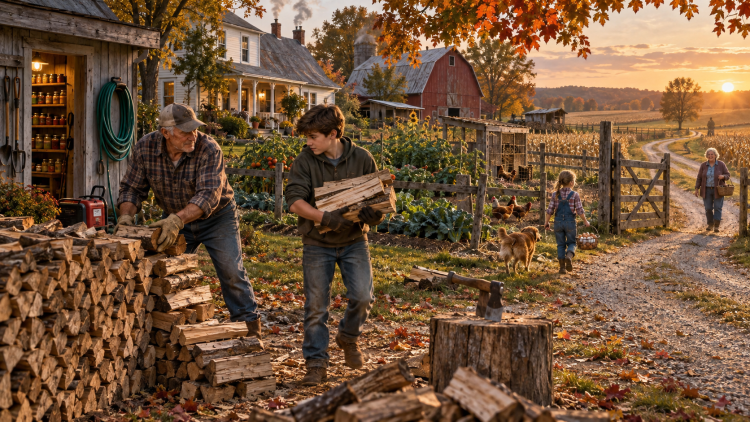
Tell them about the winter Grandpa cut more wood than he thought he’d need… and then go stack wood with them. Tell them why you return a borrowed tool cleaner than you received it, and then let them watch you wipe it down.
Children copy what they see far more reliably than what they’re told.
“Not slothful in business; fervent in spirit; serving the Lord” (Romans 12:11) isn’t primarily something to hang on the wall.
It’s something they should catch you doing.
Where Napoleon Hill’s Extra Mile Comes Up Short
There’s one correction we ought to make when teaching Hill’s principle to our children.
Hill strongly emphasized that going the extra mile eventually pays. Often it does. People notice reliability. Customers remember good service. Employers remember the employee who solved the problem instead of saying, “That’s not my job.”
But don’t promise your children something Scripture doesn’t.
Sometimes you carry the pack two miles and the Roman soldier doesn’t say thank you.
Sometimes you work late for years, and somebody else’s nephew gets the promotion. Sometimes you help somebody who never returns the favor. Sometimes you sow carefully, pray for rain and watch the crop burn anyway. Life’s full of that kind of thing.
Christ’s second-mile teaching, after all, appears in a passage about being struck, sued, and compelled… not a passage about career advancement (Matthew 5:38-42).
That’s important.
Jesus wasn’t giving His listeners a clever strategy for getting Caesar to notice them.
He was teaching them how free people live even when circumstances aren’t fair.
So the promise we hand our children needs to be bigger than Carnegie’s paycheck.
The reward is real, but the timetable belongs to God. And sometimes part of the reward is simply the man or woman you become while carrying the pack.
Hill came remarkably close to recognizing this himself. He argued that the greatest benefit of extra service often doesn’t belong to the person receiving it, but to the person rendering it, because the habit changes the mind and character of the worker.
Scripture pushes that road all the way to its destination:
“Well done, thou good and faithful servant.” (Matthew 25:21)
And Christianity doesn’t merely give us a command to serve.
It gives us the pattern.
“The Son of man came not to be ministered unto, but to minister” (Matthew 20:26-28).
Christ didn’t merely teach the second mile.
He walked it.
The Inheritance Rust Can’t Eat
Homesteaders put a lot of thought into what we’re leaving behind.
Maybe it’s forty acres and an old farmhouse. Maybe it’s the tractor, Grandpa’s rifle, Grandma’s cast-iron skillet, a cellar full of jars, heirloom seeds tucked into envelopes, a stack of seasoned oak, some hand tools and enough practical knowledge to keep the place running when the power goes out.
That’s good.
Scripture says, “A good man leaveth an inheritance to his children’s children” (Proverbs 13:22).
But there’s another inheritance that may matter even more.
Inflation can eat cash. Rust can eat steel. Fire can eat a barn. Taxes can consume land, markets can collapse, and one hard decade can scatter possessions accumulated over three generations.
But those things can’t easily take away a grown son who has learned to do more than required, do it cheerfully, and do it honestly when nobody is watching.
A Harvest That Outlives Your Homestead
They can’t take away a daughter who understands that today’s seed may not become tomorrow’s supper… but she plants it anyway.
They can’t take away a child who knows that service isn’t beneath him, work isn’t punishment, excellence isn’t showing off, and faithfulness doesn’t require an audience.
That inheritance travels.
It fits in no bug-out bag because it’s already inside the person carrying the bag.
“Train up a child in the way he should go: and when he is old, he will not depart from it” (Proverbs 22:6).
So tomorrow, somewhere between feeding the chickens and stacking the wood, watch for the opportunity.
When the assigned job is finished, point toward the thing that still needs doing.
Then give it a name.
The first mile gets the chore done.
The second mile builds character.
And that’s an inheritance worth leaving behind.
Source material adapted from Napoleon Hill’s writings on the habit of going the extra mile. Scripture quotations are from the King James Version via Bible Gateway.