 Print
Print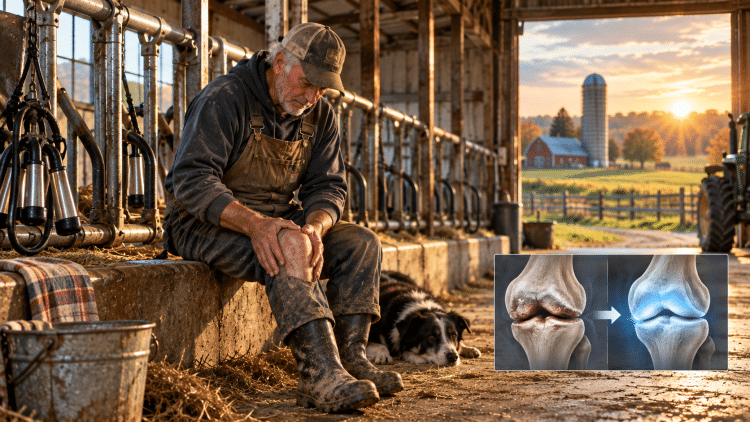
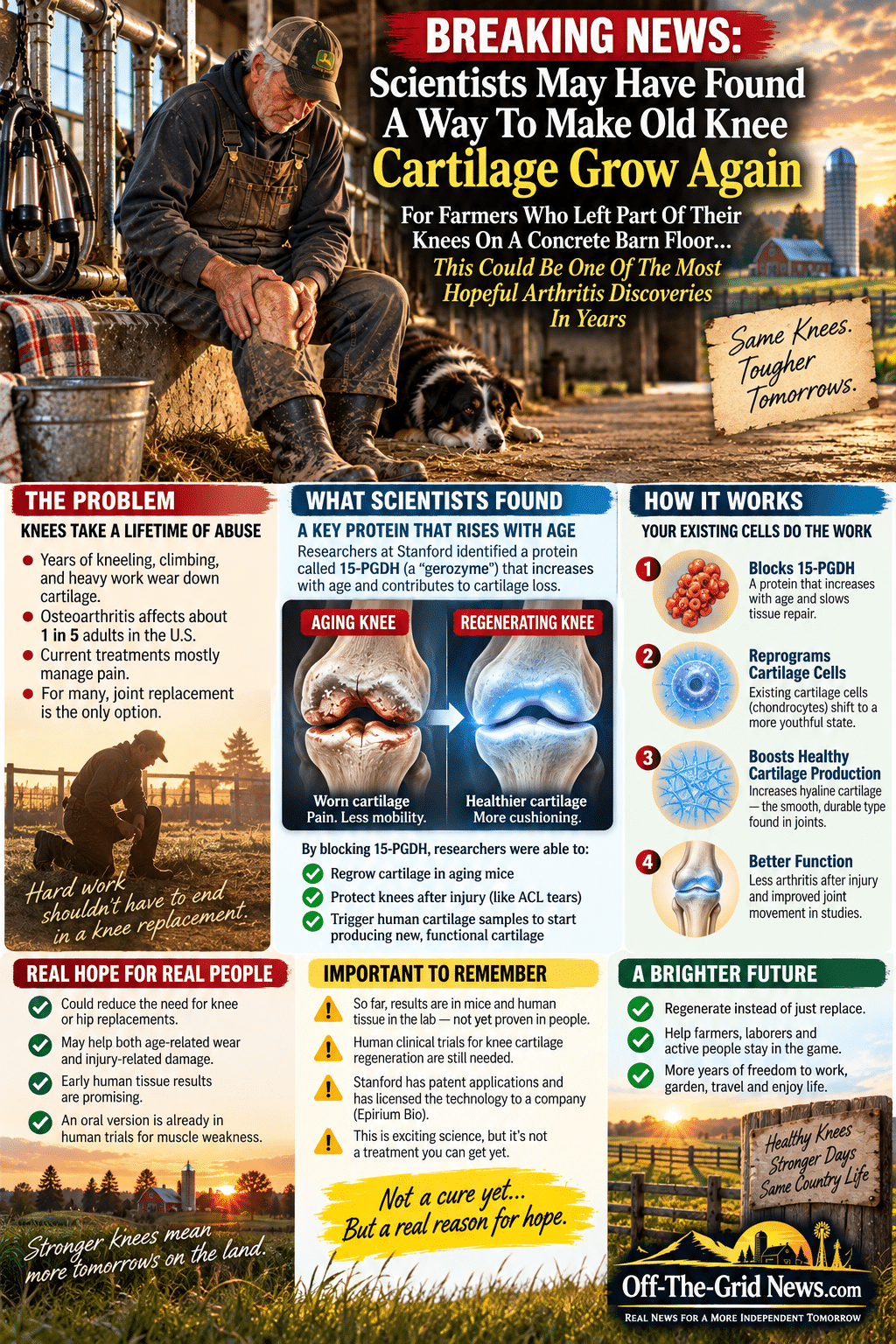
For Farmers Who Left Part Of Their Knees On A Concrete Barn Floor… This Could Be One Of The Most Hopeful Arthritis Discoveries In Years
If you grew up around dairy farms, you probably know somebody who walks a little differently today because he spent half his life milking cows.
Maybe it was your dad. Maybe your neighbor. Maybe it was you.
I’ve had plenty of friends who milked cows in the old stanchion barns. Morning and night, seven days a week, they worked their way down a row of Holsteins on concrete floors. Kneel down. Stand up. Bend over. Twist. Carry the milker. Step around the gutter. Then do it all again at the evening milking.
Nobody called it an exercise program.
But their knees sure remembered it.
Years later, those old farmers started paying the bill. Stiff knees in the morning. Pain climbing into the tractor. Trouble getting down to fix something underneath a piece of equipment. And eventually, for plenty of them, the words nobody particularly wants to hear:
“You’re probably going to need a knee replacement.”
Now researchers at Stanford Medicine have reported something that would have sounded almost impossible not very long ago.
They got old knee cartilage to grow again.
Not artificial cartilage.
Not a mechanical replacement.
The animals’ own cartilage.
And perhaps most intriguing of all, human cartilage taken from people undergoing knee replacement surgery responded to the same experimental treatment in the laboratory.
That doesn’t mean your orthopedic surgeon is going to have this treatment sitting on the shelf next Tuesday.
But for anybody whose knees have been ground down by 40 years of barns, fields, construction sites, shop floors and hard work, this is research worth watching.
The Part Of The Body That Doesn’t Like To Fix Itself
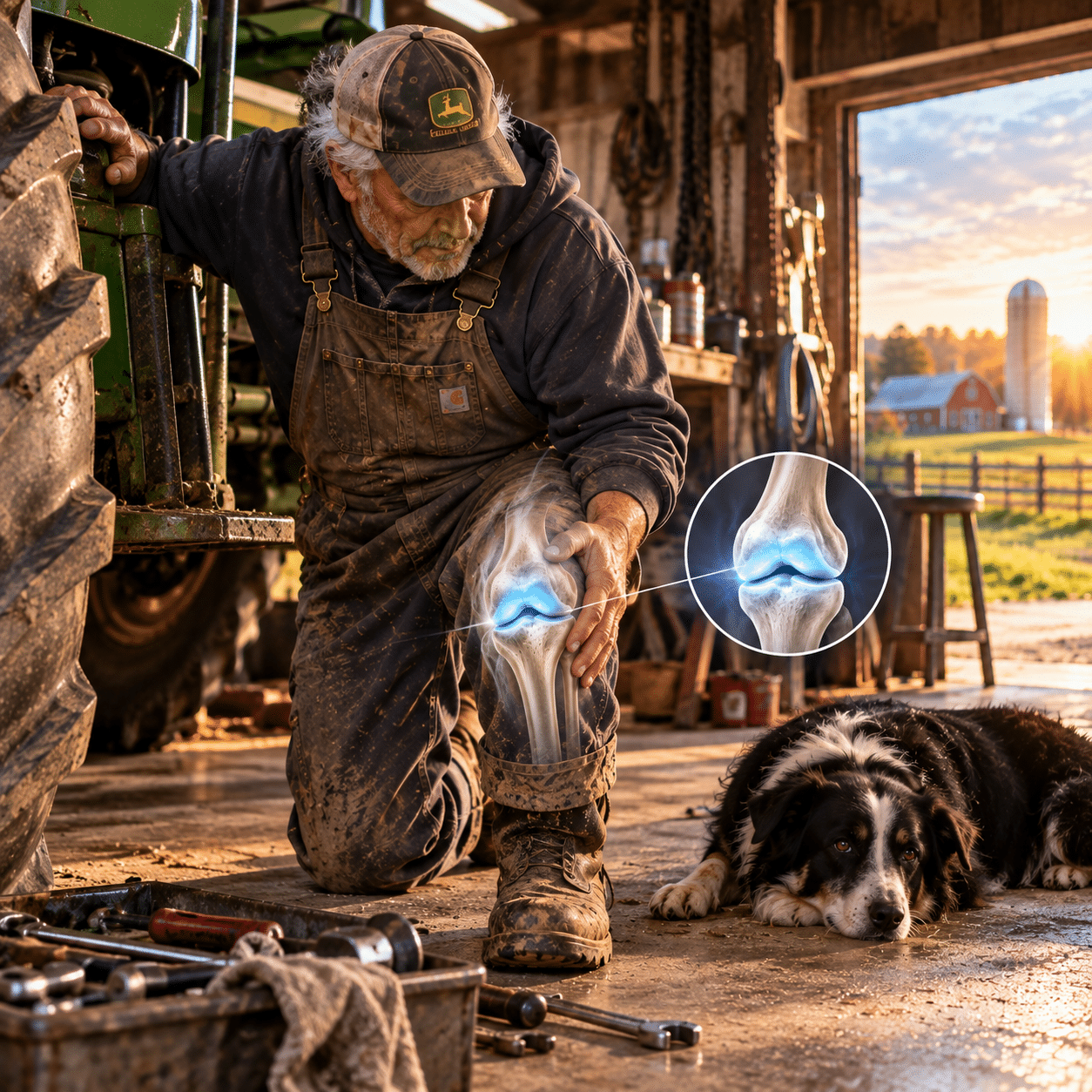
A farmer understands wear.
Leave a bearing without grease long enough and metal starts eating metal. Run a cultivator point through enough acres and eventually there isn’t much point left.
Your joints aren’t all that different.
The ends of the bones inside joints are covered with smooth articular cartilage. It’s remarkable stuff. Stanford describes cartilage surfaces as generating even less friction than ice sliding on ice.
But there’s a catch.
Once that cartilage starts disappearing, the body isn’t very good at putting it back.
Unlike a cut on your hand, articular cartilage has little natural capacity to repair itself. It doesn’t have the rich blood supply many other tissues enjoy, and scientists haven’t found the kind of readily available stem-cell population in articular cartilage that might simply rebuild what’s been lost.
That’s one reason osteoarthritis can become such a one-way road.
Cartilage gets thinner. The joint becomes inflamed. Movement hurts. Eventually ordinary chores become negotiations with your own knees.
The source material accompanying the study notes that osteoarthritis affects roughly one in five American adults. Current treatments mostly try to manage symptoms rather than reliably reverse the underlying cartilage loss.
But the Stanford researchers started looking at the problem differently.
Instead of asking how they could replace the worn-out cartilage, they asked whether the old cartilage cells might be persuaded to start doing their job again.
That’s where things get interesting.
They Found Something That Rises As We Age
Researchers focused on an enzyme with the decidedly un-country name 15-hydroxyprostaglandin dehydrogenase, or 15-PGDH.
Scientists have called it a “gerozyme” because its levels increase with aging and appear to contribute to declining tissue function.
Think of it almost like finding the brake dragging on an old hay wagon.
You can keep pulling harder.
Or you can figure out why the wheel isn’t turning freely anymore.
When researchers compared knee cartilage from young and old mice, they found about twice as much 15-PGDH in the older animals. Then they gave the older mice a small-molecule drug that inhibited it. They tried both systemic treatment and injections directly into the knee.
What happened surprised them.
The old animals’ cartilage got thicker.
More importantly, the animals produced hyaline cartilage — the smooth articular cartilage joints actually need — rather than merely producing inferior scar-like fibrocartilage.
Stanford researcher Nidhi Bhutani described the extent of regeneration as remarkable.
For people who have spent years being told that worn cartilage basically doesn’t grow back, that’s a mighty interesting word.
Regeneration.
It Didn’t Require Finding Some Magical Stem Cell
Here’s another fascinating part.
Researchers initially expected that stem cells might be responsible.
They weren’t.
Instead, the existing cartilage cells — called chondrocytes — appeared to change what they were doing.
Old cells started behaving more like younger cells.
Treatment reduced populations of cells associated with cartilage degradation and fibrocartilage while substantially increasing a population involved in making healthy hyaline cartilage and maintaining the extracellular matrix that gives cartilage its structure.
In other words, researchers didn’t necessarily have to haul in a whole new crew.
They got the crew already standing in the barn to start working differently.
That’s an important distinction because regenerative medicine has often focused on finding, growing or transplanting stem cells.
This approach suggests that sometimes the machinery needed for repair may already be sitting there.
The trick may be figuring out how to switch it back on.
Then They Injured Knees
The researchers didn’t stop with ordinary aging.
They also tested the treatment following knee injuries resembling the kind of damage associated with ACL injuries.
That’s important well beyond the football field.
Farmers know traumatic knee injuries, too. Step into a hidden hole carrying a feed sack. Twist getting down from the tractor. Slip on frozen manure. Have a gate knock you sideways.
You can hurt a knee in half a second and remember that half-second for the next 30 years.
In the experiments, mice received the inhibitor twice weekly for four weeks following injury.
The treatment dramatically reduced their likelihood of developing osteoarthritis, and treated animals moved more normally and put more weight on the injured leg than untreated mice.
That’s particularly interesting because repairing an injured ligament doesn’t necessarily prevent arthritis years later.
Stanford notes that roughly half of people suffering certain ACL injuries eventually develop osteoarthritis in that joint within about 15 years.
So preventing the long-term deterioration could ultimately be every bit as important as repairing the original injury.
But then came the experiment that should make people pay particularly close attention.
They Tried It On Human Cartilage
Researchers obtained cartilage from people with osteoarthritis who were undergoing total knee replacement surgery.
Think about that for a moment.
This wasn’t pristine cartilage from healthy 22-year-olds.
It came from knees damaged badly enough that doctors were replacing the joint.
Researchers treated those samples with the 15-PGDH inhibitor for one week.
The tissue showed fewer cells expressing the age-associated enzyme. Genes connected with cartilage degradation declined.
And the samples began showing regeneration of articular cartilage.
Stanford researchers say the results suggest existing damaged cartilage cells may be biologically reprogrammed toward a healthier state rather than simply discarded and replaced.
That’s a very different way of looking at an old knee.
Maybe the field isn’t dead.
Maybe it has simply stopped producing.
Now Comes The Big Warning
This is where we’ve got to keep both boots planted firmly on the ground.
Nobody has demonstrated yet that this treatment will regrow knee cartilage inside human beings.
The dramatic regeneration occurred in mice.
The human results came from cartilage tissue studied outside the body.
Those are exciting findings, but they’re not the same thing as giving Grandpa an injection and watching him climb out of the combine six months later with brand-new knees.
The researchers themselves say human clinical trials specifically examining cartilage regeneration are still needed.
There’s another reason to maintain some healthy country skepticism.
Worth noting: Stanford University holds patent applications involving 15-PGDH inhibition for cartilage and tissue rejuvenation, those applications have been licensed to Epirium Bio, and researcher Helen Blau is a co-founder with financial interests in the company. That’s not evidence the science is wrong, but it’s a disclosure readers deserve to know.
Still, there’s one encouraging development.
An oral 15-PGDH inhibitor has already entered human clinical testing for age-related muscle weakness, and Stanford reported this year that an experimental PGDHi compound continues to be investigated for muscle regeneration.
So researchers aren’t merely staring at a Petri dish wondering whether anybody could ever take such a drug.
They’re already moving down that road.
For The Farmer Who Can’t Kneel Down Anymore
There’s something almost poetic about this research.
Farm people spend their lives repairing things.
We weld the broken bracket instead of throwing away the implement. We replace the rotten board instead of tearing down the barn. We nurse an old tractor through another planting season because there’s still useful machinery underneath that faded paint.
For generations, medicine hasn’t had much opportunity to take that approach with worn-out knee cartilage.
Once enough of it was gone, it was gone.
Manage the pain.
Change how you work.
And eventually, perhaps replace the joint.
Now scientists are asking whether the old joint might contain more repair capacity than anybody realized.
Maybe someday the choice won’t simply be between living with the pain and replacing the knee.
Maybe doctors will be able to walk into that biological machine shop, loosen the brake that’s keeping old cartilage cells from doing their job, and get the machinery producing again.
We’re not there yet.
But somewhere tonight there’s a retired dairyman lowering himself carefully into his chair because the knees that carried him through 30 winters of twice-a-day milking don’t bend like they once did.
For him, this research isn’t an abstract discussion about enzymes and gene expression.
It’s hope.
And after all those mornings when he walked into a freezing barn before daylight because cows don’t care whether your knees hurt, I’d say he’s earned a little of that.