 Print
Print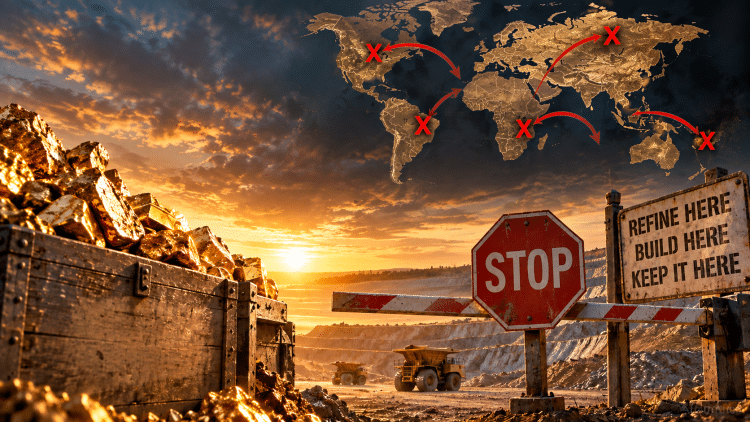
When The Folks Mining Most Of The Gold Stop Shipping… It Might Be Worth Paying Attention
From Laos To China, Gold-Producing Nations Are Refining It At Home, Taxing Heavy On The Way Out And Stacking More In Their Own Vaults. That Ought To Wake Up Anybody Willing To Listen
Out on a homestead, you learn a few things the hard way. You don’t sell every bushel of corn and hope the grocery store stays open, run the diesel tank down to fumes because the fuel truck has always shown up before, or build your entire winter plan around somebody else keeping a promise.
You keep something back.
A little grain. A little fuel. A little cash. A stack of firewood nobody can turn off with the flip of a switch. And now something mighty interesting is happening in the gold market that follows much the same country logic.
Some of the countries that actually dig the world’s gold out of the ground are becoming less eager to ship it away.
Instead, they’re building refineries at home, putting taxes on exports and encouraging more domestic ownership. In some cases, central banks are also buying gold and putting it into national reserves.
Laos is doing it. Indonesia has slapped new duties on gold exports. China has been doing its own version of this for years, while other gold-producing countries are looking for ways to capture more value from the metal before it leaves home.
Different countries. Different policies. But the same question keeps popping up:
Why are the people sitting closest to the gold mines suddenly so interested in keeping more of the gold?
First Rule Of The Farm: Don’t Sell The Seed Corn
For decades, much of the international gold business followed a pretty simple trail. A mining country dug gold out of the earth, while the ore or partially refined doré often went somewhere else for additional processing.
Then major financial and refining centers such as Switzerland, London and Hong Kong handled large portions of the refining, trading or storage. In other words, the country with the hole in the ground didn’t necessarily capture all the economic activity that happened after the rock came out.
That’s starting to bother some governments.
Take Laos. The country produced roughly 12 tonnes of gold in 2025, according to figures cited in reports on the country’s new gold strategy, but much of its gold has historically left the country without Laos capturing all the downstream value.
Now Laos is developing domestic refining capacity and a broader precious-metals industry built partly around the Lao Bullion Bank and the Laos-International Precious Metals Refinery. International refiner MKS PAMP has also announced cooperation with Lao Bullion Bank aimed at developing the country’s precious-metals ecosystem.
The idea isn’t difficult to understand.
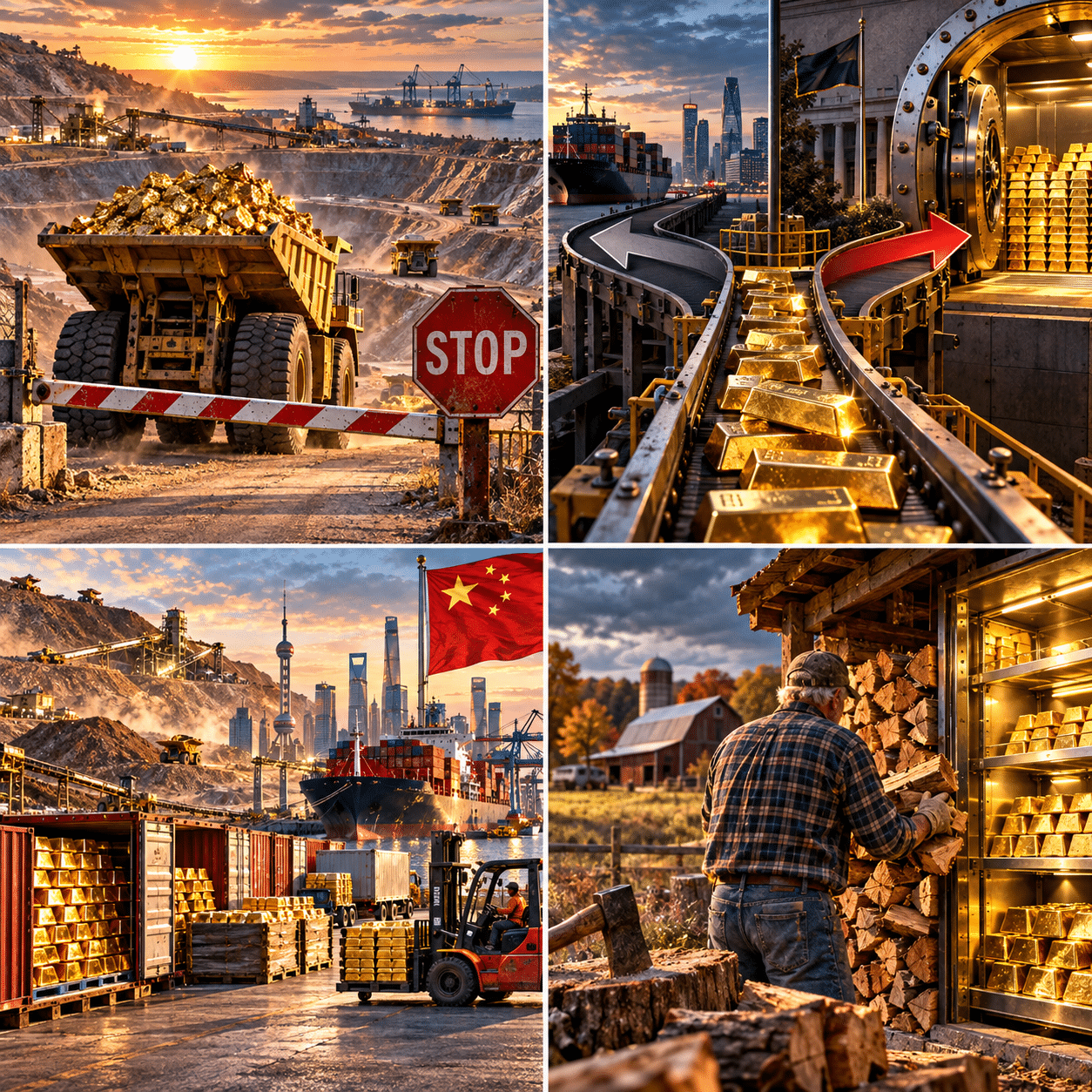
Imagine cutting oak trees off your own farm, loading the logs onto somebody else’s truck and shipping them three states away. Somebody else mills the lumber, somebody else dries it, somebody else builds cabinets from it — and then you buy the cabinets back.
At some point, you might scratch your head and say:
“Maybe we ought to own the sawmill.”
That’s roughly the thinking behind Laos’ effort to build more of its gold-processing industry at home. The country wants more refining, more financial activity and more of the value attached to its natural resources remaining inside its own borders.
And Laos isn’t alone.
Indonesia Just Put A Tollbooth At The Gate
Indonesia is another major gold producer, with some of the world’s largest known gold resources. Yet even while Indonesian gold was being exported, local investors sometimes had trouble finding physical gold bars to buy.
So Jakarta decided to make exporting the stuff more expensive.
Indonesia imposed new gold export duties beginning in December 2025. Depending on the gold product and reference price, those duties can rise as high as 15%, with less-refined gold such as doré generally facing the heavier burden.
The government’s reasoning was hardly hidden. Officials said they wanted more gold production, liquidity, circulation and value-added processing to remain inside Indonesia rather than watching the metal and much of the business surrounding it head overseas.
That’s not a little paperwork fee.
That’s a cattle gate.
And Jakarta has essentially hung a sign on it saying, “You can haul the gold out. But it’s going to cost you.”
Now zoom out to China.
China produces more gold than any other country in the world, mining roughly a tenth of global output in recent years. Yet China is also one of the world’s largest gold consumers and continues bringing substantial quantities of the metal into the country.
Think about that combination. The biggest gold producer in the world digs enormous quantities out of its own ground…
And then brings more in.
Meanwhile, China maintains tight controls over gold exports. Put the pieces together and the old assumption that newly mined gold simply pours into one giant worldwide bucket begins looking a little shaky.
The mines may still be producing.
The ounces just aren’t necessarily traveling.
And That Changes The Gold Equation
Usually, when people talk about a possible gold shortage or rising gold prices, they focus almost entirely on demand. Central banks are buying, investors are buying, Chinese households are buying and exchange-traded funds can absorb enormous quantities when investment sentiment turns bullish.
But now something interesting may be happening on the supply side too.
If producing countries refine more gold domestically, encourage their citizens to own it, tax exports and direct some locally mined ounces toward national reserves, the amount of newly mined gold freely circulating through international markets could tighten even if the mines themselves keep running.
That doesn’t mean the world suddenly “runs out of gold.” Far from it.
Gold is unusual because enormous quantities mined throughout human history still exist above ground. Unlike diesel fuel that gets burned or wheat that gets eaten, an ounce of gold can sit in a vault, jewelry box or dresser drawer for generations and eventually come back onto the market.
Higher prices can also tempt existing owners to sell. So the relevant question isn’t simply how much gold exists.
It’s how much gold is available for sale at today’s price.
Every farmer understands that distinction. There might be 40,000 bushels of corn sitting in bins around the county, but if everybody decides to keep the auger shut, those bushels aren’t really part of today’s available supply.
Good luck buying them for yesterday’s price.
And that brings us to the bigger story.
Something Changed After 2022
In 2022, Western governments froze hundreds of billions of dollars’ worth of Russian central-bank foreign reserves following Russia’s invasion of Ukraine. Whatever a person thinks about the wisdom or morality of that decision, reserve managers around the world were handed a rather unforgettable demonstration.
Foreign reserves aren’t merely about what you own.
They’re also about who controls access to what you own.
A government bond is somebody’s promise. A bank deposit exists inside a financial system, while foreign currency held abroad depends partly upon relationships with foreign governments, banks, custodians and payment networks.
Gold sitting inside your own vault is different. It doesn’t need another country to honor the note, and it doesn’t need a foreign bank to clear a payment before the metal continues existing.
That doesn’t make gold magically untouchable. Governments can regulate it, restrict it, tax it, confiscate it and control where it moves.
Still, the distinction remains important:
There’s a difference between owning something tangible under your control and owning somebody else’s promise to give you something later.
A homesteader doesn’t need an economics degree to understand that.
A Full Woodshed Doesn’t Need A Counterparty
Think about winter. There’s a big difference between having enough money in the checking account to buy firewood and having six cords stacked behind the barn before the first snowflake falls.
There’s a difference between having money for groceries and having shelves lined with canned beef, tomatoes, beans, rice and flour. And there’s certainly a difference between owning a generator and owning a generator with fuel, oil, spare filters and the extension cords you’ll need when the lights go dark.
One is purchasing power.
The other is stored capability.
Gold obviously isn’t firewood, diesel or canned beans. You can’t eat it, it won’t pump your well, and it won’t keep the wood stove burning at three o’clock on a January morning.
But national reserve managers appear increasingly interested in the same basic principle: keep at least some wealth in a form that doesn’t depend entirely upon somebody else making good on a promise.
And the numbers are getting hard to ignore.
The People Running The Vaults Are Sending A Message
The World Gold Council’s 2026 Central Bank Gold Reserves Survey found that 89% of surveyed central-bank reserve managers expect global central-bank gold holdings to increase over the next 12 months.
Even more interesting, a record 45% said they expect their own institution to increase its gold holdings during that period. Meanwhile, 83% expect gold to represent a larger share of total reserves five years from now, while **74% expect the dollar’s share of global reserves to decline.
And there’s another fascinating little nugget buried in that survey.
When central banks expecting to purchase gold were asked how they might fund those purchases, half pointed to domestic gold-purchase programs using local currency. In other words, buying gold closer to home isn’t merely something financial commentators are talking about; it’s appearing in reserve managers’ own plans.
Meanwhile, the World Gold Council reports that central banks have accumulated an average of roughly 1,000 tonnes of gold per year during the past four years, about twice the average of the preceding decade.
Those aren’t predictions carved into stone. Central bankers can be wrong just like farmers, economists and weathermen.
But they tell us something important about how the people managing enormous national reserves are thinking.
And China makes the trend even harder to miss.
China Isn’t Just Mining Gold. It’s Stacking It.
China’s central bank has continued adding to its reported gold reserves. By September 2026, the People’s Bank of China had extended its reported buying streak to 23 consecutive months.
And official purchases may not tell the whole story. Analysts have long debated how completely reported central-bank numbers capture actual sovereign gold accumulation, particularly where purchases may occur through other state institutions.
That distinction matters. Reported holdings are facts disclosed by governments; estimates of additional buying are still estimates and ought to be treated that way.
Still, the broader central-bank trend isn’t imaginary.
According to the World Gold Council’s latest demand data, central-bank net demand jumped to 289 tonnes in the second quarter of 2026, about five times the revised first-quarter total and a record for a second quarter.
The Council also notes that unreported official-sector buying remained elevated. While first-half demand was uneven because some countries sold gold, reserve-manager sentiment toward the metal remained exceptionally strong.
In fact, central bankers speaking at the London Bullion Market Association conference this October described a structural shift in the gold market since 2022, driven partly by emerging-market central banks seeking greater diversification amid geopolitical uncertainty.
That’s worth dwelling on.
Central banks have become much bigger players in the gold market than they were before 2022. At the same time, some gold-producing nations are looking for ways to keep more refining, more value and potentially more metal at home.
Demand behavior is changing.
Supply behavior may be changing too.
That combination deserves attention.
But Don’t Mistake A Strong Story For A Straight Line Up
Here’s where folks can get themselves in trouble. A compelling long-term story doesn’t mean gold goes straight up, because it never has.
Higher interest rates can hurt gold because gold doesn’t pay interest. When Treasury yields rise, investors can earn income from government bonds while a gold bar continues doing exactly what gold bars have done for 5,000 years.
It sits there.
As of October 7, Reuters reported that spot gold had fallen to roughly $4,108 an ounce, touching a two-month low as a stronger dollar and rising Treasury yields pressured the metal.
That’s worth remembering. Even with central banks buying, China accumulating and producing countries trying to capture more value from their own metal, gold can still fall.
And sometimes it can fall hard.
Anyone telling you otherwise is probably selling something.
Indeed, central-bank buying itself isn’t expected to climb forever in a straight line. Metals Focus has projected that central-bank gold demand could decline about 15% in 2026 to roughly 720 tonnes — yet even that would leave buying above pre-2022 levels.
That distinction matters because it tells us what kind of story this really is. This isn’t necessarily “everybody is buying more gold every month.”
It’s that the baseline itself appears to have shifted.
The Real Story Isn’t Tomorrow’s Gold Price
Wall Street banks remain generally constructive on gold over the longer run, although their price targets change as interest rates, currencies and economic conditions move. That’s why I’d pay less attention to somebody’s precise target for December 2027 and more attention to the behavior underneath those forecasts.
Central banks are diversifying reserves. China continues accumulating gold, while gold-producing countries are thinking harder about where their production goes and who captures the value from it.
Meanwhile, the World Gold Council says geopolitical risk, diversification, crisis performance and protection against inflation remain important reasons central banks hold the metal.
Put those pieces together and something bigger than a normal commodity trade begins to emerge.
This is becoming a story about control.
The Real Lesson For The Homestead
For an off-grid family, gold belongs in a very different category from water, food, heat and electricity. A Krugerrand won’t run your well pump, a gold bar won’t start your tractor, and a stack of coins won’t keep your grandchildren warm when the power goes out in January.
So don’t confuse financial reserves with working preparedness.
But there’s still a mighty useful lesson buried in this story. Countries are asking themselves the same kinds of questions homesteaders have been asking forever: Who controls what we depend on? Where are our reserves actually stored? What happens if the normal system stops working?
And perhaps most importantly:
What happens if somebody else changes the rules?
Those are good questions whether you’re managing a $500 billion national reserve or a 20-acre homestead.
The answers won’t be the same, of course. A nation may want bullion reserves while a rural household may need a deeper pantry, another cord of wood, spare well-pump parts, a second source of heat and enough cash tucked away to handle a week when the electronic payment system isn’t cooperating.
But the principle underneath them is remarkably similar.
Dependence feels cheap right up until the day it becomes expensive.
Before Winter Comes, You Put Something Back
Maybe that’s the simplest way to understand what’s happening.
The world’s gold producers aren’t all abandoning international markets. They aren’t all dumping the dollar, and they certainly aren’t locking every newly mined ounce inside a national vault.
But the direction bears watching.
Countries that once seemed perfectly happy to dig gold out of their soil and send it overseas are asking harder questions about that arrangement. Some are building refineries, some are taxing exports, some are encouraging domestic gold markets, and central banks around the world continue holding and buying substantial quantities of the metal.
Meanwhile, China — the biggest producer of them all — continues mining gold at home while also drawing additional gold into the country.
That ought to make a person curious.
Because back on the homestead, when the fellow who owns the orchard suddenly quits selling all his apples, the farmer starts keeping more seed corn in the bin, and the neighbor with the biggest woodshed starts stacking another row before winter, you don’t automatically run out and copy him.
You might, however, wander over to the fence and ask:
“What do you know that I don’t?”
That may be the most interesting part of this entire gold story.
The countries sitting closest to the mines are looking at a world of sanctions, debt, rising geopolitical tension and financial uncertainty and asking themselves how much of their tangible wealth they really want somewhere else.
Increasingly, the answer appears to be:
Maybe we ought to keep more of this stuff right here at home.