 Print
Print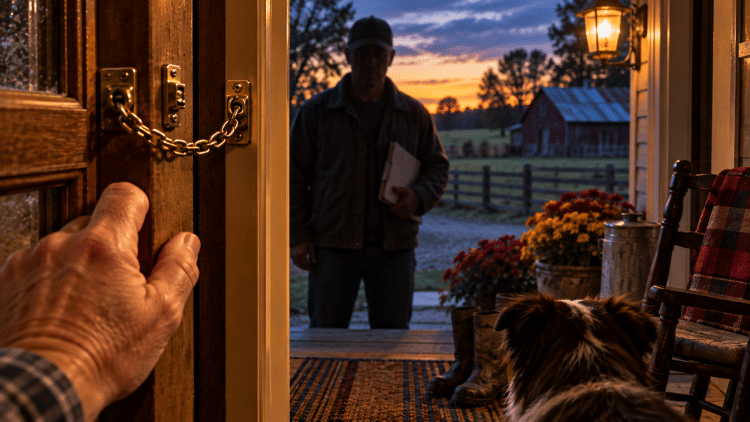
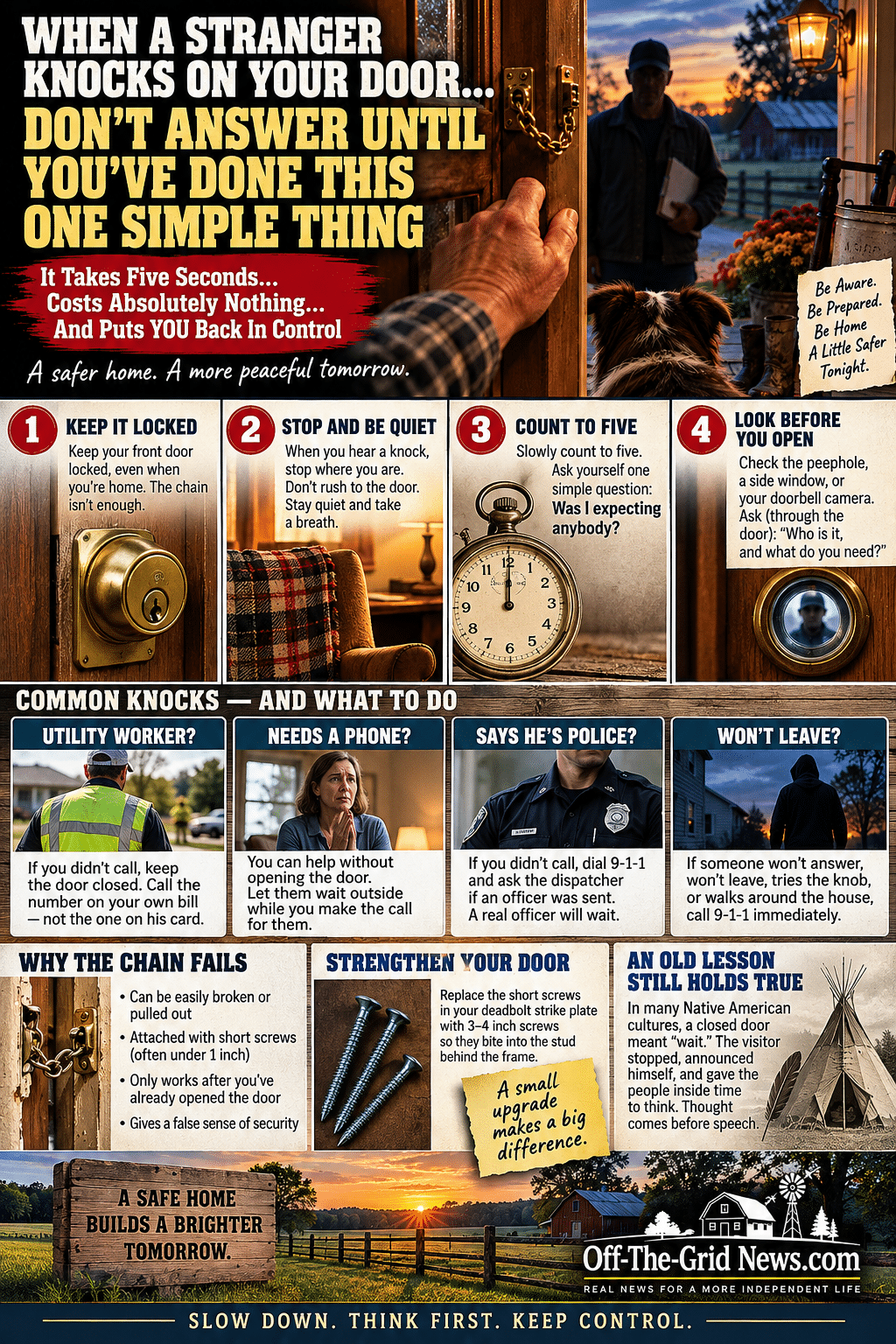
It Takes Five Seconds… Costs Absolutely Nothing… And Puts YOU Back In Control
There’s An Old Rule About Strangers That Every American Homeowner Ought To Bring Back
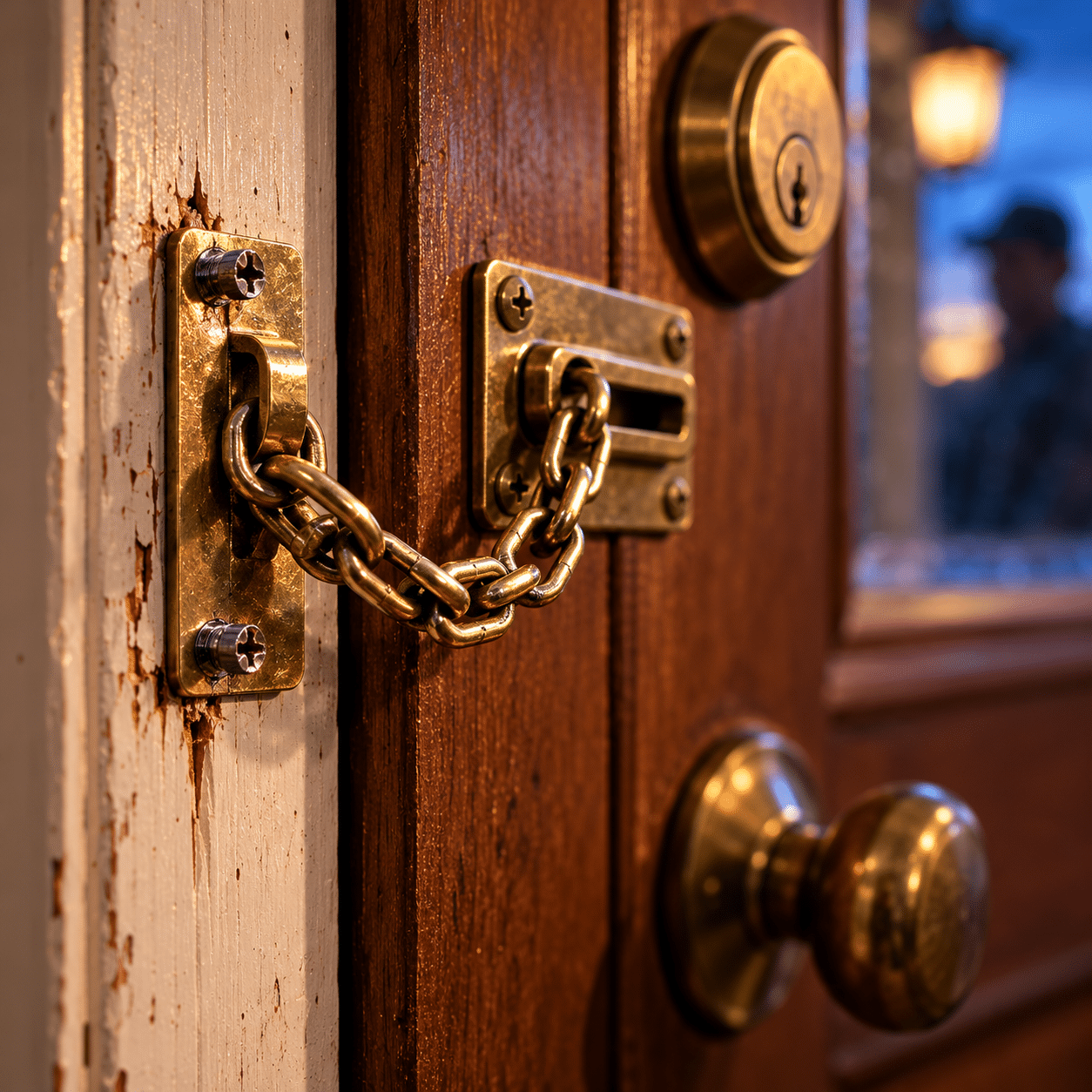
There’s a little brass chain hanging on the inside of millions of American front doors. Odds are, you’ve got one yourself, screwed into the wooden doorframe just above the deadbolt.
And when some stranger comes knocking after dark, that little chain can make you feel mighty secure. You slide it across, crack the door three inches, and figure you’ve got things under control.
But here’s the trouble.
That brass chain might be the weakest piece of security in your entire house. And the mistake that puts you in danger often happens BEFORE you ever touch it.
You see, there’s an old lesson about strangers, patience, and closed doors that our ancestors understood a whole lot better than we do today.
And once you understand it, you may never answer your front door the same way again.
The Burglar Who Knocks First Isn’t Being Polite
Back in 2016, a Portland, Oregon, television station decided to ask some rather interesting people how they went about their business.
The folks at KGW News sent questionnaires to 86 convicted burglars serving time in Oregon prisons. They wanted to know how these fellows picked their targets, what frightened them away, and what happened before they broke into somebody’s house.
One answer ought to make every homeowner sit up straight.
Every burglar who answered that particular question said he knocked on the front door before breaking in.
And if somebody answered? Well, these fellows had their excuses ready.
One might pretend he was looking for a lost dog. Another might claim he had the wrong address, while a particularly creative fellow described wearing nice clothes, carrying a clipboard, and offering a harmless-looking survey.
You can read more about the 86-burglar investigation and its findings.
Now, most people knocking on your door aren’t criminals. They’re neighbors, delivery drivers, church friends, or somebody trying to sell you replacement windows you don’t need.
But every unexpected knock presents a little question.
Who’s inside that house? Is anybody home? And if somebody answers, what can I learn about them?
Unfortunately, we’ve developed a habit of answering that question before we’ve even thought about it.
The knock comes, the dog starts barking, and we jump out of our favorite chair like somebody just hollered that the barn’s on fire. Then we hurry across the living room, grab the knob, and open the door.
And just like that, we’ve let a complete stranger set the pace.
An Old Plains Indian Custom We’ve Nearly Forgotten
Here’s where this story takes an interesting turn.
Long before anybody dreamed up electronic doorbells, security cameras, or those flimsy brass chains, Native American communities had well-established customs governing how strangers approached a home.
And one of the most important ideas was remarkably simple.
The visitor didn’t get to decide when the conversation started.
In 1933, Lakota author Luther Standing Bear published Land of the Spotted Eagle, a remarkable account of the customs and values he remembered from his upbringing.
Among the things he described was the importance of silence.
In Lakota society, Standing Bear explained, people weren’t expected to rush into conversations or demand immediate answers. A thoughtful pause showed courtesy and respect, rather than confusion or weakness.
He summarized the principle with four beautiful words:
“Thought comes before speech.”
You can read Standing Bear’s discussion of silence and conversation, along with information about his 1933 book.
Now, Standing Bear wasn’t writing a home-security manual. He was describing something much deeper about manners, patience, and the way people treated one another.
But there’s a mighty useful lesson hiding in those old words.
You don’t have to answer somebody simply because they’ve decided it’s time for you to talk. And you certainly don’t have to open your front door just because somebody knocked.
Back Then, The Stranger Did The Waiting
The same general respect for the household’s boundaries shows up in other historical accounts of Plains life.
In 1911, anthropologist Clark Wissler published The Social Life of the Blackfoot Indians. Among the customs he recorded was the proper way to approach the tipi of somebody you didn’t know.
A stranger was expected to stop some distance away and call out before approaching further. Depending on who was home, the visitor might be expected to remain outside rather than simply walk in.
You can read the account yourself in Wissler’s original 1911 work.
Now, think about that for a moment.
The stranger stopped. The stranger announced himself. And the people inside retained control over what happened next.
Compare that with what happens at many American homes today.
A fellow knocks, and we come running. He rings the bell twice, and we hurry even faster, as though there’s some unwritten law requiring us to appear before he gets impatient.
Somewhere along the way, we managed to turn the whole arrangement backward.
The person standing outside became the one giving orders.
And the person inside became the one expected to obey.
But there’s another old account that makes our modern habit of rushing look downright foolish.
Four Days Of Patience… Versus Four Seconds Of Foolishness
Between 1964 and 1969, anthropologist Keith Basso conducted research among Western Apache people on the Fort Apache Reservation in Arizona.
What he discovered was a fascinating cultural understanding of silence, especially when dealing with strangers.
In certain situations, speaking too quickly wasn’t considered friendly. It could actually be inappropriate because the people involved hadn’t yet had enough time to understand one another.
Basso described these customs in his 1970 research paper, “To Give Up on Words: Silence in Western Apache Culture.”
One of the examples involved men working together during a cattle roundup. Two men who hadn’t previously met went several days without speaking directly to one another.
Only after spending time observing his new companion did one man finally decide the fellow was somebody he wanted to talk with. After that, conversation came naturally.
Now, I’m not suggesting you stand behind your front door for four days while the UPS driver grows a beard on your porch.
But think about the contrast.
Those men were willing to take days getting comfortable with a stranger. Meanwhile, we sometimes give the fellow holding a clipboard about four seconds before opening our homes to him.
And that brings us to another warning worth remembering.
According to the Federal Trade Commission’s advice on avoiding scams, criminals frequently try to pressure people into making immediate decisions.
They want you frightened, excited, confused, or rushed. Anything that keeps you from slowing down long enough to think clearly works in their favor.
That ought to tell you something.
When a stranger desperately wants you to hurry, that’s usually a good reason to slow down.
The Five-Second Rule That Puts YOU Back In Charge
So how do we take those old lessons about patience and put them to work in a modern American farmhouse?
Well, I’ve got a simple suggestion.
Call it the Five-Second Rule.
To be clear, this isn’t an ancient Native American ritual. Nobody was standing outside a tipi with a stopwatch, counting down five seconds before answering a visitor.
It’s simply a practical habit inspired by an older understanding of patience, boundaries, and thinking before acting.
And here’s how it works.
First, keep your exterior doors locked, even when you’re home. That’s consistent with the Seattle Police Department’s burglary-prevention recommendations.
Then, when somebody knocks unexpectedly, don’t immediately jump up and race toward the door. Instead, stop what you’re doing and count slowly to five.
While you’re counting, ask yourself one very important question:
Was I expecting anybody?
That little question can save you a surprising amount of trouble.
If you’re expecting your brother-in-law to stop by with a trailer full of firewood, there’s probably no mystery about who’s knocking.
But if it’s nine o’clock at night, the driveway’s dark, and nobody’s supposed to be visiting, that’s a different matter altogether.
Either way, you’ve given yourself a few seconds to think instead of reacting automatically.
And those five seconds are only the beginning.
Keep Your Hand Off The Knob Until You’ve Made Your Decision
Once you’ve taken your five seconds, there’s no reason to race toward the door.
Walk over at your own pace, keeping the deadbolt locked. If you have a peephole, nearby window, or doorbell camera, use it to see who’s standing outside.
Then speak through the closed door.
A simple, firm question will do the job: “Who is it, and what do you need?”
You don’t have to sound frightened, angry, or suspicious. Just speak plainly, like a fellow asking somebody why they’re standing in his driveway.
And remember, you don’t owe a stranger information about who’s home, whether your husband is away, or when somebody else might be returning.
In fact, the Los Angeles Police Department specifically warns homeowners never to reveal that they’re home alone.
The same police guidance recommends identifying visitors before opening the door, including people claiming to be police officers, repair workers, or delivery personnel.
That’s worth remembering because uniforms, badges, and clipboards can all be convincing.
But convincing isn’t the same thing as legitimate.
And your front door isn’t a courtroom where you’re required to hear every stranger’s case.
Four Knocks Every Homesteader Ought To Think About
Now, let’s put this rule to work with a few situations that could happen at just about any farmhouse, country home, or suburban front porch.
1. The Fellow In The Safety Vest Who Says He’s From The Power Company
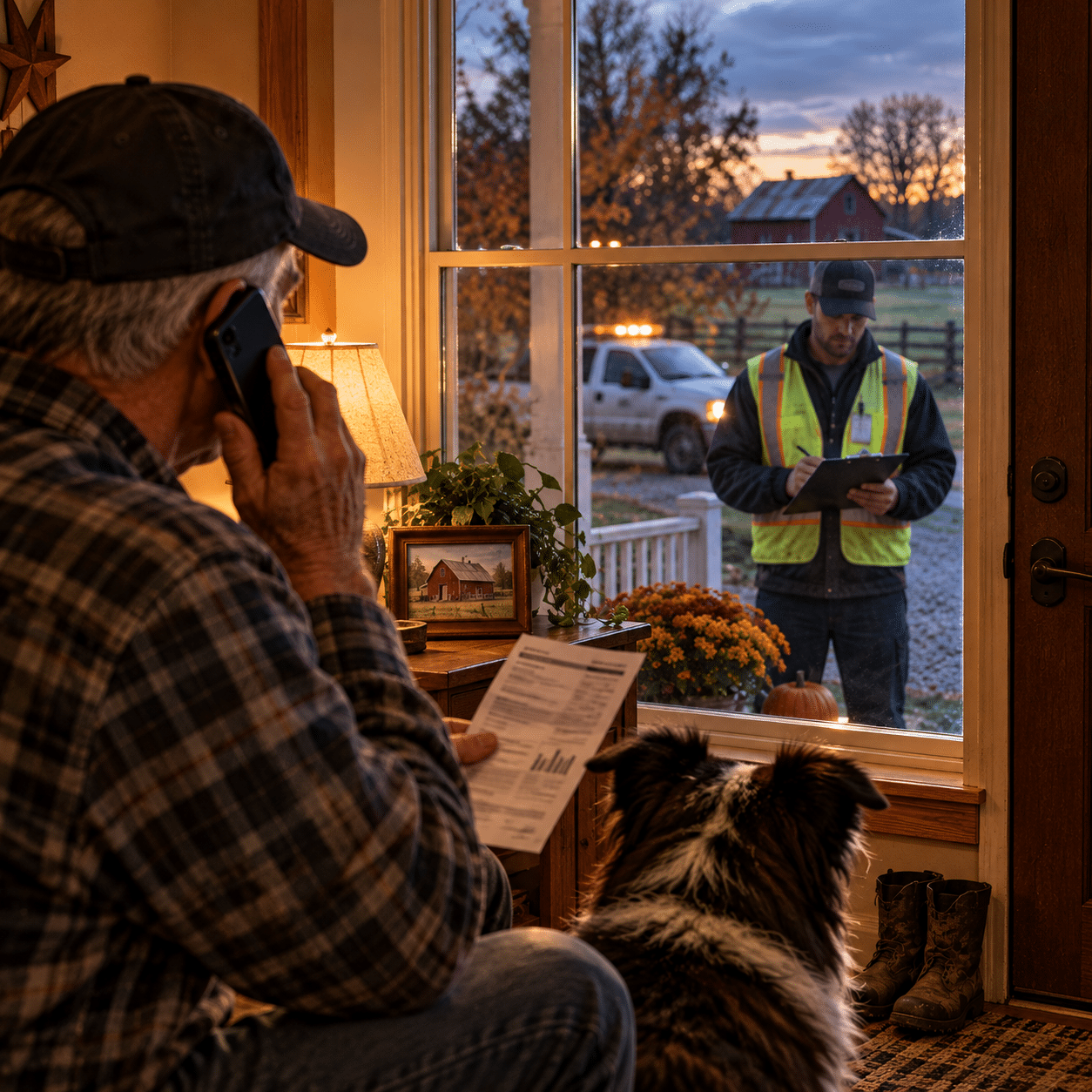
Imagine you’re finishing supper when somebody knocks on the front door.
There’s a man standing outside wearing a reflective vest, carrying a clipboard, and claiming he needs to inspect something connected to your electric service.
You didn’t schedule an inspection, and you haven’t received any notice.
So what do you do?
Simple. Keep the door locked and tell him you’ll contact the utility company yourself.
Then call the number printed on your electric bill or listed on the company’s official website.
Don’t use the telephone number on his business card, and don’t let him pressure you into opening the door while you make the call.
The FTC specifically warns about utility impostors who show up unexpectedly and try to frighten homeowners into immediate action.
A legitimate worker’s identity and reason for visiting can be verified through the company.
And if the fellow gets angry because you want to check?
Well, that’s another good reason to keep the door shut.
2. The Stranger With The Broken-Down Car
Here’s one that can tug at your heartstrings, especially if you were raised in the country.
Somebody knocks and says his car broke down. His phone is dead, he’s stranded, and he needs to borrow yours.
Now, most of us were raised to help people in trouble.
And that’s a good thing.
But being a good neighbor doesn’t require opening your home to somebody you don’t know.
Tell the person you’ll gladly call a tow truck, roadside assistance, or emergency services if needed. Ask for the information through the closed door and make the call yourself.
If it’s bitterly cold or the person appears to be in immediate danger, explain the situation to emergency dispatchers and follow their guidance.
You can still help somebody without putting yourself or your family at unnecessary risk.
Kindness doesn’t require surrendering common sense.
3. The Unexpected Knock From Somebody Wearing A Badge
Now suppose somebody appears at your door claiming to be a police officer.
Maybe he’s wearing a uniform. Maybe he has a badge, or perhaps he says he’s investigating something that happened down the road.
If you weren’t expecting an officer, keep the door closed while you verify who he is.
You can call 9-1-1 when the circumstances warrant it, or contact the police department through its published nonemergency number and ask whether an officer has been sent to your address.
Naturally, don’t interfere with a lawful emergency or police action.
But remember that a badge-shaped piece of metal doesn’t automatically prove somebody is who he claims to be.
And verifying an unexpected visitor’s identity is a sensible precaution, not an insult.
4. The Stranger Who Won’t Take No For An Answer
Finally, there’s the knock that turns into something more troubling.
Maybe the person refuses to identify himself. Perhaps he keeps pounding after you’ve told him to leave, starts trying the doorknob, or walks around toward the back of the house.
That’s when the conversation is over.
Don’t open the door to argue, threaten, or chase him away. Move to a safer location, keep your family together, and call 9-1-1 if you believe someone is attempting to enter or threatening your safety.
The Seattle Police Department’s burglary-prevention guidance recommends calling emergency services when a crime is in progress.
And here’s something else worth considering.
If you’ve got children or grandchildren in the house, make sure they understand that an unexpected knock doesn’t mean they’re supposed to open the door.
Teach them to get an adult instead.
After all, the best home-security habit in the world won’t do much good if your eight-year-old opens the door before you’ve finished counting.
That Little Brass Chain Is Giving You False Confidence
Now we come back to that shiny little piece of hardware hanging beside your front door.
For years, people have treated those brass security chains as though they were miniature bank-vault locks.
Slide the chain into place, open the door a few inches, and everything’s supposed to be fine.
Except there’s a rather serious problem.
A door chain isn’t designed to withstand the kind of force a determined intruder may use.
The Los Angeles Police Department addressed this directly in its personal-security recommendations.
The department warned that small chains connecting doors to their frames can be broken or pulled loose.
And if you’ve ever replaced a door chain, you probably understand why.
Many are attached with short screws driven into relatively thin wood. Depending on the construction, a hard shove can tear the hardware loose or damage the surrounding frame.
But there’s an even bigger problem with relying on a chain.
You have to open the door before that chain becomes your last line of defense.
Think about that.
You’ve taken a perfectly good locked door, pulled it open several inches, and placed your confidence in a little strip of metal and a handful of screws.
All because somebody knocked.
There’s a better way to handle the situation.
And the remarkable thing is that the basic principle was understood long before anybody invented a brass door chain.
Two Crossed Sticks That Worked Better Than A Brass Chain
Let’s return for a moment to the old Plains tipi.
In their book The Indian Tipi, Reginald and Gladys Laubin described traditional customs surrounding the entrance to these homes.
Among those customs was a simple signal.
When two sticks were crossed over a closed tipi entrance, it indicated that the occupants were away or didn’t want visitors.
The sticks weren’t a physical barrier capable of stopping somebody determined to enter.
They were a message.
A historical account of traditional tipi manners preserved by the South Peace Historical Society describes the same custom.
When the entrance was open, friends might enter freely. But when the covering was closed, visitors were expected to announce themselves and wait.
And when those two sticks were crossed over the entrance, the message was stronger still.
Don’t come in.
Of course, those customs worked because the people involved understood and respected them. Two sticks wouldn’t stop a modern criminal any more than a polite sign on your porch would.
But the lesson is still worth its weight in gold.
The people inside had already decided whether they wanted visitors.
They didn’t wait for somebody to appear at the entrance before figuring out what to do.
And that’s the important difference between those crossed sticks and your little brass chain.
The crossed sticks communicated a decision already made. The brass chain tempts you to open the door before making one.
Now, that’s a lesson worth bringing home.
A Few Dollars At The Hardware Store Could Make A Big Difference
While we’re talking about front-door security, there’s another simple improvement worth making this weekend.
And unlike some of those expensive electronic security gadgets, this one doesn’t require a monthly subscription, a smartphone, or an electrician.
All you may need is a handful of longer screws.
You see, the strike plate is that little metal piece attached to the doorframe where your deadbolt slides into place.
In some homes, the screws holding that plate are surprisingly short.
That means the plate may be secured mostly to the wooden doorjamb rather than the stronger framing behind it.
And when somebody kicks a poorly reinforced door, the wood around the strike plate can split apart.
The Seattle Police Department explains this weakness in its official door-security bulletin.
The department recommends replacing short strike-plate and hinge screws with three- to four-inch wood screws that reach into the structural framing.
It also recommends sturdy deadbolts, reinforced strike plates, and properly maintained doorframes.
Now, you’ll want to make sure the screws are appropriate for your particular door and frame. Some doors, especially those with sidelights or unusual construction, may need additional reinforcement or professional attention.
But for many ordinary wooden door frames, properly installed longer screws are a relatively inexpensive improvement.
And while you’re at it, take a good look at the rest of your entryway.
Is the deadbolt working smoothly? Can you see who’s outside without opening the door? Are the porch lights working, and can somebody hide behind an overgrown shrub beside the steps?
Those little things matter.
A good lock, a solid door, proper lighting, and a clear view of the porch can make your home a much harder target.