Print

The Reformers Raised A People Who Could Read… And Then Question Their Preachers
How the men accused of chaining the human mind helped put books into ordinary hands and why the church should remember…
Picture a boy at a rough wooden table, working through a sentence while daylight fades across the floor. His father has chores waiting, his mother has supper to finish, and nobody in that house has time to waste.
Yet somebody insists the boy must learn to read. His soul matters. His work matters. And someday, when a smooth talker opens a Bible or a politician opens his mouth, that boy ought to have something better than a blank stare.
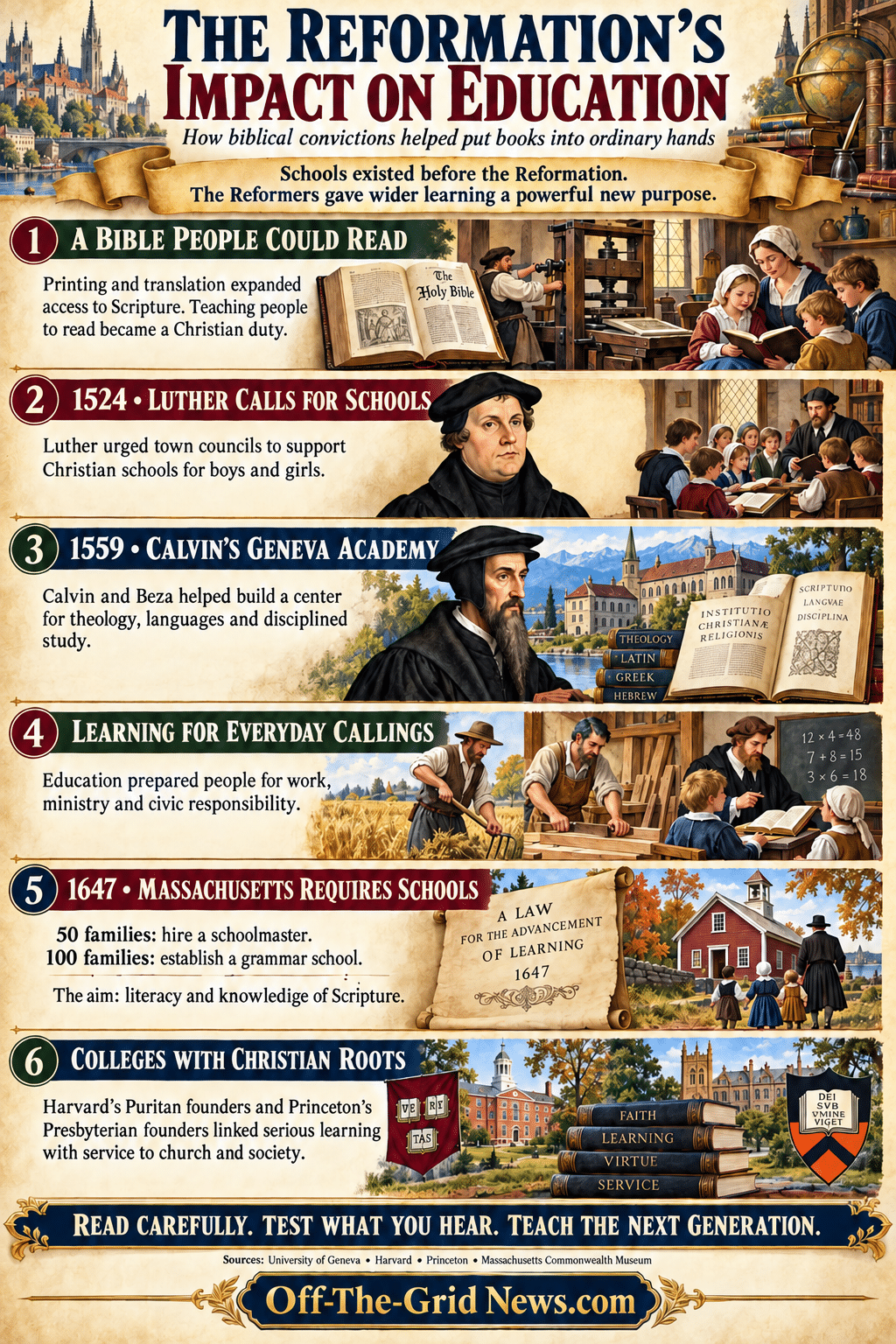
That conviction helped change the Western world. It also grew deep roots in the Protestant Reformation, a movement too often reduced to an argument about predestination or a German monk with a hammer.
The Reformers understood something we are in danger of forgetting these days: theology eventually walks out of the sanctuary and starts building things. Sometimes it builds a school.
The Schoolhouse Had Roots Before Luther
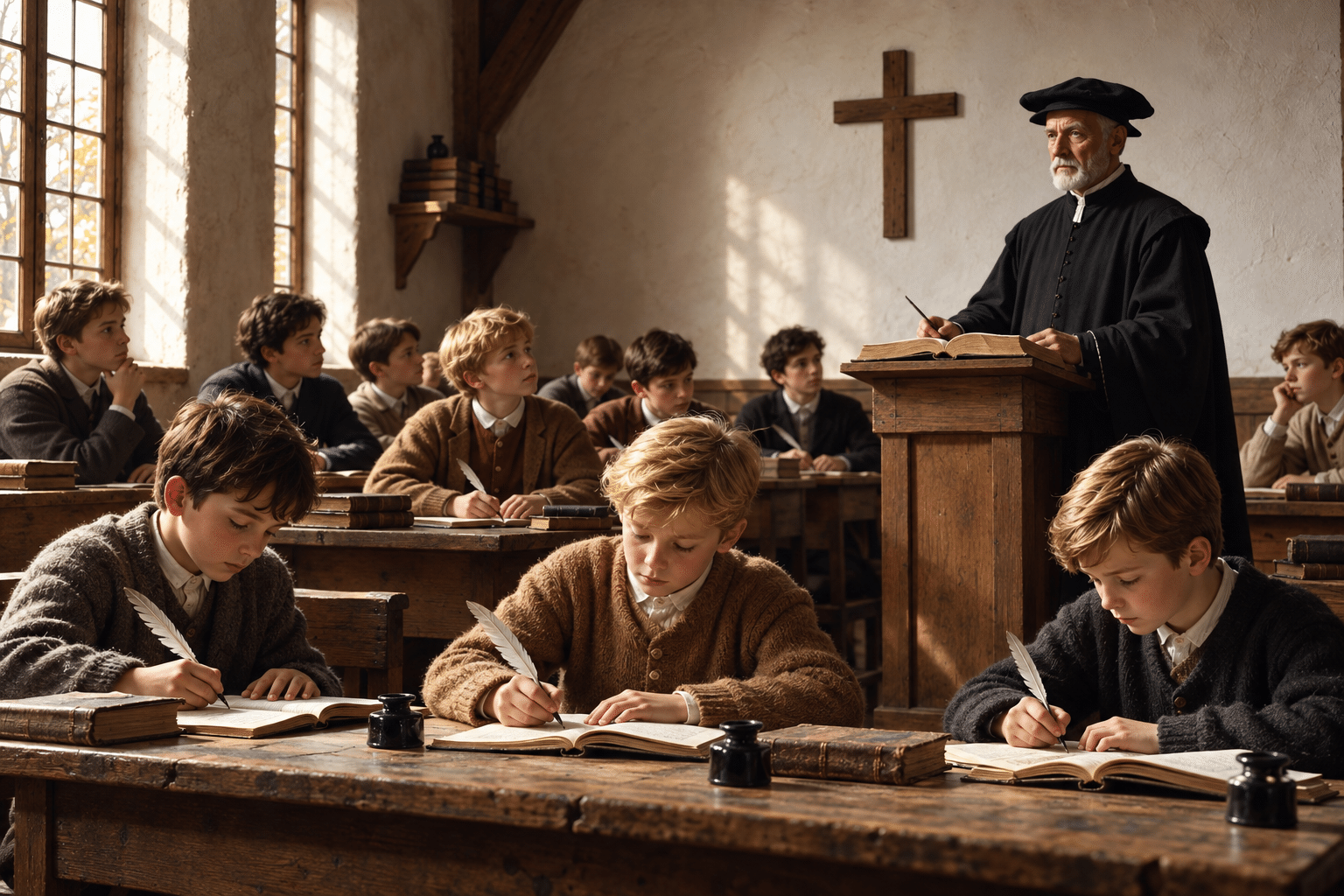 First, let’s clear the brush. Christians did not invent education in 1517, and nobody needs to pretend they did.
Ancient civilizations had schools. Medieval monasteries preserved manuscripts, cathedral schools trained scholars, and universities existed centuries before Luther. Some women received an education before the Reformation, too, although opportunities were sharply unequal.
The real achievement was more powerful than a fairy tale about universal late Medieval darkness. The real key here is that the Reformers helped give wider schooling a compelling theological purpose and pushed churches, households, and governments to take responsibility for it.
If God had given His people a written Word, then leaving ordinary people unable to read it was a serious problem. A Bible on the table meant little to a child who could not decipher the page.
The alphabet suddenly had consequences reaching into eternity.
A Bible in the House Changed the Assignment
Printing made books more available. Translation brought Scripture into familiar speech. Reformation preaching supplied an urgent reason to open the book.
Together, those developments helped turn literacy from a useful accomplishment into a religious obligation. Fathers and mothers were expected to teach the faith, and believers needed the tools to examine what they heard.
That principle has teeth. Acts 17:11 commends the Bereans for searching the Scriptures to test apostolic preaching. If even Paul’s teaching could be examined against God’s Word, the fellow behind your church’s microphone should survive a few honest questions.
The fact is, a congregation that can read carefully is harder to bluff. It can follow an argument, notice a missing verse, and distinguish what the text says from what a confident speaker wishes it said.
That is a powerful reason to teach a child his letters.
Luther Wanted School Desks as Well as Church Reform
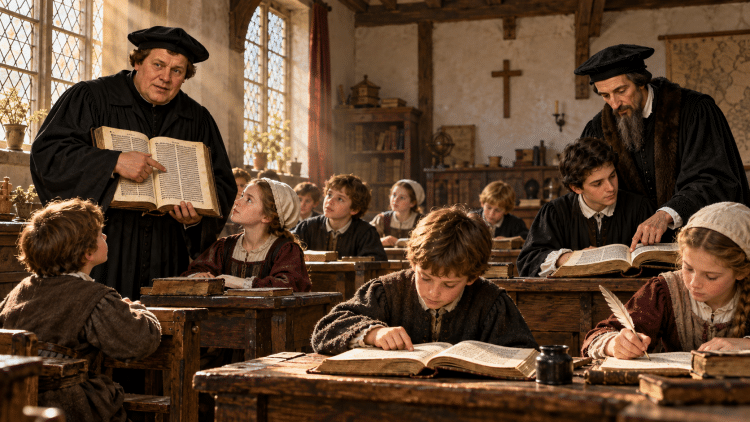
In 1524, Martin Luther appealed to German town councils to establish and maintain Christian schools. His concern extended to boys and girls, and to the community’s need for educated people capable of carrying public responsibilities.
The Lutheran School of Theology at Chicago’s account of the document also records an awkward fact: the breakup of religious orders had disrupted existing education. Luther was responding to damage as well as pursuing reform.
He challenged parents who preferred a child’s immediate earnings to the longer benefit of schooling. Anyone who has watched a family struggle through planting or harvest can understand the pressure. Luther nevertheless insisted that tomorrow’s needs deserved a place at today’s table.
He also appealed directly to civic authorities to support education. His program assumed that schools should serve Christian truth and the common good.
His faith demanded practical arrangements: teachers, money, books, and time away from work. An educational vision that never gets beyond a sermon illustration leaves the children exactly where they started.
Calvin Built More Than a Reputation for Being Stern
Then consider John Calvin. People who know little else about him often picture a grim man policing everybody’s pleasures. They should spend a moment looking at his school.
In 1559, Calvin helped establish the Geneva Academy, with Theodore Beza as its first rector. The University of Geneva traces its own beginnings to that institution.
Its educational design joined preparatory schooling to advanced learning. The university’s theological faculty history explains that Calvin envisioned preparation for both church ministry and civil government, with instruction embracing theology, biblical languages, classical authors, logic, rhetoric, and philosophy.
Here was serious Christian scholarship taking institutional shape. Reading Scripture required linguistic care. Training leaders required disciplined thought. Teaching the next generation required more than good intentions and a stack of inspirational leaflets.
The Academy drew students into a city that became an influential center of Reformed learning. Its story belongs in any fair account of the educational inheritance carried by Protestant Europe.
Bottom Line: this strong Christian conviction built an institution devoted to demanding study.
Your Son Might Become a Farmer and Still Need a Mind
Now, behind that educational ambition stood the doctrine of vocation. A lawful calling could honor God whether a man preached a sermon, kept accounts, practiced law, or worked the soil.
That belief gave learning a purpose beyond producing more clergymen. Communities needed competent people doing ordinary work faithfully.
A farmer benefits from arithmetic, observation, and a working knowledge of the natural world. A carpenter needs accurate measurements. A citizen needs enough history and judgment to recognize an old swindle wearing a new necktie.
For the homesteader, this should feel familiar. The garden punishes careless observation, and the ledger exposes wishful thinking. God’s world gives us good reasons to pay attention.
Christian education, understood that way, trains up a person for responsibility. Further, it should produce people who can read a difficult paragraph and also recognize when the fence needs fixing.
The Puritans Put Their Convictions into Law
Across the Atlantic, the connection between Scripture and schooling became explicit. In 1647, Massachusetts passed the measure remembered as the Old Deluder Satan Law.
The Commonwealth Museum describes its requirements: towns of fifty families had to hire a schoolmaster; those with a hundred had to establish a grammar school. The underlying concern was that ignorance of Scripture left people vulnerable to deception.
Seriously, read the law itself; the motive is unmistakable. Learning mattered to both church and commonwealth, and communities were expected to make provision for it.
The legislation demolishes the notion that schooling emerged only when Americans finally escaped their religious convictions.
In this case, religious convictions put the schoolmaster on the payroll.
Harvard Was Worried About Ignorant Preachers
Harvard’s beginnings make the point just as plainly. Founded in 1636, the college belonged to a Puritan project that treated scholarship as essential to the church’s future. My wife’s family (on her grandfather’s side) provided some of the property that went to John Harvard for the college, so the story is of great interest to me.
Harvard Divinity School preserves the founders’ explanation: they feared leaving an uneducated ministry when their existing ministers died. Serious preparation for religious leadership stood near the institution’s foundation.
Later, Presbyterian founders established the College of New Jersey, now Princeton. Its own historical account describes a purpose encompassing ministers and other learned professions, with service to church and society closely connected.
These institutions drew on multiple educational traditions. Their histories nevertheless make one thing clear: Protestant theology was a builder of higher learning. The people responsible expected faith to demand intellectual work.
The Inheritance Waiting at Your Kitchen Table
So here is some off-the-grid theology worth carrying home: teaching your kids to read is an act of Christian stewardship with consequences extending far beyond that child’s report card.
The Reformers’ achievement challenges a church content to entertain children while somebody else forms their understanding of the world. It challenges parents who want strong convictions without the patient work of teaching, listening, correcting, and reading together.
A congregation can help struggling readers. It can support teachers, assist families with school costs, and put worthwhile books into young hands. A grandfather can sit beside a grandson and work through a page instead of handing him another screen.
Those are modest acts. So is planting an acorn.
We inherited a belief that ordinary children deserve serious learning. Reformation Christians helped deepen that conviction and gave it schools, books, teachers, and enduring institutions.
Honor them by taking up the work. Pull a chair to the kitchen table, open a good book, and help the next generation understand what it reads.
A child who learns to handle words carefully will grow into an adult who is harder to deceive. That is a harvest worth working for.