 Print

Can Something You Already Have In Your Pantry Help Your Aching Shoulder?
What Tendon Studies… Exercise… And Experimental Peptides Can Really Tell You About Avoiding Shoulder Surgery
Maybe it happened while you were heaving a feed sack into the pickup. Maybe you wrangled a frozen gate that had no intention of opening. Either way, your shoulder barked, and now pulling on a coat feels like a wrestling match you can’t win.
Then comes the MRI and three unwelcome words: torn rotator cuff. Suddenly, you’re picturing a sling, unfinished chores, and somebody else stacking the firewood while you supervise from the porch.
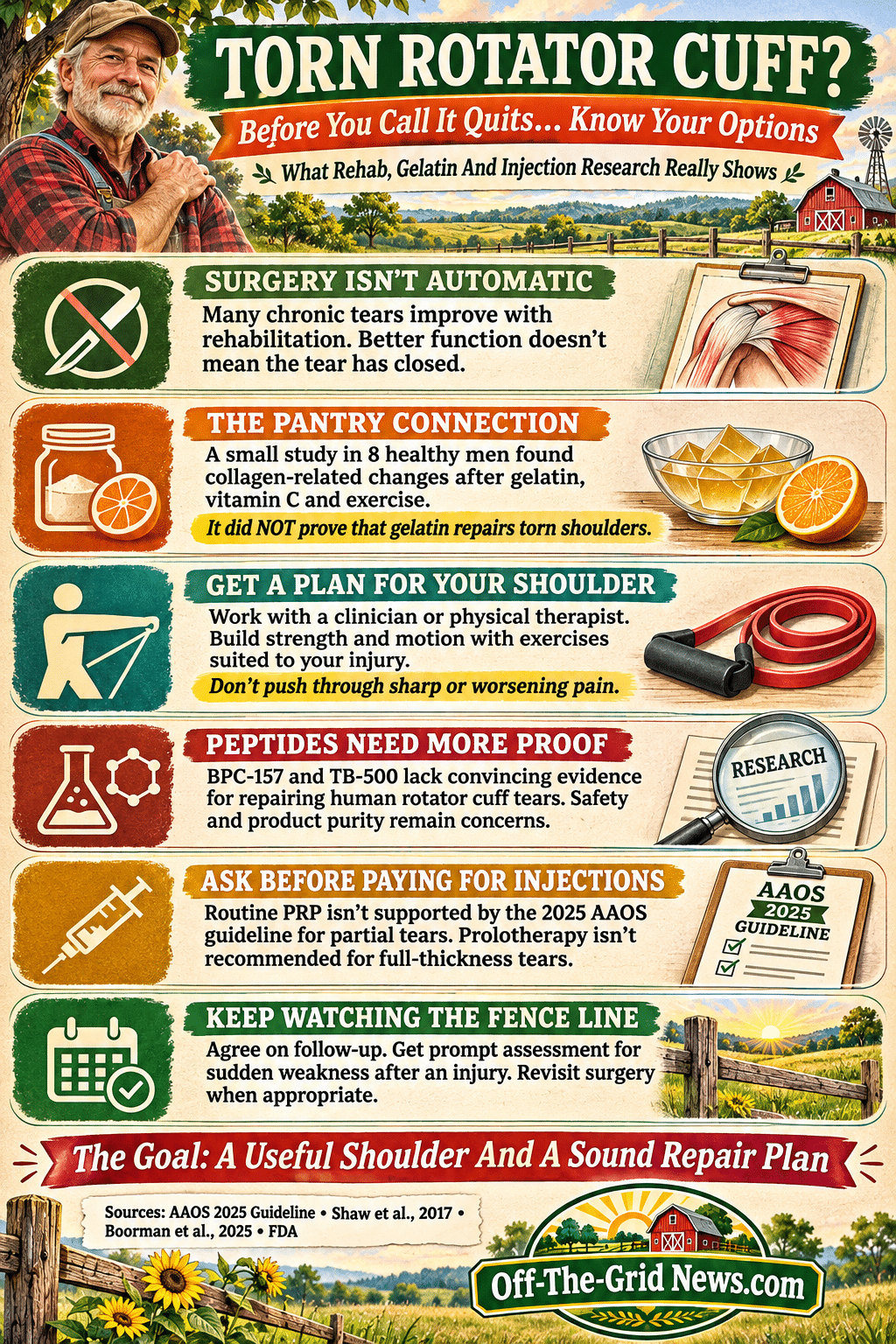
Now, hold on before you surrender the work gloves. Many people can get meaningful relief without surgery, and some keep doing well for years. The crucial part is sorting out which research belongs in your repair plan and which promises are running ahead of the evidence.
There’s encouraging news here. There’s also a mighty big difference between getting a shoulder working better and knitting a torn tendon back onto the bone. Gelatin, exercise, and experimental peptides don’t all have the same evidence behind them, no matter how confidently somebody sells the story.

A Torn Tendon Doesn’t Automatically Mean an Operation
First, check out a Canadian study of chronic full-thickness rotator cuff tears. After a three-month nonsurgical program, 75 percent of participants initially did well enough to avoid surgery. These weren’t imaginary injuries or a little soreness after splitting wood… their tears had been confirmed with medical imaging.
Better yet, the researchers found lasting benefit among many who responded. Only two patients who were doing well at five years later crossed over to surgery during the long-term follow-up. However, the final quality-of-life scores came from just 41 respondents, so the results deserve some breathing room rather than a blanket promise.
Also, this wasn’t proof that the tendons had grown back together. The study tracked how patients felt and functioned, and it focused on chronic tears. You can’t take its reassuring findings and automatically apply them to a fresh injury that suddenly leaves you unable to raise your arm.
Still, that’s valuable news for a working homesteader. An MRI finding can start a conversation about options; it doesn’t have to end the conversation before you’ve asked a single question.
Know Whether You Have a Frayed Rope or a Broken Connection
Think of your rotator cuff as the small crew that steadies and moves your shoulder. According to the American Academy of Orthopaedic Surgeons patient guide, a partial tear leaves some tendon attached, while a full-thickness tear involves detachment through the tendon’s thickness. The size and extent still matter.
So does how it happened. A shoulder that’s gradually complained for years is a different proposition from one that quit working after yesterday’s fall. Significant weakness, a large tear, or a recent traumatic injury can change the discussion about surgery.
That’s why the first job is to pinpoint what you’re dealing with through a proper assessment. Tell the clinician what you actually need that arm to do: carry water, run a saw, lift a grandchild, or reach the shelf above the stove. Those details matter more than a vague promise that you’ll be able to resume “normal activity.”
Around a homestead, normal activity covers a lot of territory.
Gelatin Has Very Interesting Research Behind It
Now, let’s clear away the fog around that pantry ingredient. In a small 2017 randomized crossover study, eight healthy men received placebo or vitamin C-enriched gelatin, including a 15-gram dose, before brief rope-skipping sessions. The drink contained about 48 milligrams of vitamin C, and exercise began an hour later.
The gelatin increased circulating amino acids used in collagen. Researchers also found an increase in a blood marker associated with collagen formation, and serum from participants supported collagen production in laboratory-grown ligaments. Those are interesting clues about nutrition and connective tissue.
However, nobody in that experiment was getting a torn rotator cuff completely repaired. A blood marker doesn’t tell us whether a detached shoulder tendon reattached, and a laboratory ligament isn’t a farmer trying to get through chores. The findings don’t establish that gelatin heals shoulder tears or prevents surgery.
Here are the cold, hard facts in plain English: researchers saw something worth studying further. They didn’t discover a grocery-store substitute for a surgical repair.
Keep the Pantry Experiment in Its Proper Place
Naturally, a cheap ingredient catches the eye when the alternative might involve an operating room. There’s nothing foolish about asking whether food can support recovery. The trouble starts when “might help” gets promoted to “will fix it.” That shortcut can leave you with false confidence and a shoulder that still won’t cooperate.
Even so, if you’re curious about gelatin, take the actual study to your clinician or a registered dietitian. Ask whether trying it makes sense alongside your rehabilitation and ordinary meals. That conversation is more useful than copying a recipe from somebody who’s selling a supplement tub.
Also, measure grams rather than assuming every envelope holds the same amount. The research dose isn’t a universal prescription, and repeating the drink three times daily hasn’t been established as an effective treatment for a torn cuff. Don’t turn a small experiment into a mandatory kitchen ritual.
Most of all, keep an open mind and your expectations honest. You can be interested in a low-cost idea without asking it to carry more weight than the evidence can bear. A sack marked “seed” still needs to contain something that grows.
Your Shoulder Needs a Sensible Work Order
Meanwhile, rehabilitation deserves the attention that miracle-cure advertisements usually steal. The AAOS shoulder conditioning program explains that strengthening the muscles supporting the shoulder can improve stability, while appropriate stretching helps restore motion. It also says the exercises should be selected with a doctor or physical therapist.
In practice, that means getting a plan tailored to your shoulder, with instructions you can follow: which movements, how much resistance, how many repetitions, and when to progress. You also need to know what to stop doing for now. “Exercise your shoulder” is about as helpful as telling somebody with a stalled tractor to “work on the engine.”
Here’s a trap to avoid: don’t borrow a pain threshold from a general tendon article and treat it as permission to push through a torn shoulder. AAOS advises against ignoring pain during its conditioning exercises. Ask your therapist what symptoms should mean stop, adjust, or call.
For that matter, don’t count hauling another load of feed as your rehabilitation session. Chores arrive on the livestock’s schedule, not your shoulder’s. A controlled exercise gives you a chance to manage the demand rather than letting an awkward load make the decision.
Feeling Better Is Good News but Keep Watching the Fence Line
The 2025 AAOS clinical practice guideline reports that both physical therapy and surgery can improve outcomes for symptomatic small-to-medium full-thickness tears. It also warns that tear size, muscle wasting, and fatty changes can progress over five to ten years with nonsurgical treatment. Healed surgical repairs can provide better outcomes than physical therapy or repairs that don’t heal.
In other words, avoiding surgery can be a reasonable choice, but it needs follow-up. Feeling better doesn’t guarantee the underlying tear is unchanged. Decide with your clinician when to reassess and whether repeat imaging would change the plan, rather than assuming everybody needs another MRI at exactly three months.
Think of it like a gatepost that’s leaning. You might keep the gate working by adjusting the hinges, but you’d still want to know whether the post was moving. Function and structure are related questions, not interchangeable ones.
Peptide Promises Are Far Ahead of Proven Shoulder Results
Next come BPC-157 and TB-500, names that sound more like tractor parts than anything you’d put in your body. Online discussions can make them sound like a secret weapon against every stubborn tendon problem. But be assured… that thousands of anecdotal reports do have value.
Now, animal findings can help scientists decide what to test. They can’t establish that a product will safely restore a person’s torn rotator cuff. An impressive rat experiment is a research lead, not a claim for a 100% restoration. But keep reading…
There’s a registered University of Arkansas for Medical Sciences pilot study of BPC-157 after rotator cuff repair. The registration describes daily injections for 90 days after surgery and assessment of healing and recovery. The record lists an estimated January 2027 start; so the research is on the way.
Important: take a closer look at the phrase “after surgery.” Even a successful result would answer a question about supporting a surgical repair, not prove that BPC-157 can replace one. A trial registration describes a plan to gather evidence; it doesn’t supply the evidence in advance.
Meanwhile, the FDA identifies safety concerns for BPC-157 and the thymosin beta-4 fragment called TB-500. These include potential immune reactions, peptide impurities, and inadequate safety information. “Research use only” on a vial doesn’t prove or disprove the efficacy of the peptide.
Before Paying for Injections…
What about platelet-rich plasma, or PRP, made from your own blood? It’s been studied in people, but that doesn’t make it a proven way to close a torn tendon. Ask whether a proposed treatment aims to reduce pain, improve function, or change healing; those are different claims.
The 2025 orthopedic guideline doesn’t support routine PRP for rotator cuff tendinopathy or partial tears, and it says routine nonsurgical PRP for full-thickness tears may not be indicated. It also recommends against prolotherapy for full-thickness tears. A single corticosteroid injection may offer short-term pain and function improvement, but it doesn’t repair the tear.
Before you open your wallet, demand a plain-English explanation of what benefit is realistic, how long it might last, and whether it helps you participate in rehabilitation. Your shoulder deserves a treatment plan, not a string of expensive guesses.
Make a Plan That Gets You Back to Your Own Chores
First, start by asking what kind of tear you have and whether a nonsurgical trial is appropriate. Then get a rehabilitation plan with a clear follow-up date. Keep a little notebook of practical changes: sleep, dressing, reaching, and the chores you’ve agreed are safe.
If gelatin interests you, discuss it as an optional addition rather than the foundation of the whole project. Keep experimental peptides in the research category. And if your shoulder suddenly loses strength after an injury, get it assessed promptly instead of spending weeks trying pantry remedies.
Finally, don’t let pride steer you onto the wrong track by making “no surgery” the goal. The goal is a useful shoulder and a good decision while your options are still open. Sometimes careful rehabilitation gets you there; sometimes an operation earns its place.
You don’t have to hang up your work gloves just because an MRI shows a tear. But the way back calls for the same judgment you use everywhere else on the homestead: inspect the damage, choose the right repair, and don’t let a smooth sales pitch do your thinking. You’ve got chores waiting and no spare shoulder hanging in the tool shed.