 Print
Print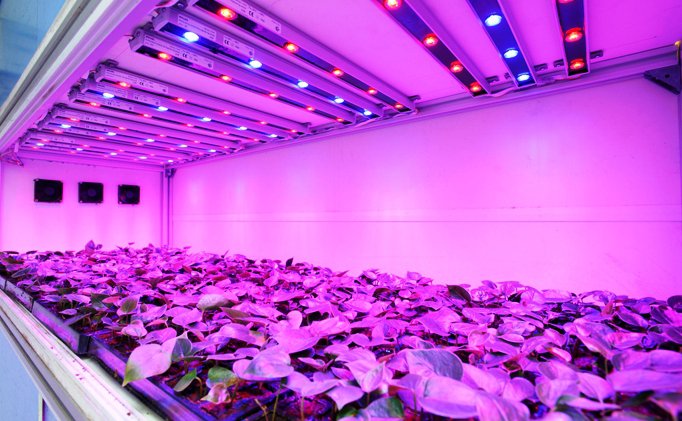
One of the most important considerations for indoor gardening is light. While some vegetables will chug along with a bare minimum of six hours of light daily, they will flourish with 12-16 hours daily. Clearly, grow lights are a must, especially during winter. However, one of the most common mistakes among indoors gardeners is using the wrong type of light.
Red, Blue, And Full-Spectrum Light
Let’s start by talking about the color in light. We perceive sunshine, for instance, as white light, but it’s actually made up of all the colors of the rainbow — it’s full-spectrum. Light bulbs don’t generate light the same way that the sun does, and the color of light they produce often appears as off-white. Traditional incandescent bulbs, for instance, give off a yellow-red glow, whereas basic fluorescent tubes often have a blue glow.
Looking For Non-GMO Vegetable Seeds? Get Them From A Company You Can Trust!
Plants have different reactions to the different colors within light. Blue light encourages the growth of strong leafy plants, while red light helps plants flower and fruit. It helps to understand how plants react to red and blue light in order to choose the best grow lights for your indoor garden.
Fluorescent Grow Lights
Not that long ago, basic fluorescent tubes were the only real option for grow lights, and many gardeners still swear by them. They are inexpensive, easy to install, and energy efficient. And, with the advent of compact fluorescent light (CFL) bulbs, installation is easier than ever, since you can simply screw a bulb into any existing light fixture.
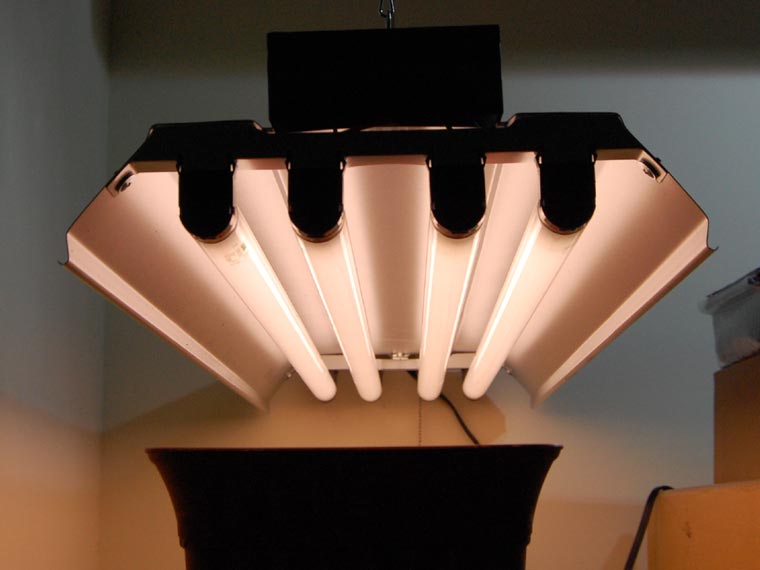
Fluorescent bulbs come in warm (red), cool (blue), and full-spectrum ranges. The light that fluorescents produce is relatively weak, but there are also high-intensity fluorescent bulbs if needed. Full-spectrum and high-intensity fluorescent bulbs are more expensive than basic ones, but they may end up being more cost-effective.
LED Grow Lights
Light emitting diodes (LED) bulbs have a lot of potential for grow lights, but they are not yet widely used. Like many technologies in their infancies, they are relatively expensive, although their cost is coming down. Keep your eye on LED grow lights because they have a lot of benefits, including having a long life and being energy efficient, and emitting little heat. Also, they can be programmed to produce specific wavelengths of light.
HID Grow Lights
There are two types of high-intensity discharge (HID) bulbs, both of which produce bright and intense light. Metal halide (MH) bulbs emit light that is quite similar to natural sunlight, without generating a lot of heat. However, they do tend to the blue end of the spectrum, and depending on the type of bulb used, you may need to supplement with high-pressure sodium (HPS) lighting, which emits red light. HPS bulbs are excellent to promote flowering and fruiting. However, both types of HID bulbs can only be used in special fixtures, with ballasts, and the complete set-up can be expensive.
Your Grow Light Set-Up
Indoor gardening requires light, but that light must be cool. The heat created by incandescent and halogen bulbs is too intense and will fry your seedlings. Stick with fluorescent, LED or HID lighting.
Consider where the grow lights will be placed in your house. If your plants are already getting a great deal of light from a south-facing window, then weaker bulbs (like basic fluorescents) will work fine as supplementary lighting. If your plants are in a darker area of your home, you will need more powerful grow lights, like high-intensity fluorescent or HID bulbs.
The distance between your plants and your light source depends on what kind of bulbs you use. Since fluorescents are weaker, they can be placed only 2-3 inches from your plants; but LEDs should be 12-18 inches away. Either way, you will need to adjust the height of your grow lights as your plants get taller. Don’t count on keeping the position of your lights static. Seedlings will grow tall and spindly, without putting out leaves, if they need to stretch toward a far-away light source; and, of course, you don’t want them to touch the bulb.
The most complicated part of creating a grow light system is figuring out how big — in terms of wattage — it needs to be. It’s not just about the square footage of your growing space, but also about the type of light you’re using and what you’re growing. You will need a higher wattage if you’re using weaker bulbs, or are growing light-loving plants. Lettuce, for instance, needs less light than tomatoes do. While it’s tempting to just go with a higher wattage to cover all contingencies, that can have a negative effect on your energy consumption. There are all kinds of online guides that can help you figure out how to tailor your wattage to your plants.
Grow lights aren’t rocket science, but they aren’t a trip to the candy store, either. To effectively use grow lights, it helps greatly to have some understanding of how plants react to light, and of the available bulb options. Once you have that knowledge, you can optimize your own grow light set-up so that it best suits your needs.
What advice would you add on using grow lights? Share your tips in the section below:
Bust Inflation With A Low-Cost, High-Production Garden. Read More Here.