 Print
Print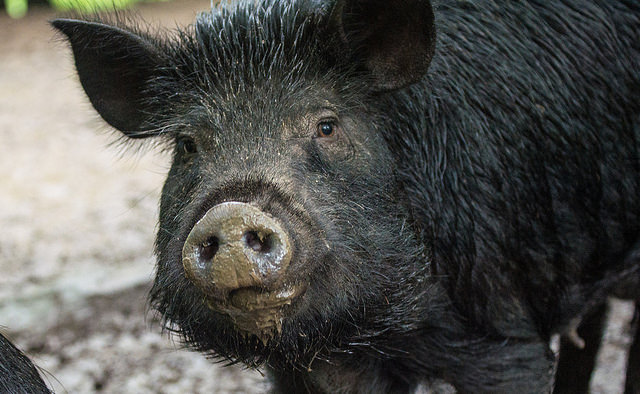
If you’re thinking about raising a couple of hogs for your family’s freezer, the first place to start is by deciding on the type of pig you want.
Heritage hogs and commercial meat hogs are distinctly different in many ways. Depending upon your space constraints, budget, timeline and individual beliefs you may find one better than the other. Heritage hogs are more self-sufficient but slower to grow. Meat hogs are fast growers but require more maintenance. And when it comes to the quality of the meat, it’s like comparing apples to oranges.
Heritage animals were bred by our colonial forefathers to adapt well to the local environment with little maintenance. In America, common breeds include Choctaw, Guinea Hog, Mulefood, Ossabaw Island and Gloucester Old Spot. These breeds were developed to exhibit better foraging abilities, longevity, maternal instincts, and resistance to disease and parasites when compared to selectively bred commercial breeds.
Here’s four traits of heritage hogs you need to know:
1. Heritage hogs are cheaper to feed (but need more space). You can set a heritage hog loose on acres of pasture and allow it to forage for the bulk of its diet, saving you tons in feed costs. But this means it must have permanent access to pasture. This is the first, and largest, discrepancy between the two types of hogs. How much space are you willing to dedicate as “hog land?” Heritage hogs were developed to fend for themselves on open land.
Diatomaceous Earth: The All-Natural Livestock De-Wormer!
For a small farm without an acre to spare for hog pasture, heritage breeds may not be the right choice. Commercial hogs that were developed to thrive in very small spaces get by perfectly well on as little as 20 square feet of space per hog. These breeds include Duroc, Hampshire, Yorkshire and Landraces. They will do just fine on dirt; however, these types of hogs need access to commercial hog feed 24/7 to meet their growing potential.
2. Heritage hogs are heartier. Not only are heritage breeds raised more humanely than your standard commercial CAFO pig, but they are also much more hearty. Thanks to their DNA, heritage breeds are naturally resistant to a variety of diseases and parasites. They are able to adapt to their environment without any help from you. You won’t ever have to juice up your Old Spots with antibiotics or growth hormones. Nor will you have to give them regular de-wormer. While commercial-breed hogs may not specifically require antibiotics or other medications, they are more susceptible to disease and parasites than heritage hogs. They also don’t deal as well with extreme weather conditions.
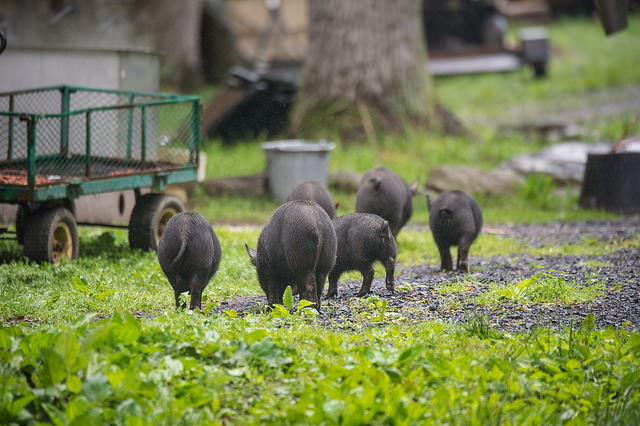
3. Heritage pork is more flavorful. When you think about the pork you will get as a reward in the end, a big factor is the taste you want. Commercial-type hogs have a leaner carcass, producing a light pink meat and little lard. This is the classic “supermarket” pork taste that so many people are accustomed to and may prefer. However, darker heritage pork has a more full, complex flavor; it is well-marbled with fat, meaning it is more juicy and tender. Like all grass-fed meat, heritage pork is also healthier for you. It is higher in good fatty acids, beta carotene, and vitamins D and E.
Learn How To Make Powerful Herbal Medicines, Right in Your Kitchen!
Of course, not everything about heritage hogs is great. Let’s examine the one negative.
Caveat: They’re Slow Growers
Though the cost of feeding commercial hogs might seem daunting, remember that you will only be feeding them for a matter of months. Commercial hogs are bred for fast growth and good feed efficiency. A 50-pound feeder hog can reach market weight in as little as 100 days. If you are looking for some farm-raised meat and needing it fast, commercial hogs are the way to go. This is especially beneficial if you don’t like having hogs around full-time. Raise a couple of Hampshire-Durocs from August to November and have a pork-filled freezer and pig-free yard until next summer.
Though some heritage breeds mature faster, most take over a year to reach a weight worth taking to the butcher, some even longer. This is due in part to their genetics makeup and in part to their diet. If you are supplementing your heritage hogs with commercial feed, you may be feeding them more than a commercial hog in the long run.
As far as temperament goes, it can be a toss-up. Both types have more docile and more aggressive breeds. If you are looking for a pig with personality, Guinea Hogs can be real sweethearts. However, you may find raising pigs you’ve bonded with a big drawback when it’s time to hit the butcher’s block. Ultimately, if you want some quick, low-cost pork you raised yourself, then crossbreed commercial hogs are the way to go. If you want to preserve an environmentally sustainable breed that practically cares for itself, get a heritage hog.
What is your favorite type of hog? Share your advice in the section below:
Discover The Secret To Saving Thousands At The Grocery Store. Read More Here.