 Print
Print
Your Gray Hair Isn’t Just A Sign Of Getting Older… It’s A Record Of The Years You’ve Lived, The Storms You’ve Weathered, And A Biblical Honor Our Culture Has Nearly Forgotten
There’s a good chance the first gray hair you spotted wasn’t sitting proudly on top of your head. It was hiding somewhere around your temples, just above your ears, or perhaps sneaking into your beard like an uninvited guest at Sunday dinner.
Then another showed up, followed by another. Before long, the fellow looking back at you from the bathroom mirror had a little more frost around the edges than he remembered.
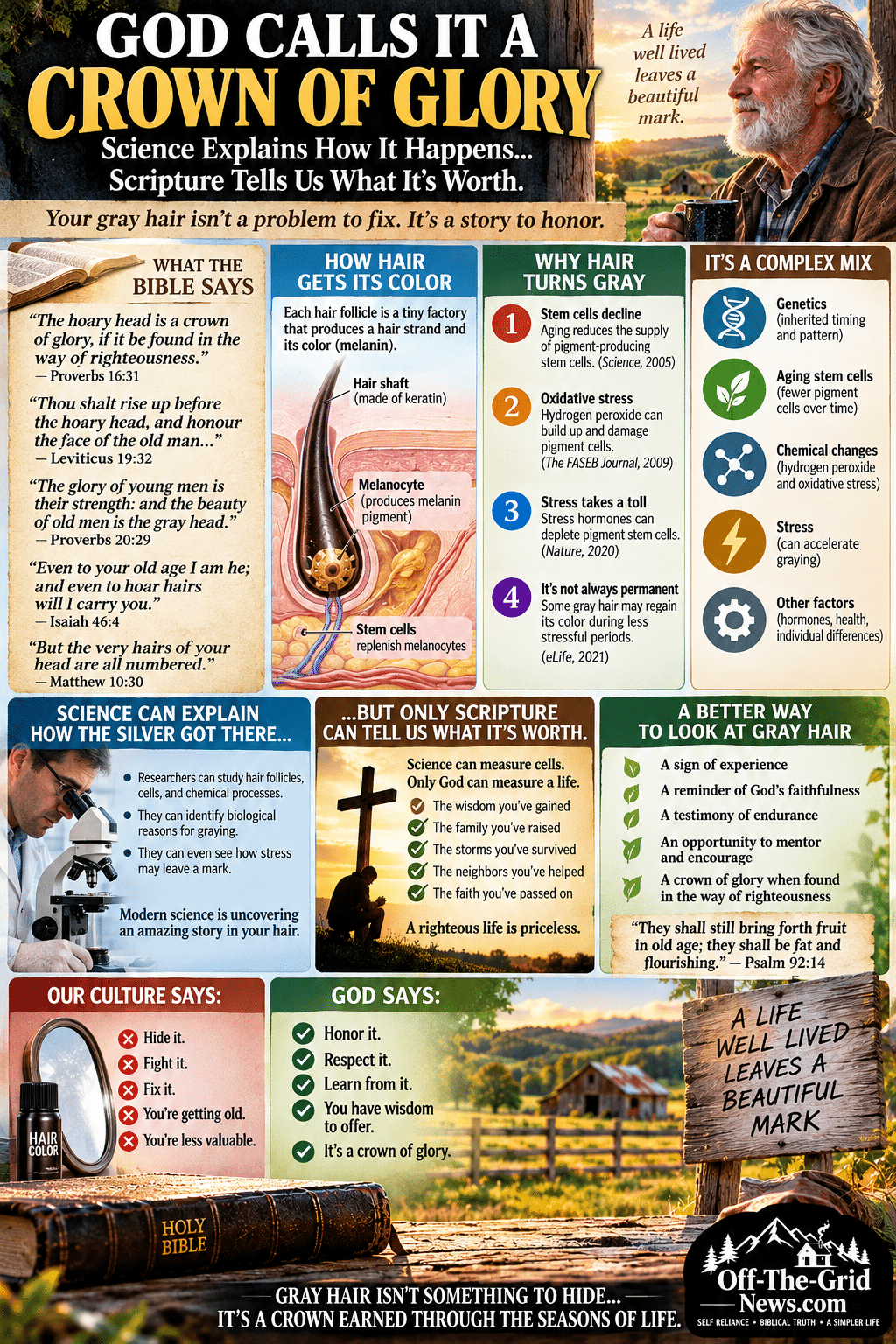
Funny thing is, your hair wasn’t simply turning gray at random. Every follicle on your head has its own biological machinery, its own supply of pigment-producing cells, and its own timetable for growing old.
And scientists are discovering that the silver creeping across your scalp may tell a surprisingly interesting story about your body.
But here’s the part that ought to make us stop and think.
The very thing modern America spends a fortune trying to cover up is something the Bible calls a crown of glory.
When God Sees A Gray Head… He Doesn’t See Something That Needs Fixing

Long before somebody invented hair dye, anti-aging creams, and television commercials promising to make sixty look like thirty, God gave Israel a remarkable command. In Leviticus 19:32, He said:
“Thou shalt rise up before the hoary head, and honour the face of the old man, and fear thy God: I am the LORD.”
Now, don’t miss what God is saying here. When an elderly person enters the room, the proper response isn’t to look away, roll your eyes, or wonder whether they’re keeping up with the latest technology.
It’s to show respect.
God doesn’t present honoring the elderly as a nice little social custom, like holding the door open at the feed store. He connects it directly to fearing Him, and then finishes with those unmistakable words: “I am the LORD.”
In other words, how we treat the old folks says something about how seriously we take God.
Solomon makes the same point in Proverbs 16:31:
“The hoary head is a crown of glory, if it be found in the way of righteousness.”
It’s not a defect, an embarrassment, or something that needs to be hidden beneath a bottle of artificial color.
It’s a crown.
And in Proverbs 20:29, Solomon goes even further: “The glory of young men is their strength: and the beauty of old men is the gray head.”
Young men have their strength, their energy, and their ability to throw hay bales all afternoon without spending the next three days complaining about their backs. Older men have something different: the opportunity to demonstrate wisdom, judgment, and the character that comes from years of living.
That’s why Job 12:12 declares, “With the ancient is wisdom; and in length of days understanding.” And Proverbs 17:6 reminds us that “children’s children are the crown of old men.”
Picture a grandfather sitting on the porch with silver hair, watching his grandchildren chase chickens across the yard. He possesses a kind of wealth that no Wall Street banker can manufacture.
Even Heaven Uses White Hair As A Picture Of Majesty
When Scripture gives us visions of divine glory, white hair appears in some of its most breathtaking descriptions.
In Daniel 7:9, the prophet sees the Ancient of Days seated upon His throne, with the hair of His head “like the pure wool.” And in Revelation 1:14, John describes the glorified Christ with hair “white like wool, as white as snow.”
These are prophetic visions filled with symbolism, not suggestions that God grows old. But the imagery is striking.
The color our culture associates with fading beauty becomes, in Scripture, an image of purity, majesty, and eternal authority.
And for the believer growing older, God offers a promise far more valuable than a younger-looking face. In Isaiah 46:4, He declares, “Even to your old age I am he; and even to hoar hairs will I carry you.”
The God who carried you through childhood, marriage, raising children, good harvests, and lean years hasn’t suddenly decided your usefulness expires when your hair changes color.
He’s still carrying you.
A Gray Head Deserves Respect… But Wisdom Still Matters
Now, Scripture doesn’t teach that everybody becomes wise simply because they’ve survived seventy birthdays. Anybody who’s spent time at a county board meeting knows better than that.
John Calvin recognized the distinction in his commentary on Leviticus 19:32. Older people may undermine their own dignity through foolish behavior, yet age itself remains worthy of the respect God commands.
That’s why Solomon adds those important words: “if it be found in the way of righteousness.”
Years alone don’t make a man righteous. But years spent walking with God, learning from mistakes, keeping promises, and serving neighbors can produce something no young man can acquire overnight.
It’s the difference between an old fence post that’s merely been standing for forty years and one that’s actually held the fence together.
We’ve Built A Culture That Worships Youth… And Treats Old Age Like A Disease
Walk through almost any drugstore and you’ll see what modern America thinks about growing older. Entire shelves are devoted to covering gray hair, smoothing wrinkles, and convincing people that the greatest tragedy in life is looking their actual age.
Meanwhile, the elderly are too often treated like yesterday’s newspaper. Their stories are dismissed, their experience overlooked, and their opinions brushed aside because they haven’t mastered the latest phone application.
Scripture warns us about this upside-down society. In Isaiah 3:5, one description of social disorder is that “the child shall behave himself proudly against the ancient.”
Paul offers a better approach in 1 Timothy 5:1: “Rebuke not an elder, but entreat him as a father.”
You can disagree with an older man without humiliating him. And a society that stops listening to its grandparents may eventually repeat mistakes those grandparents already learned to avoid.
But while Scripture tells us what gray hair ought to mean, science is discovering how it happens.
The Little Pigment Factory Hiding Beneath Your Scalp
Picture a tiny factory operating beneath your skin. Every hair follicle produces a strand made mostly of keratin, while specialized cells called melanocytes supply the pigment that gives it color.
Think of keratin as lumber coming out of a sawmill and melanin as the stain applied before the boards leave the building. When the pigment machinery fails, the follicle can keep producing hair without its familiar color.
Those pigment-producing cells depend on stem cells that replenish them during hair growth. Like seed corn stored in an old barn, that supply must be maintained if you expect another crop.
In a landmark 2005 study published in Science, Emi Nishimura and colleagues demonstrated how failures in maintaining these stem cells contribute to graying.
The factory hasn’t necessarily shut down. It’s still producing hair, but the crew responsible for adding color is disappearing.
Why The Gray Often Shows Up Around Your Temples First
For plenty of folks, the silver first appears around the temples or sideburns before spreading elsewhere. Others notice it in their beards or scattered across the crown.
Scientists know follicles in different scalp regions behave differently, but they haven’t conclusively established one explanation for the familiar temple-first pattern.
Genetics plays a major role in when graying begins and how quickly it progresses. So if your father resembled a snow-covered fence post at forty-five, don’t be surprised when your temples follow the family tradition.
But genetics isn’t the whole story.
Your Hair Follicles May Be Producing Their Own Bleach
Here’s a strange twist. The biological environment responsible for hair pigmentation can also accumulate chemicals that interfere with pigment production.
One of those chemicals is hydrogen peroxide, the same basic compound found in Grandma’s brown medicine bottle.
Normally, protective enzymes, including catalase, help break down hydrogen peroxide. But as follicles age, oxidative stress can interfere with the cells and enzymes responsible for maintaining color.
In a 2009 study published in The FASEB Journal, researchers found elevated hydrogen peroxide in gray and white human hair, along with reduced protective enzyme activity.
Imagine an old tractor slowly accumulating corrosive material inside its machinery. It may keep running, but eventually the damage interferes with its work.
Part of the machinery that helps make your hair beautiful can also participate in the chemistry that eventually steals its color.
Can A Hard Life Really Turn Your Hair Gray?
You’ve probably heard somebody say a difficult year turned their hair gray. Maybe you’ve said it yourself after a bad harvest, a family crisis, or months when the bills arrived faster than the money.
Scientists have discovered a mechanism that may help explain that old saying.
In a 2020 study published in Nature, researchers discovered that stress activated sympathetic nerves in mice, releasing norepinephrine that depleted pigment-producing stem cells.
That’s the same nervous system that prepares you to react when a bull breaks through the fence or a tractor starts rolling downhill.
Researchers found that blocking the relevant nerve activity or cellular response prevented stress-induced pigment loss in the mice. Human hair follicles differ, so these experiments don’t establish that every stressful experience causes human hair to turn gray.
Nevertheless, the discovery offers a plausible explanation for something people have observed for generations.
Sometimes the hard years really do leave their mark where everybody can see it.
The Most Surprising Discovery: Some Gray Hair Can Regain Its Color
For years, conventional wisdom held that once a hair turned gray, its color was gone for good. But researchers have discovered that the process isn’t always permanent.
In a 2021 study published in eLife, scientists examined individual human hairs and measured pigmentation changes along their lengths.
Like reading growth rings inside an old oak tree, they could reconstruct periods when a follicle produced more or less pigment.
Then they compared those changes with participants’ reported stressful experiences. In some cases, hair regained pigmentation during periods associated with reduced stress.
The study was small and didn’t establish a reliable way to reverse ordinary aging-related graying. Still, it suggested that certain follicles retain more flexibility than researchers once believed.
So don’t book a fishing vacation expecting to return with the hair you had at twenty-five. But the findings offer another reminder that the human body sometimes possesses surprising resilience.
What Science Can Explain… And What Only Scripture Can Tell Us
Scientists can peer into a hair follicle and identify the cells that manufacture pigment. They can trace chemical reactions, investigate stress-related changes, and examine individual hairs for clues about when their color changed.
And that’s remarkable science. But there’s one question no microscope or laboratory can answer.
What is an old man’s life actually worth?
Science can explain why your grandfather’s hair turned silver. It can describe his wrinkles, his weakening muscles, and why his hands aren’t as steady as when he could swing a splitting maul from sunup to sundown.
But science can’t tell you what those hands accomplished. It can’t measure the children they raised, the promises they kept, the neighbors they helped, or the prayers they offered beside a hospital bed.
And it certainly can’t tell you why you ought to stand when that old man enters the room.
For that, we must look beyond the laboratory and open the Bible.
Long before scientists discovered melanocyte stem cells or the relationship between stress and gray hair, God had already told His people something extraordinary about the silver that comes with age.
He called it a crown.
Not because every elderly person is automatically wise, but because a long life spent walking in righteousness can produce something far more valuable than a youthful appearance.
Science can explain how the silver got there. Scripture tells us what a righteous life beneath that silver is worth.
God Doesn’t Count Your Years The Way The World Does
In Matthew 10:30, Jesus makes an astonishing statement:
“But the very hairs of your head are all numbered.”
Your scalp contains tens of thousands of follicles, each with its own growth cycle and biological history. Researchers can spend entire careers trying to understand those tiny systems, yet Jesus uses the hairs of our heads to illustrate the intimate knowledge and care of our heavenly Father.
And that’s especially comforting as we grow older.
The world measures human value by appearance, speed, and productivity. But in Psalm 90:12, Moses asks God to “teach us to number our days, that we may apply our hearts unto wisdom.”
Notice what he doesn’t request. He doesn’t ask for a younger face, stronger muscles, or another head of dark hair.
He asks for wisdom.
The Best Harvest May Still Be Ahead Of You
Anybody who’s worked a garden knows a plant’s value isn’t determined by how it looked in spring. Some crops produce early, while others deliver their richest harvest after months of patient tending.
Human lives can be like that.
An old farmer may no longer throw hay bales onto a wagon, but he can teach his grandson to recognize a coming storm, repair a broken gate, or make a decision he’ll still respect twenty years later.
And a grandmother whose knees aren’t what they used to be can teach a young mother to stretch a grocery dollar, comfort a frightened child, and keep faith when everything seems to be falling apart.
Those aren’t small contributions. They’re harvests that can feed a family long after the hands that planted the seeds have grown old.
That’s why Psalm 92:14 offers this beautiful promise concerning the righteous:
“They shall still bring forth fruit in old age; they shall be fat and flourishing.”
The Next Time You See A Gray Head… Remember What God Called It
Somewhere along the way, our culture got things backward. We started treating gray hair as shameful, old age as something to fear, and people who’ve lived the longest as though they have the least to contribute.
But Scripture tells a different story.
The gray at your temples may reflect genetics, aging pigment cells, chemical changes, and perhaps some of the difficult seasons you’ve endured. It cannot tell your entire life story, but it reminds us that the years have passed and that every human life carries a history worth respecting.
And if those years have been spent growing in righteousness, serving others, and walking faithfully with God, Scripture gives that gray head a name.
A crown of glory.
So when an elderly man walks into church or a silver-haired woman enters the local diner, remember God’s command. Stand up, show respect, and listen to what they have to say.
That gray hair may belong to somebody who has forgotten more about surviving life’s storms than the rest of us have learned.
And if you’re the one looking in the mirror, wondering where all that silver came from, perhaps it’s time to stop treating every gray strand as something that needs hiding.
After all, a crown isn’t something you’re supposed to be ashamed of wearing.