 Print
Print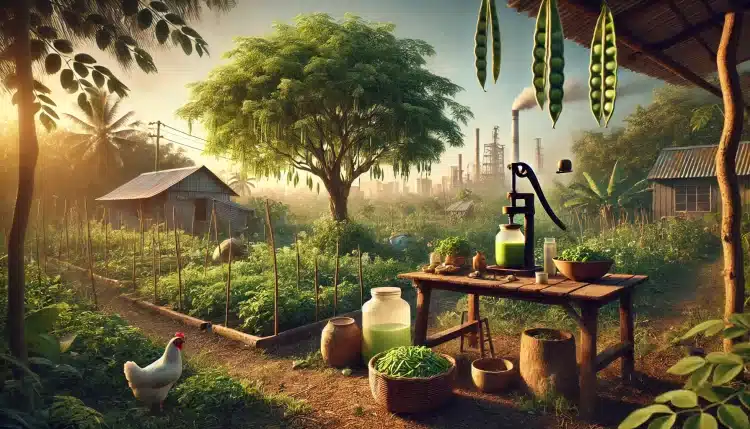
Why Homesteaders Around the World Still Trust Moringa
There’s a tree most folks in the modern world have never heard of. Yet it can shoot up 10 to 15 feet in a single year, thrive in miserable soil, and quietly crank out food, fuel, and medicine like a one-tree homestead supply line.
It’s called moringa—Moringa oleifera—and for thousands of years it’s been doing something remarkable: helping ordinary people survive when systems fail.
While oil companies wired the modern world to pipelines and power plants, this stubborn little tree kept growing along dusty roadsides and village edges. And in those overlooked places, it kept feeding families, purifying water, and producing useful oil.
In other words, while the modern world built complex supply chains, moringa quietly kept proving a simple truth: sometimes the best survival tools grow on trees.
The Tree You Can’t Monopolize

Picture a patch of dry ground where most crops have already surrendered.
Corn curls up. Beans shrivel. The soil turns pale and dusty.
But standing there in the heat, bright green against the sky, is a moringa tree.
That resilience is part of the reason it’s been treasured across India, Africa, Southeast Asia, and the Caribbean for centuries. When other crops fail, moringa keeps producing.
And nearly every part of the tree is useful.
The leaves are the real powerhouse. Gram for gram, they’re loaded with nutrients—high protein levels, along with calcium, iron, vitamin A, and vitamin C. Many nutrition researchers have described them as a kind of natural multivitamin growing on a branch.
Across the tropics, families cook the leaves like spinach, stir them into soups, or dry them into green powder that can be stored for months.
Then there are the pods, often called “drumsticks,” which are cooked like green beans. The flowers are edible too, adding a mild flavor to salads and stir-fries.
Even the roots can be used in small amounts as a horseradish-like spice.
So what looks like one scraggly tree is really a full pantry growing in the yard.
Oil From a Backyard Tree
Now here’s where things get even more interesting.
Inside each moringa pod are seeds that contain roughly 40 percent oil by weight. Press those seeds and you get a pale, clean oil rich in oleic acid—similar in many ways to olive oil.
Historically, people used moringa oil for cooking, skin care, and lamp fuel. The oil burns cleanly and resists going rancid, which made it especially valuable in hot climates.
Long before modern petroleum refineries existed, families were lighting lamps with oil pressed from trees like this.
And that idea—local fuel grown on local land—is exactly the kind of decentralized energy system early inventors once imagined.
In fact, when Rudolf Diesel introduced his famous engine at the Paris Exhibition in 1900, he demonstrated it running on plant oil. He believed farmers might one day grow their own engine fuel. As you might expect, he soon disappeared. See the link above.
Later experiments showed that oils like moringa oil can function as biodiesel with minimal processing.
Imagine the implications for a homestead.
Instead of relying entirely on outside fuel, a small grove of trees could produce oil for lamps, tools, and possibly even small engines.
Turning Muddy Water Into Drinking Water
Yet one of moringa’s most remarkable abilities has nothing to do with food or fuel.
It has to do with water.
Let’s say you’re on a rural homestead and your water supply turns cloudy. Maybe the creek floods, maybe the well gets contaminated, maybe the grid goes down and treatment plants stop working.
Moringa offers an old solution.
Crush a handful of dried seeds into powder. Stir that powder into a container of dirty water. Then let it sit.
Within about thirty minutes, natural proteins in the seeds act like microscopic magnets. They grab suspended particles—dirt, microbes, and other contaminants—and pull them together into clumps that sink to the bottom.
What’s left on top becomes dramatically clearer.
Scientific studies of traditional practices in places like Sudan have shown that moringa seed powder can remove 90–99 percent of bacteria from contaminated water, including pathogens such as E. coli.
One mature tree can produce thousands of seeds each year—enough to treat significant volumes of water.
For people living far from modern filtration systems, that simple biological trick can mean the difference between sickness and survival.
Why Industrial Agriculture Forgot the Tree
If moringa is so useful, why isn’t it everywhere?
Part of the answer lies in how modern agriculture developed.
During the mid-20th century, the Green Revolution pushed many countries toward large-scale monoculture farming—high-yield seeds combined with synthetic fertilizer, pesticides, and irrigation systems.
Those methods increased crop production in the short term, but they also created heavy dependence on industrial inputs: chemicals, machinery, and fossil fuels.
In the process, many traditional food systems were abandoned.
Tree-based agriculture—sometimes called food forests—was often cleared to make room for uniform rows of wheat, rice, or export crops.
Plants like moringa, once valued as part of diverse local ecosystems, were dismissed as “primitive” or irrelevant to modern agriculture.
But what looked outdated on paper often turned out to be incredibly resilient in practice.
The Science Finally Catches Up
Over the past few decades, researchers have taken a closer look at moringa, and the results have been hard to ignore.
Studies consistently show that moringa leaves are densely packed with nutrients, including essential amino acids, vitamins, and minerals. In regions suffering from malnutrition, dried moringa leaf powder has been studied as a supplement capable of significantly improving dietary intake.
Researchers have also validated the water purification ability of moringa seeds, confirming that the proteins responsible for coagulation can reduce bacterial contamination and turbidity in water.
In other words, many of the old village practices surrounding this tree weren’t superstition at all.
They saw “practical science” learned through generations of observation.
Ironically, while development programs often overlooked moringa for decades, the Western wellness industry eventually discovered it.
Today, you can walk into upscale health food stores and find bags of moringa powder marketed as a premium superfood.
Smoothie blends, capsules, teas—moringa has become a trendy supplement for health-conscious consumers.
But those glossy packages usually tell only part of the story.
They talk about antioxidants and vitamins.
What they rarely mention is that the same plant can produce cooking oil, purify water, feed livestock, and grow rapidly on marginal land.
For homesteaders, that broader usefulness matters far more than a trendy label.
A Homesteader’s Quiet Advantage
From a self-reliance perspective, moringa checks a lot of boxes.
First, it grows fast—sometimes 10 to 15 feet in a single season.
Second, it tolerates drought and poor soil surprisingly well.
Third, it produces continuously. Once established, a tree can yield hundreds of pods and thousands of seeds every year.
That means one plant can provide:
- Daily nutrition through leaves and pods
• Oil for cooking or lamps
• Seeds for water purification
• Shade and soil improvement
Plant several trees and you begin building a small but meaningful layer of resilience into a homestead system.
And perhaps most importantly, moringa asks very little in return.
It doesn’t demand chemical fertilizers. It doesn’t require elaborate equipment. It simply grows.
The Old Solutions Still Grow
Today the world is facing a strange trio of challenges: energy uncertainty, fragile food systems, and growing water stress.
Many official solutions involve massive infrastructure—large solar installations, industrial agriculture, expensive treatment plants.
Yet scattered across backyards and rural farms throughout the tropics is a simpler solution that has existed for centuries.
A fast-growing tree.
A tree that feeds people, purifies water, and produces useful oil.
You won’t see it dominating headlines or government programs. It doesn’t generate massive profits or require billion-dollar investments.
But quietly, wherever someone plants it, moringa keeps doing what it has always done.
It grows.
And sometimes that simple act—roots in poor soil, leaves in the sun—is enough to remind people that resilience doesn’t always come from complicated systems.
Sometimes it starts with a seed in your hand and a tree growing beside your fence.