Print

New Research Discovers A Compound In Broccoli For A Potential Cure Against A Devastating Nerve Disease
When Grandma Said To Eat Your Broccoli… Her Instincts Were Spot On
Walk out to the garden on a crisp fall morning and there it stands: broccoli, with tight green heads and dew shining on its broad leaves. Most of us see a side dish waiting for a little butter. Scientists in Australia see something else worth bringing to the table.
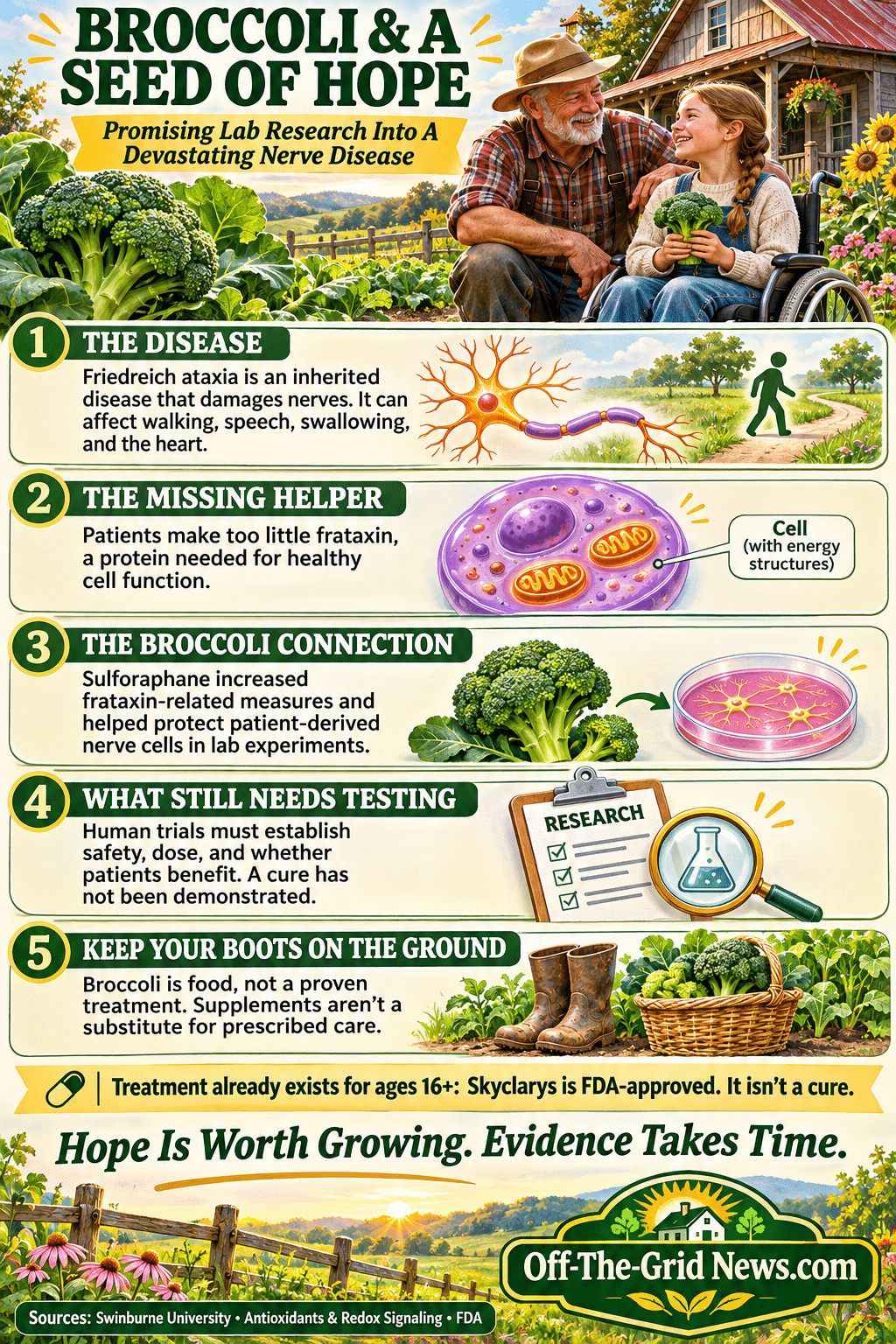
They’re studying a broccoli compound that could help researchers develop a treatment for Friedreich ataxia, a rare inherited disease that damages the nervous system. It often starts in childhood, gradually making everyday movements harder. Walking across the yard can become a struggle, and speaking clearly can become one, too.
Now comes the hopeful part. In laboratory experiments, that compound has helped vulnerable nerve cells and increased a protein those cells desperately need. That’s a promising start, though there’s still a long row to hoe before anyone can call it a proven treatment.
For families living with this disease, it’s a row worth tending.
A Cruel Disease That Steals Childhood One Step at a Time

Picture a youngster scampering toward the chicken coop, boots thumping down the porch steps and an empty egg basket swinging from one hand. Then picture that same child struggling to keep the balance and coordination needed to make the trip. That’s the precious independence Friedreich ataxia can steal.
According to the FDA’s explanation of the disease, symptoms commonly begin in children and teenagers. Damage to nerves can interfere with walking, speech, and swallowing. The disease can also affect the heart and shorten a person’s life.
Meanwhile, families have to keep living around it. There’s school, supper, appointments, and the business of helping a child do things that used to come easily. A diagnosis like this reaches far beyond the doctor’s office.
There’s no cure. But researchers are looking for ways to slow the damage, protect nerve cells, and give people more good years with more independence. To understand why broccoli entered the picture, we need to look at what’s going wrong inside those cells.
The Missing Protein That Leaves Nerve Cells Vulnerable
For starters, every chore on a homestead takes energy, whether you’re hauling firewood or carrying water to the hens. Your nerve cells have their own steady workload. They need a dependable energy supply to do it.
One of the helpers involved is a protein called frataxin. In Friedreich ataxia, changes in the FXN gene leave the body short of that protein. The shortage disrupts work inside the cells’ energy-producing structures, called mitochondria, and makes vulnerable cells more likely to suffer damage.
Think of a woodstove trying to heat the house while something keeps interfering with the draft. You can keep feeding it, but the whole system still struggles. The comparison isn’t exact, of course, but it helps explain why scientists care about restoring something the cells are missing.
Now here’s where sulforaphane enters the picture. The compound associated with broccoli has shown an ability to raise frataxin levels in experimental nerve cells. Researchers want to find out whether that laboratory improvement could eventually help people, too.
An Unexpected Discovery Worth Digging Into
In a peer-reviewed study published in Antioxidants & Redox Signaling, researchers tested sulforaphane on sensory nerve cells grown from stem cells derived from patients with Friedreich ataxia. These cells gave the team a way to study important features of the disease in the laboratory.
The results revealed several reasons to keep digging. Sulforaphane increased frataxin-related measures, improved survival of the affected cells, and changed markers associated with oxidative stress and inflammation. Those are processes that can contribute to the trouble inside diseased cells.
In plain English, the compound appeared to help protect vulnerable cells on several fronts. Anyone who’s kept an old place going knows why that gets attention: a sound roof won’t solve a failing foundation. Researchers are interested in approaches that can address more than one part of the damage.
Even so, here’s the crucial distinction: a dish of living cells can’t tell us whether a child will walk better, speak more clearly, or live longer. Those questions require studies in people. The findings justify further work; they don’t settle the outcome.
Hope for Younger Children and the Cold Hard Facts
Behind the research is Associate Professor Faith Kwa at Swinburne University of Technology. In its August 2026 announcement, the university described the work as a possible path toward a treatment that families could afford and access. It also said the team was seeking funding for clinical trials.
That goal matters. A useful treatment has to do more than look good on a laboratory chart. Eventually, it has to reach patients in a form doctors can prescribe, at a dose that works, with risks families and clinicians understand.
For younger children, the need is especially pressing. Here’s a crucial detail, though: some teenagers already fall within an approved treatment’s age range. The gap is especially painful for younger children whose families are still waiting for an approved option.
The FDA-approved medicine Skyclarys, or omaveloxolone, is indicated for adults and adolescents 16 and older. It isn’t a cure, and that approval doesn’t cover younger children. That leaves good reason to pursue additional options without overlooking the progress already made.
Don’t Mistake the Garden Harvest for a Treatment
Of course, before anybody plants three extra rows and starts calling the seed catalog a prescription pad, let’s keep our boots on the ground. Eating broccoli hasn’t been shown by this research to treat Friedreich ataxia. Neither has picking up a sulforaphane supplement at the store.
A laboratory experiment uses a particular preparation under controlled conditions. A serving of broccoli, a commercial supplement, and a future medicine aren’t interchangeable. The details matter: how much of a compound reaches the right tissues, how long it stays there, and what it does in a patient.
So keep enjoying your garden harvest, but don’t gamble on these findings as a home treatment plan. Families considering supplements should discuss them with the child’s treating clinician. Prescribed care shouldn’t be stopped or replaced because a promising research headline caught somebody’s eye.
Hope doesn’t need a bigger claim than the evidence can carry.
A Familiar Compound With Crucial Questions to Answer
To begin with, sulforaphane has been studied in people for other purposes, and Kwa points to that existing human safety research as a reason for optimism. Researchers also have access to commercially available preparations. Those practical advantages could help future development if clinical trials produce encouraging results.
Even so, don’t confuse familiar with fully tested for every use. Researchers still have to figure out an appropriate formulation, dose, treatment schedule, and safety profile for people with Friedreich ataxia, particularly younger patients. They also need to learn whether any benefit lasts.
Then there’s the affordability question. An accessible treatment is the researchers’ aim, but its eventual cost and availability haven’t been established. It’s fair to welcome the possibility without promising families something nobody can deliver yet.
A homesteader understands this part. Good seed matters, but you still have to get the crop through the season.
The Funding Hurdle That Can Leave Rare Diseases Ignored
Meanwhile, another hurdle can stall the work before it reaches families: research money. In the university’s account, Kwa explains that limited public awareness of Friedreich ataxia makes research funding harder to secure. A devastating disease can turn a family’s whole world upside down while remaining almost invisible to everybody else.
For that reason, getting to clinical trials is a crucial next step that takes resources, careful planning, and willing participants. Researchers have to move from encouraging cell findings to evidence that can guide real medical decisions. That step is essential, even when families understandably wish the work could move faster.
Meanwhile, learning the disease’s name is a small but useful beginning. So is sharing an accurate account of the research, with its promise and its limits kept together. Families deserve attention without having to sort through exaggerated cure claims along the way.
After all, most rural communities know what happens when a need finally becomes visible. Somebody notices, somebody asks how to help, and work that seemed impossible starts getting hands behind it.
Small Victories That Could Change an Ordinary Day
For a family facing progressive illness, independence isn’t an abstract word. It can mean holding a fork, getting dressed, or joining everyone else at the kitchen table with less help. Those are examples of what families hope future treatments might preserve, not benefits this broccoli compound has already proved.
Even with those limits, there’s plenty of room for hope. The research has identified something worth testing, and the next job is to find out whether the laboratory promise holds up in people. No honest gardener counts the harvest while the plants are still small.
So the next time you cut a head of broccoli for supper, give that plain green vegetable another look. It’s still good food from a well-tended row. Meanwhile, a compound associated with it gives scientists something valuable to investigate. Their goal is to help families hold on to more time, more ability, and more ordinary days together.
That would be a harvest worth working for.