 Print
Print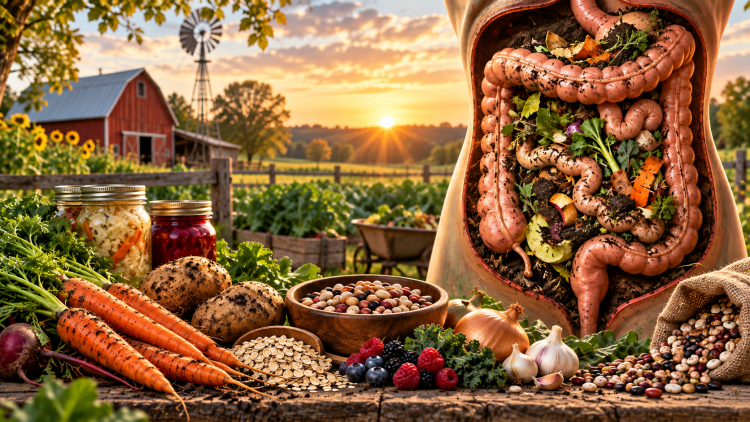
Why “More Fiber” Isn’t The Whole Answer… And The Simple Gut-Health Rule Your Grandparents Already Understood
There’s A Tiny Farm Inside Your Belly… And Most Americans Are Starving Half The Livestock
If you’re living the homesteader life and have had mud and manure on your boots, you already know a compost pile has moods. Feed it nothing but wet grass clippings and pretty soon you’ve got a hot, slimy, stinking mess that could knock a buzzard off a fence post.
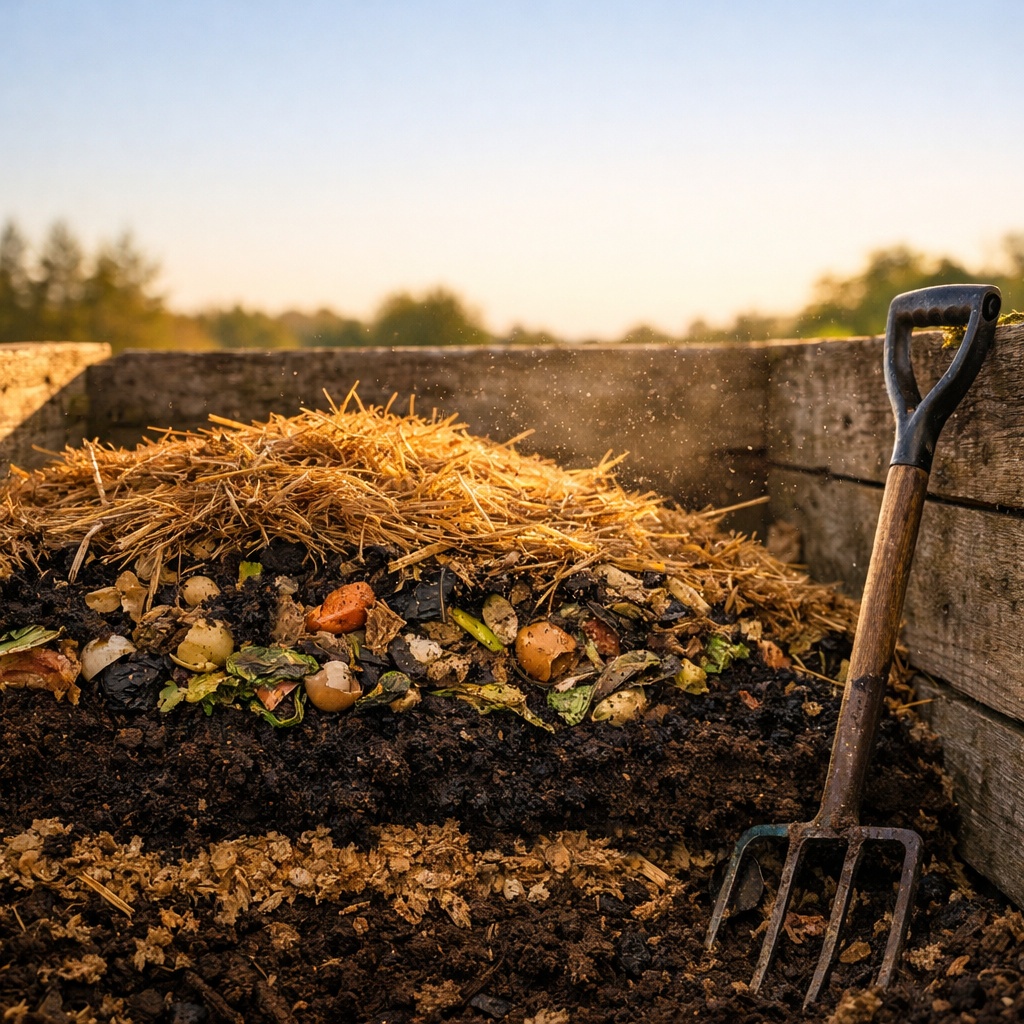
But mix in some straw, dry leaves, kitchen scraps, garden waste and a little manure, and something entirely different happens. The pile starts humming along, breaking down slow and steady until yesterday’s garbage turns into rich, dark soil.
Now here’s the strange part.
Your gut isn’t all that different.
Your colon is a living fermentation system packed with an enormous community of bacteria and other microbes, and what you shovel into the front end helps determine what those little critters have to work with at the other end.
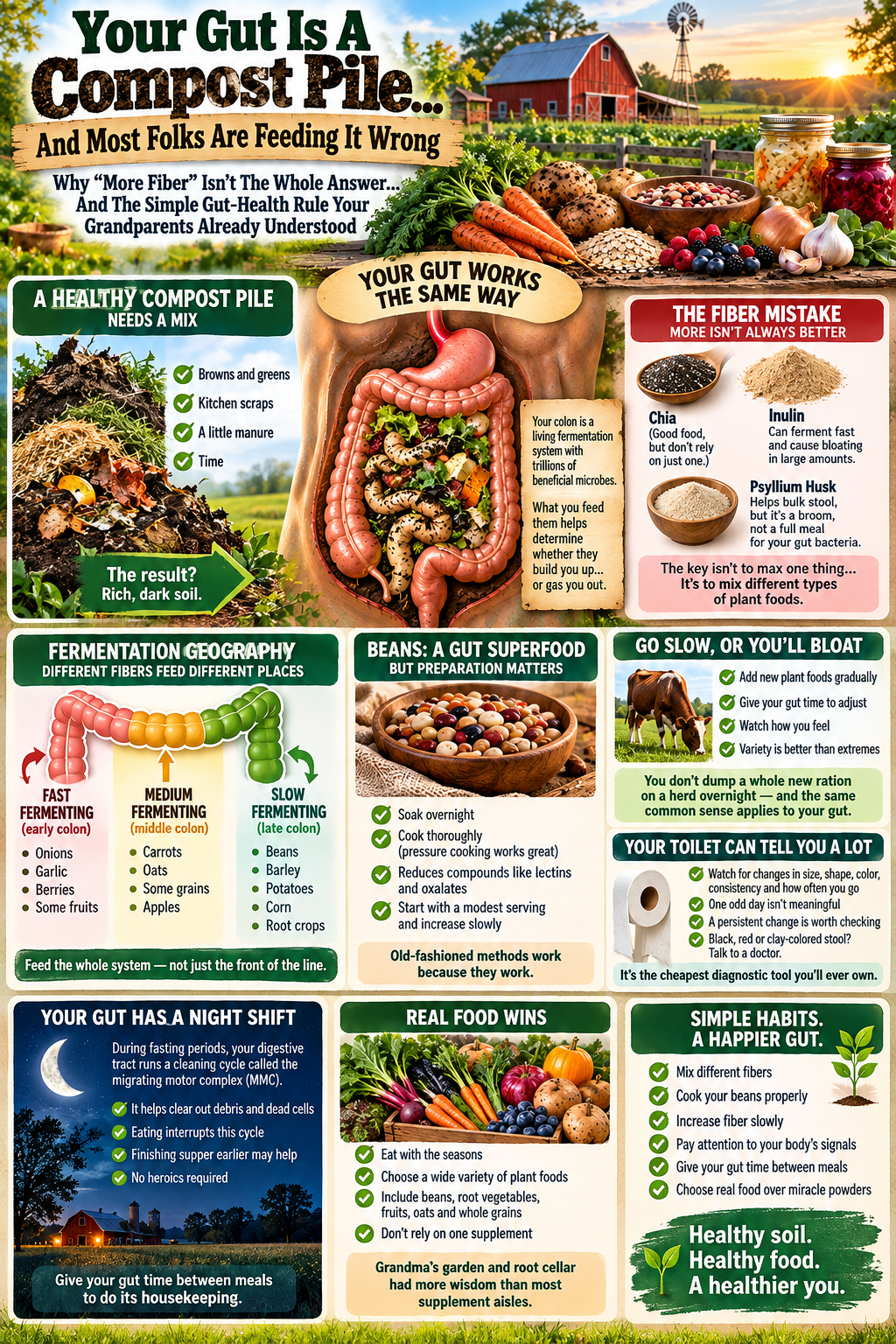
And that’s exactly what British surgeon Dr. Karan Rajan has been trying to get people to understand. Rajan has spent years treating digestive disease and operating on patients, and lately he’s been talking extensively about fiber, gut bacteria and something he calls “fermentation geography”—the idea that where different foods get fermented in your colon may matter almost as much as how much fiber you eat. Dr. Karan Rajan Dr. Rajan’s discussion of fiber and fermentation geography
That’s an important distinction.
Because somewhere along the way, Americans heard “eat more fiber” and did what people tend to do with good advice.
We took it clear to the barn roof.
The Fiber Craze That’s Missing Half The Point
Right now, “fibermaxxing” is having its moment. Folks are shooting for 30 grams or more a day, which can be perfectly reasonable—but then some try to get most of it from a narrow handful of foods or supplements.
A mountain of chia. Spoonful after spoonful of psyllium husk. Inulin or chicory-root fiber showing up in everything from protein bars to powders.
The problem isn’t that these fibers are automatically bad. It’s that they don’t all behave the same way once they hit the digestive tract.
Psyllium, for instance, is particularly useful for holding water and bulking or normalizing stool. It is not, however, the same kind of rapidly fermentable buffet for microbes that fibers such as inulin can be. Rajan’s point is that swallowing a supplement and hitting a fiber number on a nutrition app isn’t necessarily the same thing as feeding a diverse microbial community. Rajan on psyllium, inulin and different kinds of fiber
Meanwhile, inulin can ferment rapidly—which is one reason large supplemental doses can leave some people feeling like somebody inflated a bicycle tube inside their britches. Research published in Gut found that inulin increased colonic gas in people with IBS, while psyllium reduced gas produced from inulin fermentation. Read the study in Gut/BMJ
But don’t walk away thinking the lesson is “avoid fiber.”
It’s almost the opposite.
Don’t max out one ingredient and call it a healthy gut. Build a mixture.
Think Like A Man Rotating Cattle Through Pasture
Here’s where Rajan’s “fermentation geography” idea gets interesting, because it maps onto a homestead better than most medical diagrams ever could.
Picture your colon as a long stretch of pasture. What gets fermented quickly is largely used earlier in the trip, while slower-fermenting material can travel farther down the line before microbes finally get their supper. Rajan’s explanation of fermentation geography
That’s important because microbial communities and conditions aren’t identical from one end of the colon to the other. Different substrates become available at different points, meaning the type of fiber reaching the colon can influence what gets fermented—and where.
It’s a little like rotational grazing.
Turn the cattle loose on the same little paddock every morning and they’ll chew it down to dirt while good grass stands untouched over the hill. A smarter farmer spreads the pressure around.
Likewise, Rajan recommends thinking beyond the old idea that fiber is simply “soluble” or “insoluble.” Instead, he emphasizes a mixture of faster-, medium- and slower-fermenting plant foods so fermentation isn’t concentrated entirely at one end of the system.
Thankfully, you don’t need some $49.95 tub with a picture of a laboratory on the label to do that.
You’ve probably got half the answer sitting in the pantry.
Onions, garlic, fruits, oats, carrots, barley, beans, lentils, potatoes, sweet potatoes and other root crops bring different fibers and resistant carbohydrates to the table. Rajan particularly points toward legumes and root vegetables as slower-fermenting choices capable of providing fermentation farther along the colon. See Rajan’s examples of slow-fermenting foods
And there’s an interesting real-world clue from the Hadza hunter-gatherers of Tanzania. Researchers have documented striking seasonal changes in their gut microbiome as the foods available to them change throughout the year. Stanford Medicine on the Hadza microbiome
In other words, diversity matters—and eating a changing mixture of real plants isn’t some new Silicon Valley invention.
Grandma’s garden and root cellar may have had more nutritional wisdom built into them than half the supplement aisle.
Cook Your Beans Like Great-Grandma Did
Now we get to one of the cheapest gut foods on the homestead: beans.
Beans and other legumes bring fiber, resistant starch and fermentable carbohydrates to the table, and Rajan regularly recommends them as part of a gut-friendly diet. But there’s another old-fashioned lesson hiding in the bean pot.
Preparation matters.
For generations, folks soaked dried beans before cooking them. They weren’t standing around the woodstove talking about “antinutritional compounds” or measuring soluble oxalates in a laboratory.
They just knew how to cook beans.
Interestingly, modern research gives some support to those old kitchen habits. Studies have found that soaking and cooking legumes can reduce varying amounts of compounds such as lectins and oxalates, with the results depending on the bean and preparation method. Research on soaking, cooking, lectins and oxalates in pulses
Another review found that traditional methods such as overnight soaking followed by boiling can significantly reduce soluble oxalate in certain legumes. Review of plant-food preparation and antinutrients
So if beans make you feel like you swallowed a bicycle pump, don’t necessarily throw the whole crop over the fence.
Soak them. Cook them thoroughly. Start with a modest serving.
Then give your gut time to adjust.
Change The Ration Slowly… Or You’ll Hear About It
Anybody who’s fed livestock knows you don’t radically change a ration on Tuesday morning and expect everybody to be happy by Tuesday afternoon.
You ease into it.
The same common sense works with fiber. If somebody has been living on burgers, white bread, packaged food and three lonely peas next to the mashed potatoes, jumping overnight to giant bowls of beans, bran, chia and vegetables can produce plenty of bloating and gas.
That doesn’t automatically mean the food is hurting you. Sometimes it simply means you’ve changed the microbial dinner menu faster than your digestive system likes.
So add variety gradually.
Try another serving of vegetables. Add some oats. Work beans or lentils into a meal. Eat berries when they’re available, root vegetables when they’re coming out of the ground and different plant foods as the seasons change.
Then pay attention.
Because observation may be the most overlooked tool in the whole barn.
There’s A Report Card Waiting In The Toilet
You check the soil before planting. You look at the rain gauge after a storm, watch the cattle’s manure, inspect leaves for pests and listen when an engine starts making a noise it didn’t make yesterday.
Yet people can go months without paying attention to what’s coming out of their own body.
Your stool can tell you quite a bit—not diagnose you from one trip to the bathroom, but alert you when something has changed.
Look for patterns in frequency, shape, consistency and color. Pay attention to whether bowel movements suddenly become painful, whether you’re straining, whether you constantly feel unfinished or whether something has plainly shifted from what’s normal for you.
One strange day isn’t necessarily meaningful.
A persistent change is different.
And some warning signs shouldn’t be shrugged off. Black, tarry stool can indicate bleeding higher in the digestive tract, while bright-red blood can come from something relatively minor such as hemorrhoids but can also have more serious causes. Very pale, white or clay-colored stool can signal too little bile reaching the intestine. Mayo Clinic guide to stool colors and warning signs
The American Gastroenterological Association likewise lists blood in the stool—including bright red, black or very dark stool—among symptoms worth discussing with a medical professional. American Gastroenterological Association colorectal-health guidance
Green stool, on the other hand, isn’t automatically an infection. Food, coloring and faster movement through the digestive tract can all turn stool green.
That’s where common sense beats panic.
Don’t diagnose yourself from one flush. Watch the pattern, and get persistent or concerning changes checked.
And Yes… Your Bacteria Are Making Some Of That Gas
Then there’s the subject nobody discusses at Sunday dinner.
Gas.
Fermentation naturally produces gases, and changing the amount or type of fermentable carbohydrate you eat can change how much gas gets produced. That doesn’t automatically mean something has gone wrong.
But how you feel matters.
If a dietary change brings severe or persistent bloating, pain, diarrhea, constipation or other symptoms, that’s worth investigating instead of simply deciding that suffering is proof the diet is “working.”
There’s also a basic difference between bacterial fermentation of carbohydrates and bacterial metabolism of protein that reaches the colon. That distinction is one reason a balanced diet—with enough plant material reaching gut microbes—matters more than chasing whichever macronutrient happens to be fashionable this month.
Your colon isn’t a protein shaker.
It’s an ecosystem.
Give The Farm Crew Time To Clean The Barn
Finally, there’s one fascinating piece of digestive machinery that doesn’t require buying anything at all.
It’s called the migrating motor complex, or MMC.
During fasting periods between meals, the stomach and small intestine shift into a recurring pattern of contractions that helps move residual material, secretions and shed cells along the digestive tract. Researchers have sometimes described it as an “intestinal housekeeper.” Scientific review of the migrating motor complex
And here’s the important part: eating interrupts that fasting pattern. Human physiology research has documented that meals replace the fasting MMC with a different pattern of digestive contractions. PubMed review of the migrating myoelectric complex
That doesn’t prove everybody needs a 15-, 16- or 18-hour daily fast. Nor does it mean snacking is automatically harmful.
But it does remind us that the digestive system isn’t designed only to receive food.
It also has work to do between meals.
For many healthy people, something as ordinary as finishing supper, putting the kitchen away and not grazing continuously until bedtime may provide natural stretches when the gut isn’t processing another incoming load. People with diabetes, certain gastrointestinal disorders, pregnancy, eating-disorder histories or medications affected by food timing should talk with their clinician before experimenting with prolonged fasting.
No heroics required.
Maybe Your Gut Needs Husbandry… Not Another Miracle Powder
So step back and look at the whole thing from the barn door.
Eat different kinds of plant foods instead of trying to get every gram of fiber from one powder. Rotate through vegetables, fruit, oats, beans, barley, lentils and root crops. Prepare beans properly, increase fiber gradually and pay attention to what your body tells you.
And don’t be afraid to leave a little space between feedings.
Because maybe we’ve made gut health more complicated than it needs to be.
A healthy compost pile doesn’t come from dumping thirty pounds of one ingredient in the same corner. Good pasture doesn’t come from hammering one paddock every day. And healthy soil doesn’t come from pouring one magic substance on it while ignoring everything else.
Living systems seem to like variety, rhythm and time.
Your gut is one of them.
So feed it wide. Feed it slow. Watch what comes out the other end. And give the little critters down there enough variety to do the jobs they’ve been doing since long before anybody figured out how to sell fiber in a plastic tub.
That’s not a fad.
That’s just good husbandry—applied to the one piece of ground you’ll carry with you for the rest of your life.