 Print
Print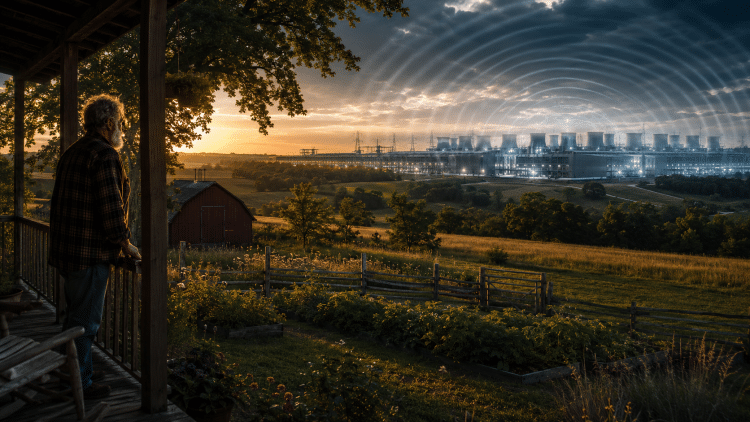
What Happens When A Jet Engine Moves In Next Door?
Why Rural Communities Are Discovering The Hidden Cost Of The AI-Driven Data Center Boom
When you live off-grid, noise usually means something.
A rooster crows at dawn. A tractor fires up in the field. A chainsaw growls for an hour while somebody cuts winter firewood. Even a barking dog eventually settles down.
The sounds of rural life come and go.
But what happens when the noise never leaves?
What happens when a low, mechanical hum settles over the countryside twenty-four hours a day, seven days a week, and keeps running year after year?
That’s the question more rural communities are starting to ask as massive AI data centers spread across farmland, industrial parks, and small-town America. And according to a growing body of research, lawsuits, and citizen complaints, the issue may be far bigger than most people realize.
The New Factory Nobody Talks About
Most folks picture data centers as quiet buildings filled with computers.
After all, they’re not steel mills. They’re not coal plants. They don’t have smokestacks pouring black clouds into the sky.
From the road, many look almost harmless.
Yet behind those walls sits an enormous amount of equipment that must be cooled every minute of every day. Servers generate tremendous heat, and that heat has to go somewhere. As a result, giant cooling systems run nonstop, pushing air through massive fans and chillers around the clock.
That’s where the trouble begins.
Unlike many industrial noises that come in bursts, data center noise is continuous. It doesn’t arrive for a shift and then go home. It doesn’t shut down on weekends.
It just keeps going.
And for nearby residents, that constant presence can slowly become impossible to ignore.
The Sound That Travels Through the Night

Anyone who’s spent time on a homestead knows low-frequency sounds behave differently.
You can hear a distant train long before you see it. Thunder can roll across a valley for miles. A diesel engine can vibrate through the ground even when it’s far away.
Data center cooling systems produce much of their noise in those same lower frequency ranges. Residents often describe it as a hum, rumble, buzz, drone, or vibration that seems to linger in the air.
And unlike higher-pitched sounds that fade quickly with distance, low-frequency noise tends to travel farther and penetrate buildings more effectively.
That’s why some homeowners report hearing the sound inside their houses even after closing windows and doors.
The result isn’t always ear-splitting loudness.
Sometimes it’s something worse.
It’s persistence.
Why The Decibel Numbers Can Be Misleading
Here’s where things get interesting.
Most local noise ordinances rely on what’s called A-weighted decibel measurements. These measurements were designed to reflect how human ears hear mid-range frequencies.
The problem is that low-frequency sounds are heavily discounted by this system. In simple terms, the meter may say everything is fine while residents are still hearing—and feeling—the noise.
Imagine checking your garden soil with a tool that can’t detect nitrogen.
The test might say the soil looks great while your crops are turning yellow.
That’s essentially the complaint many communities are raising.
In Northern Virginia, residents reported sleep disruption, concentration problems, and an inability to enjoy outdoor spaces even when measured sound levels technically complied with local standards.
In other words, the numbers looked acceptable.
The experience didn’t.
When You Can Feel It More Than Hear It
Many homesteaders understand vibration better than city planners.
Stand beside an old diesel tractor and you feel it in your chest. Put your hand on a running generator and you feel the machine long before you analyze the sound.
Researchers are increasingly studying something called infrasound and low-frequency noise. These frequencies can exist below normal hearing thresholds yet still be perceived as pressure, vibration, or physical sensation.
Large data centers are now being examined as potential sources of this type of energy because of their cooling systems, compressors, turbines, and related infrastructure.
Scientists are still debating exactly what long-term exposure means for human health.
However, enough questions have emerged that even researchers are calling for significantly more study.
And that’s getting attention.
What The Research Actually Says
It’s important to separate established facts from speculation.
Several reviews of low-frequency noise research have found associations with annoyance, sleep disruption, concentration difficulties, headaches, fatigue, and related quality-of-life concerns.
The World Health Organization has also identified nighttime noise exposure as a significant public-health issue because sleep disturbances can create health effects that extend beyond the hours when the noise occurs.
Meanwhile, a German laboratory study found that extremely high levels of infrasound affected the contractile force of human heart tissue under controlled conditions. Researchers and critics alike acknowledge that residential exposure levels near data centers are typically far lower than those tested in the laboratory. Still, the study raised enough questions to keep the conversation going.
At the same time, a 2025 NIH-indexed paper specifically called for more research into the health effects of expanding data center infrastructure, noting that very little is currently known about long-term outcomes in host communities.
That’s a key point.
The science isn’t settled.
But neither is the concern.
Rural America Starts Pushing Back
When a problem becomes widespread enough, people stop complaining quietly and start hiring attorneys.
That’s exactly what’s happening.
Across the country, lawsuits have emerged in places as different as Virginia, Michigan, New Jersey, Massachusetts, Mississippi, Texas, and North Dakota. Residents describe everything from constant humming and sleepless nights to headaches, outdoor spaces they no longer enjoy, and noise that seems to penetrate their homes.
In one Virginia community, residents reportedly resorted to placing mattresses against windows in an attempt to block the sound.
Think about that for a moment.
People moved to the countryside seeking peace and quiet.
Now they’re stacking mattresses against their windows.
That’s not a picture most economic-development brochures show.
The Homesteader’s Question
For rural families, the issue isn’t just noise.
It’s lifestyle.
Many people move to the country specifically to escape constant industrial activity. They want to hear wind in the trees. They want to sit on the porch after supper and listen to crickets instead of machinery.
They invest years building gardens, raising livestock, and creating a life that feels connected to the land.
Then a project arrives promising jobs, tax revenue, and technological progress.
And suddenly the conversation changes.
Because unlike a factory whistle that blows at quitting time, these facilities never really sleep.
The hum keeps going.
Before The Concrete Gets Poured
One lesson keeps appearing throughout communities that have already faced these battles.
Document everything early.
Once construction begins, proving what conditions existed beforehand becomes much harder.
It’s important to establish a baseline record of local sound conditions before facilities are built.
That means measuring ambient noise levels, documenting seasonal conditions, and preserving evidence that may later become important in zoning disputes, permit hearings, or legal proceedings.
For homesteaders, that’s simply common sense.
You take pictures before a storm.
You test a well before contamination.
You walk a fence line before signing paperwork.
And if a major industrial project is coming to town, you document the sound of your property before someone else changes it.
A Story That’s Still Unfolding
The AI revolution is moving fast.
New data centers are being proposed across rural America at a pace few people imagined just a few years ago. Local governments see tax revenue. Developers see opportunity. Technology companies see the infrastructure needed to power artificial intelligence.
Yet many residents are asking a different question.
What happens to the people living next door?
Right now, nobody has all the answers.
The research is still developing. The lawsuits are still working through the courts. Regulators are still debating whether old noise rules are adequate for a new kind of industrial facility.
But one thing is becoming clear.
The cloud has a sound.
And out where quiet still matters, more people are starting to listen.