 Print
Print
The Viral Trucker Strike Looks Like A Rumor… The Diesel Crisis Behind It Isn’t.
Forget October 1st… October 2nd Is What Should Worry You
Mark October 1st on the calendar if you want. Social media is already doing it for you.
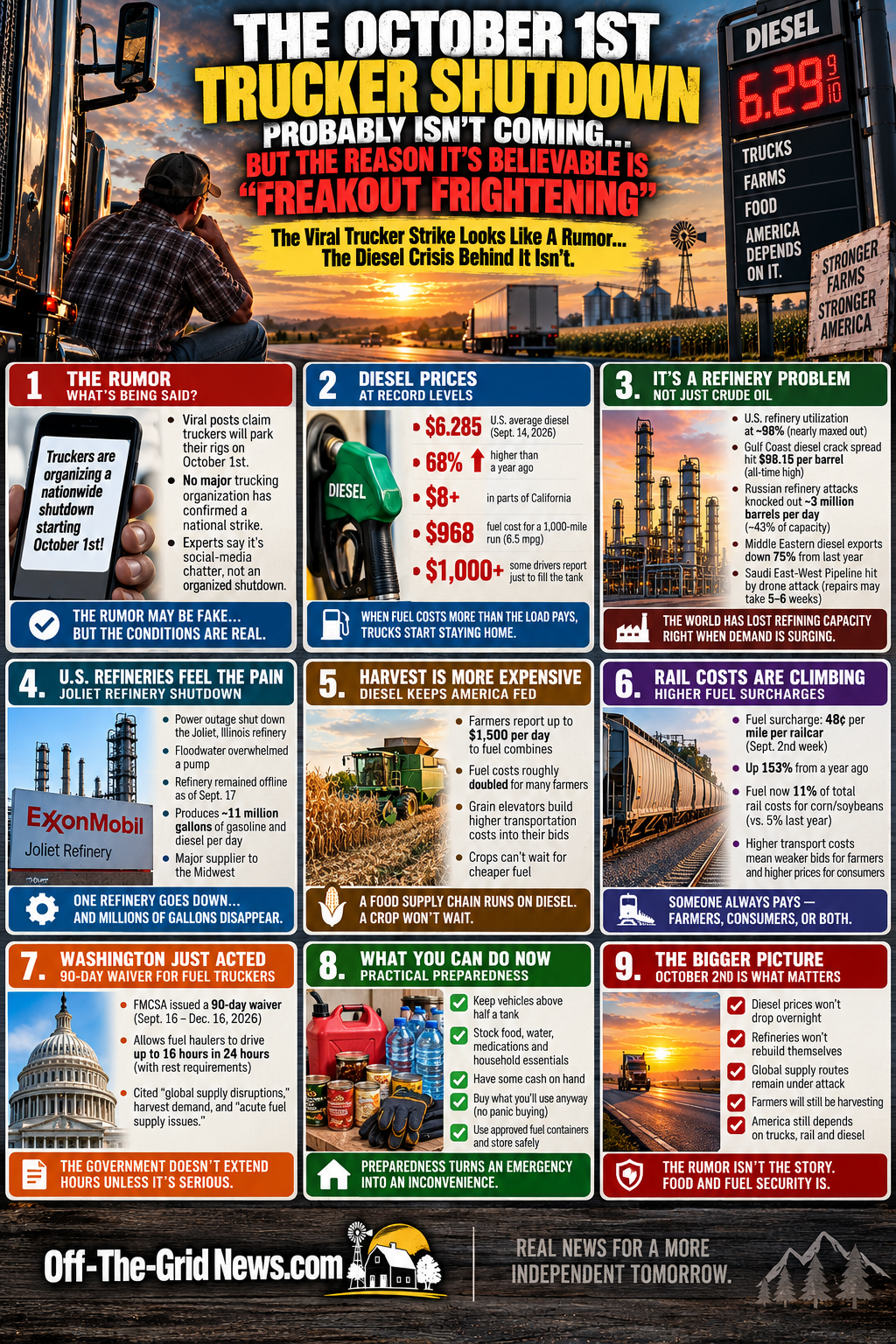
Videos are bouncing around Facebook, Instagram and X claiming American truckers have finally had enough. According to the story, they’re going to park their rigs beginning October 1st, shut down the freight system and keep those trucks parked until somebody does something about diesel prices.
There’s just one problem.
So far, there is no credible evidence that a coordinated nationwide trucker shutdown is actually scheduled for October 1st. The Owner-Operator Independent Drivers Association — which represents more than 150,000 members operating more than 240,000 trucks and small fleets — says what they’re hearing amounts to social-media chatter, not an organized national strike.
That distinction matters.
But before anybody laughs off the whole thing as another internet rumor, there’s a second part of this story that deserves a whole lot more attention.
The strike may not be real. The conditions that made millions of Americans believe it immediately absolutely are.
When A Fill-Up Starts Looking Like A Mortgage Payment
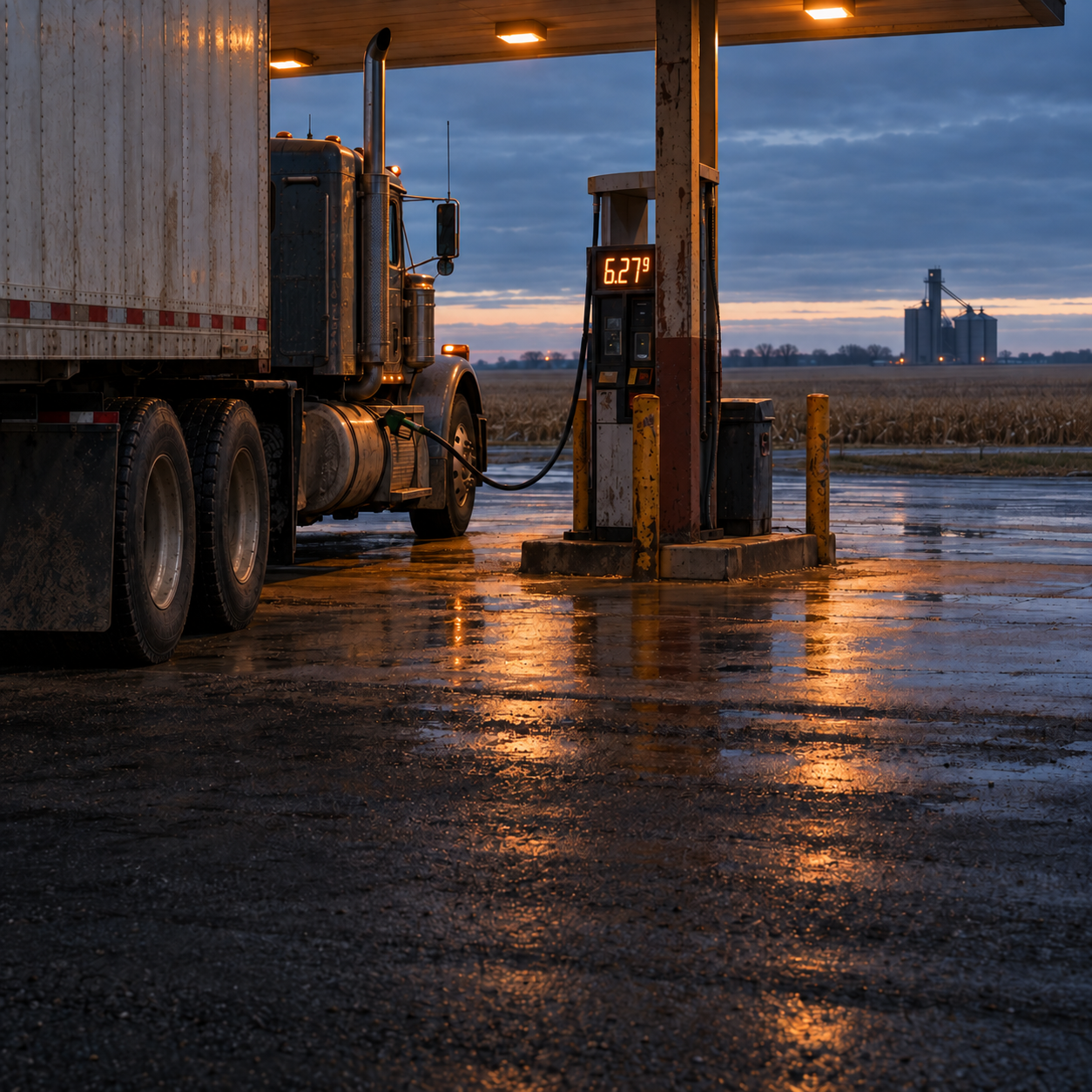
Across farm country and the trucking world, people are staring at fuel receipts that look like somebody added an extra digit.
According to the U.S. Energy Information Administration’s official weekly diesel survey, the national average for on-highway diesel reached $6.285 a gallon on September 14. That’s up from $5.257 only five weeks earlier, and today’s diesel price is roughly 68 percent higher than a year ago.
Now put yourself behind the wheel of an owner-operator’s truck.
A tractor-trailer getting 6.5 miles per gallon over a 1,000-mile run burns about 154 gallons. At $6.285 a gallon, that’s roughly $968 in fuel before you’ve paid the driver, bought a tire, made an insurance payment, paid IFTA taxes, plates, maintenance, tolls or one thin dime toward the truck itself.
And a tractor can have hundreds of thousands of dollars tied up in it.
At some point, a truck doesn’t need to “go on strike.”
It just needs to become unprofitable to move.
Nobody Has To Yell “Park The Trucks”
That’s the part the October 1st rumor accidentally gets right.
You don’t necessarily need a union leader standing on a loading dock with a bullhorn. You don’t need 50,000 drivers voting on anything. You don’t even need truckers to agree with one another.
You just need enough small carriers sitting at their kitchen tables with a calculator, a stack of bills and a cup of cold coffee.
If hauling the load costs more than the load pays, the truck stays home.
That’s not a strike.
That’s arithmetic.
And the economic pressure isn’t theoretical. Reuters reported this week that independent freight operators are being squeezed by record diesel prices, with the pressure especially severe in high-cost markets such as California.
Diesel Is The Bloodstream Of This Country
Somebody will inevitably say, “Well, I don’t drive a diesel.”
Fine.
Neither does your lettuce.
But the truck hauling it does. So does the combine harvesting your corn, the tractor planting wheat, the excavator digging a foundation, the refrigerated trailer carrying hamburger and the tanker hauling gasoline to the station where you fill your little four-cylinder car.
Diesel is the bloodstream of the physical economy. When it gets expensive, everything downstream starts feeling the pressure.
And right now, that pressure is spreading.
This Isn’t Just An Oil Problem
Here’s where the story gets more interesting.
Crude oil is expensive, but the diesel problem is bigger than crude alone. The real trouble is what happens between the barrel of oil coming out of the ground and the gallon of diesel coming out of the pump.
That’s the refinery.
One way energy traders measure that pressure is something called a crack spread — basically the difference between what crude costs and what the refined product is worth.
According to S&P Global Energy, the U.S. Gulf Coast ultra-low-sulfur diesel crack spread hit an all-time high of $98.15 per barrel on September 1st.
Think about what that means.
The raw barrel of crude is only part of the problem. The market is putting an extraordinary premium on turning that barrel into usable diesel.
Meanwhile, the same S&P Global analysis reports that the American refining system has been running practically flat-out, with U.S. refinery utilization reaching roughly 98 percent.
In homestead language, we’ve got the pump running wide open and almost no spare pump sitting in the shed.
The Refineries Have Become The Front Line
Then look overseas.
Repeated Ukrainian drone attacks have hammered Russian refining infrastructure. S&P Global estimates that roughly 3 million barrels per day of Russia’s approximately 7 million barrels per day of refining capacity has been knocked offline.
That’s roughly 43 percent of the country’s total refining capacity affected.
And it isn’t some tiny corner of Russia’s refining system. S&P reports the attacks have affected facilities representing roughly 80 percent of Russian refinery capacity.
That matters because Russia has historically been one of the world’s major exporters of refined petroleum products.
Meanwhile, disruptions around the Strait of Hormuz have cut Middle Eastern refined-product exports by an estimated 3 million to 4 million barrels per day, according to that same S&P analysis.
In other words, the world hasn’t simply lost crude oil.
It’s losing some of the machinery that turns crude oil into the stuff your tractor, semi and combine actually burn.
Then Somebody Hit The Back Door
As if the refinery problem weren’t enough, the Middle East has developed another nasty complication.
Saudi Arabia’s East-West Pipeline is the big overland route capable of moving crude toward the Red Sea while bypassing the Strait of Hormuz. That’s why it matters so much when Hormuz gets dangerous.
And now Reuters reports that three pumping stations along that pipeline were hit in a drone attack.
The pipeline had been moving roughly 4 million to 5 million barrels of oil per day — somewhere around four to five percent of global supply. Reuters reports industry sources estimate repairs could take five or six weeks, although partial operations could resume sooner.
So picture the world’s fuel system like an old farm lane.
Traffic is already backed up at the front gate.
Now somebody has started tearing boards off the back gate too.
Then Joliet Went Dark
And this one hits especially close to home for anybody living in the Midwest.
ExxonMobil’s Joliet refinery in Illinois went offline following a power outage. Power was restored.
The refinery wasn’t.
Then Reuters reported that floodwater overwhelmed a pump at the facility, further complicating the situation. As of Thursday, September 17, the refinery remained offline.
That Joliet facility processes about 275,000 barrels per day and is a major supplier of fuel to the Midwest.
More importantly for folks filling tanks, Exxon says the refinery can produce approximately 11 million gallons of gasoline and diesel every day.
Eleven million gallons.
Every day.
That’s the scale of fuel production potentially interrupted when one big Midwest refinery goes quiet.
Harvest Doesn’t Wait For Washington
Meanwhile, corn and soybeans are standing in fields.
And they don’t care what crude-oil futures are doing.
A combine doesn’t run on speeches. Neither does the tractor pulling the grain cart, the semi hauling corn to the elevator, the cattle truck headed toward the sale barn or the diesel pickup dragging a stock trailer down a county road.
They run on fuel.
And Reuters talked with farmers this week who are spending as much as $1,500 a day fueling combines, with some saying their fuel expenses have roughly doubled.
That’s real money coming straight out of farm margins.
And unlike the guy commuting to an office, the farmer can’t just decide to skip harvest until diesel gets cheaper.
The crop is ready when the crop is ready.
Even The Railroad Bill Is Getting Ugly
Then there’s the railroad.
According to USDA data reported by Reuters, average fuel surcharges on grain shipments climbed to roughly 48 cents per mile per railcar during the second week of September.
That’s up 153 percent from a year earlier.
Fuel surcharges now account for roughly 11 percent of total rail transportation costs for corn and soybeans, compared with only 5 percent last year.
Those costs don’t disappear.
Elevators and grain handlers work transportation costs into what they can afford to pay for grain. That can show up as a weaker local basis — meaning the farmer receives less for his corn or beans even while everybody farther down the food chain pays more.
Eventually, somebody pays the bill.
Sometimes it’s the consumer paying more at the grocery store. Sometimes it’s the farmer receiving a weaker bid at the elevator.
Usually it’s a little of both.
That’s how inflation works out here in the real world.
It doesn’t arrive wearing a necktie carrying a Federal Reserve chart.
It arrives on a diesel receipt.
Washington Just Sent A Quiet Signal
And here’s the part of this story I wouldn’t ignore.
On September 16th, the Federal Motor Carrier Safety Administration issued an official 90-day waiver of certain hours-of-service rules for drivers transporting gasoline and diesel.
The waiver runs from September 16 through December 16, 2026.
Under it, qualifying fuel haulers can drive as many as 16 hours within a 24-hour period, although the waiver includes mandatory rest requirements and other safety restrictions.
But don’t take my word for why Washington did it.
Read the government’s own explanation.
FMCSA says it acted because of “current global supply chain disruptions” and the need to address possible increases in fuel demand associated with transportation and agricultural harvesting.
Even more interesting, the agency says the waiver is intended to mitigate impacts on “the costs and availability of fuel.”
And buried farther down in the government’s own document is an even stronger phrase.
FMCSA says the waiver is necessary given “acute fuel supply issues.”
Those aren’t words coming from an anonymous TikTok account sitting in a truck cab.
They’re coming from the federal agency responsible for regulating interstate commercial trucking.
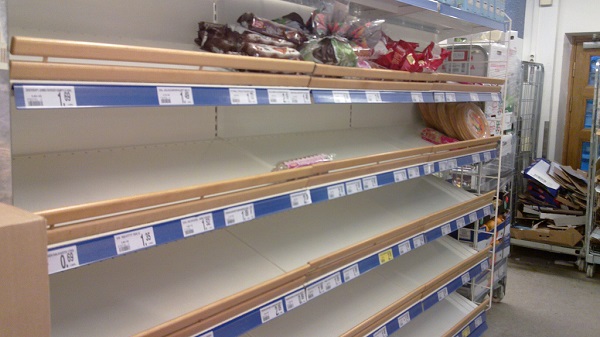
That doesn’t mean the shelves are going empty.
It doesn’t prove a trucker strike is coming.
But it sure isn’t nothing.
Do The Boring Work Before Everybody Else Does
So no, I’m not telling you to race to Costco and body-check somebody’s grandmother for the last 48-pack of toilet paper.
Please don’t.
And don’t start filling milk jugs, trash cans or whatever else you find lying around with gasoline. Fuel belongs in approved containers, stored safely and legally.
Instead, do the boring stuff.
Keep the vehicles comfortably above half a tank. Keep a reasonable supply of food, water, medications and household necessities around. Have a little cash available. If there’s something your family uses every week anyway, keeping an extra one or two on the shelf isn’t panic buying.
It’s inventory.
That’s what preparedness has always been.
Preparedness Isn’t Panic
Somewhere along the way, Americans started treating preparedness like it meant buying a bunker and a five-year supply of freeze-dried beef stroganoff.
It doesn’t.
Preparedness simply means turning an emergency into an inconvenience.
If diesel prices jump again, you’re prepared. If a refinery goes down, you’re prepared. If trucking gets squeezed, you’re prepared. If absolutely nothing happens October 1st, you eat the food you bought, burn the gasoline you already needed and go on with your life.
That’s the beauty of sensible preparedness.
There’s almost no downside.
October 2nd Is The Date That Matters
Maybe October 1st arrives and every truck in America keeps rolling.
I hope that’s exactly what happens.
In fact, based on what we can document today, that’s a whole lot more reasonable than assuming some giant coordinated nationwide shutdown is coming.
But here’s the uncomfortable part.
On October 2nd, the EIA’s $6.285 diesel problem won’t disappear because an internet rumor was wrong.
The Joliet refinery won’t magically make up every gallon lost during its shutdown. The damaged Saudi pipeline won’t repair itself overnight. Farmers will still be harvesting. Railroads will still be charging fuel surcharges. Trucks will still have to move groceries, livestock, medicine, lumber, fertilizer and practically everything else we touch.
And the federal government’s 90-day fuel-hauling waiver will still be in effect until December 16th.
Which brings us back to that rumor.
The October 1st trucker shutdown isn’t the story.
The story is why millions of Americans heard it and immediately thought, Yeah, I could see that happening.
They’ve watched diesel climb above six bucks. They’ve watched farmers spend as much as $1,500 a day fueling combines. They’ve watched rail fuel surcharges jump 153 percent.
They’ve watched Russian refinery capacity get hammered, a critical Saudi pipeline get hit and one of the Midwest’s major refineries suddenly go dark.
Then they watched Washington quietly loosen trucking rules to keep fuel moving.
So maybe the internet picked the wrong date.
Maybe it invented an event that isn’t happening.
But it stumbled onto a very real nerve.
Food supply is national security. Fuel supply is national security. And the men and women who physically move this country can’t keep doing it forever when every mile costs more than the mile before it.
So keep the tank comfortably full.
Keep the pantry stocked.
Keep your head on a swivel.
And don’t worry nearly as much about October 1st as you do about what comes after it.