 Print
Print
Defensive handgun use requires many variables to ensure success from point of aim to point of impact. Everything from handhold and trigger release to breathing and follow-up shots will have some impact on whether you hit your target with lethal force. The shooting stance, however, may help to put these other variables more naturally into place and ensure a stable platform from which you can launch an accurate and threat ending attack.
A quick disclaimer: Always obtain proper instruction and utilize practice time. Seeking outside opinion to ensure you understand the different variables in defensive handgun use will do more to help you in a potential future situation than reading any article or trying to interpret any set of information on the topic. Proper instruction is a game changer, and you are encourages to obtain it where possible.
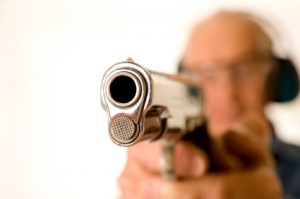 There are two more common stances in defensive shooting that most shooters recognize today: the isosceles stance and the Weaver stance. Essentially every other stance in defensive handgun aim is a derivative of one of these two stances. They tend to be the most natural, are usually the easiest to understand, and are certainly the most well known.
Each stance has its own set of benefits, and neither one could probably be proven to be better than the other given a wide range of specific defensive situations. That being said, the isosceles stance would provide an easier range of motion for situations that require larger field of view and potential danger from more than one or two acute angles. It allows the shooter to adopt a natural defensive position and pivot or rotate the upper body to accommodate wider angles.
The Weaver stance is the one you’ve probably seen in movies or adopted by police and military shooters, and it offers an excellent and accurate platform for delivering projectiles at the target while minimizing the upper body profile.
Isosceles Shooting Stance
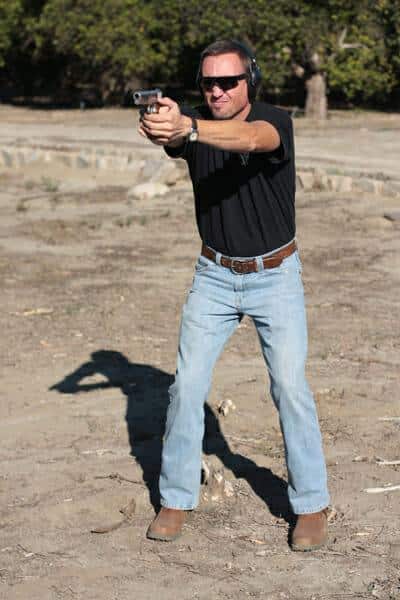
In the isosceles shooting stance, you will stand facing your opponent/target with your feet approximately shoulder width apart, a slight bend to the knees and the handgun pointing towards the target with straight and locked arms to form an isosceles triangle in the space on the interior of your arms and chest. Squared shoulders and non-moving arms will form the triangle, help control recoil, and put you back on target faster for follow-up shots.
The isosceles shooting stance is about as basic and yet repeatable and usable a stance as was ever engineered, and as such, many mainstream shooting schools as well as many local instructors teach it as one of the basic shooting stances and perhaps the one shooter should rely on in most circumstances. It’s comfortable, strong, and easy to implement when dealing with stressful situations like a potential firefight.
Weaver shooting stance
In the Weaver shooting stance, you should be standing feet at shoulder width with your weak side leg forward and your strong side leg slightly back, as though you were going to gain momentum for throwing a punch with your strong side (the pistol hand). Your weak side (or the supportive side) will be moved toward the target so that your torso
twists slightly sideways to give a smaller profile from direct impact. Knees will be slightly bent to allow better recoil absorption and side to side movement as well as balance. Your upper body should be slightly forward as though fixed on the target like a hunting dog pointing towards birds. You will push with your strong hand as hard as you pull back with your support hand as though to equalize the pressure and return to the point of aim easily, while absorbing the maximum amount of recoil. In equalizing the pressure, you will have hand against hand, your strong hand will be slightly bent, and your support hand will be bent more, so that the elbow is almost pointing downward. This position will be one that is in the same direction as if you were using an isosceles triangle stance and yet not quite fully extending with either arm. The longer arm is the strong (shooting) arm.
Keep Your Handgun Locked and Loaded, Ready For Instant Use – Without Fear Of An Accident!
Many professional shooters, writers, and those in the know are proponents of this stance, which was invented by Jeff Weaver. Jeff Cooper, perhaps one of the most well-known shooting instructors and pistol experts, was one of the more mainstream adopters of this stance.
Both of these stances can be “modified,” and each even has a specific stance that denotes its modifications.
A modified isosceles shooting stance encourages the shooter to put more pressure on the forward areas of the feet to keep from becoming “flat footed” and losing balance. By bending the knees and moving slightly forward to center the weight over the front of the feet, a shooter will have more availability to a “spring in the step” and will have access to more balance. The springiness brought on by this modified stance should also promote easier gun control and faster follow-up shots.
A modified Weaver stance encourages the shooter to lock the strong arm forward as though in an isosceles stance to minimize forward sight movement. Overextension, and therefore weak gun purchase, is minimized by maintaining the reverse pressure from the support hand as in the standard Weaver position.
Additionally, other stances continue to be introduced to defensive handgun shooting as well-known schools and the military increase research and development budgets and put more bullets downrange to test theory. More “tactical” stances have been introduced of late as the U.S. prepares to exit a decade of war in which close-quarter combat and defensive handgun shooting has been more prevalent than most other conflicts in history.
One does not need to adopt a specific stance to shoot well. In fact, the repeatability of such stances will be hindered in stressful situations, and therefore, the most natural feeling and most often practiced stance will likely be reverted to as you deal with outside influences. Every situation will present a new set of variables and potentially the need for a different stance or to use the stance combined with movement of cover. Having an excellent knowledge of multiple stances will put you in a better situation to defend yourself in a defensive shooting situation.
©2012 Off the Grid News