 Print
Print
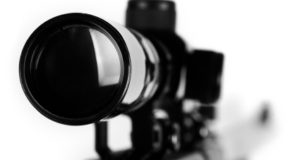 Long-range rifle shooting is the art of shooting a rifle to what you consider to be long range. Whereas most people will define it as a fixed distance, realize that when you’re new, even 100 yards might seem like an impossibly far distance. Essentially, as your comfort level grows with your weapon, you’re going to want to expand your practice and reach out further and further. Realistically, long range is considered anything past 500 yards. Most people put true long-range shooting at 1,000 yards or greater. One thing that has to be considered is that at 1,000 yards, there are many factors besides your weapon to take into account. Temperature, barometric pressure, and wind all play a factor as to where the round will go. Optics are also another factor to consider. Both environmental conditions and optics are so detailed a topic that an entire book could be devoted to each, meaning that these topics are outside the scope of this article. The basics, however, are not. Let’s start with the rifle itself to begin with.
The Rifle
There are certain types of rifles that lend themselves to long-range rifle shooting and some which do not. The very first consideration that you will notice is barrel length. Long-range rifles tend to have longer barrels, starting usually at twenty inches and progressing all the way up to twenty-four to twenty-six inches for a true long-range rifle. Longer barrels than that are entirely possible. The main reason for a longer barrel is increased accuracy. The length of the barrel gives the bullet more velocity, and a longer-barreled rifle is simply more accurate – and easier to aim – than a shorter-barreled one. Try shooting a handgun with a four-inch barrel at a target 200 yards away, and then try that with a twenty-inch-barreled rifle. You’ll most likely hit with the rifle every time, caliber considerations aside.
Action is another consideration. The action of a rifle is the operating system it uses in order to chamber and fire the bullet. For over a century, the best long-range rifles were bolt-action guns; only recently have semi-automatic rifles arisen that can challenge them.
How to hide your guns, and other off grid caches…
Caliber is the final part of the equation. No matter how long the barrel is or how finely built the bolt action is, a small, light bullet will not make it out to 1,000 yards plus. Take the .223 Remington, for example. It’s more or less the same bullet used in the 5.56 NATO M16 rifle used by our armed forces. It’s a sixty-five-grain bullet that is travelling at approximately 3,000 feet per second when fired. Its mass, however, is miniscule, and the bullet simply does not have the dynamics to reliably reach ranges of 1,000 yards. It just lacks the horsepower, plain and simple.
The starting point for most long-range calibers is usually a .30 caliber full-sized rifle round of some sort, with .308 Winchester and .30-06 Springfield being among the most popular off-the-shelf rounds. There are literally hundreds of rounds that are considered long-range capable rounds, and some of them are extremely exotic and expensive. On the production end, .300 Winchester Magnum is a fine round that can be bought just about anywhere; on the high end, .338 Lapua Magnum is a ridiculously powerful cartridge that costs several dollars per round.
Basically, you can’t go wrong with a bolt action .308 with a twenty-four-inch barrel to start out with. Remington makes some fine off-the-shelf rifles that are configured as such – its legendary 700-series rifles fit the bill quite nicely.
Considerations for the Beginner
The reason why you want a low initial outlay for your first long-range rifle is that remarkably, most of your cash will be spent on ammunition to really learn how to shoot it. You will literally spend more on the ammunition than you will on the rifle and optics in the long run, because even .308 ammunition is relatively expensive compared to handgun rounds.
Start small, and start close. Your first sessions should be at the 200-yard-or-less range, to really get you dialed in. There are several good reasons for this – errors or bad habits made at 200 yards are dramatically magnified at longer ranges. Being one inch low at 100 yards could translate to you being several feet off at 1,000 yards – meaning you won’t even be able to hit the target. The main thing you need to work on initially is steadiness: steadiness of grip, steadiness of trigger squeeze, and steadiness of breathing. You need to condition yourself to be super still and focused. When you can achieve a single-hole (or single ragged hole) group at 100 yards, then go out another 100 yards, and further after you progress. Starting out at 800 yards or more will only lead to frustration – do yourself a favor and start small. Long-range shooting can be very rewarding if you teach yourself to be methodical about it. Give it a try!
©2013 Off the Grid News