 Print
Print
Smart Money Is Quietly Moving Back Toward “Hard Assets” And Beijing Seems To Be Leading The Way
China Just Said No To Paper Money… Here’s Why Homesteaders Should Be Listening
Something strange happened in China this summer, and almost nobody sitting around an American kitchen table heard about it. China’s biggest exchange-traded fund isn’t a stock fund anymore.
It’s gold.
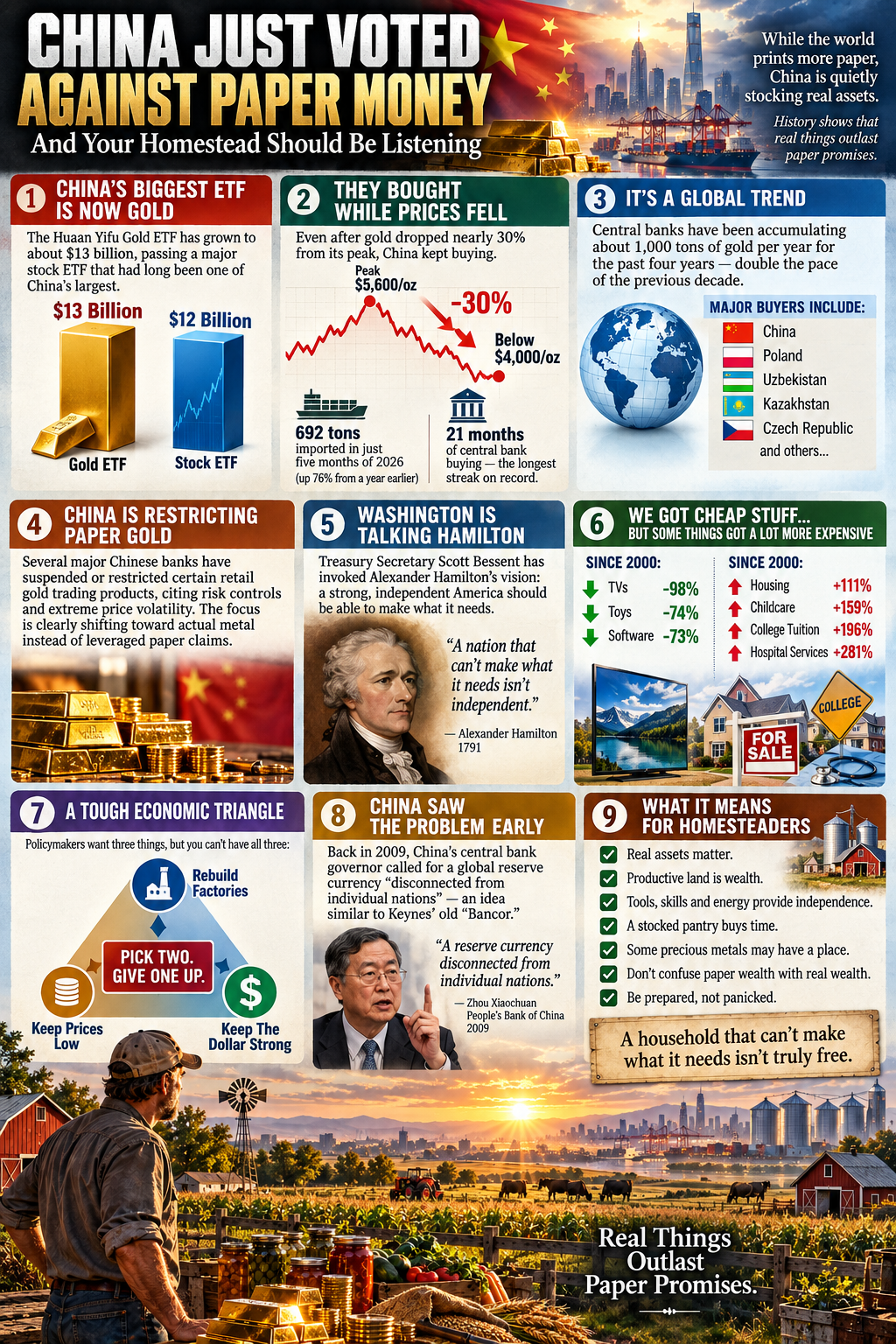
The Huaan Yifu Gold ETF climbed to roughly $13 billion in assets, passing the Huatai-PineBridge CSI 300 ETF, which had long been one of the giants of China’s investment world. In other words, a massive pile of Chinese investment money has migrated toward metal at a time when confidence in Chinese equities has been shaky.
Now, that doesn’t mean every Chinese family emptied its brokerage account and bought gold bars. Far from it. But it does tell us something about where a meaningful amount of Chinese money is looking for shelter.
And the timing makes the story considerably more interesting.
They Bought While Gold Was Getting Hammered

Gold hasn’t exactly enjoyed a smooth ride this year. After a tremendous run higher, the metal suffered a nasty correction — exactly the kind of move that normally sends nervous investors running for the exits.
China went shopping.
Chinese gold imports reached roughly 692 metric tons during the first five months of 2026, about 76% more than during the same stretch a year earlier. May alone brought in roughly 163 tons, the biggest monthly haul in more than two years.
Meanwhile, the People’s Bank of China kept adding to its own pile. By July, China’s central bank had purchased gold for 21 consecutive months, the longest buying streak on record, with another 20 tons added during July alone.
That’s starting to look less like somebody chasing a hot trade and more like a farmer stocking the pantry. When canning lids, diesel filters or chicken feed finally go on sale, you don’t complain because they were cheaper last month.
You fill the shelf.
Everybody’s Hauling Something Back To The Barn
And China isn’t alone. Central banks around the world have been accumulating gold at historically elevated levels, with countries increasingly interested in an asset that isn’t simultaneously somebody else’s debt.
China’s buying has been particularly persistent. The World Gold Council’s latest figures show the People’s Bank of China continuing its 21-month buying streak, with the pace actually picking up during recent months.
That doesn’t mean governments have suddenly sworn off dollars, bonds or other reserve assets. They haven’t. But when central banks keep stacking an asset that nobody can manufacture with a keyboard, it’s worth asking why.
Because gold has one peculiar characteristic.
Nobody else’s promise is attached to it.
A Treasury bond requires the United States to pay. A bank deposit requires the bank to remain solvent. A corporate bond requires the company to make good.
An ounce of gold just sits there.
That sounds almost laughably simple until the financial system gets complicated.
China Started Closing Some Paper-Gold Doors
Then another curious development appeared. Several major Chinese banks began suspending or restricting certain retail precious-metals trading products connected to the Shanghai Gold Exchange as gold prices became exceptionally volatile.
The banks publicly described the changes largely as risk-control measures, particularly around leveraged trading. That’s important context, because it would be going too far to claim Beijing simply ordered its citizens out of “paper gold” and into physical bullion.
Still, watch the direction of travel. At the same time China’s central bank is accumulating physical gold and enormous amounts of bullion are flowing into the country, Chinese financial institutions are becoming more cautious about leveraged retail claims on that same metal.
That’s interesting all by itself.
Then Washington started talking about Alexander Hamilton.
The Ghost Of Hamilton Walks Back Into Washington
Treasury Secretary Scott Bessent published an essay titled “Hamilton Inspires Trump’s Economic Statecraft.” He followed that theme in a June speech laying out an economic strategy built partly around domestic industrial capacity and reducing dangerous foreign dependencies.
Bessent reached directly back to Hamilton’s argument that economic security begins at home — with the capacity to build, invent and produce the industries a country needs. In Bessent’s telling, that includes semiconductors, shipbuilding, critical minerals, pharmaceuticals, advanced manufacturing and other strategically important industries.
To understand why that matters, go back to December 5, 1791, when Alexander Hamilton delivered his famous Report on the Subject of Manufactures to Congress.
America was still a startup country then — roughly four million people, mostly farmers, with comparatively little industrial capacity. We had just fought an empire for political independence while remaining dependent upon foreign manufacturers for all kinds of things we needed.
Hamilton saw the problem.
Political independence doesn’t mean nearly as much when another country controls the things you absolutely have to buy. Any homesteader who’s watched a perfectly good tractor sit dead for three weeks because one little part is floating around on a container ship understands the principle immediately.
Hamilton wanted America to make more of what America needed. His program included protective duties and government encouragement for developing industries, partly because he believed domestic manufacturing made the young country more secure and less dependent upon foreign powers.
That’s not really an 18th-century idea.
It’s a barnyard idea: If you can’t replace what breaks, eventually somebody else owns your schedule.
When The Shop Floor Goes Quiet
Here’s where the story gets uncomfortable. Over time, wealthy countries can gradually shift from making things toward financing things, and eventually the balance sheet starts looking more important than the factory floor.
Factories become investment vehicles. Houses become financial assets. Companies discover that engineering the balance sheet can sometimes produce faster rewards than engineering a better machine.
That’s financialization.
Imagine owning a beautiful farm with a seven-figure appraisal, a fat retirement account and excellent credit — but no tractor, no tools, no seed, no livestock and no way to fix the well. On paper, you’re wealthy.
Right up until something quits working.
America’s long shift toward overseas production has plenty of causes — technology, labor costs, productivity, trade policy, taxes, regulation, currency movements and global supply chains among them. It can’t honestly be pinned on one president, one political party, one trade agreement or even one year.
But the result is visible.
A lot of things Americans once made here are now made somewhere else, and Washington is openly wrestling with how much industrial capacity needs to come back. Bessent himself has described economic security and domestic productive capacity as increasingly intertwined.
Cheap TVs… Expensive Life
To be fair, Americans received something in exchange. Globalization, improved manufacturing and technology made many consumer products astonishingly cheap.
A television that once represented a serious household purchase can now cost less than a weekend grocery run. Electronics, toys, appliances and countless manufactured goods became cheaper or dramatically better for the money.
But look at the other side of the ledger.
Housing, medical care, childcare and higher education have all become far more expensive over the past quarter-century. In broad terms, many of the things that can be manufactured somewhere cheap and stuffed inside a shipping container became cheaper, while many things that must be produced or delivered locally became more expensive.
Try explaining that trade to a young couple attempting to buy five acres, raise three kids and live on one income.
The flat-screen television is practically free. The farmhouse isn’t.
And out here in farm country, that’s not an academic argument. It’s one reason a family can own productive acreage, machinery and livestock and still need somebody driving into town every morning to collect a paycheck.
Washington’s Three-Cornered Problem
Now policymakers are wrestling with an ugly economic triangle. They would like a stronger domestic manufacturing base, affordable goods for American households and the advantages that come with a strong, globally important dollar.
Those goals can pull against one another.
A strong dollar makes imported products cheaper for Americans, but it can also make American-made products more expensive for foreign customers. A weaker dollar can improve the competitiveness of U.S. exports, but it can also raise the price Americans pay for imported goods.
Tariffs can protect some domestic producers, but their costs don’t simply disappear into thin air. Depending upon the product, supply chain and market conditions, some of those costs can show up in consumer prices, lower company margins or changes in where companies source their goods.
There isn’t a magic wrench hanging on the pegboard that fixes all three problems at once.
That’s where gold enters this story.
Not necessarily as the answer — but as a clue.
China Saw The Problem In 2009
Beijing has been thinking about the international monetary system for a long time. Right after the 2008 financial crisis, People’s Bank of China governor Zhou Xiaochuan published a remarkable proposal questioning whether the world should remain so dependent upon a reserve currency issued by one particular country.
His goal was explicit: create an international reserve currency “disconnected from individual nations” and capable of remaining stable over the long run. Zhou pointed back toward ideas associated with John Maynard Keynes and toward the IMF’s Special Drawing Rights as possible building blocks for a different international monetary system.
Think about China’s problem at the time. It had accumulated enormous reserves by selling real goods to the rest of the world, only to discover that much of its national savings consisted of IOUs denominated in currencies controlled by somebody else.
That’s a strange arrangement when you think about it.
You ship somebody tractors, steel, electronics, machinery and tools. They hand you pieces of paper promising purchasing power sometime later.
That works beautifully as long as everybody trusts the paper.
We Were China Once
There’s another irony hiding in this story. Keynes had proposed an international accounting unit called the Bancor during the Bretton Woods negotiations, designed in part to put pressure on countries running persistent trade deficits and persistent surpluses.
America rejected Keynes’ version of the system.
And there was an obvious reason: America was sitting in an extraordinarily powerful position after World War II, with tremendous industrial capacity and enormous gold reserves.
We were China.
We manufactured the goods. Other countries needed what our factories produced, and dollars flowed through the growing postwar economic system.
But systems have a funny way of changing once the country sitting on top begins running persistent deficits instead of surpluses.
An Old Bretton Woods Argument Comes Back To Life
Now some of those old arguments are creeping back into public conversation. U.S. Trade Representative Jamieson Greer has explicitly argued that modern trade theory needs to reconsider the costs of globalization, dangerous import dependencies and the consequences of large trade imbalances.
Greer has also pointed back toward Keynes, noting that the architects of the postwar system understood that unrestricted trade could create serious imbalances and dangerous dependencies. That’s remarkable because arguments that once sounded like dusty economic history are suddenly being discussed by people actually shaping U.S. trade policy.
Then there’s former IMF chief economist Kenneth Rogoff.
Back in 2016, Rogoff argued that emerging-market central banks should consider shifting a significant portion of their foreign-currency reserves into gold. His reasoning contained one little sentence worth remembering: gold is in nearly fixed supply, but there is no limit on its price.
That’s an odd fact with enormous implications.
You can’t suddenly manufacture another Fort Knox full of gold. But the market can change the dollar value assigned to every ounce already sitting there.
The Number That Makes Your Eyebrows Jump
This is where we need to separate documented facts from a much more speculative theory. Some macro analysts have argued that a substantially higher gold price could eventually allow gold to play a larger role as a neutral settlement asset between countries or economic blocs.
China’s numbers make the thought experiment tempting.
If countries ever attempted to settle enormous international trade imbalances using a relatively small quantity of physical gold, the arithmetic would obviously require a gold price vastly higher than today’s. That’s where eye-popping estimates — including figures approaching $38,000 an ounce in some scenarios — enter the discussion.
But understand what that number is.
It’s a scenario, not a forecast.
There is no publicly announced U.S.-China agreement to revalue gold to $38,000 an ounce, and there is no evidence that either government has officially selected such a price. It’s an intriguing monetary theory, but that’s a long way from being an established plan.
Still, the basic mathematical point behind the theory is worth understanding. Gold’s physical supply changes slowly, so if governments ever demanded that a relatively fixed pile of metal carry a dramatically larger monetary burden, most of the adjustment would have to occur through price.
That’s exactly the characteristic Rogoff pointed toward years ago.
Then There’s Fort Knox
Another curious piece of the puzzle appeared this summer. Bessent said America’s gold at Fort Knox was “present and accounted for,” while pointing out that the United States possesses the world’s largest official national gold stockpile.
Official Federal Reserve data continue to show roughly 147.3 million fine troy ounces of Treasury gold held at Fort Knox.
Again, none of that proves some secret monetary reset is coming. The modern dollar isn’t redeemable for gold, and the Treasury continues carrying its gold on the government’s books at an old statutory valuation far below today’s market price.
But put the pieces on the kitchen table.
China is importing enormous quantities of bullion. Its central bank has been accumulating gold month after month. China’s biggest ETF became a gold fund, while American officials are suddenly talking about Hamilton, industrial independence, trade imbalances and Fort Knox.
That doesn’t prove a grand theory.
But it sure gives us something worth watching.
What All This Looks Like From The Barn Door
Maybe the grand monetary theories are wrong. Maybe gold remains simply one reserve asset among many, China’s purchases are mostly diversification, and the dollar-centered financial system keeps lumbering along for decades.
That’s entirely possible.
But something deeper is already happening whether gold becomes the centerpiece or not. Governments are rediscovering the difference between financial wealth and physical capacity.
Factories matter. Energy matters. Mines matter. Machine tools matter. Farms matter.
And the ability to produce essential goods at home matters.
Hamilton understood that before anybody had heard of ETFs, derivatives, semiconductor fabs or computerized high-frequency trading. A nation can have an impressive balance sheet and still discover, when trouble arrives, that the important question is much simpler:
Can you actually make what you need?
Real Wealth Has Dirt Under Its Fingernails
For the homesteader, that’s probably the most useful lesson buried inside this whole strange story. This isn’t an argument to empty your retirement account and back the pickup truck up to the nearest coin shop.
Nobody knows where gold trades next year, much less ten years from now. Gold can plunge, stocks can soar, interest rates can change and governments can reverse course faster than a thunderstorm rolling across a bean field.
Direction and timing are two completely different things.
But there is something worth remembering. A household can look wealthy on a spreadsheet and still be fragile.
So can a country.
A family with productive soil, stored seed, a reliable well, a stocked pantry, useful tools, livestock, firewood, mechanical knowledge and neighbors it trusts possesses a kind of wealth that doesn’t appear neatly on a brokerage statement.
Maybe some precious metal belongs somewhere in that picture for some families. Maybe it doesn’t. That’s a personal financial decision, and nobody should make it because of one article or one scary headline.
But productive assets and useful skills are different.
A wrench can fix something. Seed can grow something. A cow can feed somebody.
Land can produce.
And knowledge can’t be shut off because a server went down.
That’s the part of Hamilton’s argument that still sounds pretty good from a Northern Illinois barn door 235 years later. A household — or a nation — that depends completely on somebody else for everything it needs isn’t truly independent.
China appears to be thinking harder about that. American policymakers are openly debating industrial capacity and economic security again, too.
And whether gold eventually becomes a much bigger part of the monetary system or simply remains the world’s oldest financial insurance policy, the lesson from the barn doesn’t change:
Own some useful things. Know how to do useful things. And don’t confuse a pile of paper with the ability to produce.