 Print
Print
There’s no way around it. We just can’t control nature. If the forecast calls for an extended hot, dry period, our gardens may end up experiencing drought conditions. If we’re fortunate, we can just turn on our irrigation systems. But there may be limited water for irrigation, water conservation may be important to you, or perhaps you just don’t want to see your water bill balloon. If you want to minimize your garden’s water consumption — either by necessity or choice — check out these tips.
1. Water only when needed
There’s a lot of different advice out there about how often to water your garden. How do you know which advice to follow?
Your plants will let you know when they need water. All plants tend to wilt during extreme heat, regardless of how much moisture they have. However, if your plants are drooping during the cooler morning or evening hours, they need water. Big-leaved plants (like melons and squash) are the ones to watch, since they are more susceptible to wilting. If you spot a wilter in the morning or evening, it’s time to water the entire garden.
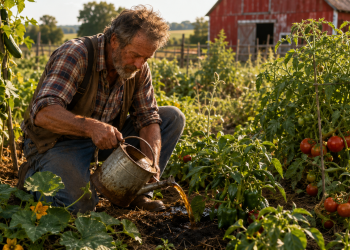
You also can test your soil, and you don’t need complicated equipment to do so. Just stick your finger into the soil. It’s normal for the top 2-3 inches to be dry; but if that dryness goes deeper than 3 inches, break out the watering cans.
2. Use greywater, wastewater and/or rainwater
Greywater can be difficult and costly to gather unless you already have a greywater recycling system installed. If you do, you’re good to go. I don’t; however, I do re-use the water from my family’s kiddie pools in my garden.
The All-Natural Fertilizer That Can Double Your Garden Yield!
I also collect rainwater, and I’m hoping that most committed gardeners do, too. Rainwater always should be your first choice for watering. It doesn’t have the salt, minerals or chemicals that treated city water, groundwater and surface water all have. Rainwater is slightly acidic, which can help neutralize the alkalinity of municipal water and greywater, if you use those on occasion. Also, it has nitrates (aka nitrogen, which is crucial to plant growth) and some organic matter for extra nutrients. Don’t just collect rainwater in case of drought; collect and use it throughout your growing season.
3. Water in the early morning or late afternoon
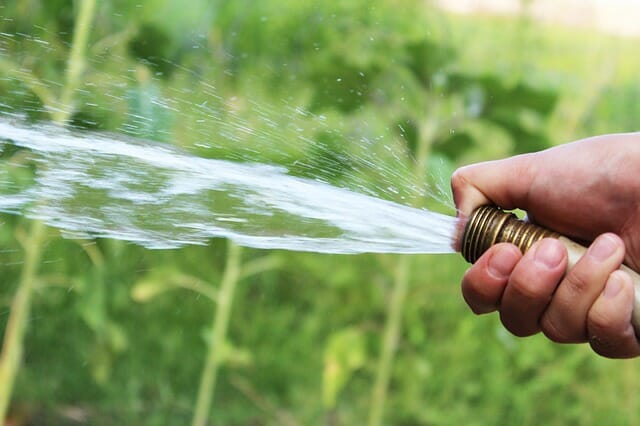
Cool early morning hours are best for watering because soil — and plants — will have a chance to absorb the moisture before it evaporates in the heat. If you’re not up with the birds (I’m a night owl myself), then invest in a timer for your outdoor faucet, or water in the late afternoon instead. It will start to cool down by then, minimizing evaporation, but it also will give the foliage a chance to dry before night falls, which is important for disease management.
4. Avoid sprinklers
Sprinklers are fairly inefficient devices, spraying water indiscriminately within their reaches. That said, hand-watering can be a chore in a large garden. An easier option is a soaker hose; even better is a drip irrigation line. Since soaker hoses spray water over a smaller area than sprinklers, there’s less waste. However, unless you can find a hose that is the exact length of your row or bed, there will be some inefficiency, since water is emitted from the entire length of the hose. Drip irrigation systems are more expensive to buy and more complicated to set up, but their emitters can be directed over plant roots for the highest efficiency.
5. Water deeply and infrequently
Watering deeply will help your plants develop a large, strong root system as the roots seek water deep beneath the surface. Deep roots have access to more moisture, meaning you won’t need to water as frequently.
How much water does your garden need? Start with a guideline of 1 inch of water per week, but you will need more in hotter temperatures. For every 10-degree increment over 60 degrees Fahrenheit, add an extra ½ inch of water. For example, today’s daily average temperature in my part of the world was 72 degrees (a high of 86 + a low of 58 divided by 2 to get the average). Since this is representative of the week, I should assume my garden needs 1 ½ inches of moisture this week.
It’s best to get watering done in one go so that it soaks deeply into the soil. You may even want to water right after a rain. Using the above example, if I got half an inch of rain overnight, it would be best to give my garden an additional inch of rain in the morning. Then I wouldn’t need to water again until my big-leaved plants droop or my soil feels dry at a depth greater than 3 inches.
6. Make trenches or reservoirs
Shallow trenches between rows or reservoirs around the bases of plants can help collect runoff water. Trenches also can serve much the same purpose as soaker hoses. If water is slowly trickled into a trench, and let run until the trench is saturated, roots near the trench will have access to that water.
Do you have any other tips for minimizing the amount of water used in your garden? If so, let us know in the comments below.