 Print
Print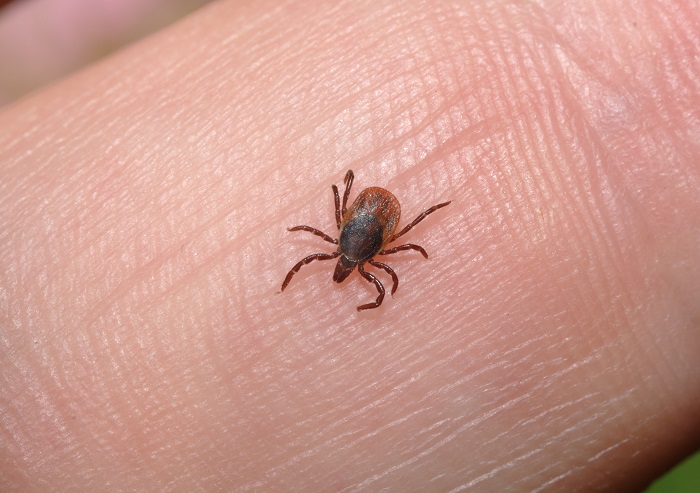
When you have been hiking or working in a wooded, grassy or weedy area, you may come home with an unwanted “hitchhiker.” It is tick season throughout much of the country.
Ticks are classified as arachnids (the classification that includes spiders) and feed on animal and human hosts. They belong to a group of mites, but even though all ticks are mites, not all mites are ticks. There are many kinds throughout the nation and the world. Fortunately, however, only a few types are of concern to humans and our pets.
Ticks can range in size from as small as a poppy seed to as large as a pencil eraser. They can be brown, reddish brown or black. When they find a host and take in blood, they enlarge. Some feeding ticks can grow as large as a marble.
They usually remain attached to a body for several days or even longer before detaching themselves and falling off. As they feed, they can change to a greenish blue shade.
Although most tick bites do not transmit disease – and most people are bitten without even knowing it – there are some tick prevention steps you can take to help keep you and your family safe from infection or disease, including Lyme disease.
Named after the town of Lyme, Connecticut, where the disease was first identified in 1975, Lyme disease and the chronic inflammation it causes is on the rise in the U.S. According to the Centers for Disease Control and Prevention (CDC), about 300,000 new cases of Lyme disease are diagnosed each year.
Here Is What You Need To Know:
- Ticks must feed for 36 to 48 hours in order to transmit Lyme disease, so your best preventative step is a full body check after you have been in a woodsy or grassy area. Ticks like to hide in folds of the skin and in dark places, so be sure to check the head and scalp, armpits, in and around the ears, the belly button, between the legs, around the waist and behind the knees.
- Bathe or shower in hot, soapy water as soon as possible after being outdoors to wash off any ticks or tick bite areas.
- Inspect clothing for ticks. Tumble dry your clothes on high heat for at least 20 minutes to kill ticks you may have missed on your clothing.
- Keep grassy and weedy areas trimmed on your property. Reduce or remove woodpiles where ticks tend to live.
- Keep your pets away from grassy pastures, prairies and wooded areas, if possible.
- Wear a hat, tucked-in long-sleeved shirt, long pants with cuffs or tuck your pants cuffs tucked into your socks when entering areas that might be tick-infested. Wearing light-colored clothing enables you to spot ticks more easily than dark clothing.

Removal Methods
Although many people swear by their own methods of removing ticks, including applying nail polish, nail polish remover, liquid soap or petroleum jelly to the tick, these methods are not foolproof and, in fact, may cause the tick to burrow more deeply into the skin.
The use of a hot match or cigarette may cause the tick to burst and, as a result, may put you in contact with the pest’s infected body fluids. For the same reason, avoid touching the tick with your bare hands. There have been cases in which humans have acquired spotted fever through a small scratch or cut.
Removal Process
If you do find an attached tick, the best way to remove it is with tweezers or a tick removal tool (available online or in most pet stores). Prompt removal lessens the chance of infection by Rocky Mountain spotted fever and Lyme disease.
- Grasp the tick’s head as close to the skin as possible, and then pull it straight out with steady pressure. It is normal for the skin to pull slightly as it would if you pulled out a hair.
- Clean the area well with soap and water and then wipe the area with an antiseptic.
- Wash your hands thoroughly.
- Circle the location of the tick bite with a permanent marker.
- Then check the bite location every few days. Seek medical attention promptly if you see signs of a rash or further inflammation or if you experience soreness or flu-like symptoms. Lyme disease is curable if treated in its early stages.
Disposal of the Tick
Safely dispose of the removed tick by placing it in a container of rubbing alcohol, sticking it to adhesive tape or flushing it down the toilet. Some health departments and university extension services provide free testing for disease. To do this, place the insect in a small, lidded jar or a zippered plastic bag along with a few blades of green grass (to provide moisture). Store the container in a cool place until you can take it to your health agency for inspection.
Some ticks are so small that they are difficult to remove. You can ask your doctor to remove it for you. Also, see your doctor if all parts of the tick cannot be removed.
Few a few precautions, you can prevent ticks from ruining your summer.