 Print
Print
I happen to be fortunate that I live in a somewhat undeveloped bedroom community. I call it somewhat undeveloped because we don’t have all the things that you would normally expect a community to have. I have to drive six miles each way to the grocery store, about the same to the hardware store, and a mile if I need a gallon of milk. One other thing about this community: While we have running water, we have no sewage system.
Many of my neighbors are actually upset about this — complaining to our city government, because they haven’t invested however many millions of dollars it will cost to put in a sewage treatment plant and then another so many million dollars to tear up all of our streets and put in sewage lines. But to me, it’s a blessing in disguise.
Remember the Carnival Cruise Line ship that was adrift in the Gulf of Mexico for five days, after an engine room fire, in 2013? Passengers testified that not only did the running water give out, but that human waste was running down and seeping under the walls, due to the lack of running water.
During a disaster when the electricity is out and there is no running water, can you imagine how wonderful your neighborhood will smell when everyone’s sewage is backed up, due to a lack of running water? If there isn’t enough electrical power to run the pumps for our water, I can guarantee you that there won’t be enough power for the sewage pumps, either.
Without running water and in some cases pumps to pump the sewage, there is literally nowhere for it to go … at least, not for most people.
But for those of us who are still on old-fashioned septic systems, well, that’s another story. While my septic system still requires water, it doesn’t require anywhere near as much water as the city sewer system does. As long as I have enough water to flush my toilets, I won’t have to dig an outhouse or bag up human waste for disposal.
How a Septic System Works
But first, let me explain how a septic system works. Most home systems consist of two 500 gallon tanks, connected together and buried in the backyard. All the drain water from the house enters the first tank, where the solids settle out of it. The effluent (the liquid part, after the solids settle) flows through a short pipe mounted near the top of the tank and enters the second tank. When that tank reaches full, the water flows out of it to the leach field.
Get Free Backup Electricity — That Works Even During Blackouts!
The leach field is the secret of any septic system. The two tanks are there to collect solids and allow them to break down. Bacteria in the water attack the solids, doing their work in the recycling process. With two tanks, all the solids manage to settle, even the paper.
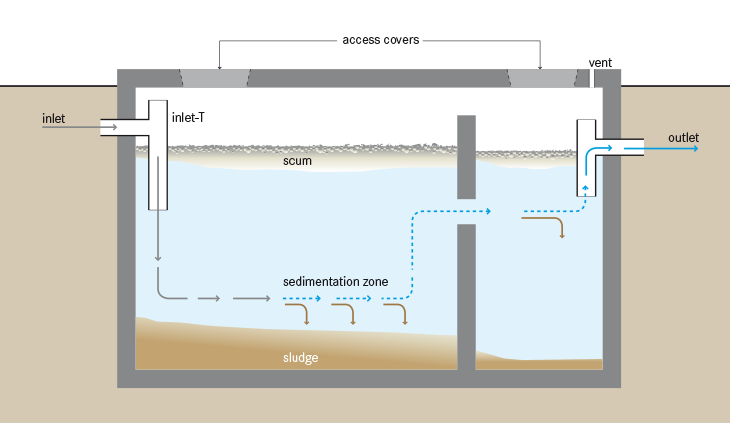
Four-inch pipes carry water from the tanks to the leach field. These pipes are perforated along the sides, allowing the water to flow out and into a gravel bed, where it can dissipate. Unfortunately, those holes also allow tree roots to find their way in.
The water entering the leach field is actually fairly clean, if you ignore the discoloration and the slight odor. Since the gravel bed is only a couple of feet below the surface of your yard, it can water the grass, trees and rose bushes. But most of it evaporates into the air, turning it into perfectly clean, pure water vapor, that falls to the ground once again as rain.
What Can Go Wrong?
The thing that most people don’t like about septic systems is that they have to be pumped out every two to three years. That’s to remove the solids which gather in the system. While the two tanks have a combined capacity of 1,000 gallons, you really don’t want more than about 300 gallons of solids, before the tanks are pumped out. That way, the water going into the leach field will be fairly clean.
Failure to pump out the system regularly could lead to solids going into the leach field and plugging up the pipes. My system actually had that happen. The builders had connected all the pipes from the house to the second tank, rather than the first, so the solids had a much easier time of finding their way to the leach field pipes than they should. Nevertheless, the system still lasted 32 years before the leach field had to be rebuilt.
It’s recommended to not use bleach with a septic tank system, because the same bleach that whitens your clothes and kills bacteria on surfaces, also will kill the bacteria in your septic tank, if you let it get in there.
The other big thing that can go wrong with a septic tank system is for tree roots to get into the leach field, the pipes and even the tanks themselves. I also had this happen to mine. Most contractors don’t use PVC cement when connecting drainage pipes together. This offers an opportunity for tree roots to find their way into the pipes. But that’s not the worst. If the drain pipes aren’t connected to the tank properly, then roots can get in there.
Roots in the pipes or in the entrance to the tanks will plug up your drains, eventually causing them to back up. The solution is to kill off the roots and clean out the lines with a power snake and a root cutter.
But tree roots are even more likely to get into the leach field than they are into the sewage pipes and septic tanks. While a few roots aren’t a problem, eventually they will reach a point where they can plug up the leach field pipes and prevent the water from actually reaching the gravel bed. When that happens, it’s time to replace the leach field.
Using Your Septic System as Part of Your Survival Plan
If your survival plan is to bug in, sheltering in place, you’ll want to make sure your septic system is ready for it. That means being sure to have the septic tank cleaned out on a regular schedule, perhaps even more often that necessary. That way, it will have capacity when you need it most.
The other thing you need to do is ensure that your leach field is in good shape. If your system is draining slowly, with the water not soaking into the ground as fast as it should, then it’s possible that you need to replace your leach field. The newer technology for leach fields is actually better, replacing the four-inch pipe with a two-foot wide leaching chamber. This has much more capacity, is cheaper to install, doesn’t require gravel and is more or less impervious to the problems caused by roots.
What advice would you add? Share it in the section below: