 Print
Print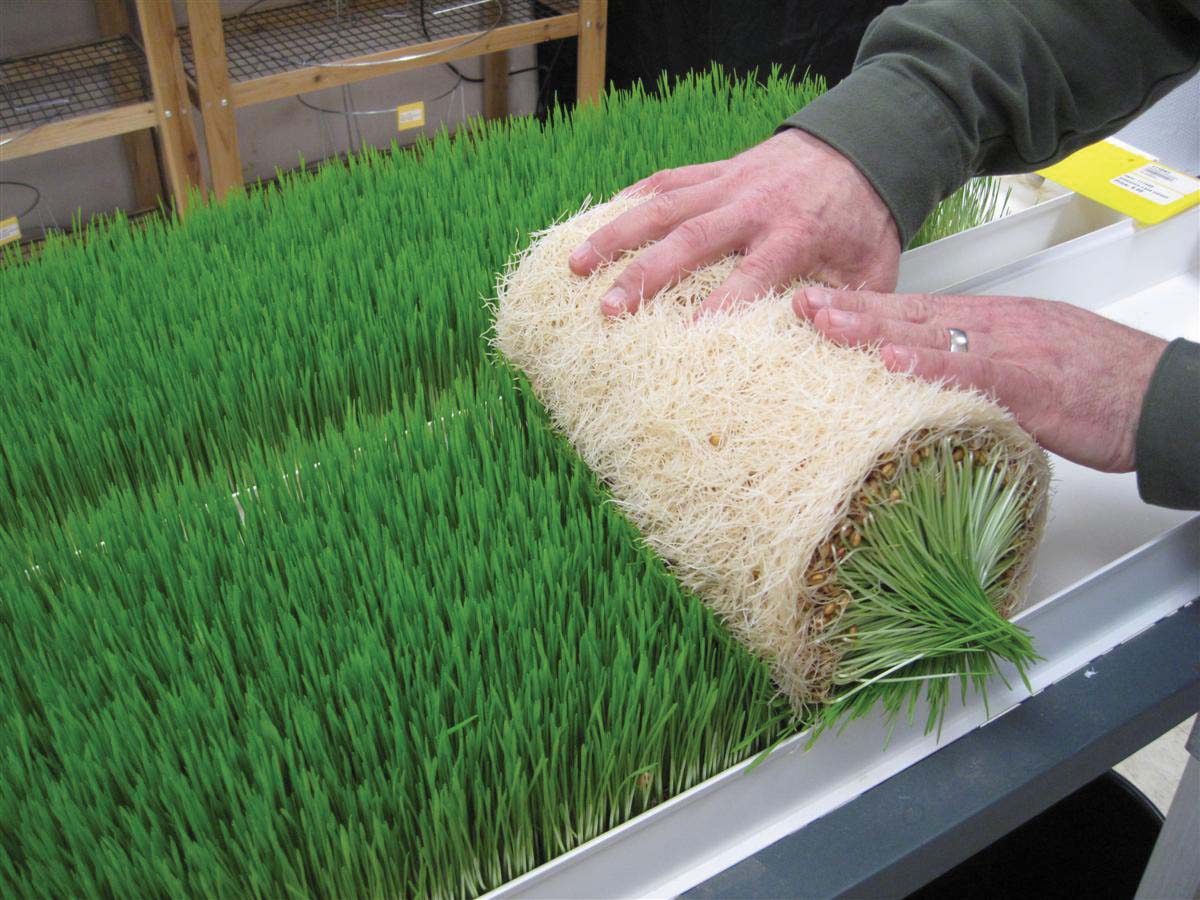
The practice of growing your own fodder has been around for generations. In recent years, though, there has been a resurgence of it due to the rising costs of feeds and hay, and the severe climates now normally seen every winter and summer. More and more farmers, both small homesteaders and big ranchers alike, are looking for ways to feed their livestock without relying on traditional sources and methods. And growing their own fodder is by far proving to be the most viable option.
Hydroponics is often used in growing organic fodder. It entails soaking grain seeds in water for several hours and placing them in growing trays to sprout for 6-8 days, after which a thick mat of green 6- to 7-inch grass is produced. All of it is fed – shoots, seed and roots — to chickens, geese, rabbits, pigs, goats, sheep, horses, cows and alpaca. Many different cereal grains are used — barley, wheat, oats, rye and corn – but legumes like soy, mung beans and alfalfa are also good. Of these, barley is the most preferred due to its speed of sprouting, thicker mass yield and higher level of nutrients.
The benefits of D-I-Y
Many who grow barley are reporting yields of 4 to 6 times the weight of the seed they sprout. A 50-lb. bag, for example, will produce for them 300 lbs of fodder in a week’s time. It therefore brings down feed costs to just a fourth or sixth of the price they would normally pay for 300lbs. of unsprouted grains or hay. Other benefits they’re citing of hydro fodder are:
- Reliability: on-site, on-demand, all-season availability.
- Sustainability: reduced or removed dependence on hay and feeds; plus, with large stocks of seeds in storage, feed supply is secure for many months and possibly years.
- Fresh, organic, non-GMO.
- Ease of digestibility, especially for ruminants which have difficulty digesting grain (less acidity problems).
- Presents less or no risk of parasitic diseases.
- Production requires little water and power, and no need for cultivated land or soil of any kind; small farmers can make their own systems at home, at low cost and in very limited space.
- No need for long-term feed storage and corresponding nutrient loss in standard grains; also, no need for large storage spaces for hay.
- Very palatable, complements the usual diets of most farm animals.
- Higher nutritional value.
- Lower cost.
A Question of Cost
Scientists are quick to question those last two items, however. They say hydroponic fodder provides just a fraction of the nutrients found in unsprouted grains or hay. Since energy and protein density is measured on dry matter (DM) basis, and the DM content of fodder is very low (at 12-15 percent, compared with 90 percent in conventional feeds), the amount of DM that’s needed in fodder to sufficiently meet an animal’s protein and energy requirements will have to be multiplied so many times.
New Survival Seed Bank™ Lets You Plant A Full Acre Crisis Garden!
Since much of the weight gained from sprouting seeds to fodder is just water, they say it would ultimately pull up over-all costs since you’d have to increase your animals’ rations so many times more.
Story continues below video
But farmers beg to disagree. Those who substantially complement their feeds with hydro fodder – or have switched to it entirely — are reporting increases in milk production and butterfat levels, lower parasite counts, elimination of foot problems, better coat/fleece quality and overall better herd health. But despite their glowing and growing reports, nutritionists — as expected — will not acknowledge them unless they’re analyzed, explained and validated by scientific studies.
But one key factor analysts may be neglecting is the biochemistry involved in the process of sprouting. Seeds and grains have “self-preservation systems” called antinutrients that protect their stored proteins, vitamins, minerals and fats over a long period of time. These are what are said to protect them from pest infestation and being consumed by both animals and humans. But if placed in the right environment, seeds are able to germinate; and in the process, the stored nutrients come to life, multiply and kick into action.
A study shows that barley seed, for example, has a crude protein level of 12.7 percent and fiber level of 5.4 percent. After 7 days of sprouting, these levels rise to 15.5 percent for protein and 14.1 percent for fiber. The digestibility of grain increases from 40 to 80 percent. Livestock then won’t have to consume as much fodder compared to commercial feed because they can obtain the necessary nutrition from a smaller volume of feed.
Story continues below video
Sprouting also produces enzymes, which are responsible for breaking down hard-to-digest proteins into simpler and usable amino acids. There is an increase in fiber and important vitamins, while phytic acid and antinutrient levels are decreased. Starches that usually cause hyper-acidity problems in ruminants are also removed.
Valid explanation or not, farmers are all too happy to grow their own fodder. After all, the proof of the pudding is in the eating. The same low DM “problem” can be said of fresh pasture, yet livestock almost always prefer pasture over grains. Need there be further explanation?
Important Considerations
There are indeed a few things that need to be considered when switching or complementing your animals’ diet with hydro fodder. The most commonly reported are:
- Risk to molds and fungus growth.
- Time, labor and equipment cost: if setup is small-scale and manually done, the process of soaking, handling, cleaning and feeding can be intensive; if automated, cost of equipment and power requirements should be considered.
- Sourcing of seeds and consistency of their quality.
But these could all be addressed, and are actually being managed, by both small-scale and large-scale producers.
When pastures have all dried up during another long, dry spell; when water is being rationed; when hay and feed costs are rising well beyond your means; and when you’re facing another Arctic blast during a brutal winter — just how will you feed your animals sustainably? The answer is D-I-Y fodder.
Sign up for Off The Grid News’ weekly email and stay informed about the issues important to you