 Print
Print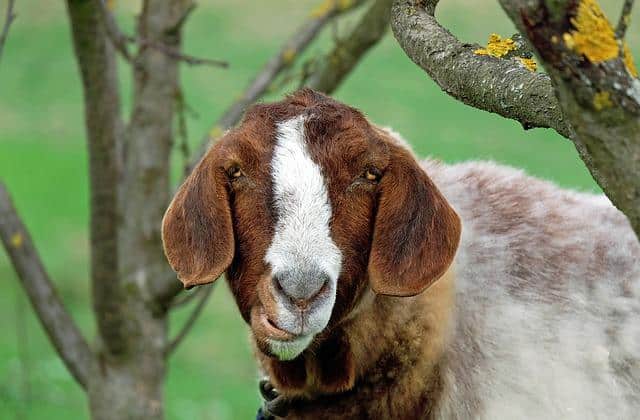
Goats are awesome animals. They provide milk and meat for our tables, fertilizer for our soil, and hours of entertainment for us to enjoy. Another benefit they provide, which many people don’t realize or take for granted, is to serve as natural, alternative mowers.
When allowed to graze, goats will scout and sample a variety of wild edibles: weeds, flowers, twigs, vines, tree leaves, shoots — even the barks of young trees.
They’re so good at clearing brush that not a few enterprising farmers have made it their business to rent out goats – an enterprise that’s taken off this past decade. Though goat-grazing weed control dates back hundreds of years, it has lately become a growing movement for sustainability in landscape maintenance.
Story continues below videos
Private land owners rent goats for weed control of their yards, woodlots and organic farms. Government agencies and environmental groups contract them for vegetation management of municipal lots, parks, forests and wetlands. Goat grazing also helps with the restoration of native habitats.
Story continues below video
In many states, the public works and transportation departments deploy goats to open up access roads and utility easements, clear railroads and roadsides, and simply reclaim places overrun with succession plants and invasive species. In drought-prone California, towns use goats for fire mitigation.
Story continues below video
Eco-friendly and Economical
Goats don’t use power tools that burn fossil fuel, spew out toxic fumes and make a lot of noise. They work quietly and do little to disturb the soil, leaving a very low carbon “hoofprint.” They don’t use chemical herbicides, nor create a massive mess of brush for landowners to rake, burn or haul to the landfill afterward. Instead, they gift them with rich, organic fertilizer – improving the soil for free. Plus, goats can get into areas hard to reach by man or machine, like slippery slopes and rocky terrain.
Diatomaceous Earth: The All-Natural Livestock De-Wormer
Best of all, they’re cheap. In 2014, rental costs ranged from $500-$1,500 per acre. Some outfits charged $250 per day for less than a dozen goats, while others charged as low as $2 a day per goat regardless of land area. Pricing really depends on several factors: location, brush density, established trails and topographical challenges in setting up a fence. Some operators say it takes 8-12 full-sized goats to clear an acre, while others claim they can get the job done with just three to four. Ultimately, it depends on how fast the owner wants his land cleared.
Food Fare
Lest you think the goats get the shorter end of the bargain here, think again. They get free meals consisting of the richest and tastiest wild forage.
Goats are voracious eaters. They’ll eat 8-10 pounds of salad a day, or about 5-15 percent of their body weight. Some of the invasive species they like to feast on are poison ivy, poison oak, blackberries, buckthorn, honeysuckle, multiflora rose, burdock or sticky bobs, yellow star thistle, scotch broom, leafy spurge, wisteria, privet and the ubiquitous kudzu.
Although there are some plants that are said to be potentially toxic to goats — like iris, rhododendron, buttercup and rhubarb — these animals are very picky and seem to be able to detect and avoid them on their own. They usually eat whatever has the highest level of nutrition in an area, and that varies according to what’s available, the time of season, and their familiarity with the species.
Story continues below video
“Targeted grazing” is what they call the deployment of goats in specific areas that are most infested with noxious, unsightly weeds. This raises the chance for native flora to thrive, while reducing the growth of unwanted ones. It’s a huge benefit to ranchers, who depend on native grasses and local forage for their cattle.
And, unlike horses and cattle, goats don’t spread seeds through their droppings. Their complex digestive systems are able to break down seeds, thus preventing these from growing.
Story continues below video
Even though goats don’t remove plant roots, they like stripping the bark of saplings down to the cane, which dry out and eventually die. Depending on what’s growing in an area and what’s being planned for it the next season, the goats are likely needed back once or twice to keep particularly stubborn, hardy species from re-growing.
A word of caution: Goats like the green bark of young trees and can debark full-sized ones and kill them — especially if they’re confined in a small, overgrazed area. If you’re going to graze your goats, make sure you protect trees that you don’t want eaten.
How to Goat-Graze
If you’re keeping goats in confinement but would like to use them for clearing brush, then start by introducing them to the invasive species in your area, and get them used to eating those. Initially, you can cut and carry the plants to their corral, and when the goats (and you) are ready, let them out more often to pasture and wooded areas. For a sizeable herd, you may want to get a guard or herd dog to ward off potential predators like coyotes, bobcats and mountain lions.
This Cool-To-The-Touch Lantern Provides 100,000 Hours Of Emergency Backup Lighting
If you’re going to target-graze, then make sure you have fencing that goats can’t easily break. A temporary electric fence or netting works best. There are solar-powered portable ones that are easy to assemble and move around so that you can strip-graze or divide up a large pasture into smaller, more manageable sections.
It’s a good idea to have a mix of different sizes of goats. Large ones can rise on their hind legs, reach for high branches and bear down on them with their weight, while the smaller ones can feast on lower branches and plants. Any variety of goats would do, but if you’ve got the budget and inclination to go for the pure breeds, rental operators like to use the Boer, Kiko and parasite-resistant Spanish breeds. Just make sure to purchase from a dealer that has similar brush types as you do. Also, don’t buy from a breeder that has high-maintenance goats. Pampered goats that have only been fed grass, hay or grain will take a lot of time and effort to get accustomed to wild forage.
Got goats? Rent Them Out
And if you’re thinking of turning this into an enterprise yourself, you may be in for a promising venture. So many invasive plants have made their way into the U.S. from Asia and Europe, that there won’t be a dearth of properties needing weed control.
Do you have any advice for using goats as weed control, or to make money? Share your tips in the section below:
Harness The Power Of Nature’s Most Remarkable Healer: Vinegar