 Print
Print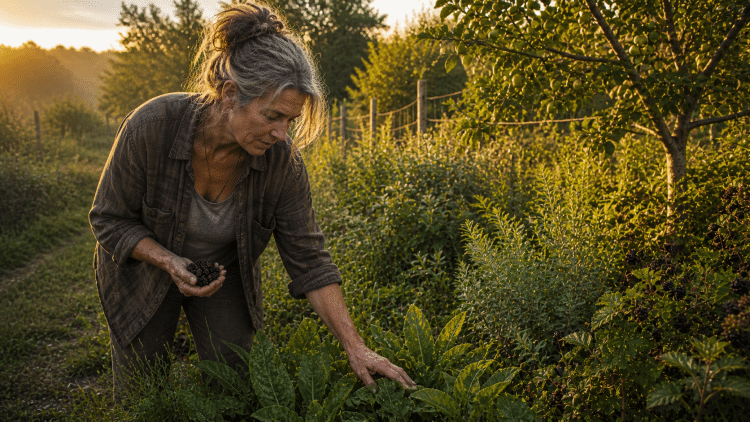
The Free Grocery Store Growing Wild On Your Property
Your Land Is Producing More Food Than You Realize
If you walk your property this time of year and don’t see food, you’re not looking hard enough.
Early summer isn’t subtle. It’s loud. It’s generous. It’s the land practically leaning over and saying, “You’re missing it.”
Because right now, berries are ripening in the hedgerows. Medicinal herbs are pushing through old fence lines. And so-called “weeds” are quietly filling in every gap with usable, valuable nutrition.
In other words, your land isn’t just sitting there. It’s producing.
And if the grid ever goes dark, this is the difference between guessing… and knowing.
Start by Looking Up: The Tree Most Folks Miss
First, lift your eyes.
Most people walk right past the black tupelo—also called black gum—without ever noticing it. Up close, it looks plain. No flashy leaves. No dramatic shape. Just simple, oval foliage that doesn’t draw attention.
But that’s actually the clue.
Because in a world of lobed, jagged, and compound leaves, simple stands out—once you train your eye to see it.
Then step back and look again. The branches shoot out almost at right angles before drooping downward at the tips. It’s a strange, almost deliberate structure, and once you spot it, you’ll start seeing these trees everywhere.
Now here’s where it pays off.
The berries are small, dark purple, and sharp on the tongue. Not something you snack on by the handful. But cook them down—add a little honey or maple syrup—and suddenly you’ve got a deep, rich preserve loaded with color and nutrients.
This is how a homesteader thinks.
Not “Do I like this raw?”
But “What can this become?”
The Orchard You Didn’t Plant
Now shift your attention a little lower.
That wide, spreading tree with small, hard fruit? That’s probably crab apple—and chances are, you didn’t plant it.
These trees don’t grow like orchard apples. They’re messy. Multi-stemmed. Low branching. A little wild-looking. But don’t let that fool you.
Crack one open and you’ll see the familiar star-shaped seed pattern. That’s your confirmation.
And while the fruit is still hard early in the season, give it time.
Because come late summer, that same tree turns into a production machine.
Run those apples through a food mill, strain out the skins and seeds, and you’ve got the base for cider, apple butter, and jelly that would cost real money anywhere else.
A hedgerow full of crab apples isn’t random growth.
It’s stored calories.
It’s future food.
It’s security.
Look Down: The “Weeds” Doing Real Work
Now drop your gaze to the ground.

That ribbed, low-growing plant creeping along your driveway or lawn edge? That’s yard plantain.
Most folks mow it without thinking twice.
But here’s the truth: it’s edible, nutrient-dense, and already growing exactly where you are.
The flavor’s a little bold. Slightly bitter. Not something you build a salad around. But chop it into soups or stews, and it disappears—quietly doing real nutritional work in the background.
And then there’s mugwort.
You’ll find it out in the field edges, standing in thick clusters with gray-green leaves—dark on top, almost silver underneath. Crush a leaf, and the smell hits you: earthy, herbal, unmistakable.
This isn’t just a plant. It’s a tool.
Dry it, and it stores well. Brew it, and it becomes a traditional remedy—used for digestion, circulation, even muscle tension.
And then there’s the reputation.
Drink a strong mugwort tea before bed, and people swear the dreams come alive—clearer, deeper, more vivid.
Whether you believe that or not, one thing’s certain:
This plant isn’t just taking up space.
Berry Season: Don’t Miss the Window
Now we get to the part that feels like a reward.
Because early summer means one thing above all else:
Berries.
The Rubus family—raspberries, blackberries, dewberries—starts producing in a way that feels almost unfair. Right now, black raspberries are hitting peak ripeness in many places, and they rival anything you’d pay top dollar for at a market.
Pop one in your mouth and you’ll know immediately.
Clean sweetness. No bitterness. No aftertaste. Just real food doing what it’s supposed to do.
And identification? Easier than you think.
Look at the thorns. On Rubus plants, they match the color of the stem. That’s your giveaway. Wild roses, on the other hand, show a sharp contrast—different color entirely.
That one detail saves you a lot of confusion in a thick patch.
And then, right alongside those raspberries, you might spot something else.
They stand out once you know what to look for—stems covered in fine reddish hairs, almost like they’ve been dusted in velvet. The berries ripen to a bright orange-red and cluster heavily, making for fast picking.
But here’s the thing:
The window is short.
Miss it, and it’s gone.
The Invasive That’s Actually a Gift
Now head to the edge of your property.
That scraggly shrub along the fence line with speckled leaves? That’s autumn olive.
Technically, it’s invasive. Brought in from Asia. Spread by birds. Hard to control.
But here’s where a homesteader sees things differently.
Instead of fighting it… use it.
Look closely at the leaves. Lighter underneath, with tiny silver speckles that almost look like dust. That’s your ID.
The berries come later—in the fall—but when they do, they come heavy.
And nutritionally?
They’re loaded. High in lycopene—far more than tomatoes—and carrying beneficial fatty acids as well.
The taste is tart-sweet, and once you dial in how to use them, you’ve got a wild superfood growing for free.
That’s not a problem.
That’s an asset.
Not Everything Is Food—But It Still Matters
Now here’s something a lot of people overlook.
Not every useful plant is meant for eating.
Take milkweed.
Yes, parts of it are edible if prepared correctly. But that’s not the main value. Milkweed is essential for monarch butterflies—one of the few plants their caterpillars can survive on.
Leave a patch standing, and you’re doing more than feeding yourself.
You’re supporting the system that feeds everything else.
And then in winter?
Those dried seed pods open up into soft, cotton-like fibers—some of the best natural tinder you’ll ever find.
One handful can mean the difference between a fire that catches… and one that doesn’t.
Then there’s yarrow.
At a glance, it can be confused with Queen Anne’s lace. But look closer. Yarrow’s flowers are irregular. Not perfectly symmetrical. The leaves are feathery, branching from a central line.
Get that ID right.
Because in a pinch, yarrow pressed against a wound can help slow bleeding fast.
That’s not theory.
That’s field knowledge.
Forage With Confidence, Not Guesswork
Now let’s talk about a couple more plants you’ve probably seen—and maybe ignored.
Wild cherry trees show up along edges and fence rows. The easiest way to confirm them? Black knot fungus. Dark, rough growths along the branches that almost look burned.
Once you see it, you won’t mistake it again.
The fruit varies. Some sweet. Some bitter. Always a bit of a gamble.
But worth knowing.
And then there’s greenbrier.
Most people hate it. Thorny. Tangled. Hard to deal with.
But look closer.
The young tips are tender. Slightly citrusy. No bitterness. Perfectly edible if you handle them right.
And even better?
The berries stick around through winter.
Food… still on the vine… when everything else is gone.
That’s not something you ignore.
The Land Isn’t Empty—You Just Haven’t Learned It Yet
So step back for a second and take this in.
The land you’re living on isn’t just scenery.
It’s not decoration.
It’s not background.
It’s a system.
A working pantry.
A medicine cabinet.
A fallback plan.
But only if you know what you’re looking at.
Because once you start seeing it—really seeing it—you realize something most people never do.
You were never as dependent as you thought.
You just hadn’t learned the landscape yet.