Print
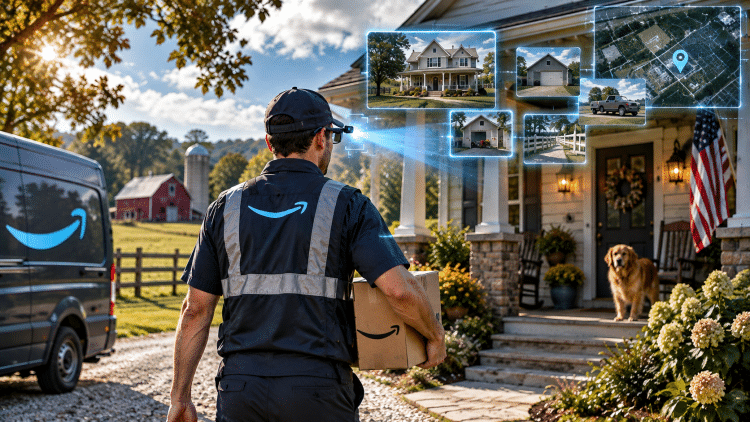
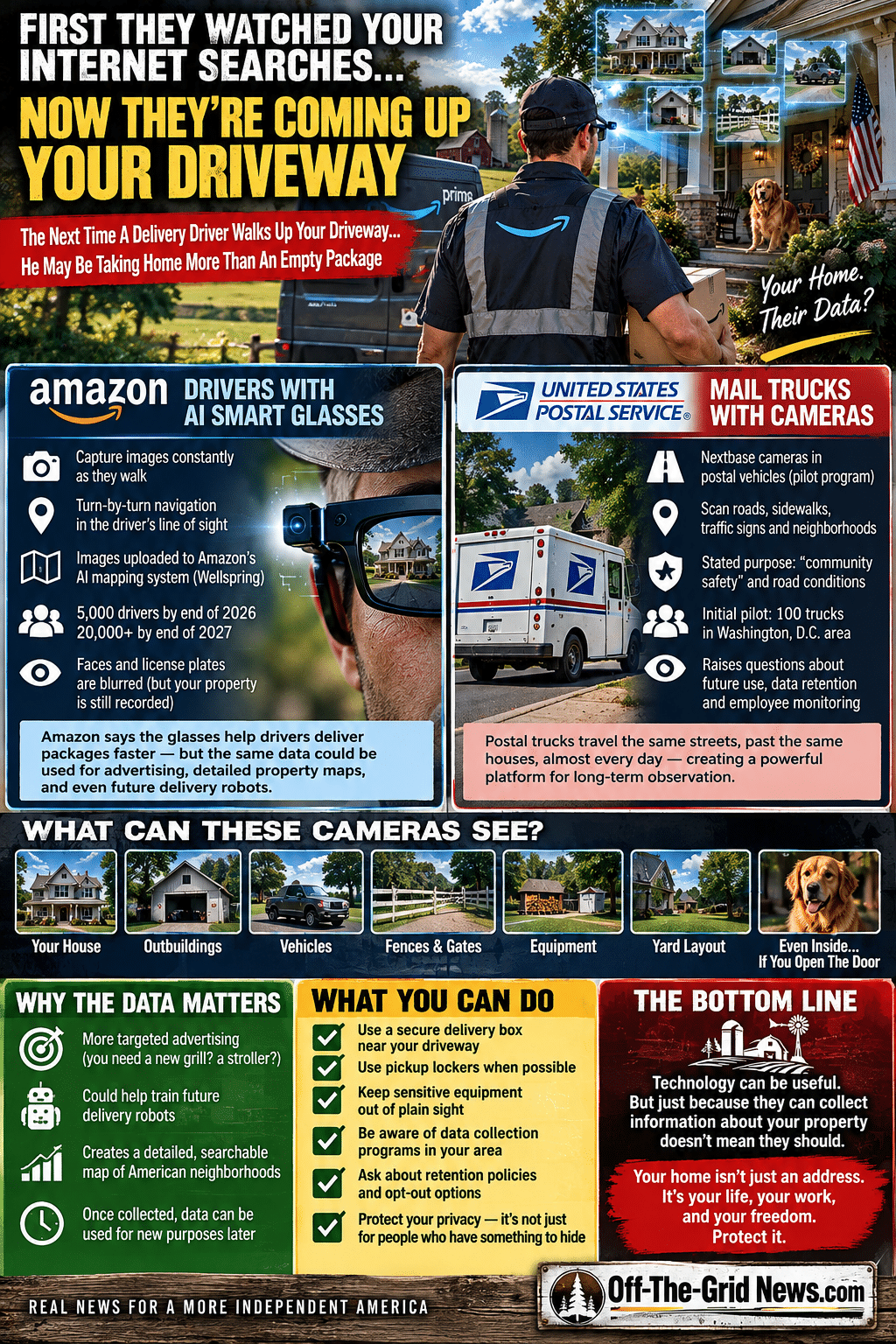
The Next Time An Amazon Driver Walks Up Your Driveway… He May Be Taking Home More Than An Empty Package
They Mapped Our Roads… Then Our Driveways… Now They’re Taking A Digital Inventory Of The American Home
There was a time when the fellow delivering your mail knew three things about your house. Your address. Where the mailbox stood. And whether that big yellow dog sleeping under the porch was friendly or liable to take a bite out of his britches.
That was about it.
The UPS driver knew where to leave the package. The Amazon fellow knew which doorbell to ring. And everybody went about their business without giving much thought to who might be watching.
But something rather remarkable is happening on the streets of America. The delivery trucks are getting cameras. The drivers are getting artificial intelligence strapped to their faces. And the ordinary trip from the street to your front porch is becoming another opportunity to collect information about your property.
Not just where you live, but what your place looks like. Where the gates are. How to approach the house. What’s sitting beside the garage.
Welcome to the age of the digital drill-down, where your home is no longer merely a place to live.
It’s becoming another collection of data points.
The Amazon Driver Has A New Pair Of Eyes
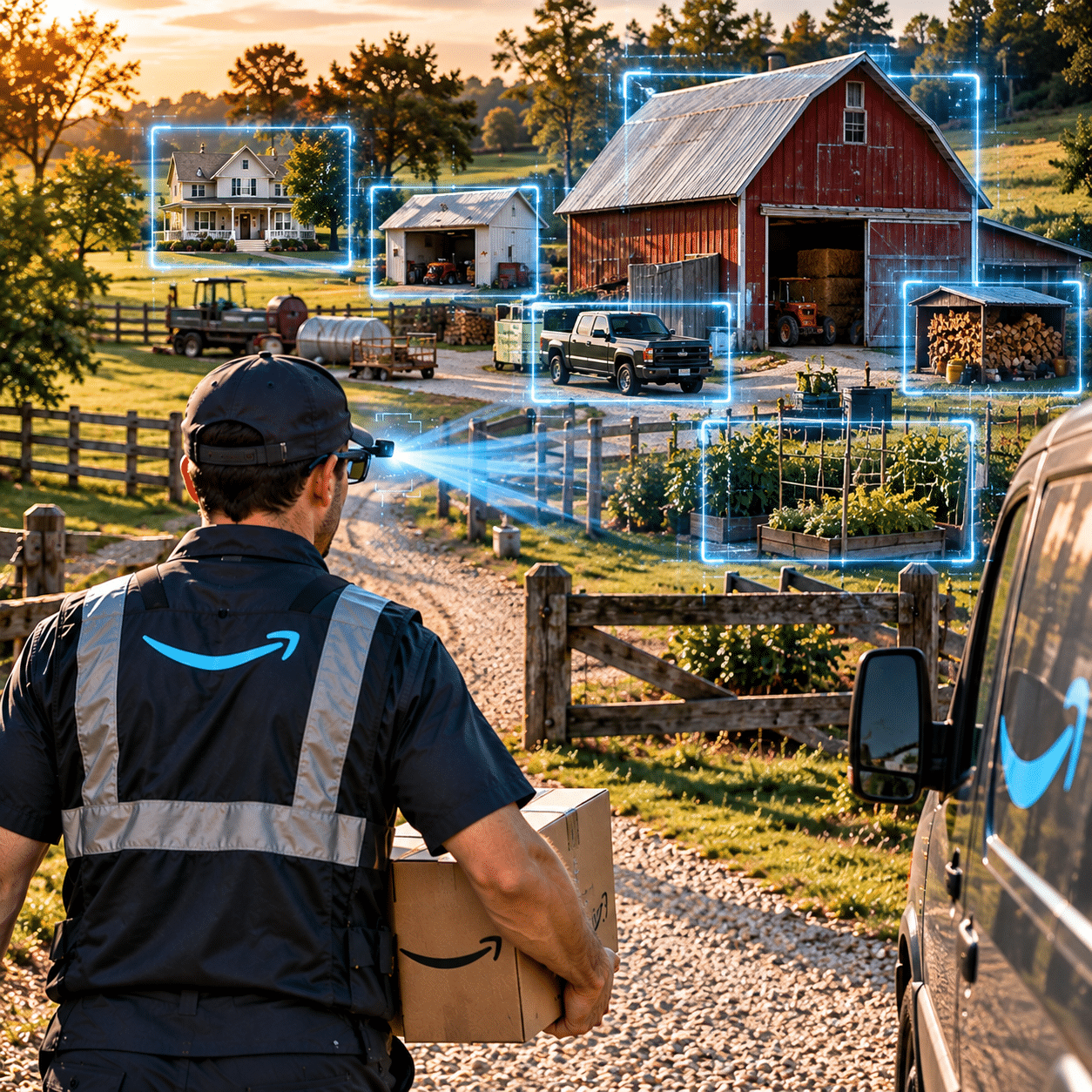
Amazon is expanding a program that equips delivery drivers with AI-powered smart glasses. The company says the technology helps drivers navigate that final stretch between their delivery vans and your front door, scan packages and take proof-of-delivery photographs without juggling a handheld device.
Fair enough. Anybody who’s ever tried finding the right entrance to a farmhouse after dark can appreciate a little help. But here’s where things get interesting.
According to Bloomberg technology columnist David Lee, the glasses don’t merely display directions. They also capture images of the driver’s surroundings repeatedly as he walks, potentially producing thousands of photographs during a single shift.
Those images can help Amazon build increasingly detailed information about delivery locations through its AI mapping system, Wellspring. The company says it uses privacy protections, including blurring faces and license plates before images are reviewed by people.
That’s reassuring. Up to a point.
Because a blurred face doesn’t necessarily hide the location of your generator, the arrangement of your outbuildings, or the route somebody would take to reach your back porch. And those are precisely the sorts of details that make a homestead different from a street address.
Amazon says it plans to expand the program to more than 20,000 devices by the end of 2027. That’s a considerable number of cameras walking up American driveways, gathering information that may remain useful long after the packages have been delivered.
Meanwhile, The Mail Truck Is Learning To Watch
Now consider what’s happening at the United States Postal Service.
According to an investigation by 404 Media, USPS has begun testing Nextbase cameras mounted in postal vehicles. The initial pilot involves 100 trucks in the Washington, D.C., area, with the stated purpose of identifying roadway conditions and improving community safety.
The cameras scan roads, sidewalks, traffic signs and other features along postal routes. USPS says the pilot includes privacy safeguards and that its findings will help determine whether the technology should be used more broadly.
On its face, identifying dangerous road conditions sounds reasonable. Nobody wants a mail carrier driving into a washed-out culvert. But former postal labor official Terry Stapleton raised another concern in an interview about the program.
Once cameras are installed, what prevents their information from eventually being used for purposes beyond the original safety program? Could the images be analyzed to identify vehicles, monitor neighborhoods or evaluate the behavior of postal employees?
Those are questions, not proof that such surveillance is already occurring. The USPS pilot cameras reportedly do not run automatic license plate recognition software, although the camera technology is capable of capturing detailed images.
Still, there’s something worth remembering about the Postal Service. Its vehicles travel the same streets, past the same houses, almost every day, making them an unusually effective platform for observing changes over time.
And unlike a satellite passing overhead, the mail truck gets a close-up view.
The Real Prize Isn’t A Photograph… It’s The Pattern
Here’s where the story gets bigger than a pair of glasses or a camera on a dashboard.
A single photograph of your driveway probably doesn’t tell anybody very much. But suppose a computer can compare hundreds of images taken over several months, identifying objects and recognizing what has changed.
A new shed appears. A fence gets installed. A trailer shows up beside the barn, or a driveway that was empty every weekday suddenly has three vehicles parked in it.
None of those observations necessarily means anything sinister. But put enough of them together, and a computer could begin constructing a surprisingly detailed picture of how a property is used.
That’s what makes artificial intelligence different from the old fellow with binoculars sitting across the street. The fellow with binoculars eventually gets hungry and goes home, while the computer can keep comparing, sorting and remembering long after everybody else has gone to bed.
And when enough information is collected, it can potentially become searchable. Not merely by address, but by objects, activities, changes or characteristics that software has learned to recognize.
The important question isn’t simply what the cameras see today. It’s what tomorrow’s computers might be able to discover from yesterday’s pictures.
Nobody Asked Grandma If She Wanted To Be In The Database
Here’s the part that bothers me most.
When you buy a security camera for your front porch, that’s your decision. You purchased it, installed it and decided where it points, even if the manufacturer’s data policies deserve a careful reading.
But when a delivery company begins collecting detailed visual information about your property, you haven’t necessarily made that same choice. You ordered a box of furnace filters, not a subscription to a digital mapping project.
Bloomberg’s reporting raised the obvious question of whether Amazon customers could opt out of this kind of image collection. According to The Verge’s account of that reporting, Amazon executive Viraj Chatterjee responded, “We haven’t thought about that.”
Think about that for a moment. We can build computers that recognize objects, map complicated environments and help guide machines around obstacles, but apparently figuring out how to ask the homeowner for permission is a considerably more difficult engineering problem.
Funny how that works.
And it isn’t merely a matter of theoretical privacy concerns. Recent reporting on delivery photographs has raised questions about how long companies retain images of customers’ homes and how difficult it can be for ordinary people to learn what information is being kept.
Today’s Delivery Map Could Become Tomorrow’s Robot Training Ground
There’s another interesting possibility hiding behind all this technology.
Amazon has invested heavily in automation, robotics and delivery systems. And robots need something human delivery drivers already possess: knowledge of the real world.
A human knows how to step over a garden hose, avoid an icy patch and recognize that the front steps are rotten. A robot has to learn those things through sensors, software and training.
Detailed images of driveways, sidewalks, porches and entryways could be useful for developing future delivery machines. In a CBS News discussion of Amazon’s smart glasses, Bloomberg’s David Lee raised that very possibility.
That doesn’t establish that every image is being collected to train robots. But it raises an interesting question about what happens when information gathered for one purpose becomes valuable for something entirely different.
Consider the irony. A delivery driver could someday help gather the information needed to teach a machine how to perform his own job.
That’s quite a thank-you present from the technology department.
When Convenience Becomes The Excuse For Everything
I’m not against technology. I appreciate GPS navigation, like knowing when a package will arrive, and certainly don’t want postal workers getting injured on dangerous roads.
But there’s an old distinction we’ve nearly forgotten.
Something can be useful without being wise.
A system that helps a delivery driver find the right porch may be useful. A system that quietly builds a lasting, searchable history of private properties would raise an entirely different set of questions.
Who owns the information? How long is it stored? Who gets access, and can it be shared with another company or obtained by government investigators?
And what prevents tomorrow’s management from finding a profitable new use for information collected under yesterday’s innocent explanation? Even when a company promises good intentions, intentions aren’t the same thing as enforceable limits.
Those questions deserve answers before these systems become permanent fixtures of American life.
What A Wise Homesteader Can Do Right Now
You don’t need to throw your smartphone into the creek or start wearing a tinfoil hat. But a little old-fashioned common sense wouldn’t hurt, especially when technology makes it easier than ever to collect information without the homeowner noticing.
Consider having packages delivered to a secure box near your driveway entrance rather than directly beside your house. Use pickup lockers when they’re practical, and keep sensitive equipment, documents and security arrangements out of plain sight.
Remember that outdoor cameras, delivery devices and mapping services can collect more information than you might expect. Pay attention when companies or government agencies announce new data-collection programs, and ask about retention policies, access restrictions and opt-out rights.
Don’t take out your frustration on the mail carrier or delivery driver. They’re trying to earn a living, not write the company’s privacy policy, and many of them have concerns about being watched themselves.
Most importantly, teach your family that privacy isn’t something reserved for people who have something to hide. It’s something ordinary people deserve because their homes and lives belong to them.
The Fence Around Your Property Isn’t Just Made Of Wood
My grandfather’s generation understood boundaries. A fence marked where one man’s land ended and another man’s began, and you didn’t wander into somebody’s barn without asking.
You didn’t rummage through his tools because you were curious. And you certainly didn’t start keeping records of everything he owned just because you could see it from the road.
Today, technology is making those old boundaries harder to recognize. A camera can see without stepping across a fence, a computer can remember without ever meeting you, and a database can assemble a picture of your life without anybody knocking on your door.
That’s why the digital drill-down deserves our attention. Not because every camera is sinister or every technology company has some secret master plan, but because the ability to collect information is growing faster than our willingness to question whether it should be collected.
The fellow delivering your mail used to know where you lived. Now the technology riding along with him may someday know considerably more, and the decisions about what gets collected could be made by people who’ve never set foot in your county.
Before that happens, perhaps somebody ought to remember a simple piece of country wisdom.
Just because the gate is open doesn’t mean you’re invited inside.