 Print

Why Your Homestead Can’t Run On Human Reason And Hard Work Alone
Working Your Four Fields Means Passing Down A Life Worth Living
Every winter, the seed catalogs land in the mailbox. Before long, you’re sitting at the kitchen table with a cup of coffee, circling enough tomatoes, beans, and sweet corn to feed three counties and a moderately hungry church picnic.
Meanwhile, the garden out back hasn’t grown an inch. Neither has your supply of daylight, your back, or the number of Saturdays between the last frost and the first ripe tomato.
Here’s the overlooked part. A homesteader needs something no catalog sells: a clear idea of what all this work is for. You can own fine tools, make careful plans, and still spend your life improving a place you’ve forgotten how to enjoy with the people you love.
In this Four Fields series, we’ve been walking the ground behind us, ahead of us, within us, and around us. Those fields hold our inheritance, our hopes, our inner life, and our work in the world. Trouble starts when we settle permanently in one and let the other three grow up in weeds.
A sharp mind helps you work them. But reason alone can’t give you everything worth growing.
The Boy Who Wanted the Whole Catalog
There’s an old story in Eugen Rosenstock-Huessy’s 1953 lectures about a minister who handed a boy a Sears catalog and invited him to mark his Christmas wishes. The youngster, delighted to have permission to use ink, proceeded to circle every item.
Every last one. You can picture the result: a Christmas list requiring several freight cars and a new township. Yet the boy had done exactly what plenty of grown people do. He’d collected possibilities without deciding which ones belonged in his life.
We do it with equipment, projects, subscriptions, and plans for next spring. A better tiller will help us grow more food. Another outbuilding will hold the tiller. Then a bigger mower will help us maintain the ground around the outbuilding.
Eventually, we need a second job to support all the things that were supposed to make us independent. The place devours your time, but its purpose gets harder to find.
Two Traps That Can Steal the Life You’re Building
The first trap is to retreat entirely into yourself. Feelings become the final authority, and anything outside that unsettles them gets shut out. In the old philosophical language, that’s the danger of the isolated mystic.
Now, prayer, reflection, and a quiet walk past the woodlot can do a person good. But an inner life cut loose from truth, duty, and other people becomes a root cellar locked from the inside. You may feel sheltered while the chores outside pile up.
The other danger runs in the opposite direction. Everything has to be useful, measurable, efficient, and ready to produce a return. In this picture, the rationalist keeps asking how to get more done without stopping long enough to ask what deserves doing.
There’s nothing foolish about measuring a board or figuring your winter feed bill. Sound reasoning can expose a bad plan and help you choose between good ones. But calculations need a purpose to serve, and they can’t carry the whole weight of faith, love, gratitude, and obligation.
Reason is a fine plow horse. It still needs somebody who knows which field needs plowing.
Before Another Bargain Empties Your Wallet Ask This
Suppose two families order the same apple trees. One wants fruit to sell, while the other wants grandchildren picking apples beside the house long after the grandparents are gone. Both families need good information about soil, disease, and growing seasons.
Now, here’s the crucial difference. Their reasons for planting will shape their choices. A spreadsheet can compare varieties and estimate costs. It can’t make a man care whether his grandchildren remember his orchard.
Likewise, you can calculate the price of a Sunday dinner down to the last potato. That won’t tell you what it means when your grown children pull into the driveway and stay an extra hour. The value of the gathering reaches beyond the grocery receipt.
This is where the field behind you and the field ahead begin speaking into today’s decisions. What have you received that deserves protecting? What do you hope to leave, and who will be there to receive it?
Once those questions have answers, many smaller choices get easier. You can leave a perfectly good bargain on the shelf because it doesn’t belong to the life you’re building.
The Hidden Trap Behind Getting More Done
Here’s where that blind spot gets dangerous. It can swallow a business, a church, or a family. At first, the machinery serves a purpose. Later, keeping the machinery running becomes the purpose.
A family buys a homestead to spend more time together. Then every evening disappears into expansion plans, repairs, and another money-making project. Soon the children know the back of Dad’s work coat better than they know his face across the supper table.
Of course, work has to get done. Animals won’t feed themselves because you’ve developed a thoughtful philosophy of family life. Yet a place built for your family ought to leave some room for your family to live there.
Similarly, an institution can become so concerned with pleasing everybody that it stops saying anything worth hearing. Clear convictions get filed away because somebody might object. Attendance, income, and appearances become easier to discuss than truth.
And just like that, the mission slips out the back door. You can keep the lights on for years after you’ve forgotten why anybody gathered in the room.
You Didn’t Build This Life From Scratch
Thankfully, there’s another way to live. It begins with admitting that you didn’t arrive here carrying everything you needed in your own head. Somebody spoke, and you listened.
Maybe your mother taught you to put a meal on the table when money was tight. Perhaps your father showed you how to sharpen a blade, admit a mistake, or finish a job after the fun had worn off. Somebody taught you words for gratitude, right and wrong, sorrow, forgiveness, and hope.
Of course, some of what we inherit needs correcting. Every family has weeds mixed in with the good seed, and honoring your people doesn’t require passing every weed along. It means caring enough to sort out what’s worth keeping, tend it, and pass it on.
But here’s the opportunity. Now it’s your turn to speak. You teach through instructions, certainly, but also through what you praise, what you refuse, and what you do when nobody’s applauding. The next generation watches how you carry the inheritance.
Best part is, you don’t have to be flawless to hand something on. You do have to recognize that you’ve been entrusted with something.
Four Little Words That Work All Four Fields
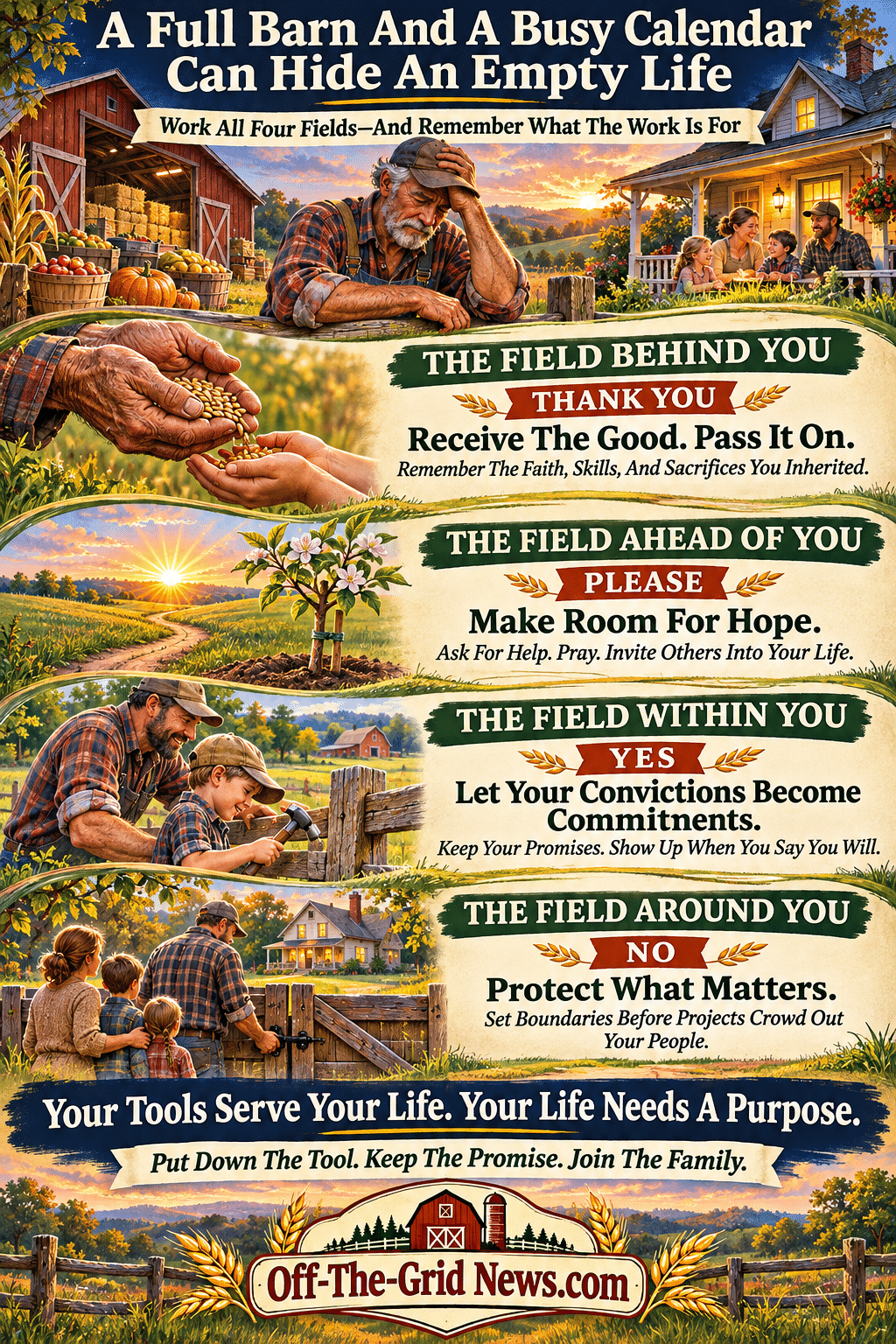
Let’s put this on the kitchen table. Bring the Four Fields into the house, and these big ideas start sounding familiar. They show up in four expressions most children learn early: thank you, please, yes, and no. A lifetime later, we’re still learning when to use them.
“Thank you” faces the field behind us. It acknowledges gifts we didn’t manufacture: life, teaching, sacrifice, forgiveness, and the ground others cleared before we got here. Gratitude keeps independence from turning into the silly notion that we owe nobody anything.
“Please” faces the field ahead. It asks, invites, and hopes for an answer we can’t force. We use it when we seek help, ask forgiveness, welcome love, or pray for a future we haven’t reached.
“Yes” gives voice to the inner field. It’s where conviction comes out of hiding and becomes an answer: I believe this. I’ll stand with you. I’m willing to take responsibility.
Somebody Has to Close the Gate
“No” marks a boundary in the field of action around us. It closes the gate on something that would trample what we’re trying to grow. Sometimes it refuses an expense, sometimes a temptation, and sometimes a demand that has no rightful claim on our time.
In Rosenstock-Huessy’s old family illustration, the mother, daughter, son, and father bring these different attitudes into view. Think of that as a family portrait illustrating the movements of life, rather than a permanent assignment of one word to each person. Every member of a healthy household needs all four.
A father needs to say thank you. A mother needs the freedom to say no. Children need to ask for help, and grown people need to do the same without acting as though the roof has fallen in.
Ignore One of These Words and Your Family Pays the Price
Consider the fellow who can say no to everybody but can’t thank anybody. His fences may be straight, but the people around him will eventually feel as though they’re living on the wrong side of one. Boundaries without gratitude make a cold home.
Then consider the person who says yes to every request. Before long, the promises overlap, the work runs late, and somebody gets disappointed. What sounded generous turns into a tangled mess of promises nobody can keep.
Or picture a household that lives entirely in the past. Every conversation begins with how things used to be, while every new responsibility waits untouched. Memory is precious, but you can’t feed this year’s chickens with a photograph of last year’s corn.
On the other hand, a family always chasing tomorrow can forget to thank the people holding it together today. That’s why the Four Fields belong together. Each helps keep the others fruitful.
A Powerful Yes Has a No Standing Behind It
Sooner or later, we’ve got to quit keeping every possibility open. Marriage makes that plain. A faithful yes to one person means closing the gate on other courtships and getting on with the work of loving the person you promised to love.
That doesn’t end affection, discovery, or delight. It gives them a home. The promise turns a wandering possibility into a life two people can build together.
The same principle reaches into parenthood, friendship, church life, and the care of a place. You can spend years wondering what kind of person you might become. Eventually, somebody needs you to become dependable enough to count on.
So you finish the fence instead of endlessly studying fences. You show up for the child instead of waiting for a more convenient season. You face up to the fact that keeping your word will sometimes cost you something you’d rather keep.
A field becomes productive when somebody quits shopping for farms long enough to work it.
Your Neighbor Needs You to Deliver the Goods
Want a simple test of whether your words carry any weight? Picture this. You tell a neighbor tomorrow looks like rain, and the sun comes out instead. You made a bad forecast; the weather has humbled better people than you.
But tell that neighbor you’ll be there at one o’clock to help load a trailer, and your words do something different. He arranges his afternoon around them. Maybe he borrows equipment, opens a gate, or puts off another job because he expects you.
See what happened? Your words have become part of his plans. If you can’t come, you owe him a call and an honest explanation. If you simply wander off and forget, your words have left him holding an empty promise.
That’s why Jesus’ teaching in Matthew 5:37 belongs as much beside the barn door as inside the church. People ought to be able to trust our answers without a big song and dance.
A dependable yes has a no behind it. You’ve turned down whatever would keep you from doing what you said.
A Clever Argument Won’t Hold Your Family Together
Now we come to the Christian heart of the matter. In John 1:1–14, the Word is Christ, who was with God, was God, and became flesh. John’s Word isn’t merely a name for human logic or a lesson in keeping appointments.
Still, Scripture gives us every reason to take our words seriously. In Genesis 1:3, God speaks light into being. Our words don’t carry God’s creative authority, but our promises and answers do carry responsibility before Him and toward one another.
Think about what words do in an ordinary household. A vow establishes a marriage. An apology opens the way toward reconciliation. A truthful warning can stop somebody from taking a dangerous step.
Meanwhile, a lie can poison trust through years of otherwise competent work. You can keep every machine on the place humming and still damage the family with a tongue you won’t govern. That’s the hard truth. The Four Fields need honest words running through them like sound fence wire.
Put Down the Tool and Listen a Minute
Family life also requires more than physical effort. A person can arrive at the end of a hard week with every chore checked off and feel worn hollow inside. One more job won’t necessarily mend that.
Then a friend says, “Come sit a minute,” and puts the kettle on. Nobody produces a grand solution. Yet being heard can clear away some of the fog and help a person face the next morning.
That doesn’t mean conversation fixes every sorrow. It means we shouldn’t overlook the help we can offer by paying attention, asking an honest question, and staying long enough to hear the answer. A loved one’s distress deserves more than instructions to toughen up.
So notice the quiet person at supper. Call the neighbor who’s been absent. Set down the tool when a child has something important to tell you.
The work will still be there. The moment to listen may pass.
Before You Circle One More Thing Remember This
When the catalogs pile up this winter, enjoy them. Dream about the orchard, compare the seed varieties, and figure out whether that new tool would earn its keep. Good planning belongs on a homestead.
Then look beyond the shopping list. Look behind you with gratitude for what you’ve received. Look ahead with hope, tend the convictions within you, and set wise boundaries around the work you take on.
Ask whether the place is helping your family grow faithful, generous, useful, and ready to carry something good into the next generation. If that answer’s getting buried under projects, it’s time to take a hard look at what you’re adding and what it’s costing you.
Work all four fields. Leave none of them fallow.
And when you pick up that pen, circle a few things you need. Then put it down while you still have enough ink to write what the whole place is for.