 Print
Print

The Founders Didn’t Believe Civil Government Was The Answer
The Babel Problem Is Alive And Well Today
America didn’t simply stumble into liberty.
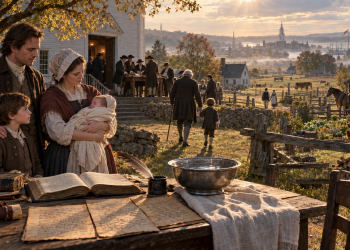
It grew inside a unique spiritual climate where biblical Christianity had room to take root, spread, and shape a culture from the inside out. Long before America became an economic powerhouse or a global superpower, it was a nation of churches, families, and local communities that carried much of the responsibility modern governments now claim for themselves.
Back then, faith wasn’t viewed as a private hobby reserved for Sunday mornings. Christianity provided the moral vocabulary of everyday life. It shaped how people thought about work, marriage, education, justice, government, and even history itself. Whether they were planting crops, raising children, building businesses, or debating politics, most Americans operated from the assumption that God was actively involved in the affairs of men.
In many ways, early America looked surprisingly off-grid.
Today, by contrast, we live in a world that places enormous trust in centralized systems. Politicians promise salvation through legislation. Experts promise solutions through management. Bureaucracies promise security through regulation. Yet the men and women who built early America generally looked somewhere else first. Before they trusted a system, they trusted Providence.
That single difference explains more about American history than most textbooks ever will.
When America Was Spiritually Off-Grid

One historian described the relationship between Christianity and American culture as a symbiotic partnership. The nation gave churches room to grow and flourish, while Christianity supplied the moral framework that held communities together. Families attended church not because government programs encouraged it, but because faith formed the foundation of ordinary life.
Even G.K. Chesterton, who had a sort of elegant hatred of America because it wasn’t Catholic enough, captured this reality with a famous observation.
He described America as “a nation with the soul of a church.” While modern ears may find that statement surprising, Chesterton was recognizing something obvious to many observers of his day. Christianity had become deeply woven into the nation’s cultural DNA.
The language people spoke reflected biblical assumptions. The institutions they built reflected biblical assumptions. Even the hopes they carried for the future reflected biblical assumptions. The average American may not have been a theologian, but he lived inside a culture shaped by theology.
Meanwhile, much of Europe was moving in another direction. As governments grew larger and industrial society became increasingly centralized, many Europeans began looking toward the state as the primary source of order and progress. Political institutions gradually assumed responsibilities once carried by churches, families, and local communities.
America resisted that trend for generations.
An Italian political observer who traveled through the United States noticed the contrast immediately. Although he was not a Christian himself, he remarked that Europe seemed increasingly statist while America remained unmistakably Christian. Looking from the outside, he could see that the nation’s strength flowed from a source many Americans simply took for granted.
The country functioned more like a spiritual homestead than a centralized machine. Responsibility lived close to home. Families handled what families could handle. Churches addressed what churches should address. Communities solved problems together before turning to distant authorities. It was a decentralized culture rooted in moral self-government.
That reality should sound familiar to anyone pursuing an off-grid lifestyle today.
Providence: The Forgotten Operating System
At the heart of early American thinking stood one powerful belief: Providence.
Today the word sounds old-fashioned, perhaps even quaint. Yet for earlier generations it explained reality itself. Providence wasn’t a theological footnote buried in a sermon. It was the lens through which people interpreted the world around them.
Americans believed God actively governed His creation. Nations rose because He permitted them to rise. Empires fell because He decreed their fall. Victories, defeats, blessings, and hardships all unfolded beneath His sovereign hand.
This way of thinking shaped how people understood history.
Take the Battle of Trenton during the dark winter of 1776. Modern historians often focus on military strategy, intelligence failures, weather conditions, or Hessian mistakes. Those explanations have value, but they miss something important. The Americans who lived through the event did not primarily credit Washington’s genius or their own courage.
They credited God.
To them, the crossing of the Delaware and the improbable victory that followed pointed directly to divine intervention. What modern historians describe as circumstances, they described as providence. What modern scholars call historical forces, they called the hand of God.
That difference changes everything.
Once a culture stops seeing God directing history, it inevitably begins searching for another force to take His place. Some people place their trust in economics. Others place their trust in politics. Many place their faith in science, technology, or bureaucracy.
The object changes.
The instinct remains.
Human beings were created to trust something. If they stop trusting Providence, they will trust the grid.
Franklin’s Babel Warning… The Limits Of Human Wisdom
Benjamin Franklin is often portrayed as the quintessential American deist. According to the popular story, he believed God created the universe, wound it up like a clock, and then stepped away.
The truth is a bit more complicated.
Franklin flirted with deism and admired many Enlightenment ideas, but he never completely abandoned belief in divine providence. In fact, some of his most memorable public statements reveal a man who remained deeply aware of humanity’s dependence upon God.
During the Constitutional Convention, as delegates struggled through bitter disagreements, Franklin delivered a remarkable speech. He reminded the assembly that Scripture teaches…
“Except the Lord build the house, they labor in vain that build it.”
Then he went further.
Franklin declared that he firmly believed God governs in the affairs of men. Without God’s aid, he warned, their political project would fare no better than the builders of Babel. Human intelligence alone could not guarantee success.
That warning echoes through history.
The Tower of Babel was humanity’s first great centralized project. Men united their resources, pooled their expertise, and attempted to build a monument to their own greatness. The result was confusion, division, and collapse.
The pattern has never changed.
Whenever societies attempt to replace God with centralized power, they eventually discover that Babel is not merely an ancient story. It is a recurring temptation.
The New Religion Of The Modern Age
America’s greatest challenge was never simply political. It was spiritual.
Even during the founding era, competing visions of reality existed side by side. Some leaders viewed society through a biblical framework. Others increasingly embraced a worldview rooted in human autonomy and secular reason.
Thomas Paine became one of the most influential voices in that movement. Although portions of his writing sounded deeply Christian, later works revealed his growing hostility toward Christianity and biblical authority.
Over time, those ideas spread.
What began as skepticism eventually hardened into something resembling a rival religion. Its creed was secularism. Its priesthood consisted of experts and administrators. Its temples were institutions. Its salvation came through systems.
Instead of looking to Christ and His church, people increasingly looked to governments, bureaucracies, corporations, and social engineers. The old faith taught that every household ultimately answers to God. The new faith teaches that every household ultimately answers to the system.
That shift transformed the culture.
And most people barely noticed it happening.
When The Government School Replaced The Faith
Few battlegrounds proved more important than education.
Early American schools existed largely to transmit Christian truth, biblical literacy, and moral character. Parents, pastors, and local communities shared responsibility for shaping young minds. Education was never viewed as neutral because life itself was never viewed as neutral.
Eventually a different vision emerged.
Advocates of universal public education promised a system built upon supposedly neutral principles. Religion would be pushed to the margins while secular assumptions occupied the center. Many Christian observers immediately recognized what was happening. They argued that neutrality was impossible because every educational system teaches a worldview.
History largely proved them right.
As generations passed, educational institutions became one of the primary engines for transmitting secular thought and assumptions. Children increasingly spent more time being shaped by institutional systems than by families or churches. Authority gradually shifted away from local communities and toward centralized structures.
A government educational grid slowly replaced the older network of faith-centered learning.
The consequences are still unfolding today.
Revival: When God Reboots A Culture
Thankfully, America’s story is not merely a story of decline.
Again and again throughout American history, God interrupted cultural decay through revival. Churches that seemed spiritually cold suddenly came alive. Entire communities experienced renewal. People who had grown comfortable and complacent were awakened to eternal realities.
Historian Ian Murray makes an important distinction between revival and revivalism. Revival is God’s work. Revivalism is man’s attempt to manufacture God’s work through techniques, emotional manipulation, and carefully engineered experiences.
One produces lasting transformation.
The other produces religious theater.
The First Great Awakening demonstrated the difference. Beginning in the 1730s and accelerating through the 1740s, a wave of spiritual renewal swept across the colonies. Ordinary men and women experienced deep conviction of sin, renewed faith, and a fresh awareness of God’s presence.
The movement crossed denominational lines and geographic boundaries. It reached cities, villages, farms, and frontier settlements. Most importantly, it reminded people that God still acts in history.
He always has.
Whitefield, Edwards, And A Nation Stirred Awake
No figure embodied the Great Awakening more vividly than George Whitefield. Without microphones, radio stations, podcasts, livestreams, or social media, he preached to crowds numbering in the tens of thousands. People traveled extraordinary distances simply to hear him speak.
His voice carried tremendous power, but the secret of his influence went much deeper. Whitefield believed every word he preached. He believed Christ saves sinners. He believed eternity is real. He believed God still changes lives.
People could hear that conviction.
Alongside Whitefield stood Jonathan Edwards, one of America’s greatest theologians. Modern readers often know Edwards only through a single sermon, but his life’s work explored the beauty of God’s sovereignty, the nature of revival, and the glory of Christ.
Together these men helped ignite a movement that reshaped American culture from the inside out. They did not accomplish this through political campaigns or legislative victories. They did it through transformed hearts.
That is how genuine renewal has always spread.
The Falling Meeting House
One story from Edwards’ ministry feels strangely relevant today.
In 1737, the congregation in Northampton gathered for worship inside an aging meeting house. Years of hard winters and structural decay had weakened the building. Unknown to those inside, disaster was approaching.
Then, during worship, a packed gallery suddenly collapsed.
Timbers crashed. Seats shattered. The structure gave way beneath dozens of people. By every reasonable expectation, the event should have produced widespread tragedy.
Yet the congregation survived.
Edwards interpreted the incident as a remarkable act of divine preservation. The experience deeply affected the town, and shortly afterward, revival swept through the community.
The symbolism is difficult to ignore. An old structure collapses. The people are spared. Renewal follows.
Across much of the Western world, the old structures are beginning to creak. Institutions that once seemed permanent suddenly look fragile. Economic systems strain. Educational systems lose public trust. Political structures grow increasingly brittle.
The old meeting house is creaking.
Off-Grid Theology For A Shaken Age
So where does all of this leave us?
It reminds us that healthy Christian culture has never flowed primarily from centralized power. It flows from Christ into families, from families into churches, and from churches into communities. Healthy societies grow outward from strong spiritual roots.
It also reminds us that education is never neutral and that discipleship always matters. Whoever shapes the minds of children largely shapes the future. If believers want a genuinely off-grid future, they must recover the responsibility of teaching the next generation.
Most importantly, history reminds us that God still governs the affairs of men. The same Providence that guided Washington through winter storms still reigns today. The same God who sent revival through colonial meeting houses still rules over nations and kings.
Meanwhile, the great grids of our age continue to wobble. Economic systems strain under debt. Media institutions continue to fracture. Educational bureaucracies lose credibility. Political systems appear increasingly incapable of solving the problems they helped create.
The old faith-driven colonial meeting house is broken.
And perhaps that is precisely why this moment matters.
Every generation eventually faces the same choice. Will it place its hope in Babel’s tower, or will it return to the older path where Providence governs, families take responsibility, churches disciple communities, and Christ rather than the state occupies the center?
That is not merely a question about American history.
It is the defining question of our time.