Print


An Old Garden Temptation Meets A Modern Promise Of Spiritual Super Powers
Scientology and the Old Garden Promise That You Can Be Your Own God
Out here in the Midwest, you don’t judge a barn by the paint. You crawl around back, jab at the sill plate, and find out whether that pretty building sits on something solid. Fresh siding won’t keep a rotten foundation from crumbling when the ground heaves.
Likewise, religious claims deserve the same up close and personal inspection. Before those promises grab you, check what they’re standing on. Scientology offers spiritual freedom and the recovery of extraordinary abilities, but its foundation raises a question older than any church building on your county road.
Are we creatures who need our Creator, or spiritual beings who need to recover the power we’ve lost?
That’s where this edition of Off-the-Grid Theology heads. Bring a flashlight. We’re going under the floorboards.
Before You Buy the Promise Hunt Down the Starting Point
Every outlook starts somewhere. People bring assumptions about what’s real, what counts as evidence, and who gets the final say. Ignore those assumptions, and you can miss a major flaw before the discussion even gets rolling. Even the fellow who says he believes only what he can prove has to explain why his method of proving things deserves our trust.
Now, that doesn’t mean evidence is useless or every opinion is equally good. It means nobody examines the world from a floating lawn chair outside reality. We’re already standing on something when the argument begins.
Christianity starts with the living God who made us and speaks truthfully. Scientology begins its account of personal liberation with a very different picture of the human self. First, though, let’s clear away the fog. Before arguing about the machinery, we’d better find out who’s supposed to own the place.
The Real You According to Scientology
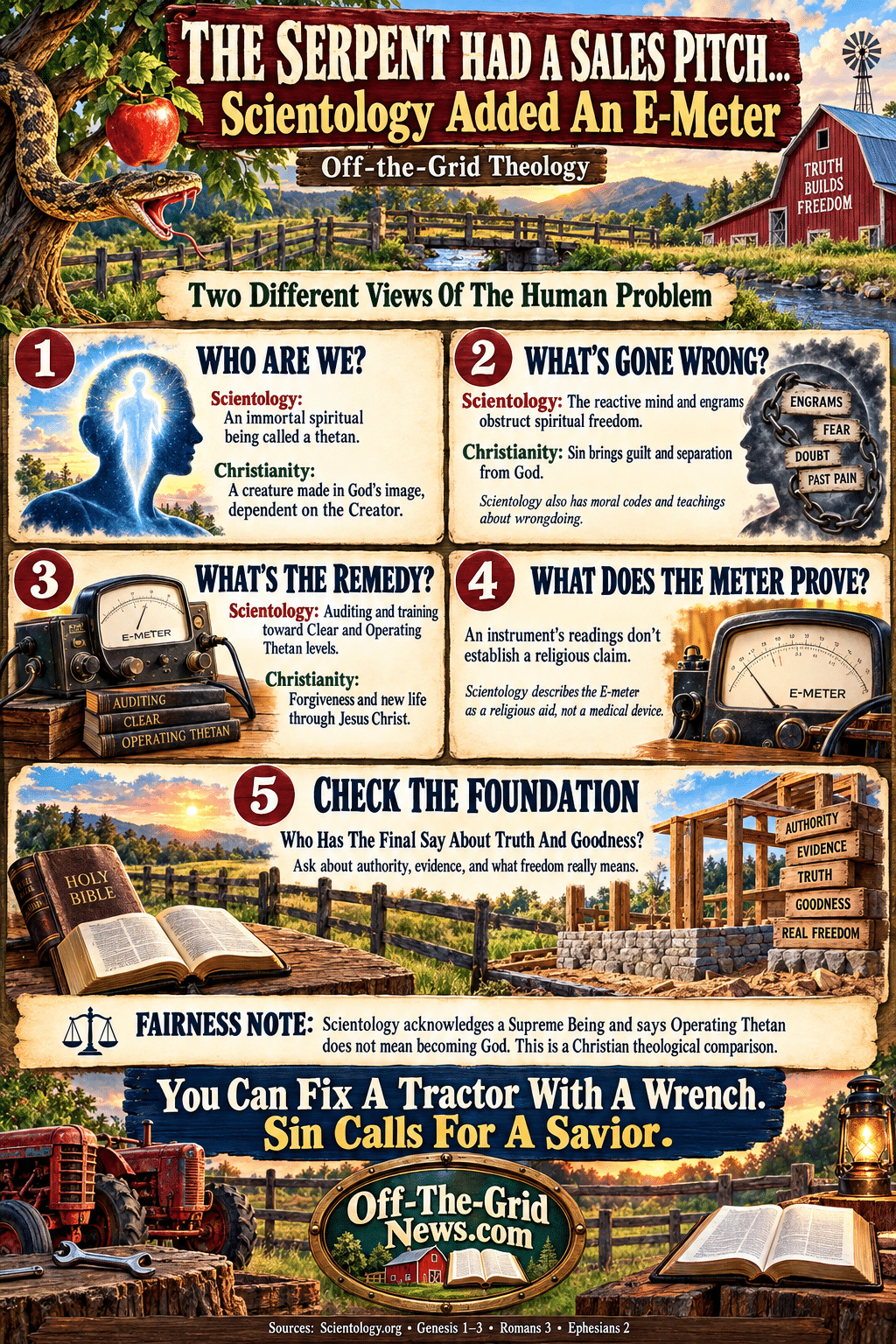
According to Scientology, your deepest identity is a thetan, an immortal spiritual being distinct from your body and mind. Its public teaching describes the thetan as the source of creation and life, with spiritual capacities that reach beyond ordinary bodily limits.
Meanwhile, its account of human trouble includes the reactive mind. This supposedly stores engrams, detailed recordings associated with moments of partial or complete unconsciousness. Scientology teaches that these recordings can influence a person’s emotions and behavior without his knowing it.
Next comes the proposed solution: auditing, a guided process that often uses an E-meter. The church describes that instrument as a religious aid; it expressly says the device isn’t intended or effective for diagnosing, treating, or preventing disease.
Through auditing, adherents pursue Clear, a state Scientology describes as freedom from one’s own reactive mind. Beyond that are Operating Thetan levels, part of a graded path commonly called the Bridge to Total Freedom. These are religious claims about spiritual advancement, not established scientific findings simply because an instrument sits on the table.
The Fence Between the Maker and the Made
Here Christianity drives a fence post deep enough to hit clay. God is the Creator. We belong to His creation, and no amount of spiritual progress turns the made thing into its Maker.
That distinction doesn’t make human beings worthless. On the contrary, Genesis says we’re made in God’s image. We have dignity, purpose, and responsibility because of whose image we bear, not because we’ve discovered a little private throne inside ourselves.
Furthermore, Acts 17 says God gives everyone life and breath. He doesn’t need us to keep Him running. We need Him with every heartbeat, including the heartbeat we spend insisting we can manage without Him. That’s a crucial distinction, however cocky we get.
Now compare that with Scientology’s promise of recovered spiritual ability. Its description of Operating Thetan says an individual can act without bodily or physical means. To be fair, that same explanation explicitly denies that reaching OT means becoming God.
Even so, let’s keep the criticism honest. The Christian objection isn’t that every Scientologist walks around declaring himself the Almighty. It’s that recovering the self’s spiritual powers occupies the place where Christianity puts reconciliation with the Creator through Christ.
Those roads don’t lead to the same farmhouse.
The Garden Sales Pitch Still Knows How to Lure Us In
Back in Eden, the serpent offered more than a bite of fruit. He coaxed human beings to distrust God’s word and grab the right to decide good and evil on their own terms. The King James wording has a familiar ring: “ye shall be as gods”.
The temptation was independence from the One who made them. Take the wheel. Set the terms. Treat dependence on God as the fence keeping you from the good pasture.
For that reason, promises of liberation through recovered inner power deserve a Christian’s scrutiny. What’s the lure, and where does it lead? The resemblance is theological; it doesn’t require pretending Scientology repeats every word of Genesis. The question is whether freedom comes through trusting God or through rising beyond the limitations we believe are holding us down.
And before we get smug, that temptation doesn’t stop at Scientology’s front door. It waltzes into ordinary churches wearing a clean shirt and carrying a Bible. Whenever we want God’s benefits while keeping final authority for ourselves, the old garden pitch has found another customer.
A Moving Needle Can’t Crack the Biggest Question
Scientology often presents its methods in the language of precision and technology. An E-meter has electrodes and a moving needle, which gives the whole scene the appearance of something you might find beside a laboratory bench.
But here’s the blind spot: an instrument doesn’t establish the truth of the religious explanation attached to it. A bathroom scale can tell you your weight. It can’t tell you whether your soul lived before your body, who made the universe, or whether your sins have been forgiven.
Likewise, Scientology acknowledges past lives and confidential advanced teachings. The church says people need preparation before receiving those advanced materials. So Christians can fairly ask what establishes their truth and how a member could pinpoint a serious error in the system.
That’s a question about authority, not a joke about unusual beliefs. Christians make extraordinary claims, too, including Christ’s resurrection, and should be willing to explain why they believe them. Everybody’s foundation deserves daylight. Ours doesn’t get a free pass.
Still, calling a religious method precise doesn’t prove its view of reality. A shiny gauge on the dashboard won’t tell you whether the bridge ahead has washed out.
You Can’t Repair Sin With a Wrench
Now let’s put another crucial detail on the table. Scientology does have moral codes, and its teaching discusses harmful acts and concealed wrongdoing. Saying it recognizes no wrongdoing would hand its defenders an easy correction and send the real argument stumbling into the ditch.
In plain English, the deeper difference concerns what wrongdoing means and what finally answers it. In Scripture, sin is rebellion against the holy God who made us. We haven’t merely collected painful experiences; we’ve also done wrong ourselves, and we’re accountable to Him.
Of course, wounds are real. People suffer terrible things they didn’t choose, and Christians shouldn’t brush that aside. But being wounded doesn’t erase our need for forgiveness any more than a broken barn window erases the mortgage.
Any farmer knows the difference between a damaged tractor and a dishonest hired hand. The tractor needs repair. The hired hand needs to come clean, return what he stole, and seek forgiveness; tightening his fan belt won’t settle the matter.
Likewise, spiritual improvement can’t, by itself, reconcile a sinner to God. Christianity’s answer is Christ’s saving work, received through faith. Ephesians 2 calls salvation God’s gift, not something our efforts earn.
Grace doesn’t arrive with a socket set.
Before You Trust the Engine Check the Fuel
Now consider the good things Scientology appeals to: spiritual worth, truth, responsibility, and the hope that life has meaning. Christians can recognize those longings without accepting the religious system built around them. Our neighbors aren’t foolish for wanting freedom from fear or a life that matters.
From the Christian perspective, those longings make sense because we live in God’s world and bear His image. We expect order because creation has a faithful Maker. We take wrongdoing seriously because moral obligation reaches beyond whichever rule happens to suit us today.
That leads to the borrowed-fuel question. If a system rejects Christianity’s foundation while appealing to truth and moral duty, what account does it give of those things? Where does their authority come from, and why should they bind someone who finds them inconvenient?
Of course, that’s an argument to develop, not a victory to announce before the other person speaks. A Scientologist may offer answers about survival, spiritual awareness, or moral responsibility. Hear those answers, then ask whether they explain why truth remains true and cruelty remains wrong even when a powerful person benefits from denying it.
After all, you haven’t inspected an engine merely because you’ve slapped a label on the fuel can.
Talk to the Person and Get Under the Floorboards
So how do you talk with a Scientologist? Start by remembering you’re speaking with a neighbor, not a target nailed to a fence. Ask what drew him in, what he believes he’s gained, and what he means by freedom.
From there, move gently but firmly toward the foundation. What makes a spiritual teaching true? If personal certainty is offered as the test, how do we settle a dispute between two equally certain people? What could show that Hubbard’s explanation was mistaken?
Next, put the promised destination under scrutiny. Is the deepest human need recovered ability, or forgiveness and reconciliation with God? Can greater power make someone good, and what would make that goodness more than usefulness to himself or his group?
Finally, explain the Christian hope plainly. God made a good world, human beings rebelled, and Christ came to save sinners. Jesus invites the weary to come to Him for rest, rather than telling them to discover that they’re powerful enough to rescue themselves.
The church says auditing and training are supported through parishioner donations. The Christian gospel locates salvation in what Christ has accomplished, freely given. That’s the difference to explain in plain English, without turning a hurting person’s hopes into a punch line.
You Weren’t Built to Hold Up the Universe
Look, self-reliance is a good thing. Learn to grow supper, mend a gate, and keep the lights on when the grid quits. Even so, don’t confuse keeping a household running with being the source of your own existence.
A man can stock his pantry and still need mercy. He can master a hundred useful skills and still be unable to forgive his own sins. Sooner or later, we have to face up to it: the strongest shoulders on the place weren’t built to hold up the universe.
That’s the freedom Christianity offers: you don’t have to become your own creator, judge, and savior. You can acknowledge the God who made you, confess what’s gone wrong, and trust the Savior who came to bring you home.
Check the foundation before you climb the bridge.