Print
One Ordinary Leaf Holds A Remarkable Story Of Sunlight… Color… And Winter Preparation
The science behind autumn leaves reveals a remarkable season of preparation—and gives us another reason to thank the One who made it.
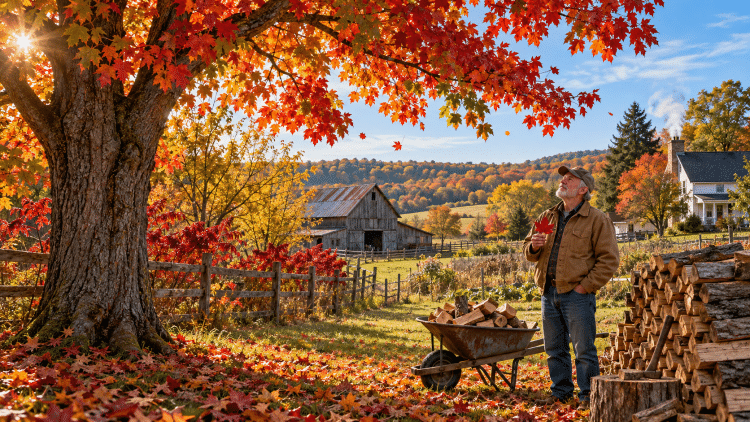
Walk out toward the barn on an October morning, and you may notice something that wasn’t there yesterday.
The maple beside the driveway has caught fire. The hickories are turning gold. Along the fence, a patch of sumac looks as though somebody spilled red paint across the hillside.
We call it “fall color,” take a picture, and get back to work.
But there’s more happening overhead than a change in scenery. Those trees are preparing for winter, reclaiming useful materials and releasing leaves through processes most of us never stop to consider.
And the better we understand those processes, the more there is to admire.
The Green Was Doing A Job
All summer, leaves have been busy making food.
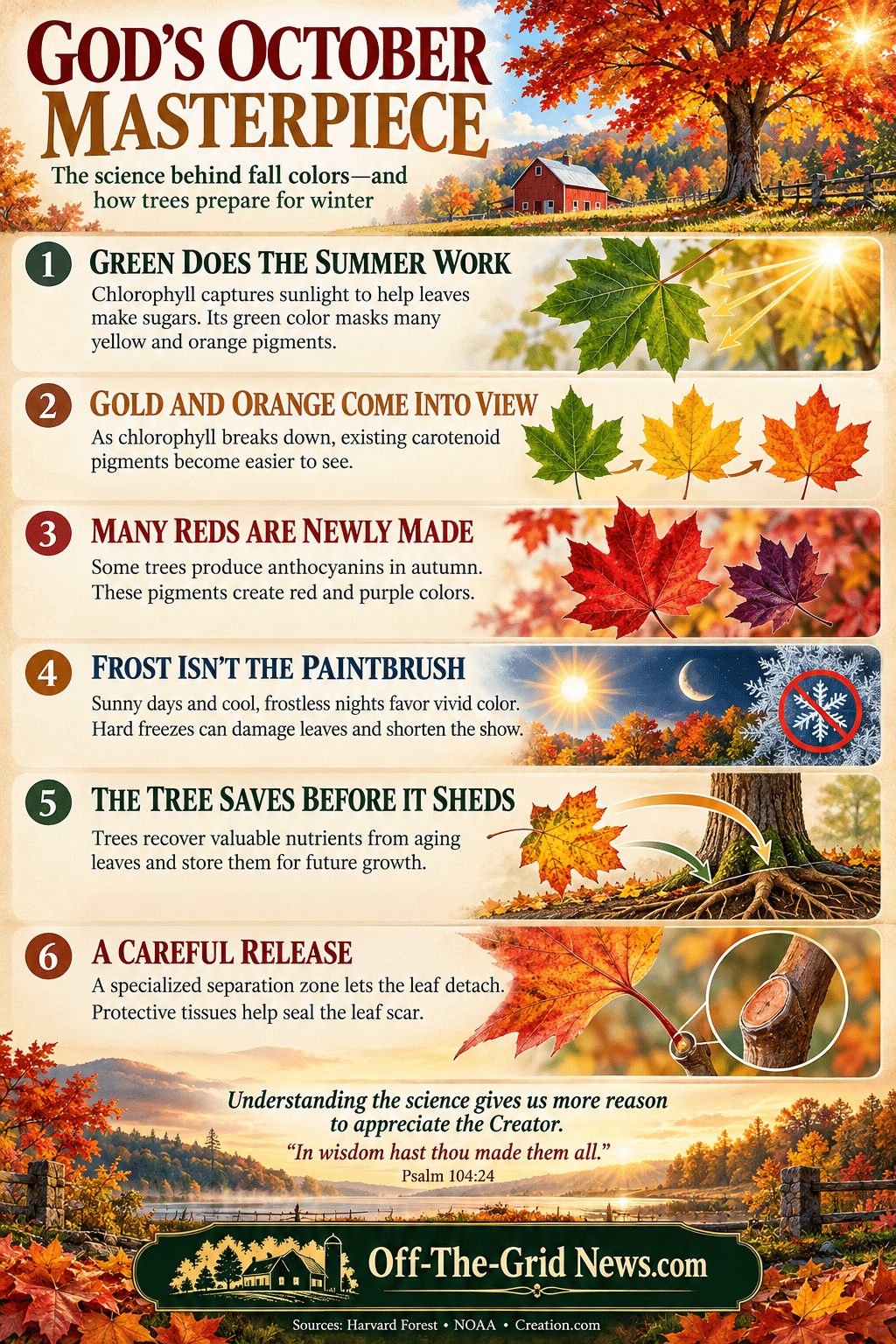
Using sunlight, they help turn water and carbon dioxide into sugars that support the tree’s growth. Chlorophyll, the pigment responsible for their green appearance, plays a central role in capturing that light.
Yet green isn’t the whole story.
Leaves also contain carotenoids, pigments that contribute yellow and orange. During the growing season, abundant chlorophyll generally masks those colors. When chlorophyll breaks down in autumn, the yellows and oranges become easier to see, as Harvard Forest explains. Harvard Forest
Think of the hickory along your lane. Some of the ingredients for its golden October display were present while you were picking tomatoes in August.
You simply couldn’t see them through all that green.
Christian writer John UpChurch describes these pigments in “Hiding Their True Colors”, connecting their work with the Creator’s ingenuity. The colors contribute to the functioning of a living leaf before they become something we stop to photograph. answersingenesis.org
That makes the beauty more interesting.
There is useful work behind the lovely view.
Some Colors Are Made For Autumn
Here’s where the familiar explanation needs a little correction.
We often hear that every fall color was hiding inside the leaf all summer. That works reasonably well for yellow and orange, but many autumn reds have a different story.
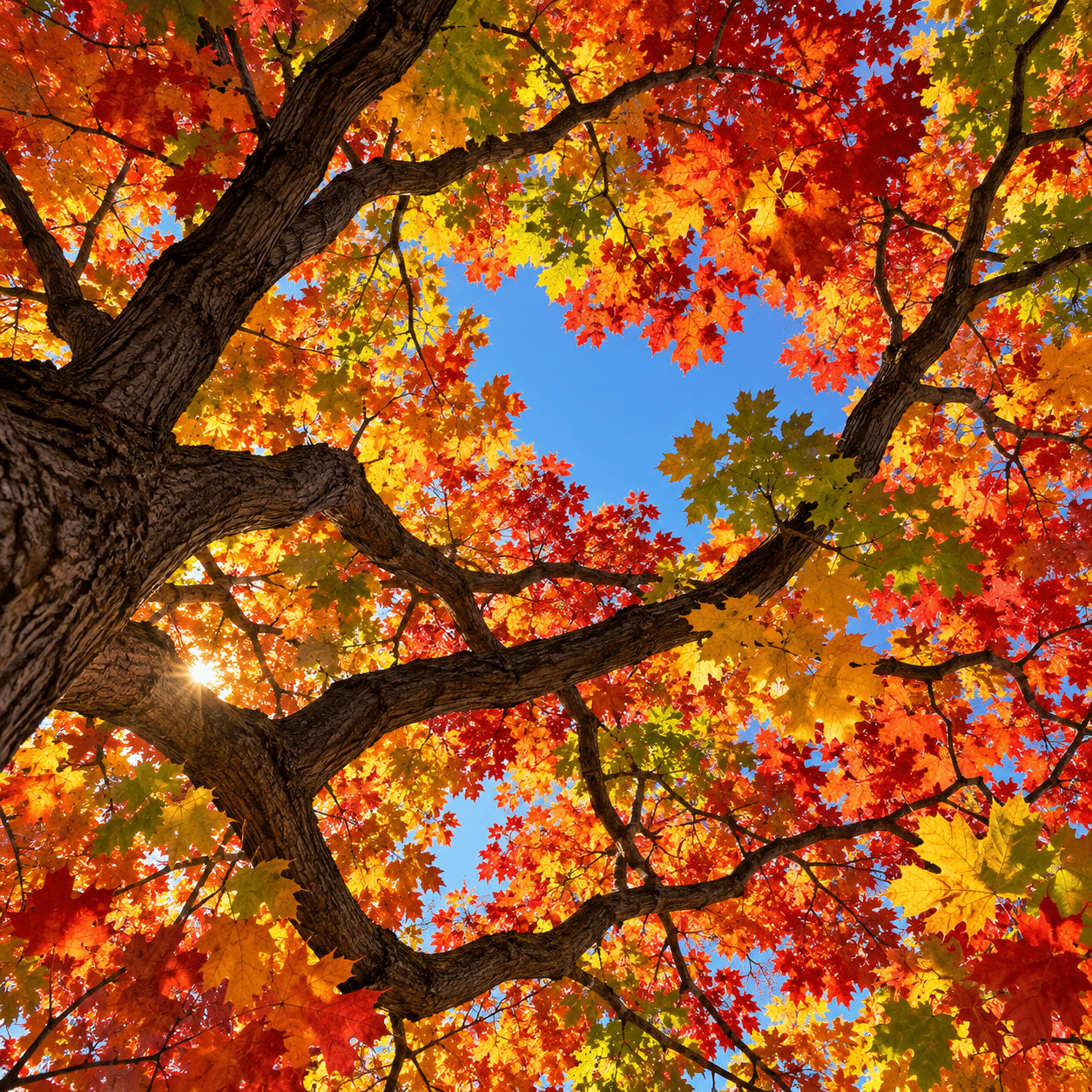
Trees such as maples can manufacture anthocyanins as their leaves age. These pigments produce reds and purples; their concentrations and combinations with other pigments help determine the final appearance.
Harvard Forest’s explanation distinguishes these newly produced pigments from the carotenoids left behind as chlorophyll disappears. Autumn involves both revealing existing color and producing new color. Harvard Forest
In other words, that red maple is doing more than taking off a green coat.
Researchers have investigated several possible benefits of autumn anthocyanins. UpChurch’s article discusses their potential role in protecting aging leaves from sunlight and helping trees recover nutrients. Explaining why trees produce these pigments remains a subject of scientific investigation. answersingenesis.org
Even familiar beauty can still hold unanswered questions.
Frost Doesn’t Paint The Leaves
Ask around, and somebody will tell you the trees need a good frost before they turn.
Actually, a hard freeze can spoil the show.
Shortening daylight helps signal the seasonal transition. Weather then influences its timing, intensity, and duration. According to NOAA, sunny autumn days and cool, frostless nights favor brilliant foliage, while drought can cause leaves to fall before reaching their full color.
Freezing temperatures can damage leaf tissues and cut the display short. www.noaa.gov
That helps explain why the same stretch of woods can look spectacular one October and disappointing the next. Species, local conditions, and the season’s weather all contribute.
A tree’s calendar reaches beyond the thermometer hanging outside your kitchen window.
The Tree Is Putting Something Away
Now comes the part a homesteader can appreciate.
Before shedding its leaves, a deciduous tree retrieves reusable resources from them. Materials recovered during this seasonal process help support future growth.
Dr. David Catchpoole describes that preparation in “Autumn Leaves Don’t Fall (by Accident)”. The changing colors accompany the dismantling of the leaf’s photosynthetic machinery and the movement of valuable resources into other parts of the tree. Creation.com
Picture a farmer putting tools away before a storm. The seasonal economy is remarkable.
Winter is coming, and useful resources are being conserved.
Then there’s the business of letting the leaf go.
Catchpoole explains that separation occurs at a specialized abscission zone near the base of the leaf stalk. Cells separate, while protective materials help seal the exposed surface on the tree’s side.
The wind may carry the leaf across your yard. The tree has already done much of the preparation that allows it to detach. Creation.com
Knowing The Chemistry Deepens The Wonder
Sometimes people speak as though understanding nature takes the wonder out of it.
I find the opposite happens.
A golden tree is beautiful from the road. Learning something about its pigments, seasonal signals, and resource recovery gives you more reasons to slow down.
The Christian can study those processes and thank God for them.
Psalm 104:24 celebrates the wisdom displayed throughout God’s works. Learning how a leaf functions gives us another occasion to recognize that wisdom. Bible Gateway
You can understand something about how a woodstove works and still be grateful for its warmth. Understanding leaf chemistry can likewise deepen your gratitude for an October hillside.
Scientific explanations give names to processes. They don’t exhaust the meaning of the beauty before us.
There’s something generous about this annual display. A family can enjoy it from a kitchen window, a child can carry a bright leaf home, and an old farmer can pause beside the gate without buying a ticket.
We spend plenty of money trying to bring beauty into our lives. Meanwhile, the hillside changes outside, and sometimes we’re too busy looking at a screen to notice. October gives us an opportunity to recover the habit of paying attention.
That attention can become thanksgiving. The tree doesn’t need to explain itself to us before we appreciate it. But when we learn a little of what is happening inside those leaves, gratitude has more substance. We begin to recognize provision, order, and beauty in something we might otherwise have walked past.
There Is A Lesson Along The Fence
Scripture also directs us to learn from the living world.
In Proverbs 6:6–8, the ant’s seasonal labor becomes an instruction in diligence and preparation. Bible Gateway
We should be careful about turning every detail of a tree into a sermon. Still, autumn offers a timely reminder to attend to the season we’re in.
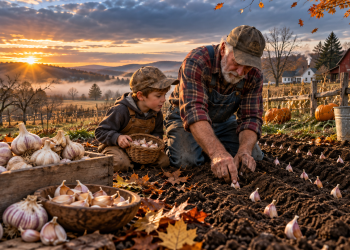
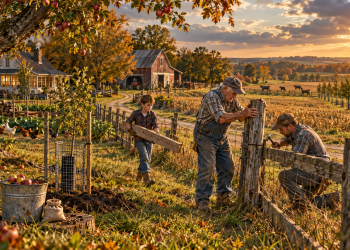
Check the chimney. Bring the tools under cover. Look over the pantry. Finish the job you’ll wish you had finished when the first bitter wind comes through.
And while you’re doing those things, look up.
The trees can remind us to prepare without making us forget to enjoy the day we’ve been given.
God’s promise in Genesis 8:22 places seedtime, harvest, summer, and winter within His continuing care for the earth. Our work takes place within that dependable rhythm. Bible Gateway
The gold above the driveway will soon be gone. The red along the fence will settle into the grass.
Take a moment before it does.
You’re watching a season of provision and preparation unfold—and there’s reason to give thanks for every leaf.