 Print
Print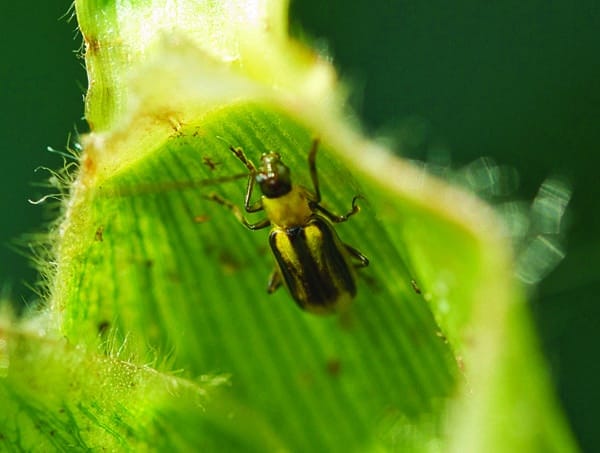

In a study that is sure to boost the claims of GMO critics, rootworms apparently have grown resistant to genetically modified corn in Illinois fields.
“It’s very alarming,” said Joe Spencer, an insect behaviorist with the Illinois Natural History Survey.
The study was conducted in conjunction between Illinois Natural History Survey and researchers at the University of Illinois and first reported by Reuters.
According to the study, Illinois farmers using Monsanto Bt corn seeds containing the protein “Cry3Bb1” – seeds that are genetically designed to kill rootworms – have become ineffective. Farmers and researchers are finding “significant damage” in their fields, the news agency said.
The rootworms have grown resistant despite the fact farmers are rotating their crops between corn and soybeans – a practice designed to prevent pest resistance. Rootworms generally lay eggs in cornfields, not soybean fields.
“It looked like continuous corn and use of the same trait year after year is what produced resistant beetles,” said Michael Gray, a professor of crop sciences at the University of Illinois. “Growers thought their get-out-of-jail-free card was just to rotate to soybeans. But what we’re seeing in northeast and east-central Illinois is beetles that are also resistant to crop rotation.”
New Survival Seed Bank™ Lets You Plant A Full Acre Crisis Garden!
Monsanto spokesman Jeffrey Neu acknowledged to Reuters that “pockets of heavy corn rootworm pressure” were found “in isolated areas of Illinois,” and he said the company was helping farmers address the problem.
Organic farmers long have expressed concern over the usage of Monsanto’s Bt corn, asserting it would harm their efforts at a successful crop. Some organic farmers sparingly spray their crops with Bt because it is a natural bacterium found in the soil.
The anti-GMO organization Beyond Pesticides says one problem with Monsanto’s GMO corn is that with “thousands of acres” of crops containing genetically engineered seeds, “it’s only a matter of time before insects become resistant to Bt.”
“Then organic farmers will be left without this important tool,” the organization says.
In March, a group of 22 researchers and scientists signed a letter to the Environmental Protection Agency expressing concern that pests were becoming resistant to GMO corn. The letter urged the EPA to deal with the issue with a “sense of some urgency.”
“Likely contributing factors to the problem,” the letter said, “include the widespread use of Bt corn hybrids (or Bt corn + insecticide) where it is not economically justified, the repeated deployment of hybrids expressing the same toxin in the same fields year after year, violation of stewardship requirements for refuges, and decreased options to employ alternative forms of pest management.”
The director of research and development with the Iowa Corn Growers Association said there have been reports of rootworm resistance to GMO corn in Iowa, but not to the level reported in Illinois.
It hasn’t been a good year for Monsanto on the public relations front. In May, Monsanto genetically modified wheat – not yet government-approved for commercial use – was found in an Oregon field. A farmer discovered it when he was spraying plants with an herbicide and noticed some of them did not die.
Federal and state officials are still trying to determine how the wheat got in the field.
“There’s really not a hypothesis that has a lot of buy-in,” Blake Rowe, chief executive of the Oregon Wheat Commission, told The Oregonian. “People are genuinely stumped. We’re beginning to mentally prepare ourselves that APHIS [Animal Plant and Health Inspection Service] won’t be able to say how it happened, and we just do the best we can to address it.”