 Print
Print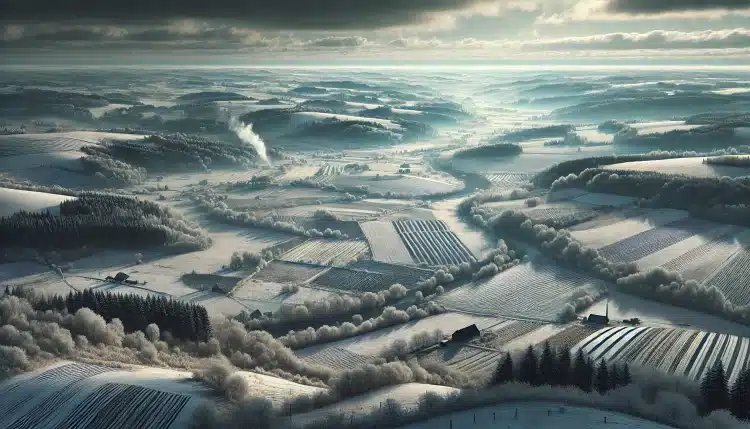
How a Quiet Scientific Reality Is Making the World More Abundant—Not Less
Here’s a question worth asking before you read another climate headline: if the Earth were really falling apart, why do the satellites keep reporting more green instead of less?
These aren’t guesses or opinions—they’re cold, mechanical eyes in orbit, measuring leaf cover, crop growth, and forest expansion across the globe. And what they see doesn’t match the story most of us have been told. Once you understand that disconnect, the rest of the climate conversation starts to look very different.
There’s something almost sacred about looking out a farmhouse kitchen window on a still December morning.
It Looks Like the Same Old Winter… But Something New Is Happening Beneath It

Outside, the world rests in a hush. Snow lies soft across the meadow like powdered sugar sifted by a careful hand. A thin ribbon of smoke lifts from the chimney and drifts east. At the edge of the woods, a lone deer stands half-hidden in shadow, its breath blooming white in the cold as it noses through the crusted snow, hunting for whatever stubborn green dares push up through frost and ice.
It’s the kind of scene you’d expect on an old Christmas card or painted on one of those nostalgic cookie tins pulled out once a year. Calm. Familiar. Timeless.
And yet, hidden inside that peaceful picture is a truth few people ever talk about—one that’s quietly reshaping the land beyond that window. Behind the roast warming in the oven, the pine trees standing dark and patient, and the wildlife thriving among them is an overlooked gift. A measurable, documented, NASA-acknowledged transformation of our planet.
The Gift of a Greening Earth
The Earth is getting greener.
And the driving force behind it isn’t mysterious or sinister. It’s one small, often-maligned molecule: carbon dioxide.
The Color Change Seen from Space
For decades now, satellites have been circling overhead, watching the Earth change shade by shade.
What they’ve recorded isn’t a planet fading or browning. It’s the opposite. Over roughly the last forty years, vegetation has expanded across as much as half of the planet’s land surface. From forests to grasslands to croplands, the green has deepened and spread.
During that same stretch of time, atmospheric carbon dioxide rose from around 350 parts per million to over 400. Much of it came from the engines of modern life—tractors breaking soil, furnaces heating homes, power plants lighting cities.
And instead of disappearing into nothingness, that CO₂ went to work.
It fed leaves. It thickened canopies. It lengthened growing seasons. It quietly fueled an explosion of plant life at exactly the moment humanity needed more food, more fiber, and more fuel than ever before.
Every loaf of bread, every bushel of corn, every cup of coffee begins with the same ancient process—photosynthesis. Plants taking sunlight, water, and carbon dioxide and turning them into sugars, structure, and life itself.
Without that exchange, there is no harvest. No timber. No pasture. No deer in the snow.
How Plants Really Respond to CO₂
Here’s the part that often gets skipped.
Plants don’t treat carbon dioxide like poison. They treat it like food.
When CO₂ levels rise, plants open their leaf pores less often, losing less water while pulling in more carbon. That means stronger growth and improved drought tolerance at the same time. Roots push deeper. Leaves grow thicker. Marginal lands begin supporting vegetation where nothing once held.
It’s not theory—it’s standard agronomy.
That’s why commercial greenhouses deliberately raise CO₂ levels to 800–1,000 parts per million. They’re not doing it for politics. They’re doing it because yields jump—often by 20 to 40 percent. Tomatoes fruit heavier. Cucumbers thicken. Lettuce fills out faster.
Field crops respond, too. Corn, millet, sorghum, sugarcane—all show improved growth, especially when water is scarce.
For anyone who’s ever walked a dry field wondering if the rain would come in time, that kind of resilience isn’t academic. It’s survival.
More Coffee, Courtesy of Carbon
Even the small pleasures benefit.
Take coffee—the beans behind peppermint mochas and Christmas morning brews. Studies from coffee-growing regions in Latin America show that higher atmospheric CO₂ increases photosynthetic efficiency in coffee plants, boosting yields by 12 to 14 percent.
That steaming mug warming your hands on a cold December morning? It owes part of its existence to the same process greening forests and fields around the globe.
It’s a quiet abundance, easy to miss if all you hear is noise and panic.
A Lesson Written in Ice
Of course, Earth has swung between warm and cold before.
From roughly the 1300s through the mid-1800s, the planet slipped into what historians now call the Little Ice Age. Growing seasons shortened. Crops failed. Rivers froze solid. Entire villages vanished under hunger and cold.
It wasn’t romantic. It wasn’t gentle. It was brutal.
Compared to that era, the warming and greening of the last century has been a gift. The 20th century delivered record harvests, expanding forests, and food security on a scale humanity had never known.
Warmth lengthened seasons. CO₂ fed growth. Together, they restored what centuries of cold had stripped away.
What the Research Actually Says
This isn’t nostalgia or wishful thinking.
A 2025 analysis published in Scientific Reports found that global crop yields remain stable—or improve—through temperature increases of up to five degrees Celsius, especially when CO₂ fertilization is factored in.
That’s not collapse. That’s adaptation.
NASA itself has documented vegetation expansion equivalent to two continental United States worth of new green cover.
And yet, those findings rarely make headlines.
Why Fear Drowns Out Facts
Instead, the public narrative is dominated by alarm.
Carbon dioxide is framed not as plant food, but as a looming villain. Greening trends are dismissed as “temporary.” Abundance is treated as suspicious. Farmers reporting bumper crops are told unseen disasters must be just around the corner.
It’s a strange inversion—where real-world evidence is brushed aside because it doesn’t serve a story built on fear.
You could call these voices the Climate Grinches. Faced with a thriving planet, they find only reasons to worry. Faced with life adapting, they predict failure.
For people who live close to the land, that pessimism rings hollow.
We see cycles. We watch soil recover. We notice thicker hedgerows and fuller fields. The Earth isn’t fragile porcelain—it’s a working system designed to renew itself.
Stewardship Without Shame
Listen, living off-grid or close to nature teaches something important.
Balance matters more than ideology.
Burning wood to heat your cabin doesn’t make you an enemy of the planet. Driving a tractor doesn’t doom the climate. Running a generator during a storm isn’t a moral failure.
You’re not outside nature—you’re inside it.
Good stewardship doesn’t require guilt. It requires care, restraint, and respect for how systems actually function. And the evidence says this system is responding with growth, not decay.
Seeing the Feast for What It Is
So when you gather around the table on a cold winter day—or any season for that matter—take another look at what’s laid out.
The roast. The ham. The potatoes. The berries. The vegetables. The bread.
Every bite exists because plants captured sunlight and carbon and turned them into nourishment. The same process feeding forests and wildlife feeds us.
Despite the propaganda, the world is not starving. It’s producing.
A Greener World, Waking Up
As the year turns and the days slowly lengthen again, step outside for a moment.
Breathe the sharp winter air. Look across the fields. Notice the dark line of pines on the horizon. Watch the deer nose through snow for green shoots.
The planet isn’t wilting.
It’s waking up.
And for those who still believe in self-reliance, honest work, and living in rhythm with the land, that quiet greening is more than data—it’s reassurance.
A reminder that God’s creation is not spiraling toward ruin, but responding exactly as it was designed to do.
That’s not something to fear.
That’s something to give thanks for.