 Print
Print
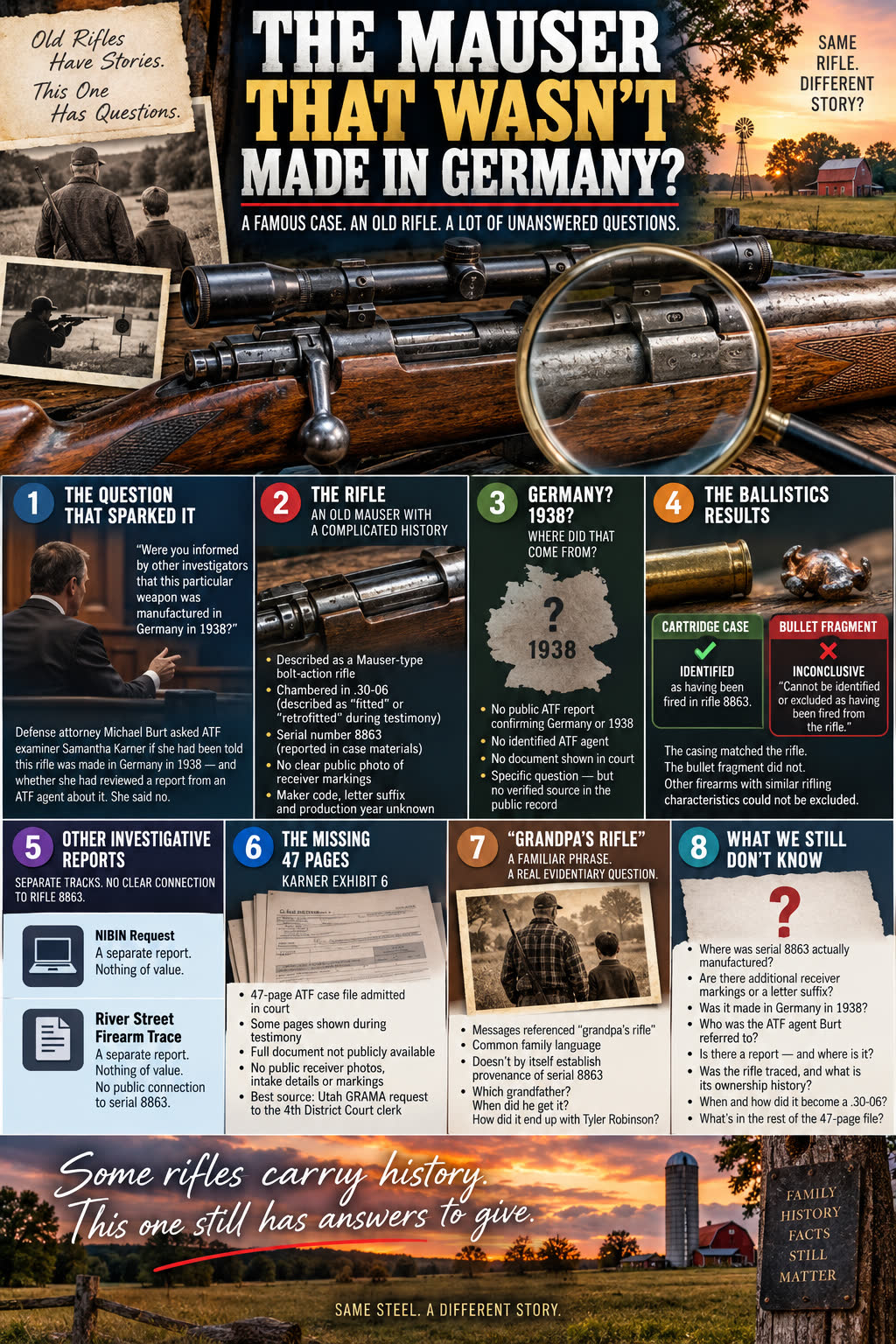
One Question About Charlie Kirk’s Alleged Murder Weapon Opened A Very Strange Door In The Kirk/Robinson Investigation
I own an old 8mm Mauser that came from my grandfather. Maybe that’s why one strange question about another grandfather’s Mauser sent me down a weird rabbit hole.
I have an old 8mm Mauser, and it came from my grandfather.
Years ago, my dad and I used to take that old rifle out and shoot it together. We had a lot of fun with it. It wasn’t some sinister object hiding in a closet. It was an old family rifle — heavy, solid, built like a fence post and carrying a little family history along with all that steel and wood.
If you’ve ever handled one of these old Mausers, you know what I’m talking about. You pick one up and immediately wonder where the thing has been. (You also realize it’s a bit much to hide in your pants.)
So who made it? When? Which arsenal? What war did it live through? How did it get to America? Who “sporterized” it? Who drilled it for a scope? And how in the world did Grandpa end up with it?
That’s probably why something caught my ear while going through the preliminary-hearing testimony of ATF firearms examiner Samantha Karner in the Tyler Robinson case.
It was just two questions.
But they were two very strange questions.
And after spending hours pulling on that thread, I’m left with considerably more questions about the rifle allegedly used to murder Charlie Kirk than when I started.
“Manufactured In Germany In 1938?”
ATF firearms examiner Samantha Karner was on the witness stand when defense attorney Michael Burt suddenly asked her whether she had been informed by other investigators that this particular weapon had been manufactured in Germany in 1938.
Karner said she had not.
Then came the question that made my ears perk up. Burt asked whether she had reviewed “a report from an ATF agent who investigated that issue.”
Karner answered that she did not believe she had.
And then the questioning moved along.
But stop for a moment.
Where in the world did Germany in 1938 come from?
Burt didn’t ask whether the rifle might be German. He didn’t ask Karner whether Mausers were manufactured in Germany, and he wasn’t giving the courtroom a history lesson about World War II rifles.
He asked about this particular weapon.
Then he referred to “a report from an ATF agent who investigated that issue.”
That’s mighty specific.
And yet after digging through the publicly available material, I cannot tell you who that ATF agent was. I cannot show you that report, tell you what it supposedly said, or show you the underlying evidence that led Burt to mention Germany and 1938.
And neither can I tell you Burt’s premise was correct.
A lawyer’s question isn’t evidence.
That’s important. But it’s still one heck of a question.
So I Started Pulling On The Thread
Once you start looking closely at this rifle, the story gets surprisingly murky.
The recovered weapon has publicly been described as a Mauser-type bolt-action rifle chambered in .30-06 and bearing serial number 8863. The ATF laboratory work is identified in court filings as case 2025-W-000401(1), with the firearms report dated September 17, 2025.
But here’s one of the first things that bothered me.
I haven’t been able to find a clear public photograph showing the identifying markings on the receiver.
The only picture I’ve ever seen shows a modern composite stock.
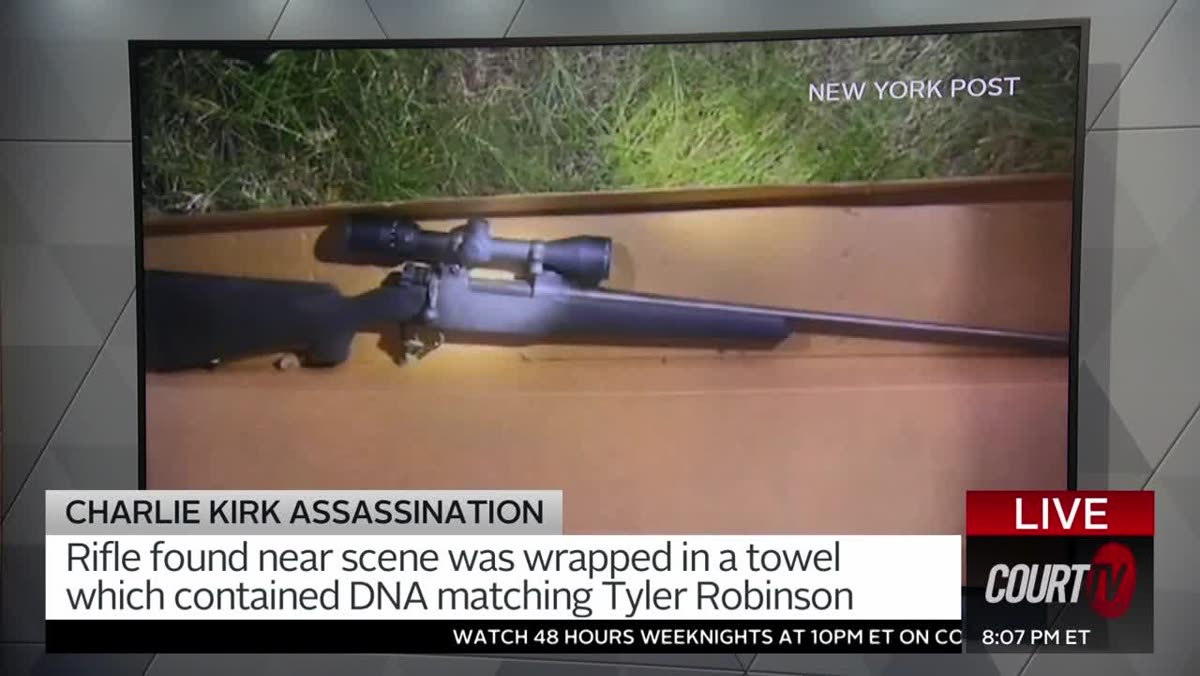
That’s the steel heart of the rifle. On an old military Mauser, markings on the receiver and elsewhere can potentially help establish the manufacturer, production history, and other details.
Yet we’re talking about Germany and 1938 without being able to simply look at a clear photograph of those markings ourselves.
Maybe those markings settle the matter.
Maybe they don’t.
But where’s the picture?
Then There’s Serial Number 8863
Serial number 8863 appears in the case materials.
Fine.
But an old Mauser isn’t a new pickup truck where one modern VIN gives you a nice, neat identity. Historical military rifles can involve maker codes, production blocks, suffixes, proof marks and other identifying information, which means the four digits 8863 aren’t necessarily the whole identification story.
That’s another hole in what we can publicly verify.
We know the reported serial number is 8863. What we don’t publicly know is whether the physical receiver contains additional identifying information, including a letter-block suffix, maker code or production-year marking.
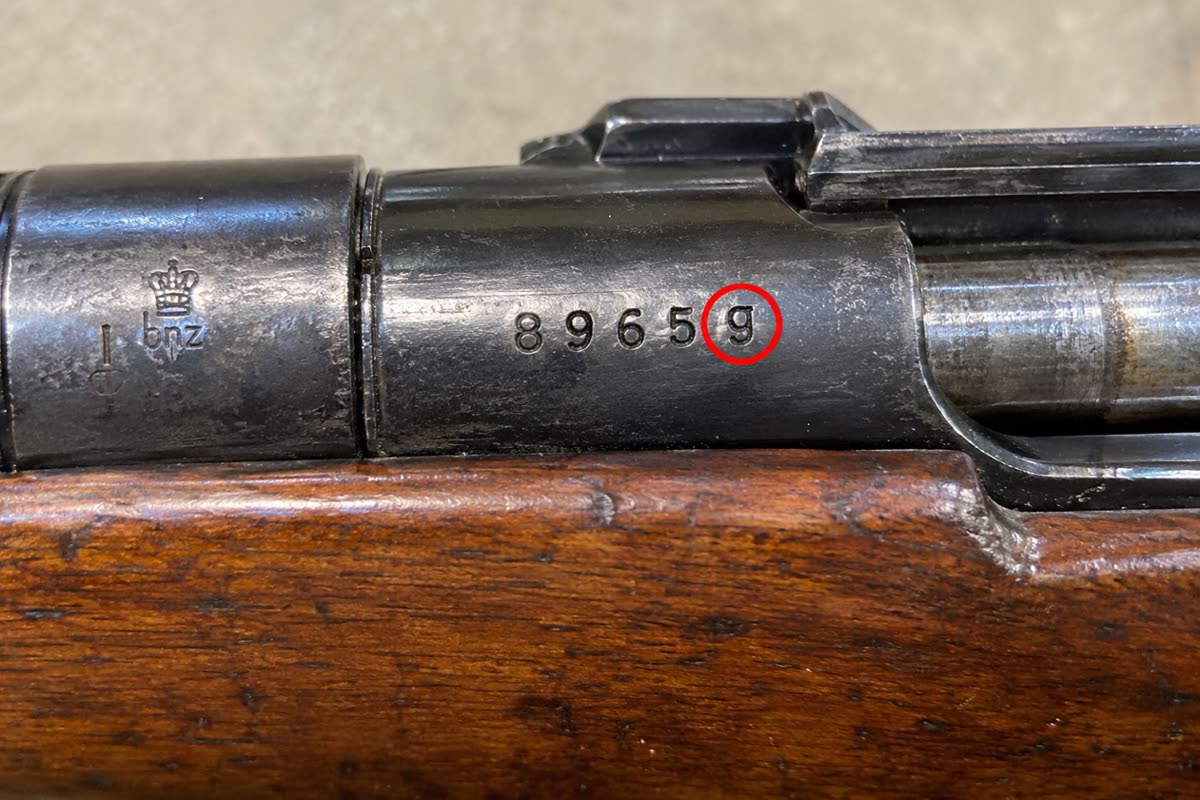
“Is 8863 the complete serial marking—and what maker code, production year, block marking, and other identifying marks are actually stamped on the recovered rifle?”
Take a close look at the Mauser above. At first glance, you might say its serial number is 8965. But look closer. The receiver actually says 8965g. That little letter matters.
That’s because old German Mausers weren’t necessarily numbered in one endless sequence. Production commonly used numbered blocks accompanied by letter suffixes. So 8965, 8965g, and 8965p could identify completely different rifles. The four numbers by themselves don’t necessarily tell you which rifle you have.
Now consider the rifle recovered in the Charlie Kirk case. Public descriptions have repeatedly identified it simply as Mauser serial number 8863. Maybe. But we still haven’t seen a clear public photograph of the receiver showing whether 8863 is the entire marking, whether a letter appears with it, or what maker code, production year, and other proof marks that might appear elsewhere on the receiver.
That’s the issue. This photograph doesn’t prove anything improper happened with rifle 8863, and it isn’t the rifle in the Kirk case. What it does show is why seeing the actual receiver markings matters. If you’re trying to establish the history and identity of an old Mauser, four digits can be only part of the story.
So the question remains remarkably simple: Can we see the receiver of rifle 8863?
That’s an awfully basic piece of information to be missing.
And What Exactly Is This Rifle?
There’s another wrinkle.
The rifle has repeatedly been described in the court record as a Mauser Model 98. Yet some secondary descriptions of the ATF material have used different model terminology, making the actual laboratory documentation particularly important.
Then there’s the caliber.
This rifle is described as a .30-06. During testimony, Utah State Bureau of Investigation Sergeant Morgan Faumuina — who acknowledged she wasn’t particularly familiar with firearms — described the Mauser 98 as being “fitted” with a .30-06 barrel.
Later descriptions have used the word “retrofitted.”
Maybe that’s exactly what happened. Old military Mausers have certainly been modified, converted, and “sporterized” over the decades.
But when?
By whom?
What was this particular rifle originally chambered in? Was the barrel replaced? Was some other conversion performed? When and where did it happen?
Most importantly, what evidence established the conversion history of this particular rifle?
We don’t know from the public material we’ve found.
Then There’s “Grandpa’s Rifle”
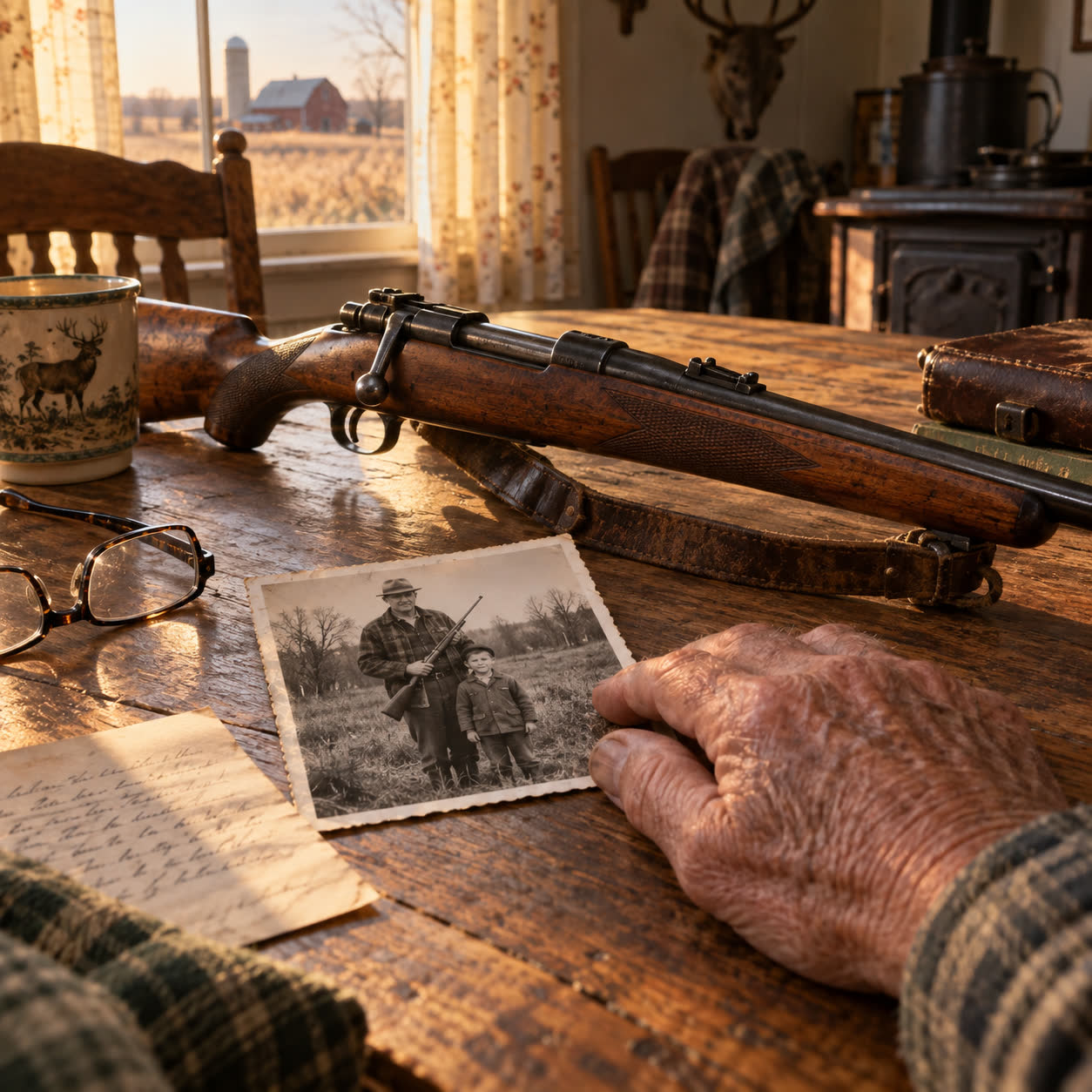
This part especially grabbed me because I understand the phrase.
I have Grandpa’s Mauser too.
If I told someone in my family, “Go get Grandpa’s Mauser,” we’d know exactly which rifle I meant. So when the alleged messages attributed to Robinson refer to “grandpa’s rifle” and “grandpa’s gun,” that sounds perfectly plausible as ordinary family language.
But there’s an evidentiary distinction that matters.
Calling something “Grandpa’s rifle” doesn’t by itself establish the documented provenance of serial number 8863.
Which grandfather was being referenced? When did he obtain it? Where did he obtain it? Did he personally own serial 8863? Did he give it directly to Tyler, or did the rifle pass through another family member first?
Those questions may have perfectly ordinary answers sitting in an investigative file somewhere.
But we haven’t found the public documentation establishing that ownership chain.
And that’s what kept bothering me, because with my Mauser, I can tell you why I call it Grandpa’s rifle. It’s part of my family’s history.
What establishes the history of this Grandpa’s rifle? You know, chain of custody stuff.
What Did ATF Actually Establish?
ATF unquestionably examined a recovered rifle.
According to the January 9 defense filing identifying the ATF laboratory report, the document is the September 17, 2025 ATF Lab Report, file “2025-W-000401(1) Firearms report_STAMPED.pdf,” later disclosed in discovery as Bates No. 011543.
ATF performed test fires, and here’s where we need to be precise.
The recovered spent cartridge case was identified as having been fired in rifle 8863. Karner’s conclusion was read into the preliminary-hearing record: “The Exhibit 2 cartridge case was identified as having been fired in the Exhibit 1 rifle.”
That’s significant evidence.
But the bullet-jacket fragment recovered during the alleged autopsy was a different story. I say alleged only because I can’t find any autopsy information.
The ATF conclusion, also read into the Day 4 preliminary-hearing record, was that the fragment “cannot be identified or excluded as having been fired from the Exhibit 1 rifle.” The comparison result was inconclusive. Again, Inconclusive.
Those aren’t the same conclusions.
Yet it’s very easy for a sentence such as “ballistics connected the rifle to the crime” to blur those two findings together.
The casing was identified to the rifle.
The bullet-jacket fragment wasn’t. Very interesting.
In Fact, Other Guns Couldn’t Be Excluded
This gets even more interesting.
Karner conducted a General Rifling Characteristics search. That kind of comparison deals with broader class characteristics rather than establishing that one particular firearm fired one particular projectile.
According to arguments made later in the proceedings, Karner’s underlying case material contained a list of other firearm types whose general characteristics potentially fit the recovered fragment.
That doesn’t prove another gun fired it.
Not remotely.
It helps explain why Karner’s scientific conclusion was inconclusive rather than a positive identification. The fragment apparently had enough characteristics to permit comparison, but not enough individual agreement or disagreement to say rifle 8863 fired it — or to exclude rifle 8863.
That’s an important distinction for anybody trying to understand the evidence without a forensic-science degree.
Inconclusive means inconclusive. Rest assured, that will come up in the actual trial.
The 47 Pages We Can’t Read
And that brings us to another curious part of this story.
Karner didn’t merely produce the short ATF report. During the preliminary hearing, Burt introduced Karner’s underlying 47-page case file, containing laboratory notes, photographs, and documentation concerning her examination.
Karner authenticated the case file during her testimony, and the judge admitted it. Portions of those materials were then displayed during the public hearing.
We’ve been able to identify fragments of the exhibit through the courtroom presentation. Those materials include photographs of evidence and documentation underlying Karner’s analysis.
But the complete 47-page exhibit?
I haven’t located it publicly online.
That’s different from saying it’s being hidden. An admitted courtroom exhibit isn’t automatically going to appear as a convenient downloadable PDF on Google.
But the distinction doesn’t make the document any less interesting.
Among other things, I’d like to know whether those 47 pages contain photographs showing the complete rifle and its receiver markings. I’d also like to see the intake documentation, laboratory notes, verification material and anything else identifying precisely what Karner received and examined.
Maybe none of it answers the Germany/1938 question.
But wouldn’t you like to see it?
I sure would.
Another Curious Distinction: NIBIN Isn’t A Gun Trace
The preliminary-hearing testimony also revealed something else that’s easy for ordinary readers to miss.
Faumuina testified about a September 24 report documenting a request involving NIBIN — the National Integrated Ballistic Information Network. She explained that test fires or cartridge-case information can be entered to look for possible ballistic associations with other evidence.
Burt asked whether anything of value came from that part of the investigation.
Faumuina said no.
But NIBIN isn’t the same thing as tracing a gun’s ownership history. It’s a ballistic intelligence system.
And, interestingly… Faumuina separately testified about another report involving a firearm trace and a firearm seized at River Street.
Those are two different things.
The River Street trace apparently produced nothing useful either. More importantly for our purposes, nothing I’ve found publicly establishes that the River Street gun was rifle 8863.
So we have evidence that firearm tracing was being used somewhere in this investigation.
What we haven’t located is a public ATF firearm-trace result specifically for serial number 8863.
That doesn’t mean ATF didn’t trace it.
Read that sentence again.
It means we haven’t found public evidence showing whether such a trace was requested, whether it succeeded, whether it failed, or whether the result simply remains outside the publicly available record.
That’s an evidentiary gap — not proof of wrongdoing.
Which Brings Us Right Back To Germany
After hours of digging, we’re right back where I started.
Germany.
And one strangely specific question from a defense attorney.
Maybe there’s a perfectly simple explanation. Perhaps an ATF investigator looked at the receiver, recognized the manufacturer’s code and production year, wrote a routine report, and moved along.
Maybe that report is sitting in discovery and simply hasn’t become publicly available. Maybe Burt’s information came from somewhere else entirely.
Or maybe Burt’s premise was wrong.
I just don’t know.
That’s the point.
I’m Going To Look At My Own Mauser Differently Now
The next time I pull my grandfather’s old 8mm Mauser out, I’m probably going to spend a little more time studying those markings.
I’ll remember shooting it with Dad years ago — the kick, the noise (which is not a “pop”–it sounds more like a cannon), and that unmistakable feeling of firing an old military rifle built in another age. Those memories are why I understand perfectly well how a family can simply call an old firearm “Grandpa’s rifle.”
Mostly, though, I’ll remember that an old rifle carries two histories.
There’s the history stamped into the steel, and there’s the history told by the family that owned it.
Sometimes those histories can be documented. Sometimes pieces of them disappear when Grandpa does.
But when a rifle becomes one of the central pieces of physical evidence in one of the most closely watched murder prosecutions in America, those little details stop being merely interesting.
They matter.
I am not saying investigators fabricated the rifle.
I’m not saying rifle 8863 wasn’t Robinson’s grandfather’s rifle, that it wasn’t manufactured in Germany in 1938, or even that another firearm killed Charlie Kirk.
The publicly available evidence we’ve examined doesn’t establish those propositions.
What I am saying is considerably simpler.
I started asking basic questions about one old Mauser — and discovered that the publicly available answers aren’t nearly as complete as I expected them to be.
Where was serial 8863 actually manufactured? What are the complete markings on its receiver? Was it manufactured in Germany in 1938?
What exactly did the unidentified ATF agent supposedly investigate? Where is the report Burt referenced? Was serial 8863 traced, and what is its documented ownership history?
When and how did it become a .30-06? In what state was that done? Implications there. Which agent asked the family questions regarding the rifle?
And what’s contained in the rest of Karner’s 47-page case file?
Those aren’t conspiracy theories.
They’re unanswered questions.
And somewhere — perhaps stamped right into an old piece of steel — there may be some remarkably simple answers.
I’ll keep digging.