 Print

Nine Families Say Trouble Followed a Blood Transfusion and They Want Answers
A New Case Series Raises Questions About Serious Illness After Transfusions
Out here, you learn early that what goes into the well matters. A cracked casing can turn a dependable water supply into a household problem before anybody notices the taste. So when families start asking what goes into a hospital blood bag, country people understand the question.
After all, that bag may someday be hanging beside your wife, your grandson or you. You deserve straight answers about its benefits, its risks and the evidence behind both.
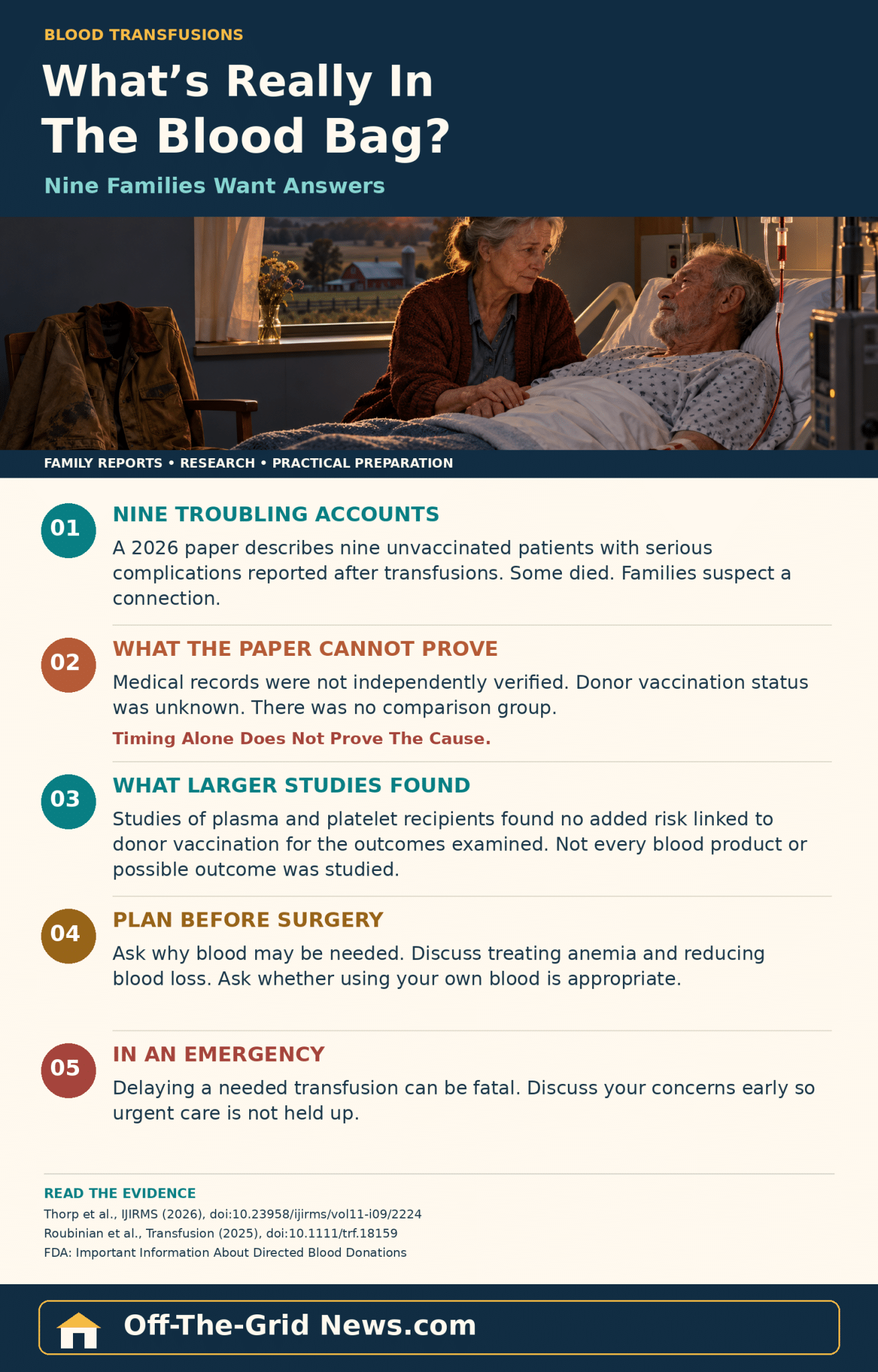
That brings us to a September 2026 paper in the International Journal of Innovative Research in Medical Science. Nine authors, led by maternal fetal medicine specialist Dr. James Thorp, describe nine people reported to have never received a COVID shot who suffered serious medical problems after transfusions. Some died, and their families suspect the blood played a part.
Those accounts deserve attention. But the paper does not establish that vaccinated donors supplied the blood, or that vaccine material caused the illnesses. Before we walk through the hospital door, that distinction belongs right up front.
Before You Judge the Harvest Look at How It Was Gathered

First, this is a case series intended to generate a hypothesis, meaning a question researchers can test. It is not a clinical trial, and it does not compare otherwise similar patients receiving blood from vaccinated and unvaccinated donors.
Instead, the authors gathered accounts through family outreach, public testimony, interviews, advocacy organizations, social media and published reports. They state that they did not confirm the medical records, laboratory findings, imaging or autopsy reports. They also could not establish the vaccination status of the donors involved.
In plain English, the paper collects alarming stories about what happened after transfusions. It cannot tell us whether vaccination had anything to do with those events, how often such events happen, or whether they occur more often with one kind of donor.
There is also a financial interest worth putting on the kitchen table. Coauthor R. Clinton Ohlers is identified as a vice president of SafeBlood, an organization that matches patients with donors who have not received COVID vaccines. That connection does not settle whether the argument is right, but readers deserve to know it exists.
The Blood Supply Has a History Nobody Should Forget
Of course, public concern did not spring out of an empty pasture. During the AIDS crisis, contaminated blood and blood products infected thousands of Americans. Hepatitis C also spread through transfusions before effective screening became available.
The paper cites estimates of more than 12,000 American HIV infections through transfusion and roughly 300,000 hepatitis C infections through transfusions and blood products before screening caught up. Tennis champion Arthur Ashe became one of the best known faces of that tragedy after receiving contaminated blood during heart surgery in 1983.
Later, the 1995 federal review of HIV and the blood supply examined the decisions behind that disaster. Among the lessons were the dangers of underestimating a developing threat, depending too heavily on industry judgments and waiting too long to act amid uncertainty.
Thorp and his coauthors believe those lessons apply again today. That is their argument, rather than a finding established by the nine cases. History gives us good reason to demand evidence and accountability; it cannot substitute for evidence about a different suspected hazard.
A Baby and a Clot His Parents Could Not Stop
The first account involves a baby boy born January 3, 2022, with serious congenital problems involving his esophagus, windpipe and heart. According to the paper, he received blood from the general supply during surgery on January 24.
His parents reported that a clot blocked a catheter in his leg within about 12 hours. They said it continued extending through major veins toward and into his heart despite blood thinning treatment. The child subsequently died.
Afterward, the family publicly questioned the transfusion and described difficulty obtaining records. Those allegations are devastating to read, but the paper does not independently resolve them. Nor does it establish whether the catheter, the child’s underlying condition, surgery, transfusion complications or another cause explains the clotting.
A grieving parent’s question deserves a serious investigation. Answering it requires the hospital record and a careful reconstruction of what happened.
More Beds More Blood and More Questions
Next comes a 58 year old California woman who reportedly received six to eight units. Her husband described fluid and clotted material collecting around her heart, requiring drainage. Again, the account raises a question without identifying the donor exposure or establishing the medical cause.
Meanwhile, a 68 year old North Dakota man received about 13 units while bleeding from an ulcer. His widow described clots in both legs, a pulmonary embolism, a clot inside his heart and eventual organ failure. He died December 4, 2022, and she acknowledged that he had already shown some tendency to clot.
Overseas, a 63 year old Dutch cancer patient reportedly requested blood from unvaccinated donors but received general supply blood instead. The account describes clots in her lungs and legs about five days after four units, followed by her death that month. Cancer itself is a major competing explanation that any investigation would have to examine.
Then there is a 65 year old Scottish man who associated a transfusion during hip surgery with facial paralysis, heart problems, nerve pain and bladder trouble. His experience belongs in the record. Determining why those problems developed requires more than their position on the calendar.
Strange Material and a Young Mother in Crisis
Two other accounts describe unusual looking material. In one, a wife reported long, pale strands removed from her husband’s chest tubes. In another, a wife photographed rubbery white material from a clot associated with her husband’s shin wound and saved a specimen in a glass jar.
Those descriptions are striking. Yet a photograph or a jar cannot establish that the material contained vaccine components, came from donated blood or caused the patient’s illness. That takes properly collected samples, laboratory analysis and a documented chain connecting the findings to the patient and transfusion.
Another case concerns a 30 year old Pennsylvania mother who hemorrhaged after a home birth. The account reports eight units of blood, disseminated intravascular coagulation, or DIC, and a 32 day hospitalization. DIC is a dangerous breakdown of the body’s clotting system that can cause both clotting and bleeding; severe obstetric hemorrhage is itself a setting in which it can develop.
Finally, a 52 year old Mississippi man with stage IV cancer reportedly received 26 units over roughly ten weeks. His wife’s diary associated successive transfusions with worsening pain, swelling and clotting. But he already had pulmonary clots and a positive COVID test before the first transfusion, and he died June 12, 2022.
The paper summarizes clotting across all nine cases, with organ failure and heart inflammation in some. Whatever the reported pattern, these were seriously ill people with substantial competing risks. Without verified records and comparison patients, the series cannot separate those risks from a suspected effect of donated blood.
What the Authors Think Might Be in the Bag
From there, the authors turn to a proposed explanation. They argue that routine blood collection does not test for the range of vaccine related substances they worry about, including spike protein, vaccine mRNA, lipid nanoparticles and residual plasmid DNA. They want additional investigation and screening.
One finding they cite comes from Yale’s research on reported post vaccination syndrome. Yale reported detectable spike protein in some participants more than 700 days after their last vaccination. The researchers emphasized that the work was preliminary and required confirmation.
That is a research question worth examining. However, the study did not test whether donated blood from those participants injured transfusion recipients. Detecting a substance, establishing its source and showing that a transfused dose causes harm are separate jobs.
The authors also cite a report associated with coauthor Nicolas Hulscher claiming detection of vaccine related material 1,222 days after vaccination. That claim does not identify what was in any of the nine patients’ blood bags, nor does it supply the missing link between donor, transfusion and injury.
In addition, the paper discusses embalmers’ reports of unusual fibrous casts and language in Pfizer’s trial protocol about reporting environmental exposure. Neither establishes that vaccinated people shed harmful material into others or that a transfusion caused these cases. A protocol’s instruction to report a possible exposure is not a finding that the exposure occurred.
Put the Larger Studies on the Scale Too
Meanwhile, evidence from actual transfusion recipients deserves a full hearing. A 2025 study by Roubinian and colleagues examined 7,773 recipients across 8,715 hospitalizations, linking plasma and platelet transfusions with donor infection and vaccination information.
The researchers found no association between donor vaccination and the outcomes they examined: thrombosis, increased respiratory support and hospital death. An earlier Roubinian study also examined outcomes before and after widespread donor infection and vaccination.
These studies have limits. Plasma and platelet findings do not answer every question about red cell transfusions, every rare complication or every possible long term outcome. Still, their results weigh against the claim that vaccinated donor blood commonly produces the severe complications described in the nine accounts.
There is another side to the risk ledger as well. A 2026 single center study by Jacobs and colleagues described 15 patients whose directed donations were sought because of vaccination concerns. The report associated those arrangements with care delays, clinical deterioration and wasted resources.
That study cannot answer every donor safety question either. But it identifies a practical danger: a search for a preferred blood source can leave a patient waiting while the medical problem gets worse.
Your Wishes Deserve a Hearing and the Details Matter
Naturally, people want a say in their treatment. Directed donation means arranging blood from a particular donor, and some families see that as a way to exercise control when they feel the hospital is not listening.
The FDA’s guidance on directed donations says there is no evidence that choosing donors on unsupported characteristics makes blood safer. Every donor still has to meet eligibility requirements, and every unit must undergo the required testing. Knowing the donor personally does not replace those safeguards.
Thorp’s paper discusses the New Zealand Baby W court case and reports that American patients have encountered refusals or traveled for care. The authors interpret those disputes as violations of patient autonomy. Their ethical judgment is part of the argument, not a blanket legal finding governing every hospital or state.
A patient’s right to discuss or refuse treatment does not automatically require a hospital to provide any requested blood arrangement. Policies, medical necessity, availability and the law all matter. Get the actual requirements from the hospital’s transfusion service before a planned operation is close enough to hear the thunder.
Make the Plan Before the Ambulance Comes
For a homestead family, the useful preparation starts with a conversation. If surgery is coming, ask the surgeon and transfusion service what blood products might be needed, why they might be needed and what options fit your situation.
Ask about treating anemia beforehand, reducing surgical blood loss and whether cell salvage or another blood conservation approach is appropriate. You can also ask whether banking your own blood, called autologous donation, makes sense. It is not suitable or necessary for every patient and needs advance medical planning.
Likewise, put your preferences in writing and discuss them with your health care decision maker. Knowing your blood type can be useful, but a neighbor with the same type is not an emergency blood bank. Safe transfusion requires compatibility testing, eligible donors and properly collected and processed blood.
Above all, do not let a frightening story make an emergency decision for you. After a tractor rollover or a major hemorrhage, delaying a needed transfusion can be fatal. That bag may be the thing that gets you home.
The nine families deserve to have their questions heard, and the blood supply deserves continuing scrutiny. The way forward is careful investigation that can confirm a hazard or rule one out, followed by action supported by the findings.
Around a homestead, we test the well because we want an answer we can use. The same standard belongs beside the hospital bed.
Primary paper: Thorp JA, Rogers C, Ohlers RC, et al. Potential Implications of COVID-19 Vaccination for Blood Donation: A Retrospective Case Series and Literature Review — Part I of II. International Journal of Innovative Research in Medical Science. 2026;11(09):234–245. doi:10.23958/ijirms/vol11-i09/2224.