 Print
Print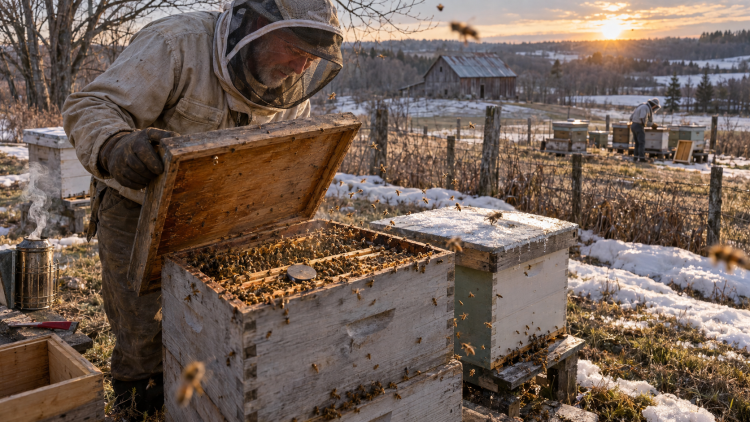
Two Bee Yards. One Cold Winter. Two Very Different Hives Come Spring
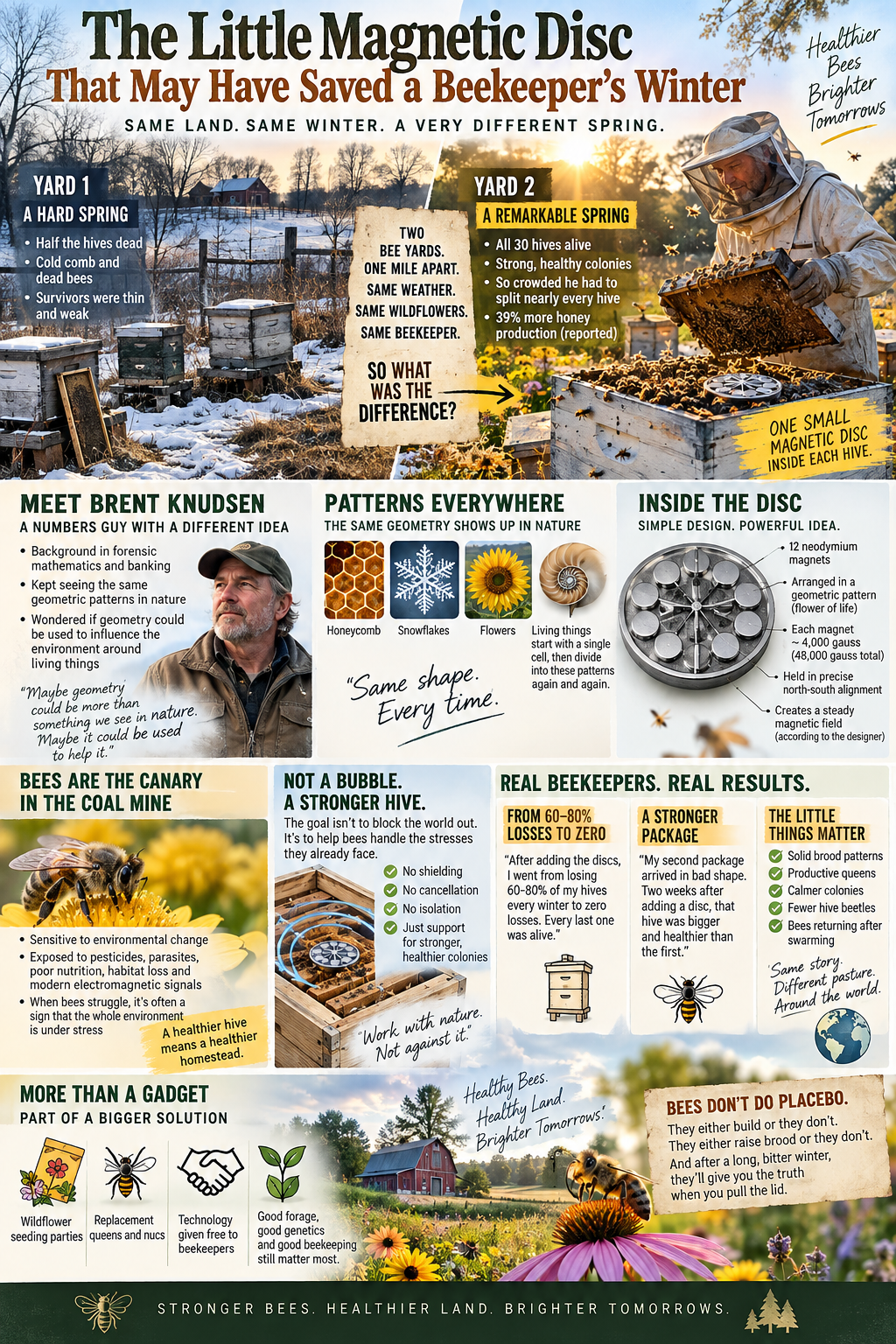
Picture two bee yards sitting barely a mile apart on the same cold Ontario ground. Same winter. Same spring weather. Same wildflowers waiting beneath the frost. Same third-generation beekeeper walking the rows with his hive tool tucked into his back pocket.
But when he started lifting lids that spring, one yard broke his heart.
Half the hives were dead. Inside those boxes were cold combs, empty clusters and dead bees scattered across the bottom boards. Even some of the colonies that had survived looked weak and thin, with barely enough bees left to cover a frame.
Then he drove over to the second yard.
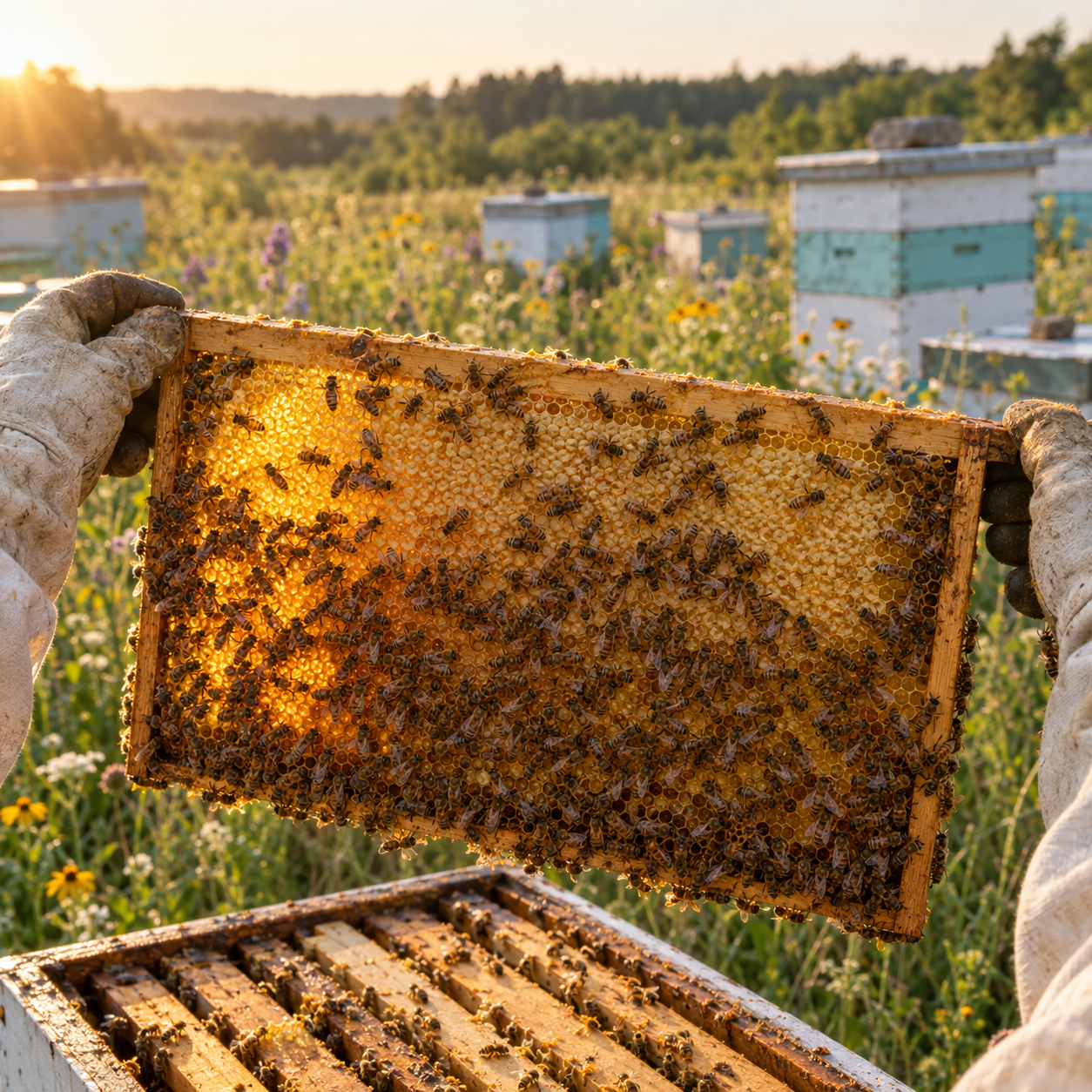
Every single one of those thirty hives was alive.
And they weren’t merely hanging on.
Those colonies were boiling over with bees. They were so crowded and vigorous that the beekeeper reportedly had to split nearly every hive and start stacking on additional boxes before the colonies decided to swarm into the nearest treetop.
Same beekeeper. Same neighborhood. Same winter.
So what was different?
Inside the hives in that second yard was a small magnetic disc.
And that’s where this story gets interesting.
He Wasn’t a Beekeeper. He Was a Numbers Guy
The fellow behind that disc is Brent Knudsen, and he’ll tell you right up front that he didn’t come to this as a beekeeper. His background was in forensic mathematics and financial technology, including writing algorithms used in banking back in the 1990s.
Eventually, he helped build a sizable banking operation, sold out and walked away from the corporate world. Instead of spending retirement polishing golf clubs, though, Knudsen started chasing an idea that had been rattling around in his head for years.
It started with patterns.
Over and over again, he says, he kept encountering familiar geometric forms: hexagons, six-pointed arrangements and overlapping circles commonly associated with what’s sometimes called the “flower of life.”
You don’t have to look very far around a homestead to find geometry in nature. Honeybees build hexagonal comb. Snowflakes form six-fold patterns. Spider webs, flowers, seed heads and countless other living structures follow remarkably orderly mathematical arrangements.
Similar geometric designs have also appeared in human artwork, architecture and religious decoration for centuries.
Then Knudsen started looking at biology.
Every bee in your hive, every bean climbing your garden fence and every person walking across your kitchen floor began with a cell. As embryos develop, those cells divide and arrange themselves into increasingly complicated structures.
Knudsen began wondering whether geometry wasn’t merely something we observe in living things.
Maybe, he thought, geometry could somehow be used to influence the environment around them.
That idea sent him down a very strange rabbit hole.
From Geometry to Magnetic Fields
Knudsen eventually began experimenting with magnets, geometry and what he describes as frequency.
Now, this is where we need to keep one boot planted firmly on the ground.
Magnetic fields are real. Electromagnetic radiation is real. Biological organisms can respond to environmental electromagnetic conditions. But the specific biological mechanism Knudsen proposes for his device—and some of the broader claims surrounding “frequency”—shouldn’t be confused with established scientific consensus.
What matters for this story is what he built and what beekeepers say happened afterward.
Knudsen says he spent about five years experimenting in a laboratory before bees ever entered the picture. Then, around 2015, friends and family began pushing him to look at the growing problems facing honeybees.
At first, he wasn’t interested.
He was perfectly happy tinkering with equipment, magnets and measurements without having several million tiny flying livestock involved.
But people kept after him.
Eventually, he agreed to try the technology around some hives.
And according to Knudsen, what happened next changed the direction of his work.
Bees Are the Homestead’s Canary in the Coal Mine
Anybody who’s kept bees for long knows how quickly a colony can tell you something is wrong.
The old coal miners carried canaries underground because the little birds could succumb to poisonous gases before the miners themselves realized there was danger. Honeybees aren’t literally doing the same job, of course, but they’re remarkably sensitive creatures living right where agriculture, weather and the surrounding environment collide.
Think about everything a colony has to handle.
There’s pesticide exposure. Parasites such as Varroa mites. Viruses and other pathogens. Poor nutrition. Habitat loss. Long stretches without good forage. Weather extremes. Queen problems. Agricultural monocultures that can turn thousands of acres green while offering bees surprisingly little to eat during parts of the year.
Modern bees also live in an electromagnetic environment very different from the one their ancestors occupied. Researchers continue studying whether—and under what conditions—various electromagnetic exposures affect insects, including honeybees. That’s a much more complicated question than simply declaring wireless signals either harmless or responsible for colony losses.
A hive rarely dies because somebody flipped one switch.
Usually, trouble piles up like February snow against the barn door.
One stress lands on another, then another, until a colony that could handle any single problem can no longer carry the whole load.
That’s why anything that appears to improve colony resilience deserves a closer look.
The Idea Isn’t to Put the Hive in a Bubble
Knudsen’s approach isn’t based on wrapping a hive in metal shielding and attempting to block every outside electromagnetic signal.
He argues that doing so could also interfere with naturally occurring electromagnetic phenomena. The Earth itself has a magnetic field, thunderstorms produce electromagnetic activity, and living creatures evolved inside that natural environment.
So his philosophy is different.
Don’t try to wall nature out.
Work with it.
That’s the idea behind the device he calls the Pure Wave Cell.
According to its designers, the goal isn’t to cancel surrounding electromagnetic energy or turn the hive into a little fortress. Instead, they believe the magnetic arrangement creates an environment that may help bees function more effectively under stress.
Again, that’s the proposed explanation.
The more interesting question for a beekeeper is simpler:
What happened to the bees?
Twelve Magnets Inside One Little Disc
Crack open the hard case and the device itself looks surprisingly simple.
Inside are twelve neodymium magnets arranged in a geometric pattern. Knudsen says each magnet is rated at roughly 4,000 gauss, and their orientation—particularly the north-south arrangement—is critical to the design.
Those magnets naturally want to move.
Instead, they’re fixed into position and held in a particular geometric relationship to one another. Knudsen believes the resulting magnetic field produces the biological effects reported by participating beekeepers.
He’ll demonstrate the field with ferrofluid, a liquid containing tiny magnetic particles. Place it near a magnet and those particles trace the invisible magnetic field into dramatic spikes and patterns you can actually see.
That’s fascinating physics.
Whether that field produces all of the biological effects attributed to the device is the part that requires good controlled research.
And that’s why the Ontario bee-yard comparison catches your attention.
Thirty Hives Came Through Alive
According to the project’s reported results, the Ontario comparison ran across three years.
The treated colonies reportedly showed better winter survival, emerged from winter stronger and produced substantially more honey than the comparison colonies. One figure reported by the project puts honey production roughly 39 percent higher in the treated yard.
If those results hold up under independent, well-controlled trials, that’s not pocket change to a beekeeper.
That’s the difference between lifting a lid in April and finding a thriving colony—or staring down into a silent wooden box.
And Ontario wasn’t the only place where beekeepers started reporting unusual results.
“Every Last One Was Alive”
One beekeeper with roughly eleven years of experience said winter had routinely taken 60 to 80 percent of his colonies.
He began using three of the cells and said his losses dropped into the 20-to-30-percent range. Later he added two more devices, and after another brutal winter he opened nine hives.
According to his account, every one was alive.
Zero winter losses.
Another beekeeper received two packages of bees several weeks apart. The second shipment arrived in rough shape—out of sugar water and with hundreds of dead bees in the package—while the earlier shipment had arrived with only a small number of losses.
She placed one of the cells in the struggling colony.
Two weeks later, she reported that the battered hive had overtaken the healthy one.
The colony was bigger, louder and growing aggressively. Even more curious, she said the bees built comb right against the device on both sides and appeared to favor that area for brood rearing.
That’s the sort of thing that makes a beekeeper scratch his head.
Then Came the Little Observations
And sometimes it’s the little things that get your attention before the big numbers do.
Beekeepers have reported solid brood patterns, productive queens and unusually calm colonies. Some say they can work particular hives with less smoke than they previously needed.
One beekeeper who had regularly been crushing hive beetles whenever she opened her colonies reported finding only one after installing a cell, while saying nothing else about her management had changed.
Another described watching a colony swarm high into a tree.
That’s normally the moment when the beekeeper looks up, sighs and starts figuring out how he’s going to get twenty feet into the air without becoming tomorrow’s emergency-room story.
Instead, she said the swarm turned around and returned to its hive within about half an hour.
She’d never seen anything like it.
Stories and testimonials have now reportedly come from beekeepers in Australia, Africa, Europe, Canada and across the United States.
Those accounts aren’t the same thing as controlled scientific evidence.
But when enough experienced people start describing similar observations, they’re worth investigating rather than simply waving away.
This Isn’t Supposed to Be a Magic Hockey Puck
Perhaps the most interesting part of the project is that 4R Bees isn’t treating the device as some magic cure for every problem facing honeybees.
In fact, Knudsen emphasizes something every homesteader already understands.
You can’t gadget your way out of bad husbandry.
No magnetic disc is going to save bees that are starving.
That’s why the organization has also supported wildflower seeding and other efforts intended to increase forage, along with assistance involving replacement queens and nucleus colonies.
Good food still matters.
Good genetics matter.
Parasite management matters.
Weather matters.
Good beekeeping matters.
The cell, in other words, is presented as one piece of a much larger effort rather than permission to forget everything we’ve learned about keeping healthy colonies.
That’s an important distinction.
The Bees Get the Final Vote
There’s something refreshingly old-fashioned about testing an idea in a bee yard.
You can make a beautiful brochure. You can build a slick website. You can fill a conference room with charts and theories until everybody’s coffee gets cold.
But eventually somebody has to walk outside and lift the lid.
Are there bees inside?
Is the queen laying?
Is the brood pattern solid?
Did the colony survive February?
Are they filling supers with honey—or are you carrying another deadout back to the shed?
Knudsen has a theory about why his magnetic geometry works. Some beekeepers who’ve tried it have striking stories about what they’ve seen. And reported comparisons, including that Ontario yard, are intriguing enough to justify more rigorous independent testing.
That’s where the story ought to go next.
Because if thirty treated colonies really can sit a mile from another yard, endure the same Canadian winter and emerge dramatically stronger the following spring, beekeepers deserve to know why.
Maybe the explanation ultimately proves to be magnetic fields.
Maybe researchers discover something more complicated.
Maybe some of the dramatic early results shrink when larger controlled trials are performed.
That’s how good science works.
But there’s one thing about bees that every old beekeeper already knows.
Bees don’t care about anybody’s theory.
They don’t read advertising copy, they don’t know what they’re supposed to believe, and they don’t do placebo because somebody gave them a fancy little disc.
They either build—or they don’t.
They either raise brood—or they don’t.
And after a long, bitter winter, they’ll give you their answer the minute you pull the lid.
Source: Brent Knudsen interview on Man in America with Seth Holehouse; project details at 4R Bees. Brent’s a good man, check him out. So is Seth.