 Print
Print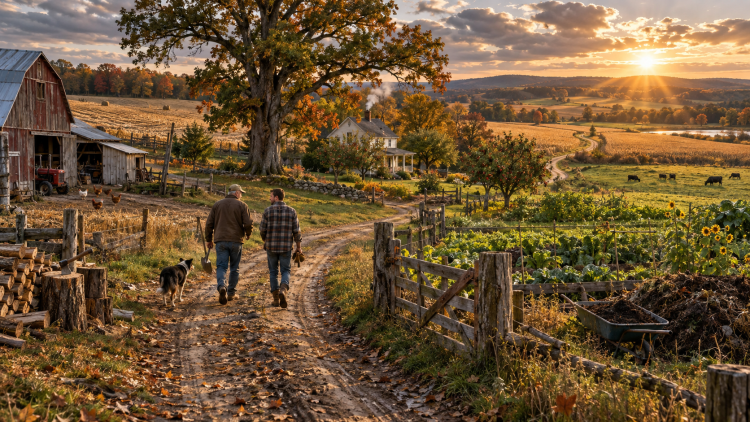
How To Change Without Losing Who You Are
Your Body Changes. Your Mind Changes. Your Life Changes. The Trick Is Learning How To Grow Without Pulling Up Your Roots.
If you spend enough years working a piece of ground… you learn something life today has almost forgotten: change does not mean something has gone wrong.
Walk through your garden in March and you may see nothing but black dirt, last year’s stalks and a few stubborn weeds. Come back in July and the beans may be waist-high, tomatoes are leaning against their cages, and zucchini are hiding under leaves like green baseball bats.
The calf becomes a heifer, and the heifer becomes a milk cow. The apple tree that looked half-dead in February may have branches bowing under fruit by September, while the pasture that looked hopeless a few years ago may finally be green again.
Even the dirt is constantly changing. Compost becomes dark earth, cover crops become mulch, leaves become fertility, and old wood becomes heat. In fact, the USDA’s Natural Resources Conservation Service explains that cover crops can reduce erosion, build organic matter and improve the health of the soil.
Nothing living stays exactly the same.
And yet, when it comes to people, we sometimes act as though changing is some kind of betrayal. “You used to believe that.” “That’s not what you said ten years ago.” “You’re not the person you used to be.”
Well… I certainly hope not.
If you’re still breathing, working, learning, praying, failing, repenting, loving and paying attention, you should be changing. The real question isn’t whether you’ll change, because sooner or later you will.
The real question is whether you’ll change like a healthy field… or get stripped, eroded and carried away by every hard wind that blows.
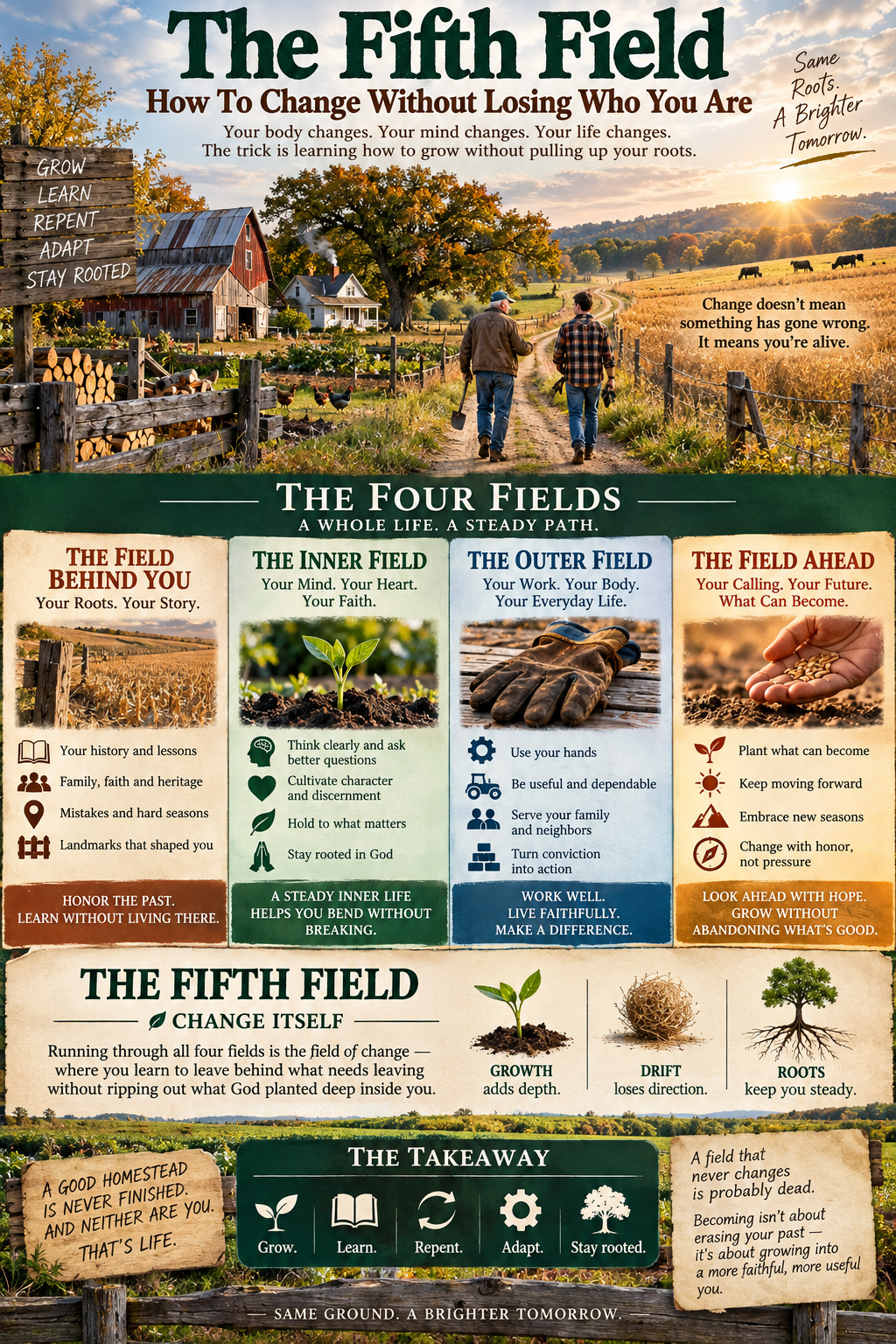
There Is Another Field Running Through The Four Fields
That brings us back to the Four Fields.
The field behind you gives you roots. It contains your history, your lessons, your mistakes, your family stories, and all those old fence posts marking places you’ve already been, while the field ahead gives you direction… the unfinished work, the calling, and the crop that hasn’t been planted yet.
Then there’s the inner field, where conviction, faith, character and discernment are cultivated. And finally, there’s the outer field, where all those things become real… where you actually work, serve, build, keep promises, and live around other people.
But running through all four together is something we might call the field of change.
That’s the ground where you learn to leave behind what needs leaving without ripping out everything God planted deep inside you. Yep, that’s a real thing. Your body changes, your mind changes, your circumstances change, your work changes, and your understanding changes, but none of that requires you to throw away the permanent things.
The trick is learning to change with a bit of dignity and honor instead of changing merely because somebody offered comfort, applause, status, safety, or offered to pay you to post something online you really don’t believe in.
That’s pretty good off-grid wisdom. A farmer who refuses to adapt eventually loses crops, but a farmer who changes everything every time some salesman pulls into the driveway with a shiny brochure may eventually lose the whole farm.
Growth And Drift Are Not The Same Thing
Here’s where we need to make an important distinction: there is a world of difference between growing and drifting.
An oak tree changes every year. It grows new branches, sheds leaves, survives storms, heals scars, and adds another ring inside its trunk, but through all of that change it remains rooted.
Now look at a piece of dead wood lying along a fence row. That changes too… it dries, cracks, rots, crumbles, and eventually disappears into the soil.
Both changed.
Only one was growing.
People can change in those same two ways. Hardship can make a person more patient, failure can knock some pride out of him, twenty years of marriage can teach lessons no book could teach, and one miserable crop can make a farmer rethink everything he thought he knew about his soil.
That’s growth.
But people can also drift. They can believe whatever makes life easiest this week, change opinions when the friend group changes, discover new “convictions” when a promotion is offered, or suddenly abandon old principles when telling the truth gets expensive.
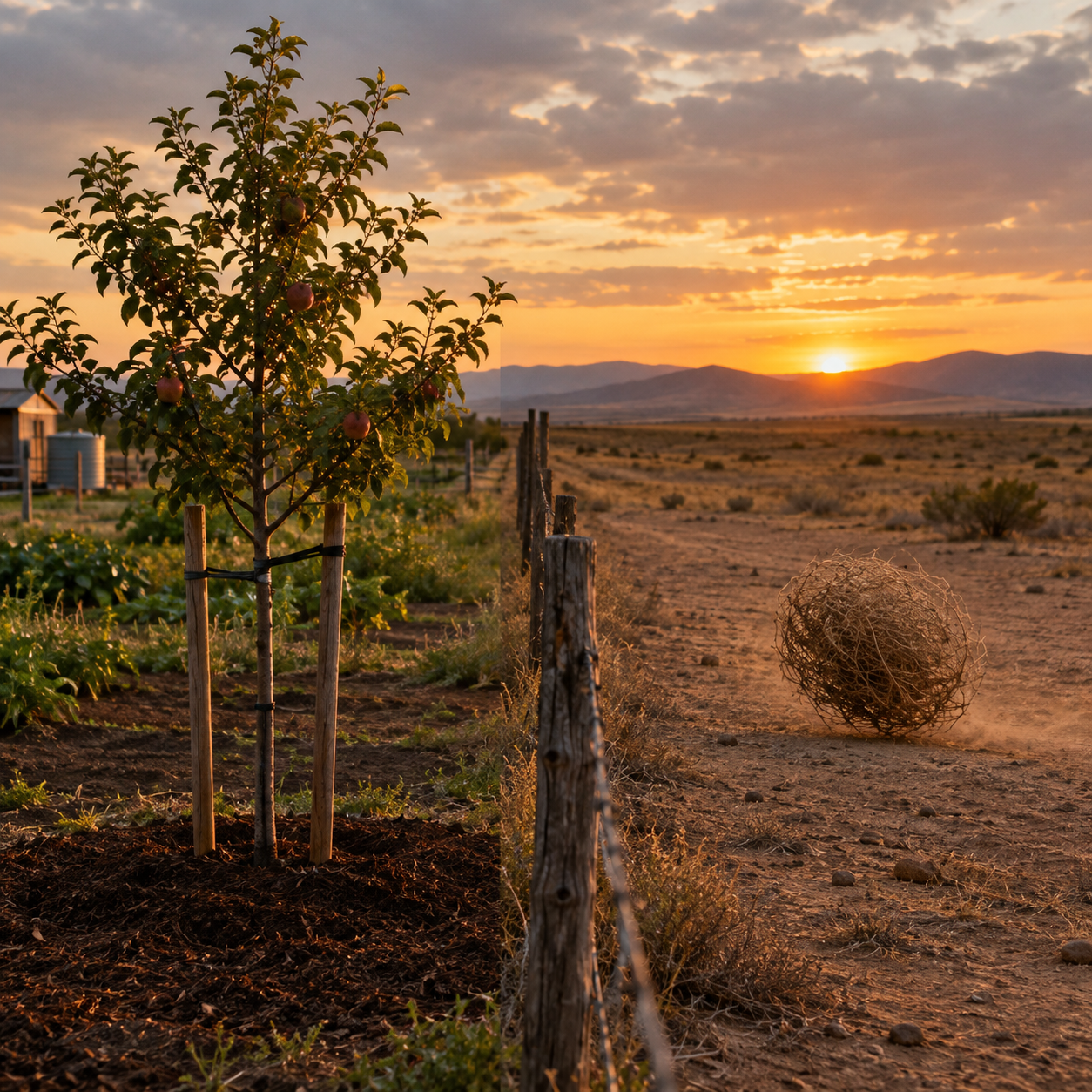
That’s a tumbleweed life.
And tumbleweeds move so easily because they don’t have roots.
So if you discover that your soil needs less tilling and more cover crops, change your approach. That’s not weakness; even NRCS soil-health guidance emphasizes reducing disturbance, keeping soil covered, maintaining living roots, and increasing diversity as ways of improving soil function.
Likewise, if a piece of equipment is eating more money than it saves, sell the thing. If your original off-grid plan has become a complicated monster requiring fourteen gadgets just to keep the lights on, simplify it.
And if a hard season teaches you that you really can’t do everything alone—that you need family, church and good neighbors… change your mind about that too. But don’t abandon your deepest responsibilities merely because some new trend blows across the internet.
Roots don’t prevent movement.
Roots are what let a tree bend without breaking.
The Inner Field: Your Mind Is A Tool, Not The Whole Farm
A good mind is a tremendous gift. It helps you calculate lumber, plan garden rotations, troubleshoot a solar system, understand a contract, diagnose an engine problem, and figure out why the chicken waterer freezes every time the temperature drops below ten degrees.
Anybody serious about self-reliance ought to use his head. But here’s the danger: your mind is not the whole homestead.
You are more than your opinions, plans, education, expertise, or ability to win an argument online. Modern life has a funny habit of putting the intellect on a throne, as though the smartest person in the room must also be the wisest.
Anybody who has lived through an actual emergency knows better.
The smartest fellow in the county can still be nearly useless during a three-day power outage if he has no courage, practical skills, humility, or loyalty to the people around him. A man may know everything about soil chemistry and still neglect his wife, while a woman may have read every book ever written about food preservation and still run herself into the ground because she refuses to accept help.
And a person can explain every political problem in Washington while having no peace whatsoever around his own kitchen table.
The mind helps you read the map, but the map isn’t the road. Your intellect can’t tell you whom to love, keep a vow for you, carry you through grief, or manufacture courage when doing the right thing suddenly has a price tag attached.
For those things you need something deeper. You need character, faith, and an inner field cultivated deeply enough to remain steady even when your mind still has questions.
The Outer Field: Your Body Is How You Meet The World
Then there’s the body.
Modern culture often treats the human body as either a machine to optimize or an obstacle to overcome. We discipline it, medicate it, decorate it, starve it, pamper it, abuse it and obsess over it, sometimes forgetting that our bodies are how we actually live in the world.
A homesteader tends to learn something different. Your back hurts because yesterday you moved forty-pound feed bags, your hands are rough because you’ve been splitting wood and fixing fence, and your knees remind you that you spent Saturday planting potatoes.
Your face may be sunburned because the afternoon was beautiful and you left your hat hanging on a nail in the barn.
That’s life.
Your body isn’t an inconvenience standing between you and your “real” existence. Bluntly stated: Your body is how you meet reality.
It’s how you hold a crying grandchild, gather eggs before breakfast, and kneel beside a sick animal. It’s how you carry soup to a neighbor, repair the gate, haul water, plant beans and sit down at the supper table with people you love.
There’s something wonderfully biblical about that ordinary physical work. Paul told Christians to aspire to a quiet life, mind their affairs, and “work with your hands”, while the story of Eden itself begins with God placing Adam in the garden “to work it and take care of it.”
And yep, your body changes. You obviously won’t have the same strength at 65 that you had at 25, and injury, illness, or simple age may eventually change what you can do.
Eventually your back develops strong opinions about projects your brain still considers perfectly reasonable. That’s my story anyway.
But losing strength doesn’t mean losing usefulness. An older homesteader may not be able to wrestle logs around anymore, but he may know exactly how to show a 20-year-old where the tree will fall before the chainsaw ever starts.
Grandma may no longer plant a half-acre garden, but give her six jars from the pantry, a cast-iron skillet and an hour, and somehow twelve people are eating supper. Our usefulness changes shape because wisdom, experience, prayer, patience, and steadiness don’t disappear simply because somebody can’t carry what he once carried.
The body changes. The calling to serve doesn’t disappear.
The Field Behind You: Your Soul Carries The Story
So if your body changes and your mind changes, what keeps you from becoming a stranger to yourself?
It isn’t personality, because personalities change. It isn’t your job, because jobs disappear, and it isn’t your address, because people move. It isn’t even every opinion you’ve ever held, because some opinions should change as we learn, repent, and grow.
What holds the story together is deeper.
Call it the soul… the center from which a person loves, hopes, trusts, repents, remembers, and remains faithful.
Think about an old farm field. Maybe your grandfather remembers when it was pasture, your father remembers corn growing there, and you remember when it sat neglected for several years, choked with thistle and brush.
Now maybe you’ve turned part of it into a garden.
The field changed, but it’s still part of the same farm. It carries history, and because it carries history… it can be restored, redirected, and made productive again without pretending its earlier seasons never happened.
There’s something profoundly human about that. You can say, “I was wrong,” or “This isn’t working,” or “I understand this differently than I did twenty years ago.”
You can even leave an old identity behind without abandoning your deepest calling.
You can change your mind without breaking your word.
And that distinction matters. You might change how you make a living, move somewhere else, plant different crops, use different tools, or chase a dream you never imagined when you were younger.
But faithfulness doesn’t mean change is automatically an excuse to abandon people entrusted to you. A husband can’t simply announce, “I’ve changed,” as though that erases his responsibility to love his wife, and a father can’t say, “I need to find myself,” and pretend his children suddenly stopped needing him.
Likewise, a neighbor doesn’t get to announce a “new chapter” while leaving old debts and broken promises scattered behind him like junk machinery in a fence row.
Scripture even uses the language of the land to make a similar point about inheritance and responsibility: “Do not move an ancient boundary stone set up by your ancestors.” The immediate subject is an actual property boundary, but the image fits beautifully here… there are some landmarks we ought to think long and hard about before moving.
Real change remains connected to love and responsibility.
The Field Ahead: Becoming Doesn’t Mean Abandoning
That’s where the field ahead becomes pretty darn important. There’s always something ahead of us that isn’t finished yet, and anybody who plants a garden already understands the principle.
A farmer doesn’t look at a bag of seed and complain that it isn’t corn. He understands becoming, so he puts the seed into the ground because he knows what it can become.
Our lives work much the same way.
The future isn’t simply a place where we escape whatever bothers us about the present. It’s the ground where today’s faithfulness becomes tomorrow’s fruit.
That means we can move toward something new without despising everything old. We can learn without pretending our fathers were fools, correct mistakes without rewriting our entire past, and repent without deciding every previous season was wasted.
We can also grow without treating the people who knew our earlier selves as baggage.
That’s mature change.
You’re not burning the farmhouse every spring because you discovered a better way to arrange the kitchen.
You’re repairing what needs repair and building what needs building.
Love Isn’t Another Chore On The List
This leads to one of the harder lessons.
Willpower matters because you need it to crawl out of bed before daylight, finish unpleasant chores, save money, learn skills, quit bad habits, and keep moving when every muscle would rather sit beside the woodstove. Willpower can split firewood, shovel manure, patch a roof, and bring order to a chaotic household.
But there’s one thing willpower can’t manufacture.
Love.
You can’t force yourself to love another human being the same way you force yourself to finish cleaning the chicken coop. Love isn’t a project-management system, another technique or another form of control.
Think about a fence. A good fence is an act of will because it draws a line in the dirt and says, “The goats stay on this side, and the tomatoes stay on that side.”
That’s useful.
But a marriage isn’t just a fence.
It’s a home.
A garden needs rows, paths, trellises and boundaries, but it also needs loose soil, sunlight, rain, insects and a thousand living processes no gardener can order into existence. A household works much the same way.
You need discipline, chores, schedules, budgets and boundaries. But if all you bring home is willpower, sooner or later you’ll have a wonderfully organized house nobody particularly enjoys living in.
Love makes room. It allows your spouse to be a whole person instead of an employee in your personal life plan, recognizes children as souls being formed rather than projects being managed, and allows you to receive help without believing dependence on another human being is weakness.
That’s not the failure of self-reliance.
That’s learning what self-reliance was supposed to be for.
Don’t Build A Homestead Around A Temporary God
Every generation has its idols… money, politics, science, pleasure, romance, career and reputation.
And yes, even preparedness.
None of those things are necessarily evil. Money buys feed, science can tell us true things about the world, politics has real consequences, romantic love is a gift, and preparedness is simply good sense.
But good things become dangerous when we ask them to do God’s job.
Off-grid folks aren’t immune. In fact, we have our own particular temptation: we can turn self-reliance into a religion. (Emmerson did)
The pantry becomes our savior, the generator becomes our security, and the land becomes our identity. Food storage, solar panels, gardens, wells, livestock, and survival skills slowly stop being tools and start becoming evidence that we don’t need anybody.
A homestead can be a gift.
It can also become a fortress.
And from the road, the two can look remarkably similar.
So ask yourself a couple of uncomfortable questions. Do you see your land as a place from which you can serve God, your family and other people, or is it proof that you don’t need anybody?
Do you prepare because you want your household strong enough to help others when things get rough, or are you preparing because you’ve slowly decided everybody outside your gate is an enemy?
The “Four Fields” aren’t a roadmap toward invulnerability.
They’re a way of becoming more faithful.
How The Four Fields Keep A Person Whole
When life begins changing quickly—and sooner or later it will—the Four Fields help keep us from breaking into pieces.
The outer field reminds us that we’re physical creatures living in a physical world, so work with your body. Plant something, repair something, carry something, and get your hands dirty enough to remember that God made a material world and called it good.
The inner field reminds us to cultivate the mind. Read, learn, and ask better questions, while studying your soil, equipment, weather, finances, and Scripture, and listening to old people who learned lessons the expensive way.
The field behind you reminds you to guard the soul and honor what you’ve inherited. Pray, rest, grieve honestly, worship and remember where you came from, keeping the good and repenting of the bad without pretending yesterday never happened.
Finally, the field ahead reminds you that your life is still moving somewhere. Keep your word, show up for your family, be useful in your church and be the neighbor who actually arrives when somebody’s tractor won’t start, basement floods or husband lands in the hospital.
Don’t use “finding yourself” as an excuse to disappear from people who depend on you.
When all four fields are tended together, change doesn’t have to tear you apart.
It can refine you.
A Good Homestead Is Never Finished
Maybe that’s the best picture of all.
A good homestead is never finished. There’s always a gate sagging on one hinge, a tool needing sharpening, a crop that ought to be rotated, a roof begging for inspection, and a piece of equipment making a noise you’re desperately hoping will go away on its own.
There are relationships to tend to. There are apologies that need making, habits that need breaking, things that need learning, and sometimes old assumptions that need plowing under.
That’s not failure.
That’s life.
You’re never really finished either. Your body will change, your mind will change, your work will change, and your roles will change. Your children will grow up, people you love will grow old, and some dreams will come true while others quietly disappear over the hill.
But none of that requires you to become rootless.
Let the field behind you give you roots without becoming a chain, and let the field ahead give you direction without making you despise today. Let the inner field cultivate truth, character, and faith rather than fear, and let the outer field turn those convictions into calloused hands, kept promises, meals shared, neighbors helped, and work worth doing.
Because the goal was never to remain exactly who you were.
A field that never changes is probably dead.
The goal is to become more real… more faithful, more humble, more capable of love, more useful to your household, more rooted in God, and more prepared for whatever season comes over the ridge next.
Grow. Change. Learn. Repent. Adapt.
Just don’t pull up your roots every time the wind changes direction.