Print
The Spare Parts and Backup Power Plan That Keeps a Little Trouble From Becoming a Long Cold Night
Keep Your Pellet Stove From Leaving Your House Frozen When You Need It Most
A hopper full of pellets looks mighty reassuring when sleet starts tapping the kitchen window. But if your stove needs electricity, all that fuel can sit there like a wagonload of seed behind a tractor that won’t start.
Now, here’s the overlooked catch worth knowing before the porch light flickers. A dependable pellet stove needs more than pellets: it needs working parts, a suitable power supply, and an owner who has thought a little farther ahead than tomorrow’s weather report.
Fortunately, you don’t need a warehouse full of motors or an engineering degree. You need a sensible shelf of supplies, a backup system matched to your stove, and a fuel stash that stays dry when the weather turns mean.
Let’s clear away the fog and get those ducks out of the snow.
The Woodpile Has a Power Cord
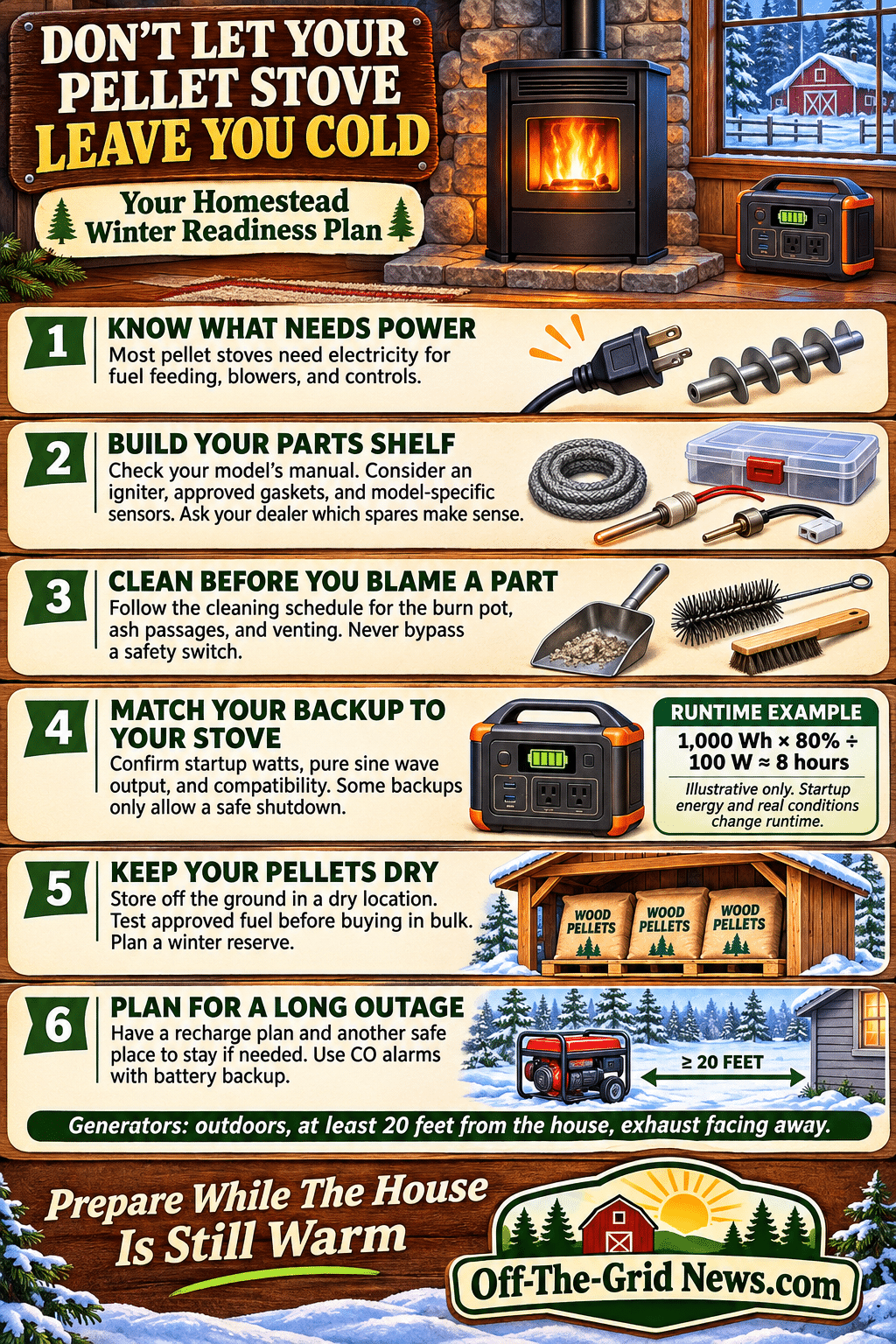
First, here’s the crucial detail that can get lost somewhere between the showroom handshake and the first cozy evening: most pellet stoves burn wood, but they depend on electricity to do it. The EPA explains that most pellet stoves need electrical power to operate their automatic feed systems and other components.
Inside the cabinet, an auger delivers fuel, a combustion blower moves air through the fire, and another blower often sends warm air into the room. Controls keep the whole outfit marching in step, rather like a farm crew that actually showed up on time.
Pull the power, and that crew’s knocked out of the job.
The fuel feed stops, powered airflow stops, and the remaining fire must burn down. Sure, the stove can still release some stored heat, but that isn’t the same as continuing to heat the house through an overnight outage.
Give the Smoke a Safe Way Out
Meanwhile, venting matters. Depending on the installation and natural draft, an abrupt loss of the exhaust blower can allow smoke to enter the room. A properly installed vent and a manufacturer-approved outage plan belong in the same conversation as that shiny new stove.
An ordinary freestanding wood stove usually has a simpler arrangement. You load it by hand, chimney draft moves the smoke, and the stove can keep giving off heat without an electric blower, provided the particular appliance is designed for that use.
That doesn’t make your pellet stove a bad purchase. It makes the power cord part of your winter preparedness plan, right alongside the snow shovel and the extra sack of chicken feed.
Build the Parts Shelf While the House Is Still Warm
Now picture an unexpected breakdown. The lights work, the refrigerator hums, and the stove refuses to feed a single pellet.
Owners on Hearth.com’s Classic Bay 1200 discussion have worked through feed problems involving possible capacitor, auger, and control-box faults. That doesn’t diagnose your stove, but it shows how one small component can stop a whole heating appliance cold.
Here’s the lesson in plain English: find out what can strand your particular model before you’re standing beside it in wool socks, staring at a cold burn pot.
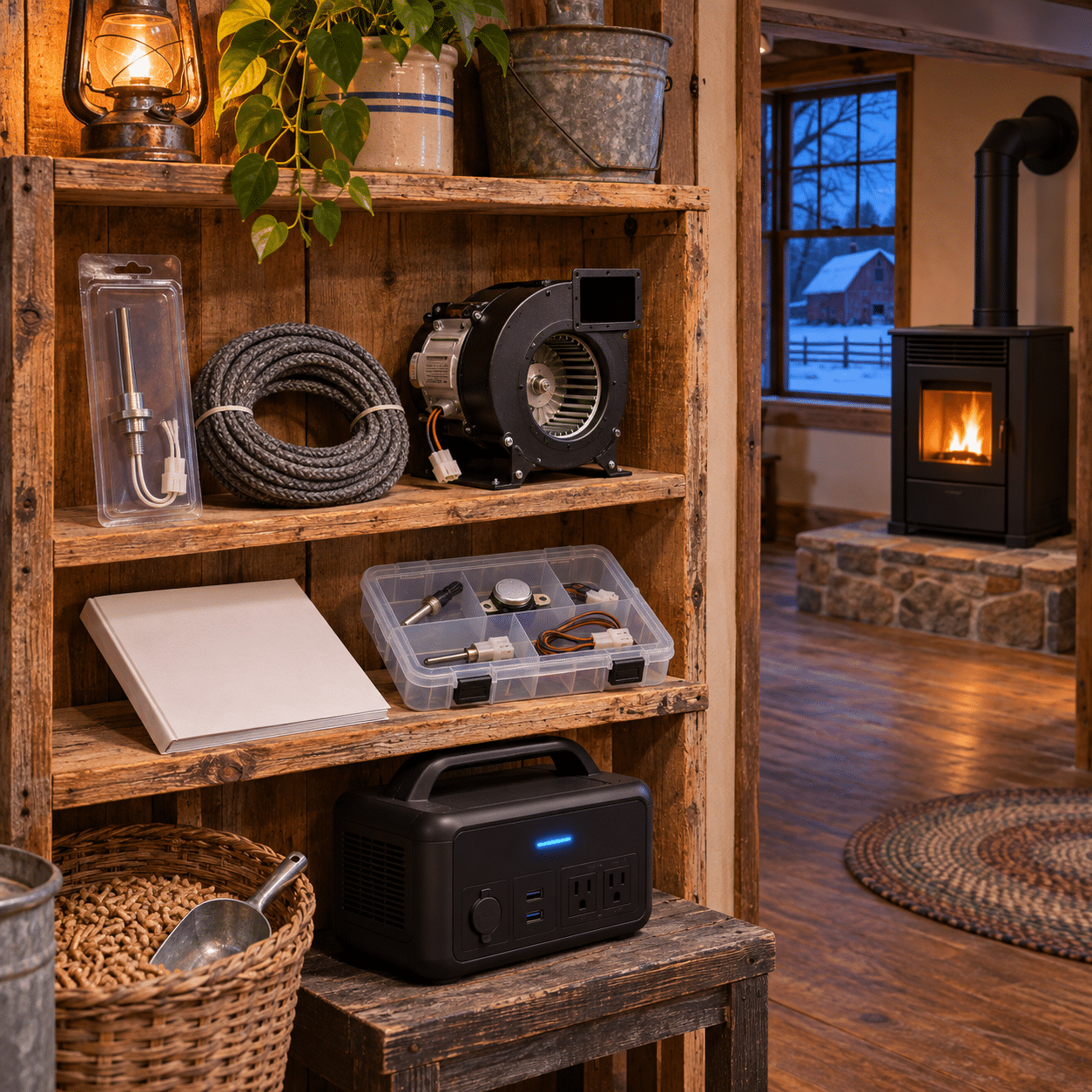
For starters, grab the owner’s manual and the correct parts diagram. Write down the make, model, serial number, and approved replacement numbers, then keep a copy with your household records and another near the supplies.
Next, ask the dealer a useful question: which parts do you actually keep on the shelf in January? A savvy service department can help you separate valuable spares from expensive trophies that may never leave their boxes.
Start With the Small Parts That Stop the Stove
For many owners, a spare igniter is a shrewd place to start. It’s the part that starts the fire, and a failed one can leave an otherwise serviceable stove unable to light automatically.
However, a failed start isn’t proof that the igniter is bad. Dirty air passages, poor fuel, blocked burn-pot holes, or another fault can produce similar complaints, so follow the troubleshooting sequence before you start swapping parts like a fellow changing tractor plugs in the dark.
An auger motor capacitor may also make sense if your stove uses a separately replaceable one. Confirm the exact approved part and whether it’s still supplied separately; a capacitor from a different appliance isn’t a bargain just because the wires look familiar.
Then consider the sensors your model actually uses. Some have snap discs, vacuum switches, thermocouples, or other temperature sensors, and having the correct spare can shorten a repair when a technician confirms a failure.
A Safety Switch May Be Trying to Tell You Something
Listen up, because this is crucial: a safety switch can trip because it’s doing its job. Restricted exhaust, overheating, a leaking seal, or another unsafe condition may be the real culprit.
Never bypass a safety device to keep the house warm. Fix the cause, and leave electrical testing and repairs to someone qualified when the manual calls for it.
Door gaskets and the right adhesive are another practical consideration. Depending on the stove, leaking seals can interfere with combustion or pressure sensing; the correct gasket size and material matter more than whatever rope happens to be hanging at the hardware store.
Finally, think about a combustion blower, auger motor, or control board in light of your circumstances. A household with another dependable heating system can make a different decision from a family whose pellet stove is carrying the whole winter load.
Of course, those bigger parts can eat up real money. Spend it where it buys you the most useful protection, and remember that a box of spares doesn’t replace the knowledge or service help needed to install them correctly.
Before You Blame a Part Grab the Ash Tools
Here’s an easy-to-overlook trap: a dirty stove can act like a broken stove, and buying an igniter won’t clear a plugged air passage. Before winter gets rolling, follow the manufacturer’s cleaning schedule for the burn pot, heat exchanger, ash traps, blowers, and vent system.
During the season, adjust that routine to the fuel and the amount you burn. More ash means more cleaning, whether the calendar says you’re due or not.
Just as crucial, give the venting a proper inspection. A pellet stove’s exhaust route is part of the heating system, not a forgotten pipe you can ignore behind the house until spring.
Always let the appliance cool and disconnect power as directed before servicing it. Handle ashes in a covered metal container on a noncombustible surface away from the house and anything that can burn; a gray-looking pile can still hide a dangerous hot spot.
There’s nothing glamorous about scraping a burn pot. Neither is there anything glamorous about explaining to the family that the stove quit because you kept putting it off.
The Wood Stove Needs a Shelf Too
If you burn cordwood, your spare-parts shelf will usually be shorter. Still, don’t let that shorter list give you false confidence, especially when the stove works harder than the hired hand all winter.
Inspect door and glass gaskets, firebrick, and any baffle board or insulating blanket specified for your model. Worn seals can admit uncontrolled air, while damaged internal components can interfere with the combustion path or expose parts of the stove to heat they weren’t designed to take.
Don’t assume every cracked brick needs immediate replacement, or that every baffle is a generic slab. Follow the maker’s guidance about damage limits and use the correct replacement material, shape, and thickness.
A spare handle assembly may be useful on some stoves. Replacement glass, when needed, must be the approved heat-resistant product; ordinary window glass has no business volunteering for that job.
Meanwhile, fuel and chimney care still carry the load. The EPA’s wood-burning appliance guidance explains the value of dry wood and proper operation, and your chimney professional can help establish an inspection and cleaning routine suited to your installation. Granted, a wood stove has fewer electrical worries. It still needs an owner who pays attention.
Buy Backup Power for the Whole Job
Back at the pellet stove, the battery question starts with two different numbers: watts and watt-hours. Mix them up, and you can empty your wallet for a handsome box that either won’t start the stove or won’t keep it running nearly long enough.
Watts describe how much power the backup can deliver at a given moment. Watt-hours describe how much energy it stores, rather like the difference between the size of a water pipe and the amount of water in the tank.
Your stove may need substantially more power during ignition than during steady operation. Motors and controls also have requirements, so check the appliance manual and the backup maker’s specifications instead of borrowing a number from somebody else’s stove.
For example, ComfortBilt’s backup-power guidance specifies pure sine wave output and recommends at least 1,000 watts, with 1,500 watts or more preferred. Those are that manufacturer’s recommendations, not a universal rating for every pellet stove ever built.
Will Your Backup Keep Heating or Just Shut Things Down
A suitable pure sine wave inverter or power station is a sound starting point, but get compatibility confirmed for your appliance. Some stoves have dedicated battery options, and some arrangements are intended mainly to allow a controlled shutdown rather than provide hours of continued heating.
That’s a crucial distinction when the temperature is dropping. Keeping the exhaust blower alive long enough to shut down safely is useful; it doesn’t automatically mean the stove will keep burning until breakfast.
Also, a power station isn’t necessarily an uninterrupted power supply. Ask about transfer behavior, whether the stove will restart after an interruption, and any restrictions on charging while running the appliance.
The best part is, the right time to learn all this is on a mild afternoon, with the dealer’s number handy. Arrange a supervised test according to the manufacturers’ instructions, rather than making the first trial run during a midnight ice storm.
Do the Battery Math Before Bedtime
Here’s a planning example, not a promise: suppose a stove averages 100 watts after ignition and a fully charged battery is rated at 1,000 watt-hours. If you allow 20 percent for conversion losses and operating overhead, you have about 800 watt-hours available, which works out to roughly eight hours before accounting for startup energy or other loads.
At a 150-watt average, that same 800 watt-hours gives you about five hours and twenty minutes. A 2,000-watt-hour battery would approximately double those illustrative times under the same assumptions.
Real results depend on the stove’s settings, cycling, inverter consumption, battery condition, temperature, and the backup system itself. Measure consumption over a representative operating period if you can, and leave a reserve rather than planning to squeeze the battery down to its last electronic gasp.
Next, confront the cold, hard facts: what happens when it runs low? Recharging from a suitable generator, a properly designed solar system, or restored utility power needs to be part of the plan, because a snowy roof and a short December day aren’t a dependable charging schedule by themselves.
If a generator is involved, keep it outdoors, at least 20 feet from the house, with exhaust directed away from buildings and openings. The Consumer Product Safety Commission’s carbon monoxide guidance also calls for battery-operated CO alarms or alarms with battery backup on every level and outside sleeping areas. Test those alarms regularly. If one sounds, get everyone outside and call 911; don’t stand beside the stove trying to argue with it.
Buy Pellets Like a Farmer Buys Seed
A pallet of pellets deserves the same kind of forethought you’d give next spring’s seed. Know what you need, know where you’ll put it, and don’t wait until the weather has everybody else reaching for the same bags.
Start with storage. Keep pellets dry, protected from leaks and ground moisture, and handled so the bags stay intact; a plastic wrapper around a pallet isn’t a guarantee against a season of rain or condensation.
Once pellets soak up moisture, they can swell and break apart. That leaves you with lousy fuel and a mess that no auger asked to inherit.
Next, buy a small amount of an approved fuel before committing to a whole winter’s supply. Watch how it feeds and burns in your stove, then check ash buildup and the cleaning it requires.
Figure Your Winter Fuel Bill Before the Snow Flies
Frankly, a cheap bag stops looking cheap if it makes the stove troublesome all winter. Follow the fuel requirements in the manual, and use last season’s consumption as your starting point for estimating the next one.
If this is your first season, ask the dealer for a realistic local estimate based on the house, climate, and how much of the heating load the stove will carry. There’s no single tonnage that fits a tight little farmhouse and a drafty old place with the north wind whistling through the trim.
Likewise, compare current delivered prices locally. Delivery charges, storage room, and how much fuel you can safely handle all belong in the calculation; yesterday’s national bargain won’t carry a forty-pound bag up your steps.
Finally, sock away a sensible reserve and keep track of what remains. The homestead rule is familiar: look in the feed bin before the animals start complaining.
A Pellet Stove Without the Plug
Now, there’s an exception worth knowing about if you’re still shopping. The US Stove Wiseway GW1949 uses gravity feeding and natural draft instead of the usual electrically powered feed and blower arrangement.
The manufacturer describes a manual lighting process using a propane torch. Its GW1949 owner’s manual lays out the installation and operating requirements, which deserve a careful read before anyone mistakes it for a drop-in replacement for a conventional pellet stove.
Natural draft still depends on the right installation, and heating performance depends on the house and conditions. But for a household weighing off-grid heating choices, eliminating the normal electrical demand is a meaningful feature to put on the scale.
Keep Winter From Picking Your Pocket
Here’s where that homework pays off: a good winter plan starts before the first frozen water bucket. Get the stove cleaned and inspected, identify the parts worth keeping, confirm the backup power will do the job, and put dry fuel where you can reach it.
Then make sure you have a fallback if repairs or an extended outage outlast those preparations. Another approved heat source, a safe place to stay, and a plan to protect plumbing are worth sorting out while everybody is warm and thinking clearly.
You don’t have to turn the mudroom into a stove dealership. You do have to know what your particular machine needs, because a shelf full of the wrong parts is just an expensive collection of paperweights.
That little bit of homework can pay off when sleet rattles the windows and the utility truck is still three townships away. The fire keeps doing its job, the family stays comfortable, and an unexpected failure has a much harder time turning into a miserable, long, cold night.