Print
Prepare For Surprises Without Swallowing Every New Scary Story
Everybody Says “Stock Up” But Does Trouble Ever Knock Before It Kicks In Your Door
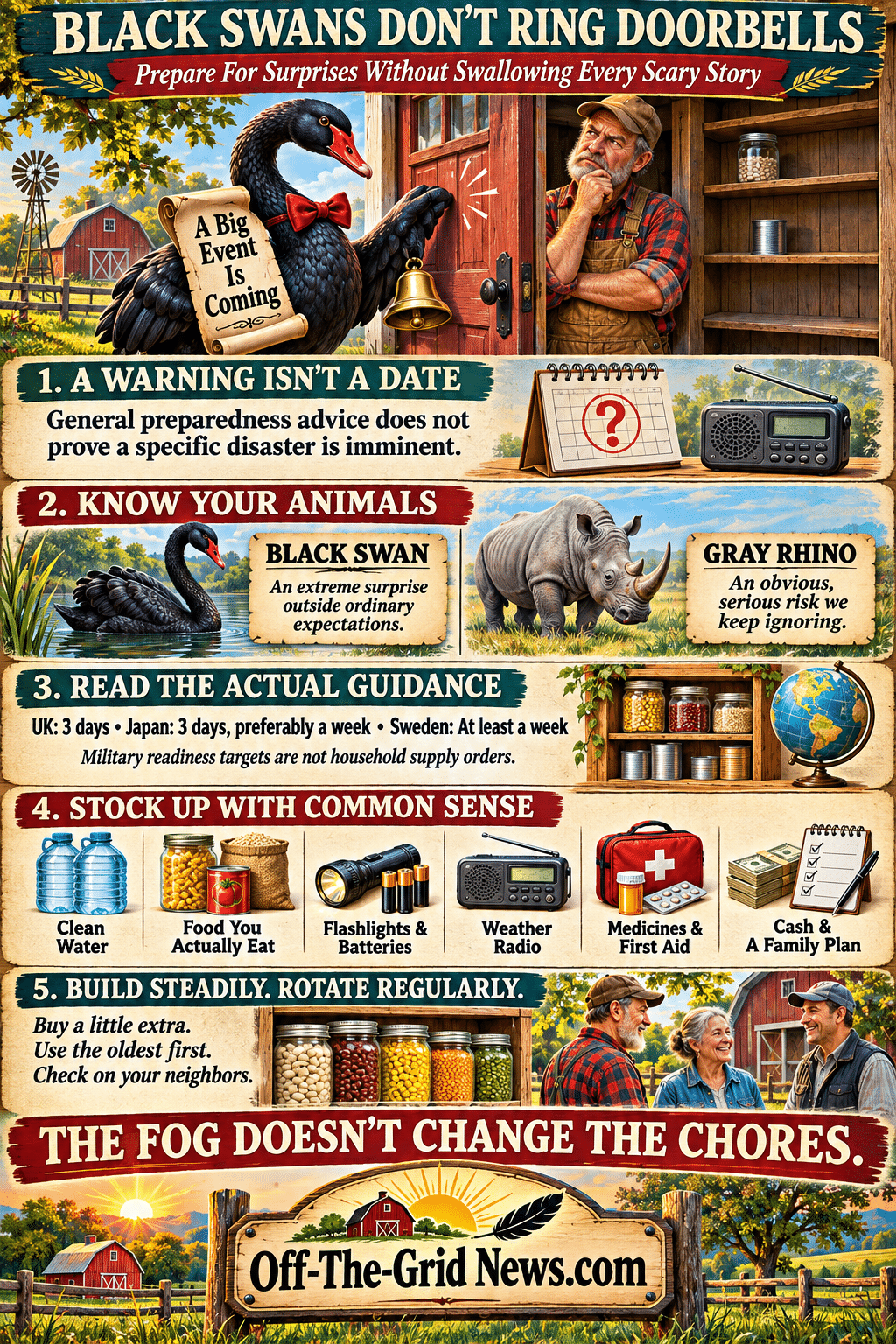
The warnings are coming at you like crows descending on a freshly planted cornfield. Turn on a show, open your phone, or wander into Facebook, and everybody and his brother’s telling you to buy food before the shelves go bare.
Former FBI Deputy Director Dan Bongino urged his audience to put away thirty days of food and water, arguing that preparation helps prevent panic. Mediaite reported his remarks, and the message has certainly stirred the pot. Meanwhile, television segments and online commentary keep that pot boiling.
Underneath the racket, though, there’s something real. Britain’s Be Ready campaign tells households to have emergency supplies, and Japan issued a nationwide preparedness appeal on November 2. American military installations are also getting attention through the Pentagon’s FORTRESS initiative.
So here’s the question sitting beside the coffee cup on plenty of kitchen tables: When this many people start saying “get ready,” do they know something the rest of us don’t?
Maybe some people know more about particular risks. But here’s the crucial distinction: the warnings themselves don’t establish that a specific catastrophe is coming, much less that anybody knows its date.
That distinction can stop a nasty rumor from grabbing you by the nerves—and dragging your wallet along for the ride.
Read the Paperwork Before You Empty Your Wallet

First, let’s clear away the fog. Pull on your boots and walk the fence line yourself. What does the actual government guidance say? And how much extra wire did somebody string onto it while repeating the story?
Britain’s campaign asks households to keep three days of supplies. Japan’s disaster-preparedness guidance recommends at least three days of food and drinking water, preferably a week. Neither recommendation amounts to a public announcement that a thirty-day shutdown is around the corner.
Bongino referred to government warnings about thirty days of preparedness. Yet the British campaign he cited says three days—a tenfold difference. A family’s decision to build a month’s reserve may be sensible, but that’s different from saying Britain’s government instructed everyone to do it.
Then there’s FORTRESS. Reporting on the program describes a military effort to improve installation resilience, including a reported goal of ninety days of independent operation. Keeping a base functioning through disrupted utilities and supplies serves a military purpose; it isn’t a ninety-day household stockpiling order.
Also, don’t mistake a preparedness baseline for a promise. Three days isn’t a guarantee that help will arrive on the fourth morning with hot biscuits and a full fuel truck. It’s a starting point, and different countries set different starting points.
What matters is what the notice actually establishes. Guidance about storms, earthquakes, cyberattacks, or interrupted utilities identifies real hazards. By itself, it doesn’t reveal a secret appointment on the disaster calendar.
Black Swans Don’t Send You a Calendar Invitation
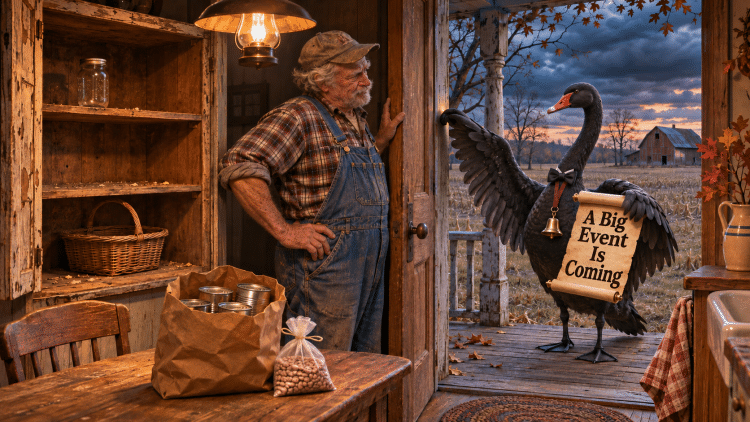
Now, let’s examine those black swans. The term, popularized by Nassim Nicholas Taleb, describes an event outside ordinary expectations that has an enormous impact and gets explained afterward as though everybody should’ve seen it coming.
Think of the fellow who says, after the barn roof lands in the bean field, “Well, naturally. The signs were all there.” Somehow, he never mentioned those signs while the roof was still attached.
Still, there’s a wrinkle. Surprise depends partly on who’s looking: an event may blindside the public while somebody else has been studying the danger for years. So “nobody anywhere knew anything” is too neat a definition for a messy world.
A widely recognized, specifically anticipated threat generally doesn’t fit the black-swan idea for the people expecting it. And a vague warning that bad things can happen certainly doesn’t prove someone has predicted the next great shock.
In fact, researchers examining pandemic risk argued that a major respiratory pandemic was a foreseeable hazard, even though its exact timing and details weren’t known. The category was familiar long before the particular emergency arrived.
You don’t need to know which tree will fall to realize an ice storm can knock out the power.
Sometimes the Danger Is Standing Right in the Pasture
There’s another useful animal in this discussion: Michele Wucker’s “gray rhino.” That’s a big, blazingly obvious threat people can recognize and still manage to ignore.
Picture a bull leaning against a rotten gate. You may not know whether he’ll push through Tuesday or Friday, but you don’t need a crystal ball to see that the hinge needs fixing.
That distinction matters because history contains plenty of disasters preceded by warnings. However, warning signs scattered through years of paperwork aren’t the same thing as a clear, complete forecast delivered to the right person in time to act.
Pearl Harbor illustrates the trouble. Roberta Wohlstetter’s work on warning and decision-making examined how meaningful signals could be lost amid competing information and uncertainty. This discussion of intelligence failures explains why finding a clue afterward is easier than recognizing its importance beforehand.
Likewise, the 9/11 Commission’s analysis identified failures involving imagination, policy, capabilities, and management. It also cautioned against judging earlier decisions as though people then possessed everything investigators learned later.
Before COVID, the federal government’s 2019 Crimson Contagion exercise tested a severe influenza-pandemic scenario and exposed readiness problems. A congressional report discussing the exercise describes those deficiencies. That’s evidence of a recognized vulnerability, not evidence that participants knew the identity or arrival date of the next virus.
And before the housing crash, investors such as Michael Burry challenged the happy talk by examining shaky mortgage lending. The broader record of warnings and failures is documented in the Financial Crisis Inquiry Commission’s report.
Here’s the crucial lesson. It isn’t that every catastrophe was obvious or that every ignored warning would’ve prevented it. It’s that overlooked weaknesses deserve scrutiny while there’s still daylight to fix them.
A Specific Warning Carries More Weight Than a Bad Feeling
For a different kind of example, look at the run-up to Russia’s full-scale invasion of Ukraine in February 2022. American officials publicly warned that Russia was preparing to attack and released intelligence to support that warning.
In a February 16 State Department briefing, officials described the danger as immediate. Russia launched the invasion on February 24. That’s a much more concrete warning than a general instruction to keep canned food in the cupboard.
However, let’s leave the story honest. Public predictions about timing weren’t a flawless appointment book, and this wasn’t the only time authorities have warned of an approaching catastrophe. Hurricanes alone should keep us from making that claim.
Nor can we assume governments always share what they know. Intelligence may be incomplete, disputed, classified, withheld, or simply wrong. Silence doesn’t prove safety, any more than an emergency checklist proves a secret plot.
Instead, demand the cold, hard facts behind the warning. Is there a named hazard, a relevant place, a stated time frame, and evidence you can examine? Or are you being asked to turn somebody’s uneasy feeling into your certainty?
The man who points out a broken fence post gives you something to inspect. The man who says he has a terrible feeling about fences gives you much less.
When Nothing Happens the Warning May Have Worked
Next, consider Y2K, because this is where hindsight can lure us into a nasty trap. The calendar rolled over into 2000 without the widespread breakdowns many people feared, and that made the whole affair an easy punch line.
But a quiet morning doesn’t tell us what would’ve happened without the repairs. Governments and businesses spent years checking and fixing computer systems; Retro Report’s examination of Y2K explores that prevention work and the argument over what it accomplished.
If you replace the rotten gate and the cattle stay home, you don’t stand there Sunday morning declaring that gates were never a problem. That’s the twist: successful preparation can make a warning look foolish to people who never saw the work.
Sweden offers another useful example. Its tradition of household civil-defense guidance reaches back decades, and the government commissioned an updated crisis-and-war brochure in 2024, as its civil-defense overview explains.
Current Swedish household guidance asks people to manage for at least a week without normal services. That reflects serious concern about vulnerability and security. It doesn’t supply a date when war or a nationwide outage will arrive.
Preparedness campaigns can reflect a worsening risk picture. They can also improve a country’s ability to cope with ordinary emergencies. Neither possibility justifies turning every brochure into a coded message about next Thursday.
Your Pantry Doesn’t Need a Prediction
So where does all this leave a family with groceries to buy, animals to feed, and enough bills already sitting on the counter?
Right where sensible country people have stood for generations: sock away a little extra while you can. You don’t need to settle a television argument before making sure supper won’t depend entirely on tomorrow’s delivery truck.
First, start with water. Ready.gov’s emergency-kit guidance recommends one gallon per person per day for several days for drinking and sanitation. Think through extra needs for heat, illness, pets, and livestock, too; a household water allowance won’t water the hens or fill a stock tank.
Also, learn what your water-treatment equipment can actually handle. Here’s a dangerous blind spot: a filter isn’t a magic wand, and no household gadget should be assumed to make chemically contaminated floodwater safe. Store clean water first, then plan sensible backups around the hazards where you live.
Next, build a pantry your family will eat from. Beans, canned meat, soup, oats, peanut butter, and familiar staples make more sense than a mountain of expensive mystery meals nobody wants. Buy a little extra, use the older food first, and keep replacing what you use.
Remember the freezer, too. It’s a blessing while the electricity holds, but a freezer full of meat isn’t the same thing as a shelf full of food you can eat without power. Include ready-to-eat options and a manual can opener.
After that, check lights, batteries, a weather radio, first-aid supplies, needed medicines, and some cash in small bills. Make a plan for staying warm, contacting family, and leaving home if local officials order an evacuation. A well-stocked house doesn’t make every emergency safe to ride out.
If you depend on a generator, give your backup plan a trial run before the lights blink. Follow CDC generator safety guidance: operate it outdoors, more than twenty feet from doors, windows, and vents, with exhaust directed away from the home. Store fuel in approved containers according to applicable rules, and use working carbon-monoxide alarms.
Finally, look beyond your own porch. Check on the older neighbor, know who relies on powered medical equipment, and talk through how you’ll help one another. Best part: a little neighborly planning can stretch farther than another cartload bought in a fright.
Keep Your Head Clear and Your Shelves Useful
Thirty days of supplies can be a worthwhile goal if your budget, space, and circumstances allow it. Build toward it at your own pace. Don’t let a frightening headline drain your wallet, saddle you with debt, or leave you staring at a pile of food you can’t use.
Meanwhile, keep the distinctions straight. A general preparedness campaign isn’t proof of an imminent catastrophe. An imprecise warning isn’t worthless merely because it lacks a date, and a quiet outcome doesn’t automatically mean the original concern was foolish.
Your job is to sort out the evidence and confront the weaknesses you can actually fix. Mend the gate, rotate the pantry, test the flashlight, and find out whether your backup plan works before a cold kitchen makes the question urgent.
Trouble doesn’t owe you a polite knock at the door.
And the fog doesn’t change the chores. Never has.