Print
Those Hedge Apples Won’t Evict All Your Spiders… But The Tree Can Sure Earn Its Keep
Before You Clear That Ugly Fence Row… See What You’re About To Throw Away
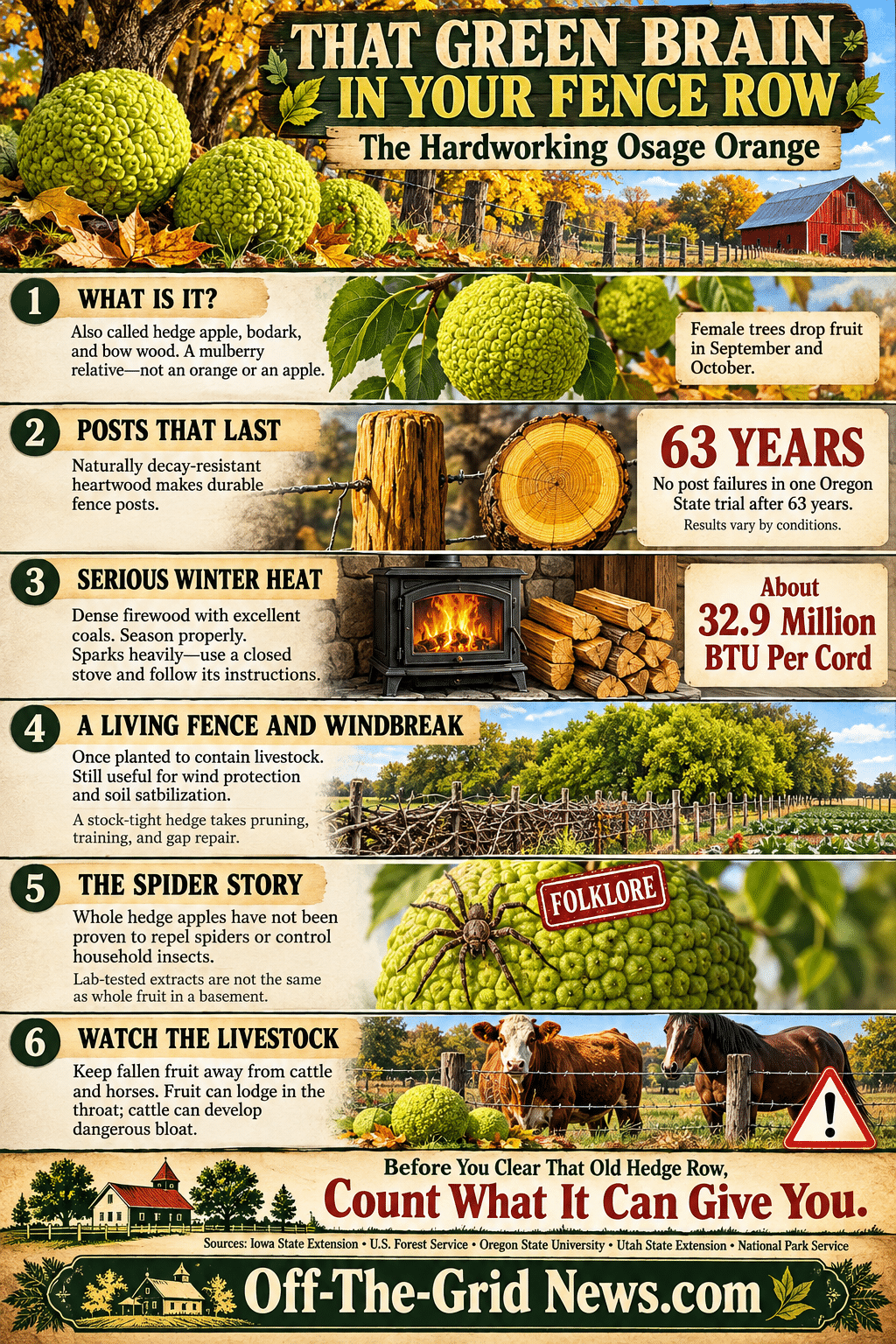
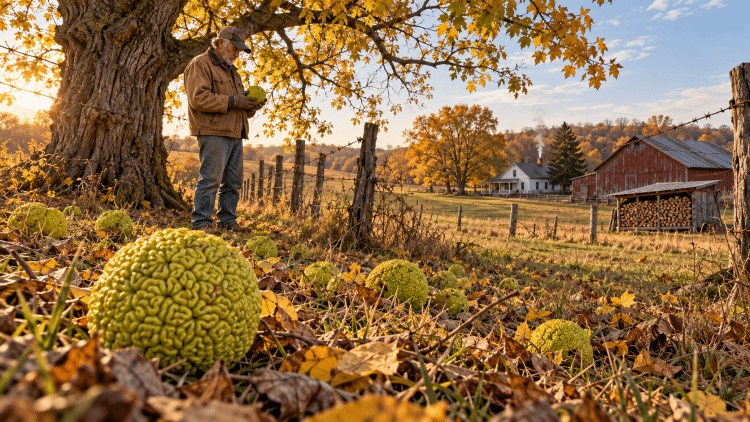
Every October, the fence row starts dropping what looks like something out of a mad scientist’s wheelbarrow. Beneath a tree turning clear yellow, softball-sized green lumps collect in the grass, each one wrinkled like a brain and heavy enough to make you watch where you step.
Pick one up and you may notice a faint citrus smell. The Cherokee Nation’s natural resources guide mentions that scent, although nobody is going to mistake this thing for a breakfast orange once they cut it open.
Around here in Northern Illinois, we call them hedge apples, or just “hedge.” Some people kick them out of the way when mowing, while others haul a bucket into the basement, hoping to send the spiders packing.
Meanwhile, the tree producing those oddballs may be one of the hardest-working things on the property. It can supply fence posts that last for decades, firewood with serious heat, and a windbreak that earns its place when a cold wind comes barreling across an open field.
Before you write it off as another thorny nuisance, take a closer look.
The Green Brain With a Family Secret
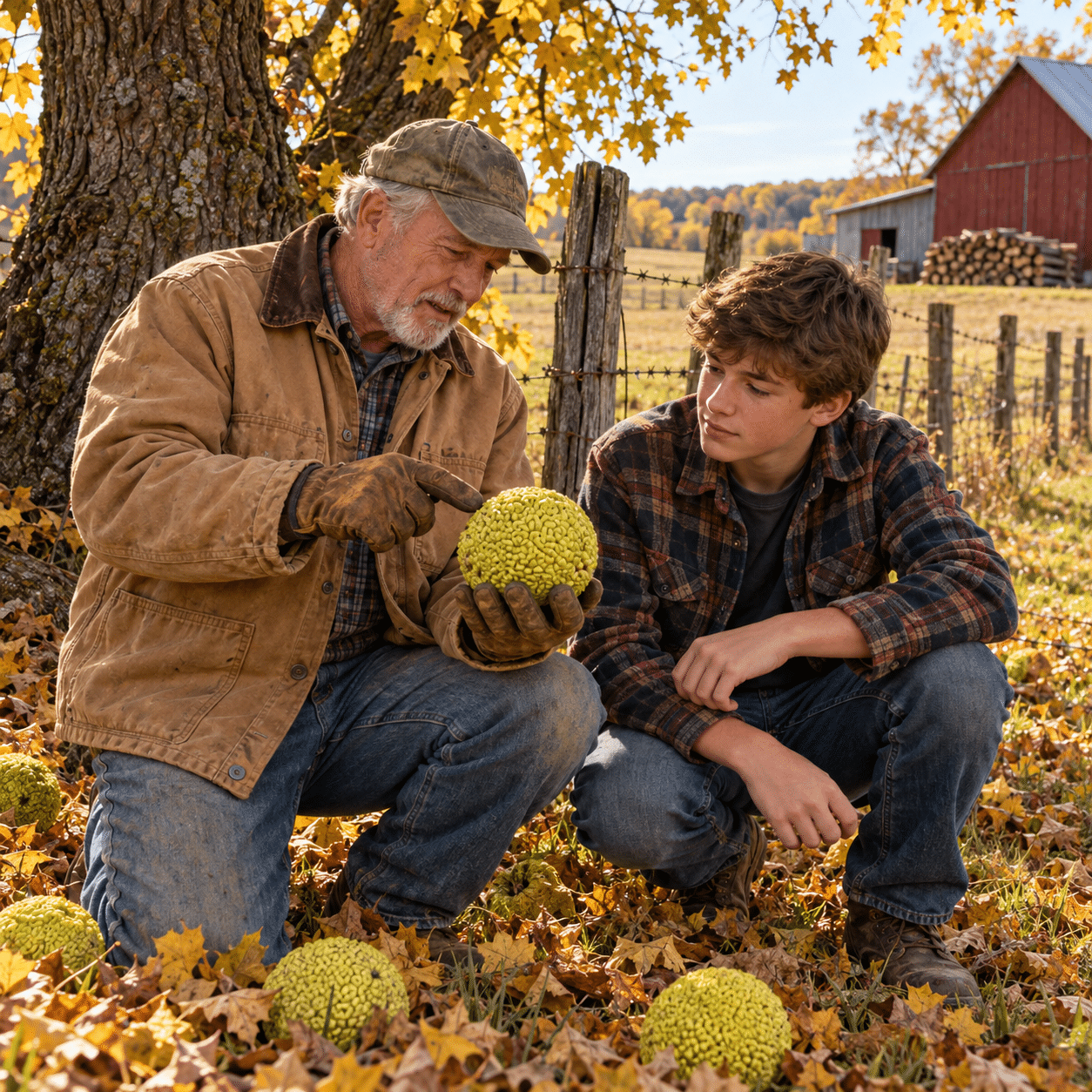 Despite its name, the Osage orange is neither an orange nor an apple. Botanically, Maclura pomifera belongs to the mulberry family, which makes those familiar hedge apples cousins of something you might actually want in a pie.
Female trees produce the big, yellow-green fruits, which ripen in September and October. Inside, hundreds of small seeds sit in a sticky mass threaded with milky latex sap, a decidedly uninviting reward for anybody expecting sweet fruit.
That said, squirrels know where the groceries are. They tear the fruit apart to reach the seeds, leaving a shredded mess that looks like somebody fed a tennis ball through a corn sheller.
That raises a good question. Why would a tree put so much effort into making a giant fruit most creatures leave alone?
One explanation reaches back to the Ice Age. As University of Illinois Extension explains, researchers have proposed that large mammals, including mastodons and giant ground sloths, once ate such fruits and carried their seeds elsewhere.
Under that hypothesis, today’s hedge apple is a leftover from a world with much bigger mouths. The animals disappeared, but the tree kept dropping the same oversized delivery package.
It is a fascinating possibility, rather than a settled explanation. Either way, that green lump beside your boot has a better backstory than most porch decorations.
Before Barbed Wire There Was Bow Wood
Long before farmers planted it along their property lines, Native folks valued Osage orange for its wood. Its historically recognized native range centered on the Red River country of Texas, Oklahoma, and Arkansas, although the exact boundaries of its original range remain a matter of discussion.
The Osage and neighboring peoples knew what they had. This was tough, strong wood that could bend into a powerful bow, and Osage orange bows became valuable trade goods.
Those bows traveled far beyond the tree’s home country, reportedly reaching the Blackfeet in Montana. One early nineteenth-century account put a good bow’s value at a horse and a blanket, a price that tells you considerably more than calling the wood “useful.”
Meriwether Lewis recorded that Native peoples would “travel many hundred miles in quest of it”. (You don’t make a big trip like that for second-rate bow wood.)
Anyway, French traders called the tree bois d’arc, meaning wood of the bow. Farm country eventually worked that name over into “bodark,” which sounds about right shouted across a barn lot.
The Fence You Had to Grow Before You Could Use It
Then settlers pushed onto the prairie and ran into a practical problem. There was plenty of open country, but in many places there was precious little timber for fencing it.
You could plow a field without solving that problem. Keeping somebody’s cattle out of the corn was another matter.
By the 1840s, interest in Osage orange as a living fence was spreading. Farmers planted the trees close together, pruned them hard, and trained the branches into a dense, thorny barrier.
The old description was “horse-high, bull-strong, and hog-tight”. Under good management, a hedge could become a working fence in roughly four years, although it demanded attention along the way.
Farmers also used a technique called plashing, bending and weaving living stems to close the gaps. Think of building a fence with material determined to keep growing while you worked on it.
Soon, hedge seed was big business. Texas reportedly shipped 10,000 bushels in 1860 alone, and Kansas landowners eventually planted about 40,000 miles of Osage orange hedgerows.
After the 1870s, barbed wire increasingly took over. Yet the old hedge found another job: farmers cut the trees into posts and hung the new fencing on them.
The tree went from being the fence to holding it up.
Fence Posts That Make Rot Wait Its Turn
For a homesteader, this may be Osage orange’s strongest selling point. A good post is something you would prefer to install once, especially after spending an afternoon wrestling an auger through stubborn ground.
The secret is the wood’s exceptionally decay-resistant heartwood. That distinction matters, because the outer sapwood does not carry the same resistance; you cannot assume every part of the trunk performs equally underground.
The long-term record is impressive. In Oregon State University’s 1996 post-farm report, published in 1999, the Osage orange posts in the trial had shown no failures after 63 years in the ground.
That is a result from a particular test, rather than a promise that every hedge post will last exactly that long. Even so, it helps explain why a Nebraska Extension publication lists untreated hedge posts at 35-plus years and repeats the old joke that they “outlast the hole.”
If you have ever replaced a rotten corner post in miserable weather, you understand the appeal immediately.
Firewood That Means Business When January Arrives
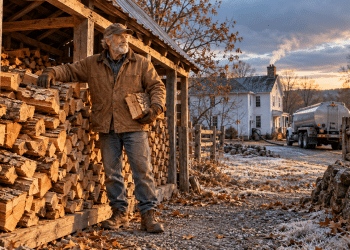
Next comes the woodshed. Utah State University Extension lists Osage orange at about 32.9 million BTU per cord, putting it above the hickory and oak entries in that table for heat per stacked volume.
That is serious stored warmth. Properly seasoned hedge makes excellent coals, giving an old fence-row tree another useful retirement plan after its growing days are over.
However, this wood has manners you need to understand. It throws sparks, so a closed wood stove is the sensible place for it, rather than an open fireplace spitting embers toward the rug.
Season it properly, control the fire, and follow your stove manufacturer’s instructions. A high heat rating is a reason to manage the load carefully, not an invitation to pack the firebox and walk away.
A Windbreak That Keeps Earning Its Place
Even standing right where it is, the tree can be useful. The U.S. Forest Service describes Osage orange’s role in shelterbelts, wind erosion control, and soil stabilization, work that matters when exposed ground starts blowing across the next township.
On a homestead, an established row may shelter a garden or barn lot while marking an old boundary. Its usefulness is worth considering before you clear the whole thing simply because it looks untidy from the road.
But a row of trees does not automatically make a livestock fence. Those historic hedges required pruning, training, and repairs where gaps developed, so an overgrown row deserves an honest inspection before you turn cattle against it.
There is another old use tucked into the tree, too. Its roots and inner bark have supplied a light orange dye, a small but interesting addition to its household résumé.
The Spiders Have Apparently Not Heard the Basement Story
Now, about that bucket of hedge apples beside the basement stairs. Every fall, somebody swears they keep spiders away, and the story gets another year of life.
There is a little laboratory science behind the larger legend. According to Illinois Extension’s account of Iowa State research, compounds extracted from the fruit repelled German cockroaches, mosquitoes, and houseflies; sliced fruit also showed effects in small, enclosed spaces.
But extracting compounds and concentrating them in a test is a different proposition from parking a whole hedge apple behind the furnace. The natural concentrations are too low for dependable results, and an open room lets the compounds disperse.
Iowa State Extension says whole hedge apples have not been proven to control insects in the home. As for spiders, the Burke Museum’s arachnologists report no evidence that the fruit repels them, pointing out that spiders live on Osage orange trees and even build webs on fallen fruit.
Unfortunately, that’s a fairly poor performance review for a spider repellent.
If you enjoy hedge apples as fall decorations, put them on the porch and enjoy them. Just use gloves if you cut them, because the milky sap can irritate some people’s skin.
Clear the Fruit Before Livestock Find It
Around the barn, the important concern is choking. The old claim that hedge apples are poisonous has followed them for generations, but Iowa State Extension identifies the serious livestock hazard as fruit lodging in the esophagus.
For cattle and other ruminants, that blockage can prevent the release of stomach gases and lead to dangerous bloat. A big, firm fruit can become a deadly obstruction without needing any poison at all.
So keep fallen hedge apples away from cattle and horses. When female trees start dropping fruit in a pasture, clear the drop zone and manage access rather than waiting to see which animal gets curious.
Take Another Look Before You Fire Up the Brush Hog
By now, that scraggly old fence row ought to look a little different. The tree that supplied bows and living fences can still give a household long-lasting posts, valuable firewood, and shelter from the wind.
That’s a useful return from something many people notice only when its fruit gets under the mower.
Come October and November, the yellow leaves and “green brains” make it easy to find. Walk the row, look at what is growing there, and consider which trees are doing work worth keeping.
You may already own a supply of fence posts and winter heat that you have been calling a nuisance for years.