 Print
Why An Old Homestead Habit Deserves A Fresh Look Before Winter
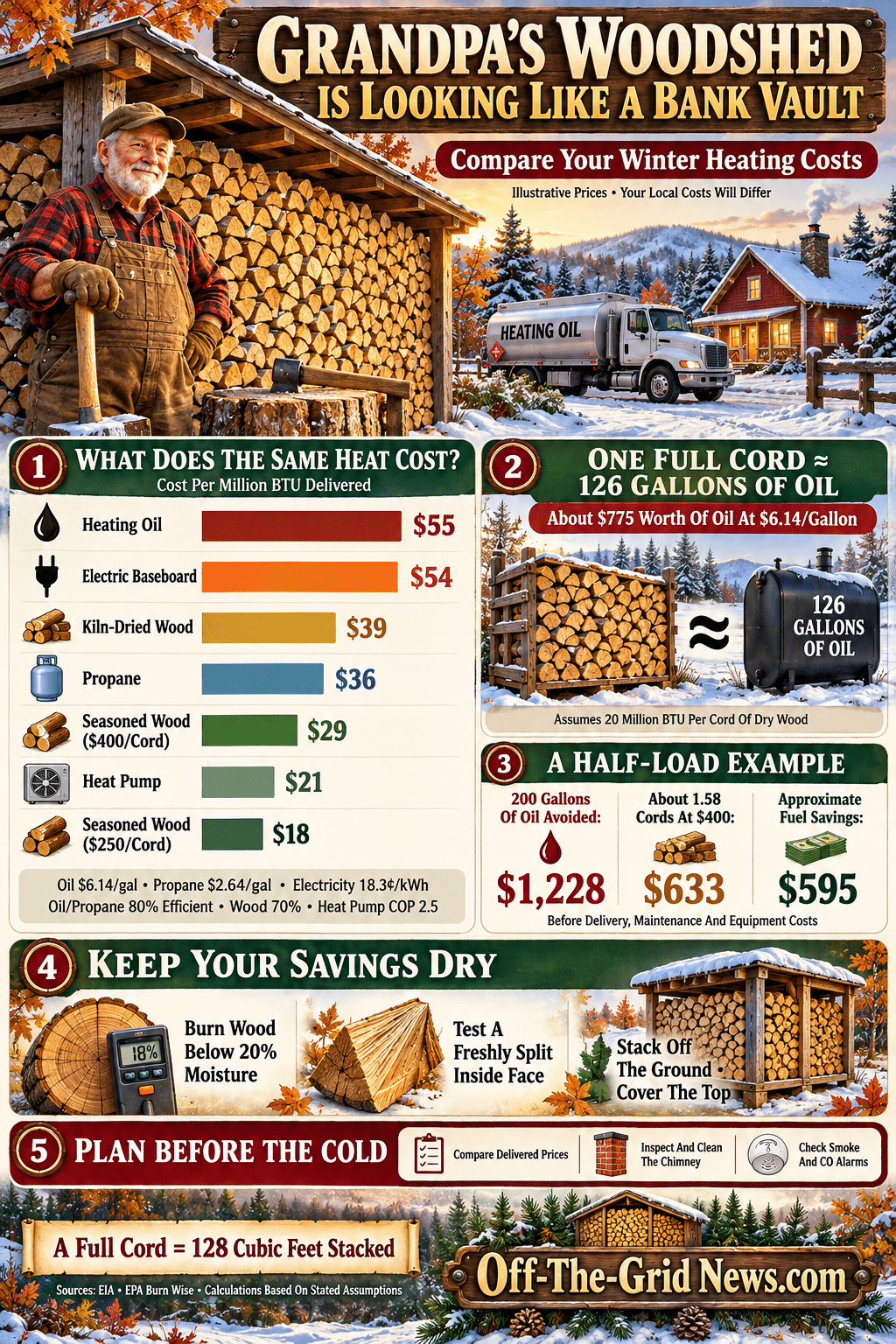
Why There’s Probably A Good $775 Worth Of Heating Oil Sitting In Your Woodpile
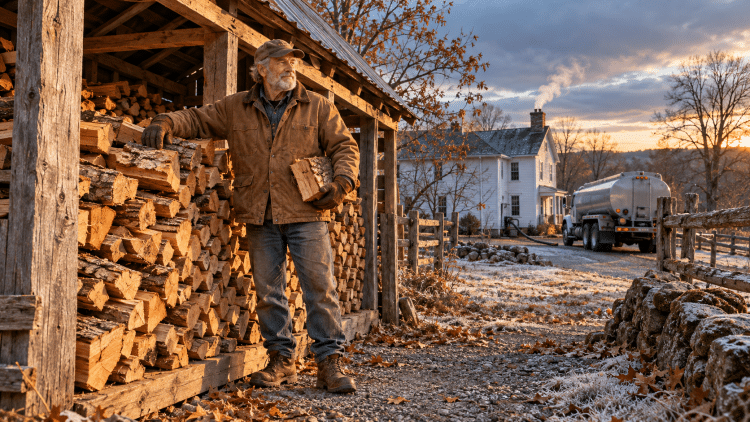
The oil truck backs up the gravel drive like it always does. The driver climbs down, drags the hose to the fill pipe, and gets things moving while you stand there pretending you aren’t watching the meter.
Then it starts clicking. And suddenly that little box on the truck seems to be eating grocery money.
This fall, there’s good reason to pay attention. Heating oil has reached roughly $6.14 a gallon in the Northeast, and a fill-up at that price can knock a respectable hole in a household budget. Put 200 gallons in the tank and you’ve just spent $1,228 before you’ve warmed a single cold toe.
Meanwhile, that ordinary stack of split hardwood behind the shed deserves another look. At those oil prices, a full cord of good, dry wood can replace roughly $775 worth of heating oil—provided you’re burning it in a reasonably efficient stove.
That’s enough to make a fellow sharpen his pencil before he sharpens his chain.
So pull up a chair at the kitchen table. Before winter starts rattling the windows, let’s compare the heat you’re buying, find out where the savings hide, and make sure you aren’t paying good money to burn water.
Why The Oil Truck Is Taking Such A Big Bite
Heating oil and diesel belong to the same fuel family. When supplies of those refined fuels get squeezed, the pain travels from the truck stop to the farm tank and straight on down to the furnace in your basement.
This year’s trouble reaches well beyond your county line. Disruptions around the Strait of Hormuz have put pressure on diesel and heating-oil markets, while refinery disruptions add another pinch. Your oil driver didn’t cause that mess, but his hose delivers the bill just the same.
Propane has a different supply picture. Much of it comes from natural gas processing, and domestic supply conditions don’t always follow the same path as imported crude or refinery output. That’s why a jump in oil doesn’t automatically mean every other heating fuel jumps by the same amount.
For this winter, EIA’s October outlook projects oil-heating expenditures up 21%, while propane expenditures fall about 3%. Those are forecasts, not promises about your house, but they tell you why it pays to compare.
Same winter. Same north wind. Very different bills.
Compare The Heat Instead Of The Containers
Now comes the part that trips people up. Oil arrives by the gallon, electricity comes by the kilowatt-hour, and firewood shows up in a truck with a fellow who says, “That ought to be about a cord.”
Those units don’t tell you the same thing. Before you compare prices, you need one common yardstick: the British thermal unit, usually shortened to BTU.
For this kitchen-table calculation, we’ll use about 138,500 BTU per gallon of heating oil, 91,500 per gallon of propane, and 20 million per full cord of dry wood. EIA explains these energy units and conversions here. The wood figure is a working estimate, because species, moisture, and the amount actually delivered all matter.
Then subtract the heat that never makes it into the rooms. We’ll assume 80% efficiency for the oil and propane equipment, 70% for the woodstove, and essentially 100% at the point of use for electric baseboard heat.
These are comparison assumptions, not ratings for every appliance. An old stove, a modern furnace, and a drafty duct system can change the answer considerably.
Using $6.14 oil, $2.64 propane, and electricity at 18.3 cents per kilowatt-hour, here’s what one million BTU of useful heat costs. Treat these as sample prices and replace them with your own delivered fuel quotes and electric rate.
| Fuel | Sample Price | Cost Per Million BTU Delivered |
| Heating oil | $6.14/gallon | About $55 |
| Electric baseboard | 18.3¢/kWh | About $54 |
| Propane | $2.64/gallon | About $36 |
| Kiln-dried firewood | $550/full cord | About $39 |
| Seasoned firewood | $400/full cord | About $29 |
| Seasoned firewood | $250/full cord | About $18 |
| Air-source heat pump | 18.3¢/kWh; COP 2.5 | About $21 |
Notice what that table does—and doesn’t—say. Kiln drying doesn’t magically give identical dry wood more energy; its practical attraction is getting reliably dry fuel when you need it. The higher price can still leave it cheaper than expensive oil, but a good local supply of properly seasoned hardwood can offer a better deal.
Also, this is an operating-cost comparison. It doesn’t pay for a new stove, a chimney liner, furnace conversion, maintenance, or the afternoon you spent stacking wood instead of fixing the gate.
The Woodpile Number That Ought To Get Your Attention
Here’s the figure worth circling. Under those assumptions, seasoned wood would have to cost about $775 per full cord before it matched the fuel cost of heating oil at $6.14 a gallon.
That’s because a cord containing 20 million BTU, burned at 70% efficiency, delivers about 14 million BTU into the house. Getting that much useful heat from an 80% efficient oil system takes roughly 126 gallons.
Multiply those gallons by $6.14. There sits your $775.
Now compare that with actual dealer listings. D & D Mulch lists a full cord of seasoned hardwood at $430, plus a $49 delivery fee. That’s a New England supplier, and the delivery charge belongs in your arithmetic just as surely as the wood does.
Another Massachusetts dealer lists average-grade seasoned hardwood at $395 per cord, with delivery charges depending on location. In coastal Maine, Pen Bay Firewood lists kiln-dried hardwood at $575 a cord, still below that illustrative oil break-even price before any additional charges.
Of course, your local quote is the one that counts. Ask about delivery, stacking, species, moisture, and quantity before you congratulate yourself on a bargain.
And make sure “cord” means a full cord: 128 cubic feet of stacked wood, commonly a stack four feet high, four feet deep, and eight feet long. A face cord or a pickup load isn’t automatically the same purchase.
If you cut your own from a woodlot or fencerow, your cash outlay may drop sharply. But count the saw fuel, bar oil, chains, equipment wear, hauling, and your time; a tree doesn’t turn itself into neat splits beside the back door.
Grandpa knew the work involved. He also knew there was something mighty comforting about next January’s heat already sitting under a tin roof.
Put A Whole Winter Through The Pencil
Let’s give those numbers a house to warm. EIA’s October forecast puts the typical oil-heated household at about 402 gallons from November through March, with projected spending of $2,115 and an average oil price of $5.26 a gallon.
For easier figuring, call it 400 gallons. At 80% efficiency, that delivers about 44.3 million BTU of useful heat, which takes roughly 3.17 cords of our example wood at 70% efficiency.
At $400 a cord, the wood costs about $1,266. Against 400 gallons of $5.26 oil, that’s a fuel savings of roughly $838; against $6.14 oil, it’s about $1,190.
That’s real money. It’s also a comparison that assumes you can replace the entire heating load with wood, which plenty of houses cannot do comfortably.
More often, the stove carries the kitchen, living room, and nearby rooms while the furnace handles distant bedrooms or takes over overnight. The layout of the house matters almost as much as the size of the stove.
So suppose wood replaces just half those 400 gallons. You avoid buying $1,228 worth of oil at $6.14, but you’ll burn about 1.58 cords to do it.
At $400 a cord, subtract roughly $633 for wood. That leaves about $595 in fuel savings before delivery, maintenance, or equipment costs—not the whole $1,228.
Still a worthwhile pile of grocery money. Just keep both sides of the ledger on the same sheet of paper.
Wet Wood Can Turn A Bargain Into A Hissing Disappointment
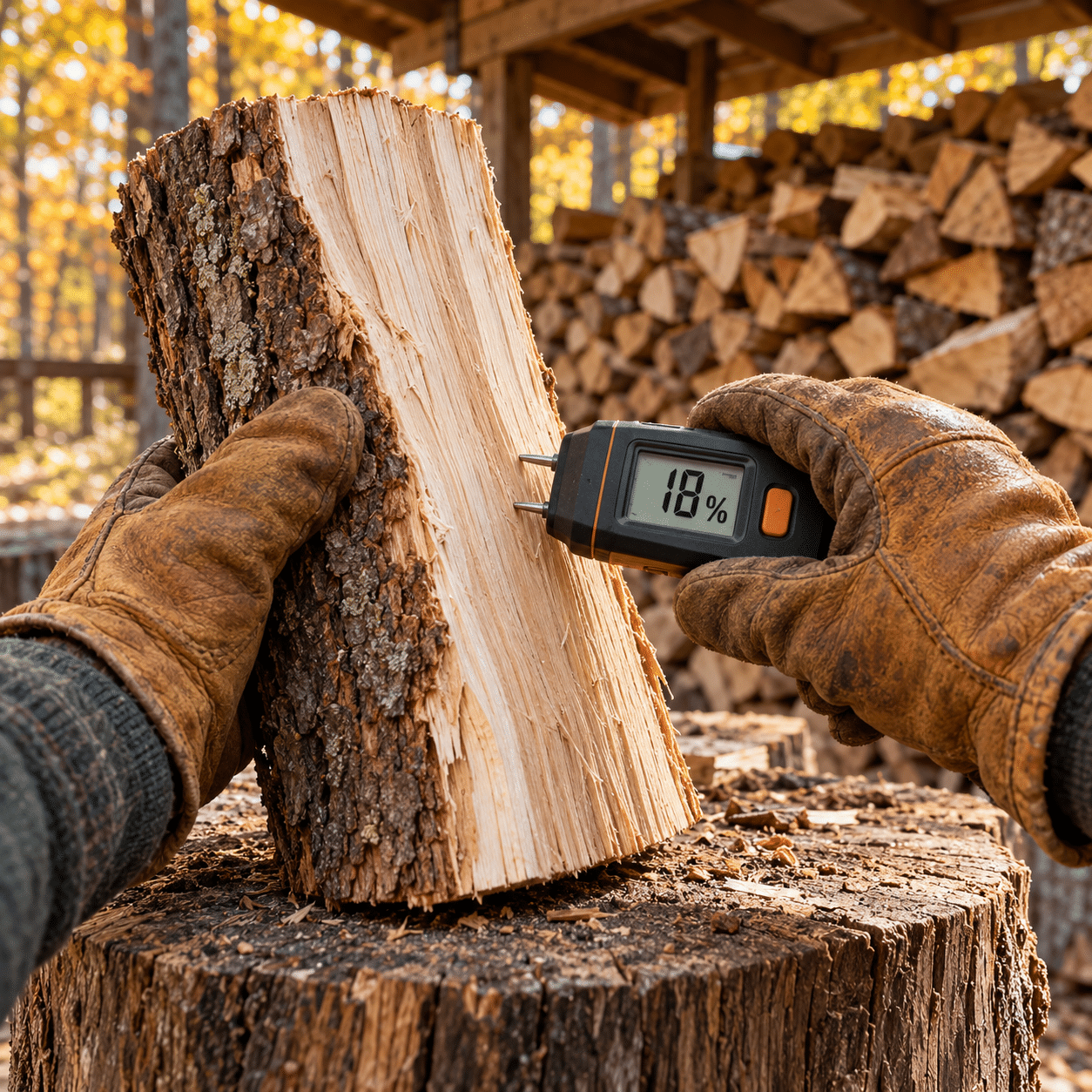
Before you call the firewood fellow, remember that every wood calculation above assumes reasonably dry fuel. A truckload of wet splits can make your tidy savings figure fall apart in a hurry.
Instead of putting all that available energy toward warming the house, the fire spends some of it driving off water. Meanwhile, smoky, sluggish burning can encourage creosote buildup in the chimney, especially when you choke the fire down and let it smolder.
That bargain starts looking less clever when the stove hisses like a wet cat and the living room stays cold.
The EPA’s wood-burning guidance recommends moisture below 20%. Use a moisture meter on the freshly exposed inside face of a split, following the meter’s directions; the weathered outside can fool you.
Also, ask when the wood was split and how it was stored. “Seasoned” is a word on an advertisement until you check the wood itself, and a calendar alone doesn’t prove a thick piece of oak is ready.
If it’s too wet, stack it for later. Keep it off the ground, cover the top, and leave the sides open so moving air can do its job.
Propane And Heat Pumps Deserve A Seat At The Table
Now, wood isn’t the only way to put some distance between your wallet and the oil truck. At the sample prices above, propane produces useful heat for about $36 per million BTU, compared with roughly $55 for oil.
But don’t mistake a national average for a quote at your tank. The EIA’s weekly propane prices vary widely by region and state, and your supplier’s terms, delivery volume, and tank arrangement can change the deal again.
If you’re considering conversion, get the complete installed price and estimate the annual savings. A cheaper gallon doesn’t justify an expensive equipment change all by itself, and the gallon of propane contains less energy than the gallon of oil.
Heat pumps deserve a fair look, too. At an average coefficient of performance of 2.5—meaning 2.5 units of heat moved indoors for each unit of electricity used—the example electricity rate gives you heat for about $21 per million BTU.
That’s attractive arithmetic, but the actual result depends on equipment, weather, installation, and any electric resistance backup. Modern cold-climate models are designed for low outdoor temperatures, so don’t assume every heat pump throws up its hands at the first frost.
For a rural household, though, outage planning still belongs in the conversation. A heat pump needs electricity, and so do most oil and propane furnaces for their controls, blowers, or pumps.
A properly installed woodstove that operates without electric fans can provide a valuable second way to heat. That matters when an ice-coated limb takes the power line down at midnight.
Buy Next Winter Before Next Winter Buys You

There’s another lesson hiding in the woodpile: timing. Buying fuel before everybody needs it gives you time to compare dealers, arrange delivery, and get the wood properly stacked.
Spring buying can be especially useful when it gives your firewood additional drying time. But don’t assume one summer finishes every species and split size; buy with the moisture meter and your storage conditions in mind.
Likewise, ask your oil or propane dealer about fixed-price and capped-price plans before the heating season. Read the fees, minimum purchases, delivery rules, and cancellation terms, because locking a price can protect you from increases while also leaving you above the market if prices fall.
And don’t compare a bargain cord of pine with a cord of dense hardwood as though the two hold identical heat. Compare useful BTU for the money, then decide what suits your stove, your storage space, and your back.
The cheapest-looking load isn’t always the cheapest winter.
Give The Oil Meter Fewer Chances To Click
You don’t have to solve the world’s fuel market before supper. You do need to know what heat costs at your address and which practical changes can lower that bill.
Start with your last delivery ticket, your electric rate, and two or three local wood quotes. Then look at the house itself: weatherstripping, obvious drafts, and neglected equipment can waste heat no matter what you burn.
Before the first wood fire, have the stove and chimney inspected and cleaned as needed. Follow the appliance’s clearance instructions, keep smoke and carbon monoxide alarms working, and make sure the fuel you stack is the fuel your stove was designed to burn.
Then put that pencil back to work. Decide how much heat the stove can reasonably carry, what the wood will actually cost, and whether an equipment change earns its keep over time.
The oil meter is going to keep clicking. The question is how many clicks you can replace with heat you’ve already paid for and stacked out back.
And next spring, while everybody else is thinking about tomatoes and fishing, give the woodshed a little attention.
Your January self will thank you.