 Print
Print
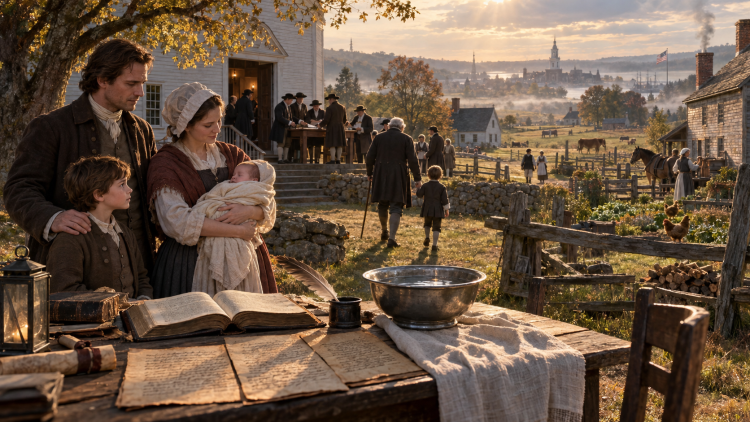
Almost Everyone Who Signed The Constitution Had Something Surprising In Common
We Keep Looking For America’s Political Roots In The Wrong Place
Full transparency. This is extremely important history. But listen, don’t take this content the wrong way. There are many Baptists, Catholics, and charismatic folks who are better Christians than I am. I state that humbly for the record. This article is not about that. It’s about history. Our history. That said…
There’s a strange little fact about the American Founding that doesn’t get much attention. Of the 39 men who signed the United States Constitution, the overwhelming majority came from churches that baptized infants… Anglican/Episcopal, Presbyterian, Congregationalist, Dutch Reformed, Lutheran, Methodist and Roman Catholic traditions.
The handful of complicated cases came principally from Quaker backgrounds, and Quakers rejected water baptism altogether. What you don’t find among the Constitution’s signers is a recognizable Baptist bloc.
That fact doesn’t prove that pouring or sprinkling water on infants somehow created America. Nor does it prove every signer personally understood covenant theology, or even that every signer was an orthodox Christian.
But put that fact beside the Mayflower Compact, the Fundamental Orders of Connecticut, the Massachusetts Body of Liberties, New England’s Puritan commonwealths, colonial household government, the Fairfax Resolves and finally the constitutional generation, and something remarkable begins to emerge.
The civilization that produced early America had learned to think covenantally.
Perhaps we’ve spent so much time treating infant baptism as an isolated argument about water that we’ve missed the civilization standing behind the baptismal font.
Covenant Theology Isn’t Five-Point Calvinism
We need to clear some theological brush before going farther. Today somebody can affirm total depravity, unconditional election, limited atonement, irresistible grace and perseverance of the saints and immediately be described as holding “Reformed theology.”
Historically, that’s much too thin.
Those five propositions principally address the doctrines of salvation disputed after Calvin’s lifetime between the Remonstrants and their Reformed opponents. The Remonstrance of 1610 presented five disputed articles, to which the Synod of Dort of 1618–19 subsequently responded. They were never John Calvin’s five-part summary of Christianity.
Calvin’s theological universe was considerably larger. He wrote about Scripture, worship, church government, sacraments, law, family, magistrates, education, vocation, property, Christian liberty and the continuity of God’s dealings with His people across redemptive history.
Here’s something striking: If you really examine Calvin’s writing carefully and analytically… you’ll find he spent about 5% of his total content on the five points. Think about that.
Reducing all of that to TULIP is like describing a 200-acre farm by pointing at five fence posts. They’re real fence posts, and they matter… but they’re not the farm.
Historic covenant theology asks a much larger question: How does the one God deal with His people throughout history? Its answer sees profound continuity between God’s covenant dealings in the Old and New Testaments.
The covenant isn’t reinvented every time a new individual makes a decision. God establishes His covenant with His people, and the classic Reformed understanding sees His covenantal promises and claims extending through households and generations.
That’s why Genesis 17:7 matters so much:
“I will establish my covenant between me and thee and thy seed after thee in their generations.”
Then Peter stands at Pentecost and says in Acts 2:39:
“For the promise is unto you, and to your children.”
That brings us directly to the issue Baptists and historic Reformed covenant theologians have been arguing about for centuries.
Infant Baptism Isn’t A Loose Board Nailed Onto Covenant Theology
It is sometimes suggested that infant baptism is merely one optional conclusion within covenant theology. Historically, that’s difficult to sustain if by covenant theology we mean the classic Reformed system represented by Calvin and subsequently systematized in the great Reformed confessions.
Look at the architecture of the Westminster Confession of Faith. It doesn’t first invent infant baptism and then rummage around Scripture looking for somewhere to attach it.
It begins upstream.
God voluntarily condescends to man by covenant. The covenant of grace unfolds through redemptive history; God’s people possess continuity across its historical administrations, while the sacraments function as covenant signs and seals.
Then comes baptism.
The Westminster Confession’s chapter on baptism describes baptism as a “sign and seal of the covenant of grace” and explicitly includes infants among those to whom the grace signified by baptism may belong.
In other words, remove the children and you haven’t merely changed the amount of water or the age of the recipient. You’ve changed something upstream—who belongs to the visible covenant community and how the Old and New Covenant administrations relate to one another.
That’s not a loose board.
That’s structural timber.
So when a modern Baptist affirms the five doctrines popularly called the Five Points of Calvinism, that doesn’t automatically make him a covenant theologian in the historic Reformed sense. He may be a Calvinistic Baptist, affirm sovereign grace and employ covenant terminology, but that still leaves the fundamental historical-theological question unanswered.
Has he retained classic covenant theology… or substantially revised its understanding of covenant continuity, covenant membership and the children of believers?
That’s not denominational name-calling. It’s a theological question, and pretending the disagreement concerns only the mode or timing of baptism badly understates what is actually at stake.
The Children Are Where The Difference Becomes Visible
And this is where the subject suddenly matters enormously for understanding early America. If covenant theology were merely an argument about whether babies should get wet, none of this would have much political or cultural significance.
But it isn’t.
The baby reveals the architecture.
In the classic covenantal conception, God doesn’t deal merely with detached individuals floating through history. He deals with people situated in families, churches, communities and generations.
Abraham receives promises concerning descendants he hasn’t met. Parents possess duties toward children; children inherit obligations they didn’t personally negotiate, while property, teaching, faith and culture move from one generation to another.
Deuteronomy repeatedly commands God’s people to teach His law to their children. Psalm 78 pushes the idea farther still: one generation teaches another so that children yet unborn will eventually arise and teach their children.
That’s covenantal thinking.
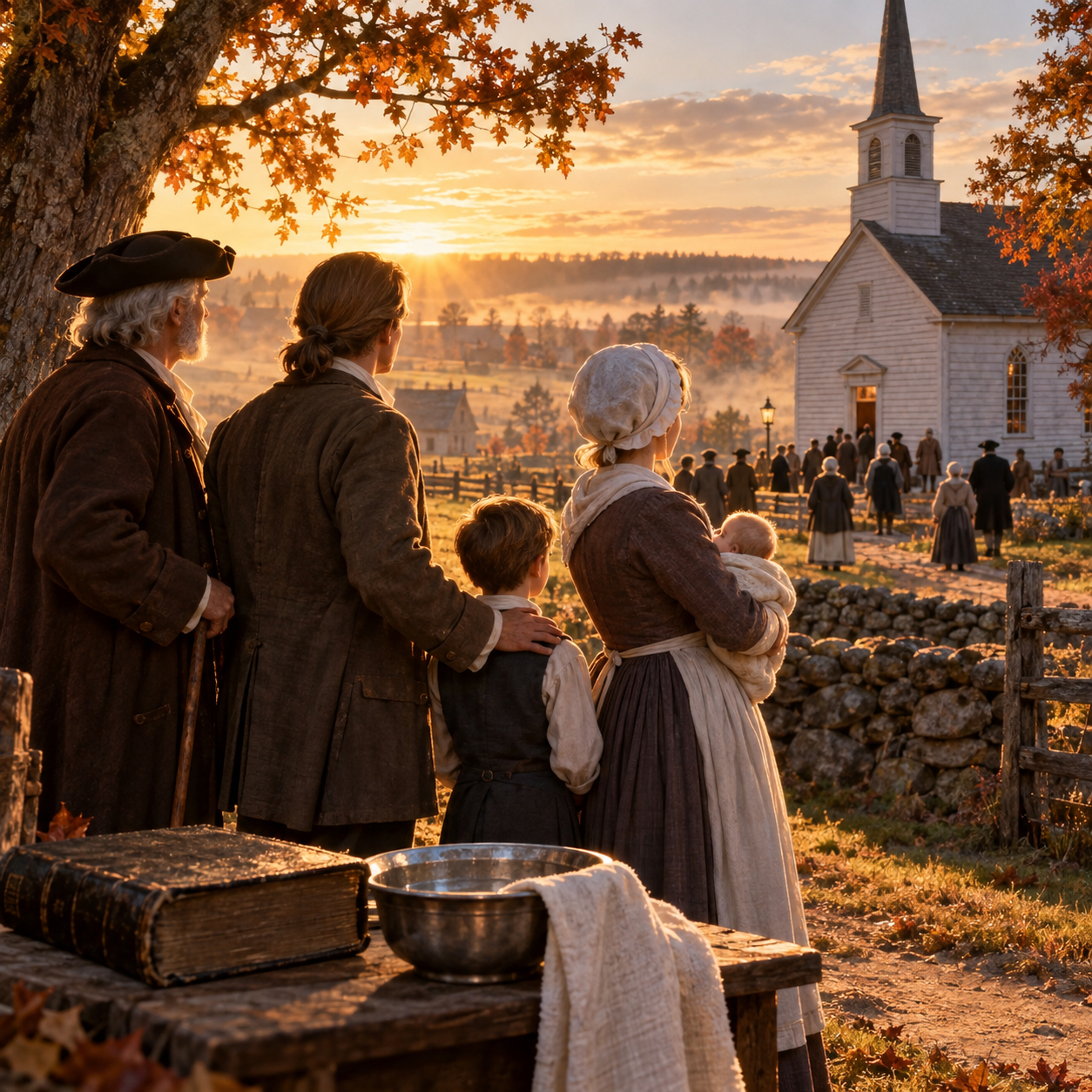
Infant baptism therefore stood as a visible reminder of something much larger than baptism itself. The congregation watched parents present a child who couldn’t vote, sign a contract, articulate systematic theology, or choose his ancestry, yet the child wasn’t regarded as a religious atom dropped from the sky.
He belonged to a household. He possessed a history and inheritance, while his parents and congregation possessed obligations before God concerning what kind of man or woman that child would become.
Now carry that worldview outside the church door.
Suddenly colonial America begins to look rather different.
Read The Mayflower Compact With Covenant Eyes
The Mayflower settlers didn’t begin their political life by announcing, “We, the autonomous individuals presently aboard this ship…” Instead, the Mayflower Compact of 1620 declared that their voyage had been undertaken for the “Glory of God” and advancement of the Christian faith.
Then came the political language. In the presence of God and one another, they agreed to “covenant and combine ourselves together into a civil Body Politick,” establishing just and equal laws for the general good and promising submission and obedience to the government they were creating.
Those words weren’t dropped randomly onto the parchment.
Covenant, body, law, obligation, submission and ordered liberty came from men living inside a theological and political world in which covenant was already one of the great organizing categories of Scripture.
The Mayflower Compact wasn’t the United States Constitution. But Americans were solemnly covenanting together politically 167 years before Philadelphia, and the Library of Congress notes that the Compact joined its participants into a self-governing “civil body politic.” (Library of Congress discussion)
That’s worth remembering.
Connecticut Makes The Connection Almost Impossible To Ignore
Then comes Connecticut.
The Fundamental Orders of Connecticut of 1638–39 open with an unmistakably theological explanation for civil government. Because, the settlers said, “the word of God requires” orderly government among a gathered people, they associated themselves into “one Public State or Commonwealth.”
They weren’t coy about the purpose either. They entered into their “Combination and Confederation” to preserve “the liberty and purity of the Gospel of our Lord Jesus” and agreed to be governed by duly established laws, rules, orders and decrees.
But notice another little phrase that modern readers can easily skip.
They made this arrangement “for ourselves and our successors.”
There it is again: posterity.
These settlers weren’t imagining society as a temporary contract among the adults presently standing in the room. They were establishing something their children would inherit, and those children would inherit responsibilities along with blessings.
The connection becomes even more explicit in the Fundamental Agreement of New Haven of 1639. Its participants actually asked whether Scripture supplied a rule for human duties “in families and commonwealth, as well as in matters of the church,” and spoke explicitly about establishing civil order for themselves and “their posterity.”
Then look at the New England Confederation of 1643. Massachusetts, Plymouth, Connecticut and New Haven declared that they had come to America with the common aim of advancing “the Kingdom of our Lord Jesus Christ” and enjoying the liberties of the Gospel, then entered a league extending to “their posterities.”
At some point, calling all of this incidental religious decoration becomes harder to maintain.
Law, Liberty And The Massachusetts Experiment
The same pattern appears in the Massachusetts Body of Liberties of 1641, the first comprehensive legal code established by New England’s English colonists.
Its opening conception is revealing. Liberties and immunities due according to “humanity, civility, and Christianity” were described as essential to the tranquility and stability of churches and commonwealths.
Then it put teeth behind those liberties.
A man’s life couldn’t simply be taken. His property couldn’t simply be seized. His family couldn’t simply be taken from him. Government itself operated under published law, and where positive law was deficient, the document explicitly appealed to the Word of God. (Full text)
This wasn’t libertarian autonomy.
It was ordered liberty under law.
And that distinction is crucial.
Rushdoony Saw What Modern Individualism Makes Hard To See
This is where R. J. Rushdoony once again becomes particularly useful. Rushdoony relentlessly asked a deceptively simple question: Who governs?
Modern Americans instinctively point toward Washington. Biblical government starts considerably closer to the kitchen table.
There is self-government under God, family government, church government and civil government. None possesses unlimited jurisdiction because none is God, and the family therefore isn’t merely a sentimental collection of individuals sharing a refrigerator.
It is an institution of government.
Parents govern and educate children. Families accumulate and transmit property, care for their elderly, transmit culture and faith, and connect dead ancestors with descendants not yet born.
Rushdoony repeatedly emphasized this generational character of the family and warned about transferring its functions to an increasingly comprehensive state. His treatment of family and government makes the larger point especially clear.
Now the pieces begin fitting together.
The Household Was A Political Reality Too
Colonial voting wasn’t universally “one household, one vote,” and we shouldn’t manufacture history to make the argument cleaner. But neither did colonial Americans generally begin with our modern assumption that every adult individual was an interchangeable political atom.
Freeholder status mattered. Property mattered. Economic independence mattered, and households mattered because political independence was commonly associated with possessing enough economic independence not to live under another man’s control.
Once again, we encounter a society thick with institutions standing between the solitary individual and the state: family, church, town, county, colony and commonwealth. That’s exactly the sort of social architecture that disappears when centralized government absorbs functions historically exercised by families, churches and local communities.
The older American arrangement wasn’t perfect. Never claimed to be.
But it wasn’t atomized either.
Then We Meet Washington And Mason At Fairfax
Jump ahead to Fairfax County, Virginia, in 1774.
George Washington chaired the meeting adopting the Fairfax Resolves, which were drafted principally by George Mason with Washington’s participation. The Library of Congress describes the Resolves as both a declaration of fundamental constitutional rights and a call for coordinated colonial resistance to British actions.
Look at the actual document. The meeting is identified as a gathering of the “Freeholders and Inhabitants” of Fairfax County, with Washington as chairman, and the Resolves named a 25-man committee including Washington, Mason, John West, William Ramsay, George Gilpin, Robert Hanson Harrison, John Carlyle, John Dalton, Charles Broadwater, Lee Massey, Edward Payne, Henry Gunnell and others.
Those men weren’t emerging from a civilization dominated by Baptist ecclesiology.
Washington was Anglican, and his infant baptism is independently documented. Mason was Anglican; numerous other committee members occupied Virginia’s Anglican parish world, and Lee Massey was himself an Anglican minister.
Virginia Anglicanism wasn’t identical to New England Puritanism, and pretending otherwise would weaken the case. But neither did the revolutionary generation suddenly emerge from a civilization built predominantly upon credobaptist assumptions about church, family and covenant.
The historical evidence points overwhelmingly elsewhere.
And Then Come The 39 Names On The Constitution
Now walk into Philadelphia in September 1787.
Thirty-nine men eventually placed their names beneath the United States Constitution. Among them were George Washington, James Madison, Alexander Hamilton, Roger Sherman, William Samuel Johnson, Rufus King, William Livingston, William Paterson, James Wilson, Abraham Baldwin, Daniel Carroll, John Rutledge, Charles Cotesworth Pinckney, George Read, Gunning Bedford Jr., James McHenry and John Blair Jr.
Their backgrounds included Anglican/Episcopal, Presbyterian, Congregationalist, Dutch Reformed, Lutheran, Methodist and Roman Catholic traditions.
Every one of those traditions baptized infants.
Using conservative classifications, at least 36 of the 39 signers can readily be associated with religious traditions practicing infant baptism. The three complicated cases—John Dickinson, George Clymer and Thomas Mifflin—had substantial Quaker backgrounds, a tradition rejecting water baptism itself.
Identifiable Baptist signers?
Zero.
That deserves more than a footnote.
It doesn’t mean every one of those 36 personally subscribed completely to Westminster covenant theology, and it certainly doesn’t mean Roman Catholic baptismal theology and Presbyterian covenant theology were identical. Nor does it mean Baptists contributed nothing to American liberty; men such as Isaac Backus (an Anabaptist) and John Leland deserve genuine credit, particularly in the struggle for religious liberty.
But let’s stop turning that genuine contribution into something historically much larger.
A few Baptists participated in the civilization that produced the Constitution. They were not the dominant theological architects of it.
And Five-Point Calvinism Doesn’t Change The Equation
This becomes especially important because modern terminology muddies the water. Someone says, “I’m a Baptist and a Calvinist.”
Fine—but what does Calvinist mean in that sentence?
If it means he affirms five propositions concerning salvation popularly summarized by TULIP, we’ve learned something important about his soteriology. We haven’t established that he shares Calvin’s covenant theology, sacramental theology, ecclesiology or understanding of the continuity of God’s covenant people.
The historical chronology alone should make us cautious. The Remonstrants presented their five disputed articles in 1610, a year after Jacob Arminius died and 46 years after Calvin’s death; the Canons of Dort answered those five articles in 1618–19.
The five points were therefore responses to a particular post-Calvin controversy, not Calvin’s own five-part definition of his theological system.
A Baptist can agree with Calvin about unconditional election while disagreeing with Calvin about the children standing beside the believer.
But that disagreement isn’t a small one.
It’s sitting directly on the covenant line.
Infant Baptism Was The Smoke… Covenant Theology Was The Fire
That’s why I think we’ve been looking at this backward. The important historical observation isn’t simply, “Wow, lots of early Americans belonged to churches that baptized babies.”
That’s interesting, but incomplete.
The deeper question is: What conception of society accompanied the theology that baptized those babies?
Now the pieces start locking together. Covenant, family, household, inheritance, posterity, property, law, oath, church and limited civil authority appear again and again alongside documents such as the Mayflower Compact, Fundamental Orders, New Haven Fundamental Agreement, New England Confederation, Massachusetts Body of Liberties, Fairfax Resolves, state constitutions and finally the United States Constitution.
None alone proves the thesis.
Together they reveal an overwhelming pattern.
The Baby At The Font Tells Us Something About The Constitution
Look, I’m not claiming infant baptism produced the Constitution. I’m claiming both emerged from a civilization containing assumptions modern Americans have largely forgotten.
The child at the baptismal font wasn’t an autonomous individual waiting eighteen years to invent himself. He had parents, a name, an inheritance, a history and duties waiting for him; meanwhile his family, church and community possessed duties toward him.
He stood between ancestors already buried and descendants not yet born.
And when Americans created political compacts, they repeatedly thought in similarly generational language. They spoke about themselves, successors and posterity… not merely the autonomous adults who happened to be alive when ink touched parchment.
Then comes Philadelphia.
Read the opening sentence of the Constitution again. The American people established their government partly to secure the blessings of liberty:
“to ourselves and our Posterity.”
There’s the child again.
Not literally at the baptismal font this time, but standing just over the horizon.
Maybe Covenant Theology Is The Missing Piece
America wasn’t created by one theological doctrine. English common law mattered; the Protestant Reformation mattered, while classical republicanism, British constitutionalism, autonomous natural-law reasoning and anti-Christian Enlightenment ideas all entered the American bloodstream for good or for bad.
History is a river with many tributaries.
But one enormous tributary has been strangely reduced in almost all modern retellings: covenant theology.
The Puritans didn’t merely believe certain doctrines concerning individual salvation. They possessed an understanding of God, history, law, family, church, society, and generations that taught them to think covenantally, and their children were part of that story.
That’s why infant baptism matters.
Not because water on a baby’s forehead somehow wrote the Constitution, but because the baby reveals the worldview.
America’s earliest covenanting settlers didn’t arrive thinking merely about themselves. They covenanted together, planted churches, established towns, created governments, built schools, accumulated property and raised children whom they expected to inherit both liberty and responsibility.
By 1787 the theology had become more complicated, the denominations more diverse and Enlightenment influences stronger. Yet when 39 men placed their names beneath the Constitution, almost all came from the broad world of churches that still confessed—in one form or another—that Christianity wasn’t merely a transaction between Jesus and an isolated adult individual.
The household still mattered. Generations still mattered, and posterity still mattered.
Covenant still mattered.
Perhaps that’s why one of the most famous political documents ever written doesn’t merely speak to the people standing in Philadelphia. It deliberately reaches forward toward people who didn’t exist yet:
“ourselves and our Posterity.”
Before America became a nation obsessed with the autonomous “I,” its ancestors had spent generations learning to say something very different:
“We covenant together.”
And if we want to understand the civilization that produced the American Founding, we may need to walk back past Philadelphia, past Fairfax, past Connecticut, all the way to Plymouth… and take another look at the children standing beside their parents.
Because the theology represented at that baptismal font may have had far more to do with the development of American ordered liberty than modern histories have taught us to notice.