 Print
Print
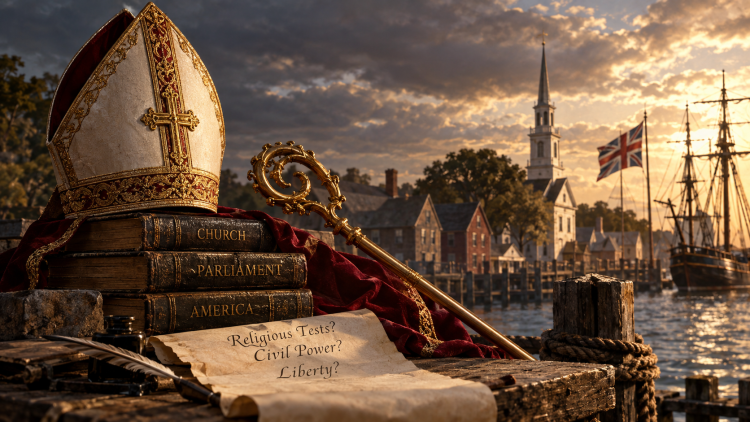
America Fought This Battle Before… When Churchmen Wanted Parliament To Build A Christian Establishment From The Top Down
The Question Today’s Christian Nationalists Still Haven’t Answered
Every generation of Americans is taught that the Revolution was about taxes. Stamps. Tea. A threepence duty. Redcoats marching through Boston while angry colonists calculated what London was taking out of their pockets.
That’s true as far as it goes, but it doesn’t go nearly far enough. Decades before my wife’s family fought at Lexington and Concord, one of the hottest arguments burning through colonial newspapers, taverns, pulpits, and meetinghouses had almost nothing to do with tea.
It was an argument over whether the British establishment could plant an Anglican bishop on American soil… and, more importantly, what kind of political machinery would be required to put him there.
The colonists understood something we seem determined to forget. The question isn’t simply whether a nation will acknowledge God; the dangerous question is who gets to define the government’s Christianity once somebody gets his hands on the machinery.
That brings us to an old bishop, an old controversy and, eventually, to Doug Wilson today.
Before The Redcoats Came The Bishops
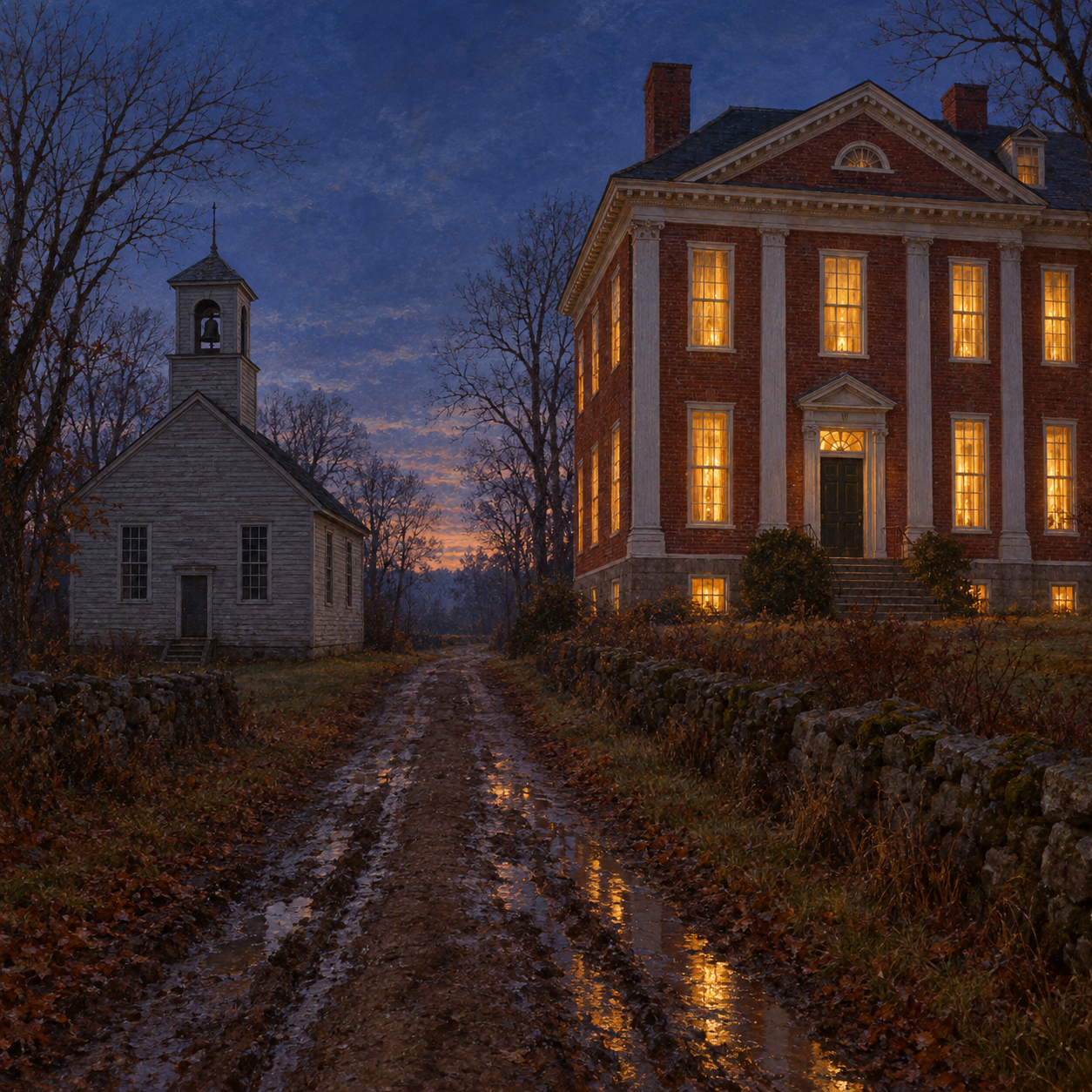
Historian Carl Bridenbaugh put this largely forgotten religious argument back on the table in his 1962 book Mitre and Sceptre. His controversial thesis was that fear of Anglican episcopacy helped prepare the colonial mind for revolution.
Historians have argued about Bridenbaugh ever since. Critics say he took colonial Dissenter propaganda too seriously and turned English bishops into villains they never really were.
But I’m confident that this criticism misses the most interesting part of the story.
Look, the real problem wasn’t that every Anglican was secretly plotting to put New England Presbyterians in chains. Most weren’t. The problem was almost the opposite: a relatively small group of well-connected churchmen wanted something that much of their own flock wasn’t demanding… and the only practical way to get it was through political power.
That’s where the story gets interesting.
The Scheme Was Hatched At The Top
The push for an American episcopate was never some roaring grassroots revival from colonial Anglicans. It was largely a leadership project centered among church officials who believed colonial Anglicanism needed bishops.
Thomas Secker promoted the idea in a 1741 sermon to the Society for the Propagation of the Gospel while still Bishop of Oxford. He worked the issue through the Board of Trade in 1749 and was reportedly told by the ministry in 1751 that there would be no bishops in America.
The broader political and religious background to this first bishop controversy is well documented in historian Patrick Mullins’ account of the struggle. Mullins’ history of the First Bishop Controversy
Horace Walpole likewise warned Bishop Sherlock that the plan was political dynamite. Whatever theological merits episcopacy possessed, imposing bishops on the colonies filled with Dissenters was another matter entirely.
Secker didn’t quit. He became Archbishop of Canterbury in 1758.
Raised in a Presbyterian household before entering the Church of England, Secker pursued an American episcopate with the energy of a convert. Yet timing mattered, and he advised allies in America to keep the matter relatively quiet while Britain was fighting the Seven Years’ War.
Then the war ended.
The Peace of Paris was signed February 10, 1763. Within weeks, Secker was again looking toward Parliament and a new opportunity for an American bishop.
Notice what’s happening here. There’s no Great Awakening for episcopacy, no wave of American conversions demanding bishops and no wagonloads of petitions rolling out of Virginia asking Parliament to send somebody over wearing a mitre.
Instead, we see bishops talking to ministers, church officials talking to English political officials, and everybody waiting for the right parliamentary moment.
The sceptre was being asked to accomplish what the mitre had been unable to accomplish by persuasion.
That’s the part worth remembering.
Even The Anglicans Weren’t Exactly Beating Down The Door
Here is where the story gets downright awkward for the idea that this was simply “Anglicans versus Dissenters.” Ordinary Anglicans weren’t exactly marching in the streets demanding bishops either.
Thomas Bradbury Chandler published his Appeal to the Public in Behalf of the Church of England in America in 1767 partly because he needed to awaken the church’s own supporters from their indifference. Think about that for a moment: you don’t launch a national pamphlet campaign to awaken a constituency already pounding on your door.
Then came Virginia.
In 1771, the Bishop of London’s commissary, James Horrocks, summoned Virginia clergy to Williamsburg to support a petition for an American bishop. Virginia was about as thoroughly Anglican as colonial America got, with roughly one hundred Anglican clergymen serving there.
Only twelve showed up.
Even that magnificent turnout didn’t produce unanimity. Four of the twelve… Thomas Gwatkin, Samuel Henley, William Bland and Richard Hewitt… opposed the effort because the gathering was far too small to pretend it represented Virginia’s clergy.
Then something remarkable happened. The Virginia House of Burgesses—filled with Anglican laymen—thanked Gwatkin and Henley for opposing the Anglican hierarchy’s proposal.
Read that slowly.
Anglican laymen thanked Anglican ministers for resisting a plan being promoted by Anglican leadership to give Anglican America an Anglican bishop. That’s not a minor historical wrinkle; that’s the whole ballgame.
This wasn’t simply “Christianity versus secularism.” It wasn’t even cleanly “Anglican versus Dissenter.” It was a small ecclesiastical-political faction trying to construct something from above that a great many people—including members of its own church—had never requested.
John Adams Remembered What The Fight Was Really About
Half a century later, John Adams hadn’t forgotten any of this. Writing to Jedidiah Morse in 1815, Adams returned repeatedly to the religious controversies that helped Americans begin questioning Parliament’s authority over them.
But Adams carefully explained that the issue wasn’t merely that Americans disliked bishops. The deeper issue was who possessed the authority to create one. Nailed it!
An English archbishop couldn’t simply wake up Tuesday morning, draw a diocese around Massachusetts and install an American bishop. Parliamentary authority would be required, and once Americans conceded Parliament’s power to construct an ecclesiastical establishment in America, Adams saw the constitutional problem immediately.
If Parliament could establish bishops and dioceses, why couldn’t it then establish tithes? Why couldn’t it regulate Dissenters? Why couldn’t it decide which religious practices received legal protection and which ones didn’t?
Adams’ surviving correspondence with Morse is especially revealing because he connects the ecclesiastical controversy to the larger American investigation into the “nature and extent” of Britain’s jurisdiction and Parliament’s authority over the colonies.
In other words, the bishop wasn’t frightening merely because he wore a funny hat.
He was frightening because Parliament had to build the chair he would sit in.
And Whose Christianity Was Parliament Going To Establish?
Adams supplied another detail that ought to stop us cold. Congregationalists, Presbyterians, Baptists, Methodists, Quakers and Moravians together vastly outnumbered Anglican churchmen; Adams estimated the combined advantage at more than fifteen to one.
Then he delivered the knife twist. In America, he said, the Churchmen were actually “the real dissenters.”
That turns the modern discussion on its head.
Imagine fifteen families living along a country road. They attend different churches—Baptist, Presbyterian, Methodist and Congregationalist—and then one family announces, “Good news. We’ve figured out what Christian government should look like.”
You might agree that Christ is King. You might agree that God’s law is real and that civil government is accountable to God.
But you’re still going to have one question.
Who gave you the keys?
Jonathan Mayhew Could Already See The Fence Posts Going In
Jonathan Mayhew, the fiery Boston Congregationalist minister, saw the danger early. His concern wasn’t simply theological disagreement with Anglicanism; he feared the institutional chain reaction that could follow an episcopal establishment… religious tests, restrictions on public office, financial support for bishops, and eventually legal disabilities for Dissenters.
Mayhew’s warning was particularly Off-The-Grid in its understanding of how power grows. People generally aren’t stripped of their liberties in one dramatic afternoon; power creeps forward through one encroachment after another as people become accustomed to surrendering a little more ground. His argument and its place in the First Bishop Controversy are preserved in the historical discussion of the period. Read the history of Mayhew and the bishop controversy
One fence post becomes another. Then comes one little jurisdiction, one harmless precedent, one “reasonable” exception, and one new power everybody promises will only be used by good men.
Before long, somebody looks up and discovers a fence around the whole pasture.
Meanwhile, Cambridge Anglicans built the Rev. East Apthorp such an impressive residence that suspicious neighbors nicknamed it the “Bishop’s Palace.” You can almost see colonial New England staring at that big house and muttering, “Uh-huh. And we’re supposed to believe nobody’s planning to put an Anglican bishop in there.”
This Was A Constitutional Argument Wearing Church Clothes
This is where Bridenbaugh’s “religious cause” of the American Revolution becomes even more interesting. It was religious, certainly, but it was also deeply constitutional.
The colonists weren’t merely asking whether bishops were biblical. They were asking what power Parliament had to authorize the establishment.
Once they started asking that question, the whole imperial barn began leaning.
If Parliament could authorize and establish a National Church, Parliament could control you in a lot of other ways. If Parliament could tax and regulate you without meaningful colonial consent, Americans increasingly wondered what limits remained on parliamentary sovereignty.
Adams remembered precisely this progression. His later correspondence traces the argument from ecclesiastical establishment into the larger colonial investigation of parliamentary sovereignty; he described Parliament’s declaration of sovereignty as hanging “like a cloud” over the continent.
The Revolution was happening in people’s heads before anybody started shooting.
And that brings us forward about 260 years… to Moscow, Idaho.
Which Brings Us To Doug Wilson
Doug Wilson deserves something his critics don’t always give him: credit for candor. He doesn’t hide the destination, even with his layered metaphors and Chestertonian jibber-jabber.
In a July 2026 NPR interview, Wilson was asked directly whether he wanted the United States eventually to become a Christian theocracy.
His answer was yes. Okay, fine.
But here’s an important distinction, because we shouldn’t make the argument easier to knock down than it needs to be. Wilson does not propose storming Washington, staging a coup or imposing his system tomorrow; he describes a generational process of preaching the Gospel, planting churches, building Christian schools and transforming the culture.
Good. Let’s grant him that argument completely.
Let’s grant the peaceful mechanism, the evangelism, the schools, and even the centuries it might take. Then let’s walk all the way down Wilson’s road and look carefully at the destination.
Because that’s where the old colonial warning bell starts ringing one more time.
“Church Bells, Yes. Minarets, No.”
When Wilson was asked what public life would look like for non-Christians in his envisioned Christian order, his answer produced one of the most revealing images in the entire debate: “Church bells, yes. Minarets, no.”
His reasoning was equally important. Wilson said the public space would belong to Christ; Muslims could worship, but they would live within an explicitly Christian country and would therefore be expected to recognize and defer to that public Christian order.
Now stop there, because the easy argument is whether Christianity or Islam is true. I’m a Christian. I don’t believe Muhammad was a prophet, I don’t believe the Quran is God’s Word, and I want my Muslims friends converted to Jesus Christ.
But none of that answers the constitutional question. This is key…
Who decides which Christian understanding gets to control the public square?
Because the moment government possesses the authority to say “church bell yes, minaret no,” you’ve handed somebody a very interesting lever.
And history says somebody eventually pulls it.
Then Comes The Religious Test
Wilson goes further than merely imagining a Christian culture. In the political order he describes, the Constitution itself would be Christian and officeholders would have to swear to uphold that Christian Constitution. Sounds like something Patrick Henry wanted. Because he did. And for good reason.
But that immediately creates another question. Who gets to hold office? Wilson’s answer is essentially not everyone, because many politicians could not sincerely swear to uphold an explicitly Christian constitution. Stay with me here.
Now we’re getting somewhere, because this is precisely the question colonial Americans learned to ask.
Who gets to determine what Christian orthodoxy actually is?
Today the line might be the Apostles’ Creed. Tomorrow it might be Vatican II, Augsburg, or the 1689 London Baptist Confession.
Does baptism regenerate? Can infants be baptized? Is the Eucharist sacramental or memorial? Can women hold civil office? What happens when Catholics outnumber Reformed Protestants… or Charismatics like Paula White outnumber both?
At some point somebody has to draw the line.
And the person drawing that line isn’t merely holding a Bible. He’s holding the sceptre.
Then There’s The Ballot Box
Wilson’s proposed voting system makes the problem even sharper. He has advocated replacing our present individual franchise with household voting, arguing that political representation should attach to households rather than simply to every adult individual.
He’s not wrong about the way things were, In fact:
That was life in America up until the Jacksonian era, roughly 1776–1850.
But again, we live in different times. Who decides what constitutes a household? Do I even need to list what passes for this today? LGBTQIA+ households? Mormon “Five Wives” households? On and on, right?
Here’s the problem: We’d have a lot of unwinding to do that the Colonial lawmakers could have never imagined.
So Wilson can try to construct answers to those questions and perhaps articulate some good points.
But that’s precisely… is the point.
Somebody has to construct the answers because somebody has to write the rules.
Once government begins determining political standing according to a particular theological conception of household government, we’ve traveled a long way beyond saying America should acknowledge God.
This Is Where The Mitre Starts Looking Familiar
Now we can finally make the comparison carefully.
Doug Wilson is not Thomas Secker. Secker wanted imperial and parliamentary machinery to create an ecclesiastical structure in colonies that weren’t asking for it, while Wilson explicitly says the Christian society he envisions must emerge through evangelism, persuasion, church planting, Christian education, and widespread cultural conversion.
Those are different roads. Pretending otherwise would be sloppy history.
But here’s the problem: different roads can still arrive at a disturbingly similar constitutional destination.
A confessional political order. Religious qualifications for office. Government distinctions between approved and disapproved public religious expression. A political franchise shaped by a particular theological understanding of the household. The truth is… whether we want to admit it or not… is that we live in a polytheistic culture.
And eventually the state must answer the question:
Who counts as Christian enough?
That’s where Secker’s ghost walks back into the room. Not because Wilson wants an Anglican bishop—he obviously doesn’t—but because colonial America already discovered the danger of constructing religious machinery inside the state.
Once you build the machine, your favorite theologian doesn’t necessarily get to operate it forever. Think MAGA here. Same color hat. Same words on the hat. Now a very different constituency with a very different ideology and very different goals.
Imagine Wilson Gets Everything He Wants
Here’s the thought experiment I’d like every Christian Nationalist to answer. Suppose Wilson wins… not through force, but through evangelism.
Churches multiply. Christian schools flourish. Families grow. Millions convert, and after several generations America overwhelmingly identifies as Christian.
Wonderful.
Then America adopts a Christian Constitution. Doug Wilson eventually dies, his children die, his grandchildren die, and two hundred years pass.
Another Christian faction becomes the majority.
Maybe they’re Roman Catholic. Maybe they’re Anglican, Pentecostal or a form of Christianity you and I haven’t even encountered yet.
Now they get to run the machine.
They decide what “Christian Constitution” means. They decide who can hold office, which religious expressions belong in public, what qualifies as a household, and what Christian orthodoxy means.
Eventually they decide whether your church bell rings.
Still like the machine?
Because that’s the question the colonists were learning to ask. They weren’t designing a government merely for the bishop they liked; they were designing it for the bishop they feared.
The Founders Had Already Seen This Movie
The American answer was not atheism. That modern myth needs to die.
The men resisting an Anglican form of Christian Nationalism weren’t standing outside churches waving copies of Richard Dawkins. They were Congregationalists, Presbyterians, Baptists, Anglicans, Quakers and other Christians arguing fiercely with one another about the proper relationship between church and civil authority.
The question wasn’t simply whether Christ was Lord. The question was whether Parliament should be entrusted with determining exactly how religious authority would be institutionally expressed in America.
Increasingly, Americans answered no, especially at the federal or National level.
Not because Christianity was too unimportant for public life.
Because Christianity was too important to hand over to politicians.
Adams’ later recollections make this connection especially interesting. Looking back on Virginia, he pointed to Anglican-educated men such as Richard Henry Lee, Patrick Henry, George Wythe, Thomas Jefferson and James Madison and asked why they ultimately joined in stopping an Anglican establishment.
That is a historical question worth asking again.
Rushdoony… Saw The Trap
This is where the Christian Reconstructionist tradition gets more interesting than many of its modern admirers realize. R. J. Rushdoony emphasized regeneration before political reconstruction; the order mattered.
God’s law had to work outward through transformed people, families, churches and communities rather than simply downward from a captured state. His son Mark Rushdoony later made the distinction explicit: Christian Reconstruction was not supposed to mean grabbing statist power and then using the machinery against everybody else.
That older Rushdoony Reconstructionist instinct is worth recovering.
Start with the man, then the household, then the church, then the neighborhood and town. Build schools and businesses, raise children, feed widows, care for the elderly, plant gardens, teach Scripture and preach Christ.
Make Christian civilization so fruitful that your neighbor starts asking why your orchard keeps producing while his ideological plantation is dying.
That’s Christian reconstruction.
No Christian Nationalism required. No mixing the word Christian, a believer in the one true Trinitarian God… with the word Nationalism, a hazy and easily hijacked ideology.
The Off-The-Grid Way To Build A Christian Country
There’s something wonderfully off-grid about that model. You don’t capture Washington; you make Washington less necessary.
You don’t need a federal Department of Christian Culture telling people how to live. You build Christian culture yourself, and instead of seizing centralized machinery, you decentralize the machinery until there isn’t much worth seizing.
That’s slower. Much slower.
Nobody gets a television panel for faithfully raising six kids, helping his neighbor repair a barn roof, serving as a church elder for thirty years and teaching his grandchildren the Psalms. But civilization is built that way… one fence post, one supper table, one congregation, one school, one business and one family at a time.
Christian America Doesn’t Need A Central Lever
This is where the old Anglican bishop controversy finally comes home.
Thomas Secker thought America needed “governing” bishops. Many Americans—including plenty of Anglicans—weren’t convinced, and the establishment increasingly faced the problem that Parliament would have to provide the authority necessary to make the project work.
Americans therefore began asking a much bigger question: why should Parliament possess that kind of power in the first place?
Once they started pulling that thread, an empire eventually unraveled.
Adams remembered the connection decades later because he understood what had happened. Americans had learned that arguments about ecclesiastical establishment eventually become arguments about political jurisdiction and the limits of government itself. Read Adams’ 1815 recollections at Founders Online
Who governs? Who decides? Who defines and who enforces?
And what happens when the people answering those questions aren’t your people anymore?
Those remain the questions.
The Bishop Who Never Landed Still Has Something To Teach Us
Now, the bishop who never landed may be one of the best warnings Christian America ever received. Not because bishops are uniquely dangerous, not because Anglicanism is uniquely dangerous, and certainly not because Christianity is dangerous.
The warning is simpler:
Never build a religious political machine that you would be terrified to see operated by your theological opponent.
That’s the test.
If Baptists wouldn’t want Catholics holding the lever, don’t build the lever. If Presbyterians wouldn’t want Pentecostals holding it, don’t build it.
And if Protestants wouldn’t want Muslims holding it, don’t build it either. Think this is speculative? Go to London if you get a chance and look around. An Anglican machine built. A machine hijacked by Islam.
Please understand, this is not hair splitting. Ask anyone in England who’s been arrested for simply questioning the machine. Hate crime? Thought crime? Called terrorists. Yikes!
Again, if Doug Wilson wouldn’t want the Archbishop of Canterbury deciding which church bells may ring in Moscow, Idaho, perhaps the federal government should avoid placing an ontological stamp of approval on any form of Christianity. Why? Because governments can’t authorize what’s Christian and what’s not. If you do want to play that game… leave it to the individual states. That was colonial thought anyway.
Preach Christ instead. Plant churches, build schools, raise families, restore neighborhoods and make Christianity beautiful, durable, productive and impossible to ignore.
Do apologetics, Hit evangelism with all the force you can muster. Start with Dearborn.
Let the Gospel travel across America the old-fashioned way… from one converted heart to another, one household to another and one little church to another.
That’s slower than legislation and messier than a five-point political platform.
And nobody gets to sit on a throne at the end.
Good.
Because our forefathers had already seen what happens when somebody else’s Christianity arrives wearing a mitre in one hand…
And carrying the sceptre in the other.