Print

The Dark History Behind Those Beautiful Ancient Temples
The Night Great Pan Died And The Bloody World Christianity Turned Upside Down
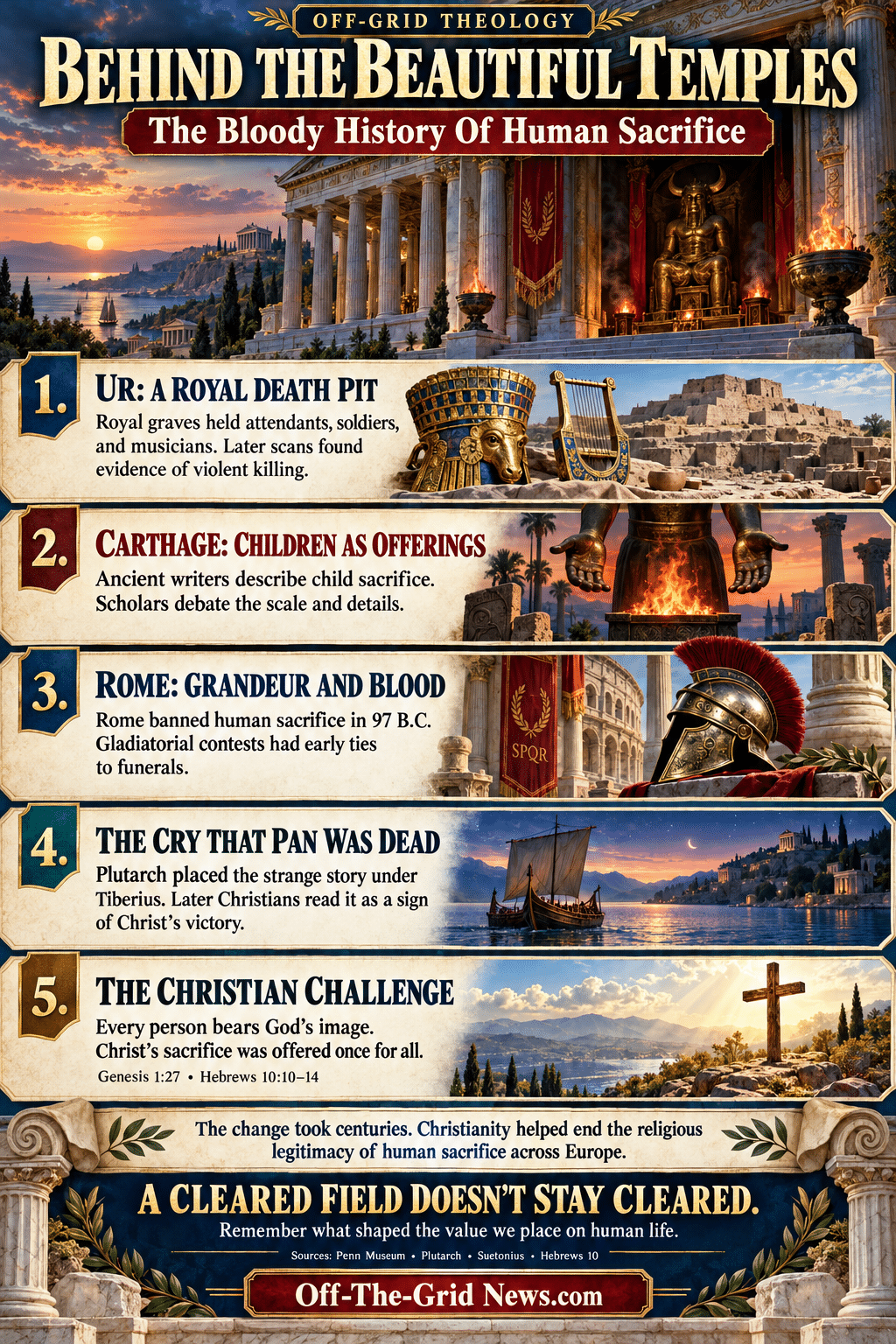
Your history teacher probably gave you the brochure version of the ancient world. Marble temples shining in the sun. Philosophers holding forth in clean togas. Athens inventing democracy while Rome laid roads straight as a fence line across half the map.
What the brochure left out was the smell.
Behind those handsome columns stood a world where human beings became religious offerings. A frightened city needed help. A king needed company in the grave. Somewhere, somebody decided the gods would feel better if another person stopped breathing.
The late historian and writer Otto Scott made the darker side of that world part of his argument about the great Christian revolution. His larger point deserves a hearing: we polish the past until we can admire it without getting anything unpleasant on our shoes.
Meanwhile, the graves keep turning up.
Human sacrifice took different forms in different societies, and it was never the whole story of ancient religion. But it appears across enough centuries and enough cultures to wreck the comfortable idea that the old world was one long philosophy seminar interrupted by an occasional chariot race.
So pull up a chair. This is off-grid theology with some dirt under its fingernails, and it starts where the Sunday school mural stops.
They Put On Their Best Clothes And Went Into The Grave

Start at Ur, in what is now southern Iraq, traditionally identified with the Ur associated with Abraham. In the 1920s, archaeologist Leonard Woolley opened its royal cemetery and found that important people had apparently taken their households into death with them.
There were armed men, attendants, and musicians with their instruments. Gold ornaments and elaborate headdresses lay among the remains. In one burial, the Great Death Pit contained 74 sacrificial victims, most of them richly dressed young women.
Picture the scene without the museum glass. Fine clothing. Bright metal. A musical instrument resting beside hands that would never play it again. All that splendor arranged around a hole in the ground.
Woolley thought the attendants had gone down voluntarily and drunk poison. It made a terrible sort of sense within his reconstruction: the ruler was leaving, and the court would follow.
However, later examination made that tidy procession look considerably uglier. CT scans of two preserved heads found evidence of blunt-force trauma, suggesting violent killing rather than the peaceful poison scene Woolley imagined. Fine jewelry cannot tell us whether its wearer agreed to die.
Either way, the household had become burial equipment. The king needed servants in the next world, and living people paid the moving expenses.
The Emperor Was Dead So The Women Had To Die Too
Now head east. In ancient China, royal burials and sacrificial deposits from the Shang period reveal another society where human lives could be spent on the ruler and the spirits.
Nor did the practice disappear neatly when the Bronze Age ended. Early Ming emperors were still accompanied in death by palace women more than three thousand years later. The custom of sacrificing childless consorts was finally abolished for the Ming imperial court in 1464, as discussed in British Museum scholarship on Ming court culture.
Let that date settle in. Gutenberg’s printing revolution was underway. Columbus was a boy.
The world had learned to do astonishing things by then. Yet a woman could still lose her life because an emperor had lost his. Skill with ink, bronze, navigation, or government did not automatically teach a civilization what a human being was worth.
When Carthage Panicked The Children Paid
Next comes Carthage, the wealthy trading power on the North African coast. In 310 B.C., with the army of Agathocles threatening the city, its people faced a military crisis that the historian Diodorus Siculus described as a religious emergency too.
According to his account, the leading families had offended their god by substituting purchased children for their own sons. Now, with danger at the walls, the supposed bargain had to be repaired.
Diodorus reports that two hundred children from leading families were publicly sacrificed. He also describes at least three hundred others offering themselves. In his telling, a bronze figure held out sloping hands, and children placed upon them fell into fire below.
Those details come from a Greek author writing about a hostile people, and scholars dispute the numbers and parts of the description. The evidence for Carthaginian child sacrifice has itself been fiercely debated; classicist Llewelyn Morgan explains why he accepts its reality while treating Diodorus’s narrative with care.
That distinction matters. We need neither swallow every lurid detail nor pretend the underlying question disappears because the witness had enemies.
Still, the logic in the account is unmistakable. The city had a problem, the gods wanted payment, and somebody’s child became the currency.
Athens Had Philosophers And Human Scapegoats
Of course, the Greeks usually arrive in our history books with better lighting. They gave us interesting philosophy, literature, and political experiments. They also had rituals built around loading a community’s pollution onto an unwanted person and sending that person away.
These human scapegoats were called pharmakoi. In Athens and elsewhere, their expulsion was tied to purification, including the festival of Thargelia. The Oxford Classical Dictionary’s account describes that basic practice.
Did the scapegoats always die? No such blanket claim is justified. Ancient accounts disagree about killing and expulsion, and the evidence varies by place and period.
But even if the victim survived, the arrangement deserves a harder look. The town found somebody expendable, piled its trouble on his back, and showed him the road.
Remember that when somebody serves you an ancient world scrubbed clean of everything except reason and sunshine. Athens deserves study. It does not need a fresh coat of whitewash.
Rome Knew The Problem Before Christianity Arrived
Rome complicates any easy story, and we ought to say so plainly. Pagan Romans themselves condemned human sacrifice, and Pliny records a senatorial prohibition in 97 B.C., long before Christianity became a public force.
That means Christians did not invent every objection to ritual killing. It also means the practice was serious enough to be condemned. Rome’s own disgust belongs in the record alongside Rome’s long history of bloodshed.
Then consider Nero. In Suetonius’s account of his reign, a comet frightened the emperor, and an astrologer advised that the threatened ruler could divert the danger onto prominent men. Nero consequently set his sights on the nobility, with conspiracies providing a convenient excuse.
That was imperial murder fed by an omen, rather than a straightforward report of a temple sacrifice. Even so, the family resemblance is ugly: somebody else must die so the powerful man can feel safe.
Meanwhile, Rome’s gladiatorial shows had roots in funerary observance. The first recorded Roman contest, in 264 B.C., involved three pairs of fighters at the funeral of Decimus Junius Brutus Pera. Later games grew into enormous public entertainments, but their early connection with honoring the dead should not be airbrushed away.
Even Julius Caesar’s Rome supplies a disturbing episode. Cassius Dio reports that two soldiers were ritually killed on the Field of Mars, with their heads displayed near the Regia. Dio admits he cannot explain the real reason for the act.
Rome could build an aqueduct that still impresses an engineer. That did not mean it had repaired the human heart.
The Sacred Grove Was No Country Picnic
North of the Alps, the picture stays rough. Julius Caesar described the Gauls constructing enormous wicker figures, filling them with people, and setting them alight under druidic supervision.
Now, Caesar was a conqueror describing the people he conquered. His account needs to be read with that fact sitting on the table. It remains important evidence of what an ancient observer reported, rather than a photograph we can inspect from every angle.
Centuries later, Charlemagne’s laws for conquered Saxony explicitly punished human sacrifice with death. Those same laws also imposed brutal penalties in the service of forced Christianization. We cannot praise the prohibition while pretending the surrounding coercion smelled like roses.
Farther north, Adam of Bremen described human and animal sacrifices at Uppsala in the eleventh century. His account was secondhand, and its details remain disputed. However, the National Museum of Denmark explains that archaeological evidence supports human sacrifice in Viking Age Denmark, even while warning against taking hostile Christian descriptions at face value.
So forget the picture of pre-Christian northern Europe as a harmless woodland retreat. There were farms and families, skill and courage. There was also blood beneath some of the sacred trees.
The Church Fathers Saw Something Behind The Idols
Now we reach the theological nerve of the matter. Early Christian writers such as Justin Martyr treated pagan worship as more than an innocent misunderstanding. Behind the idols, they saw demonic deception taking honor that belonged to God.
Augustine developed the same broad argument in The City of God. This was a Christian judgment about spiritual reality, and we should identify it as such. An archaeologist can uncover an altar; Christian theology asks what kind of worship was taking place around it.
Further, Scripture had already spoken against sacrificing children. In Jeremiah 19:5, God condemns the burning of sons as offerings to Baal. Christianity inherited that opposition from Israel’s Scriptures, rather than discovering it on a blank page.
Here is the point that gets lost when ancient religion becomes a pleasant display of pottery.
A god who makes the community feed him its children is demanding something monstrous. Calling the ceremony traditional does not improve it.
The Voice Across The Water
Against that background comes one of antiquity’s strangest stories. Plutarch tells it in On the Obsolescence of Oracles, placing the event during the reign of Tiberius, the emperor who ruled when Jesus was crucified.
A ship was sailing toward Italy when it came near the islands of Paxi. A mysterious voice called for an Egyptian pilot named Thamus. After repeated calls, he answered and received an extraordinary instruction: announce the death of Great Pan when the ship reached Palodes.
Later, with the water quiet and the wind gone, Thamus called toward the land. The response, according to the story, was a great lament from many voices. News eventually reached Tiberius, who investigated.
Imagine standing at the stern. No wind in the sail. Black water beside the hull. Then a human voice throwing the news into the dark: “Great Pan is dead.”
Eusebius later gave the story a Christian interpretation, connecting its timing with the overthrow of demonic power through Christ. Plutarch himself was a pagan writer, not a Christian announcing that conclusion.
Was the report history, legend, or a misunderstood cry? We can’t settle that by liking the ending. Nor does Plutarch date it to the precise night of the Crucifixion. Its Christian force lies in the meaning later believers saw in it: the old powers had met their conqueror.
A Sacrifice That Shut Down The Demand For More
Christianity began without an imperial army. Fishermen preached. Households gathered. Slaves, women, tradesmen, and people with standing heard the same announcement: the crucified Jesus had risen, and Caesar was not the highest authority in the room.
The message carried a radically different account of human worth. Genesis 1:27 grounds that worth in God’s image. A child’s life does not acquire value because the city finds him useful, and a servant does not become disposable when his master dies.
Then comes the heart of it. Hebrews 10:10–14 presents Christ’s offering as sufficient, once for all. The answer to guilt is not another child, another captive, or another frightened woman pushed toward a royal tomb.
The sacrifice has already been made.
Over time, Christian teaching helped destroy the religious legitimacy of human sacrifice across Europe. That change involved preaching, conversion, law, and, in some places, coercive rulers. It was neither instant nor the work of Christians alone, and the church’s own sins deserve honest accounting.
Still, something enormous changed. Practices that could once be defended as duties to the gods became violations of the God Christians worshiped. A civilization had learned to recoil where earlier worshipers had knelt.
Quit Clearing The Field And See What Grows
That is why this belongs in off-grid theology. We spend plenty of time asking whether the well will run, whether the pantry will hold, and whether the stove will carry us through January. We should also ask what keeps a society from deciding its weakest neighbors are fuel.
Otto Scott’s warning about faith and civilization points toward a real concern, even if sweeping claims about every civilization outrun what history can prove. A society can inherit moral habits while forgetting the convictions that helped establish them. The inheritance can last long enough to make its beneficiaries careless.
Meanwhile, fashionable interest in the occult does not mean every curious reader is halfway to a sacrificial altar. The deeper danger is an old habit of mind: deciding some people may be spent so the rest of us can prosper, feel safe, or wash our hands.
Out here, we know a cleared field does not stay cleared because Grandpa once swung an axe. Leave it alone, and the brush noses through the fence. Saplings follow, and before long the ground you thought you owned is disappearing under shade.
The same goes for a civilization’s moral ground. Teach your children why a human life is sacred. Tell them what stood behind some of those beautiful marble columns. Give them more than the brochure.
And when somebody says the old gods were harmless… ask who had to feed them.