Print


Seven Sisters In The Sky… And An Ancient Theory About A Drowned World
A Seminary Professor Looked Into Halloween… And Saw A World Under Water
Walk down a small-town street on October 31, and you’ll find enough plastic bones to stock a medical school. Skeletons cling to porch rails. Inflatable ghosts wobble beside the driveway while children drag candy bags big enough to hold a winter’s supply of potatoes.
Meanwhile, ask what the whole business means and somebody will tell you to relax. It’s costumes. It’s candy. It’s a little fun before the weather turns ugly.
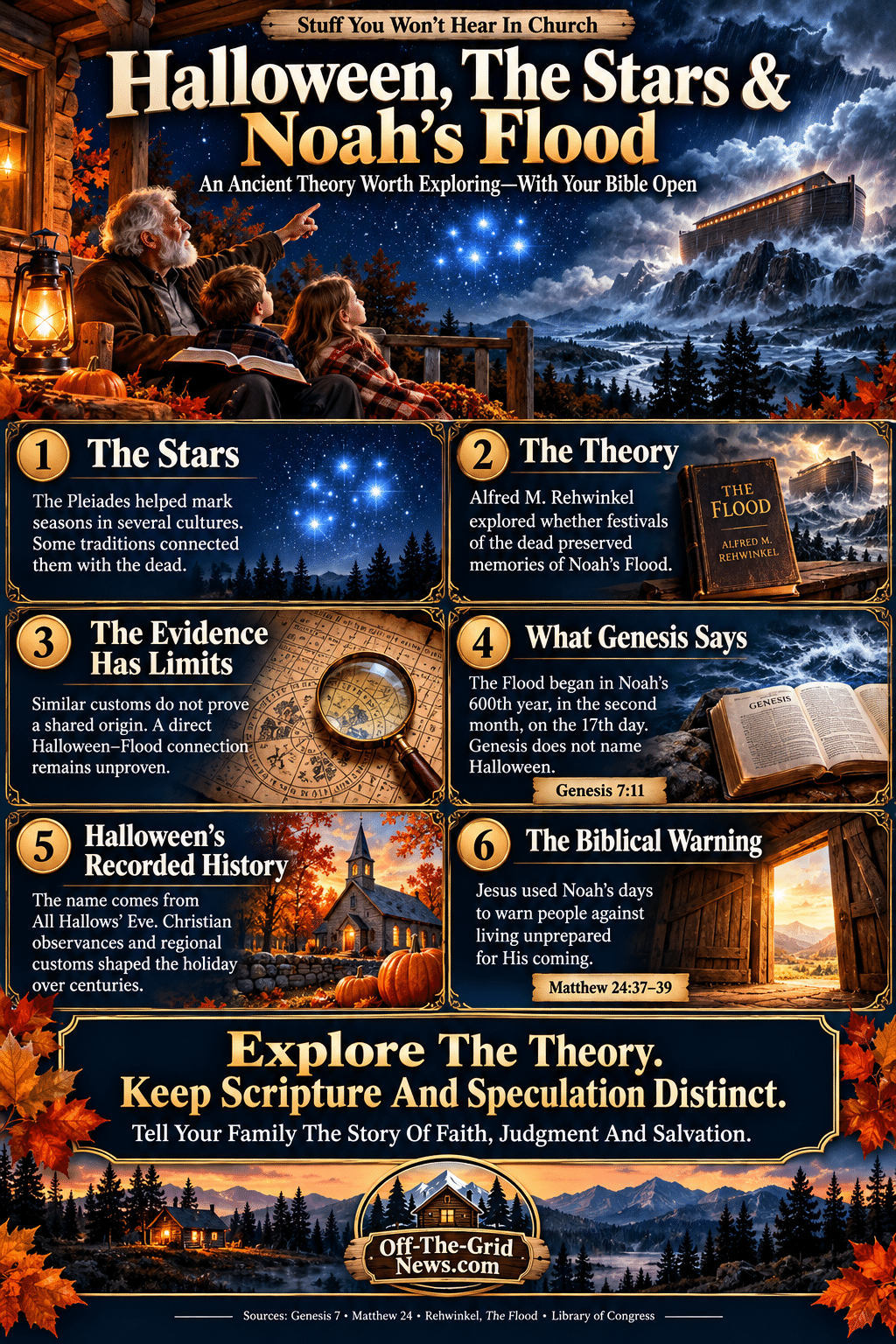
But an old theological argument asks a question worth carrying out onto the porch: Could some autumn festivals of the dead preserve a battered memory of the world Noah survived?
A few years back, a Lutheran professor thought the connections deserved attention. Later, R. J. Rushdoony drew a pointed moral lesson from that reading. The historical theory is disputed, and Halloween’s documented history is more complicated than a straight road back to the ark. Still, the biblical question underneath it can put a chill in the October air.
When a culture remembers the dead, what exactly is it remembering about God?
A Seminary Professor Looked Past the Candy Bowl
Back in 1951, Concordia Publishing House published Alfred M. Rehwinkel’s The Flood in the Light of the Bible, Geology, and Archaeology. Rehwinkel taught at Concordia Seminary in St. Louis, and Concordia still lists his book.
His starting point was straightforward. He believed Scripture spoke truthfully about the world God made and about the judgment recorded in Genesis. Consequently, he treated the “great-flood traditions” as clues worth examining rather than old stories to sweep off the table.
That does not make his book a reflection of modern, atheistic, evolutionary geology. It makes it a Christian argument, written from a particular understanding of biblical history. Readers deserve to know what kind of book they have opened before following it into the woods.
One part of Rehwinkel’s case concerned flood stories scattered among the nations. Another concerned something stranger: festivals of the dead, the turning of the year, and a small cluster of stars hanging over the autumn countryside.
If you’ve ever walked out to check the chickens on a clear fall evening, you may have seen that little glittering patch. It’s the Pleiades, often called the Seven Sisters.
In this argument, those stars become a kind of calendar nailed to the sky.
The Seven Sisters and an Old Theory About the Dead
The researcher behind this part of the story was Robert Grant Haliburton, a nineteenth-century Canadian writer. His work on The Festival of the Dead connected seasonal ceremonies, the Pleiades, and traditions of catastrophe.
As Haliburton assembled his comparisons, he believed he saw a pattern. Peoples separated by oceans associated the stars with the year’s turning, and some of their ceremonies remembered the dead. He proposed that these customs carried fragments of a common ancient memory.
Rehwinkel found that possibility compelling. In his reading, mankind had carried the memory of the Flood out into the world, then wrapped it in local gods, rituals, and stories until the original event was almost hidden beneath the wrapping.
Picture a family account passed down around kitchen tables for generations. The names get muddled, details wander, and somebody adds a flourish. Yet a stubborn piece of the original story remains.
However, resemblance alone cannot establish a family tree. A harvest ceremony in one country and a mourning rite in another may share a season without sharing an origin. Even an impressive pile of parallels needs reliable dates, local sources, and evidence that the connections actually existed.
That is where this theory needs a firm hand on the reins. It offers an intriguing explanation; it does not supply a proven birth certificate for Halloween.
Around the World With the Ancestors
In the material Rehwinkel drew from, the examples ranged widely. Reports from Australia described ceremonies involving the Pleiades and painted bodies that reminded European observers of skeletons. Accounts from the Society Islands and Fiji connected seasonal observances with departed relatives.
Those reports helped build the argument, but they should be read as historical reports about particular communities. Sure, they don’t establish that all Aboriginal Australians or all Pacific Islanders shared the exact same religion, calendars, or festivals. That’s just common sense. A continent is a mighty big place to squeeze into a footnote.
Then there is Peru. Colonial accounts describe an Inca season called Ayamarca, associated with the dead and ceremonies involving ancestral remains. The picture is striking: families carrying ancestors into the life of the community instead of leaving them quietly in their tombs.
In Mexico, remembrance of departed relatives remains visible in Día de Muertos. UNESCO describes the indigenous festivity as welcoming the temporary return of deceased loved ones, with offerings and preparations that join family memory to religious practice.
Nevertheless, Día de Muertos has its own history. Mexico’s National Institute of Anthropology and History describes a tradition shaped over centuries by indigenous and Catholic contributions.
Haliburton also drew on Mexican ceremonies involving the Pleiades and fears of cosmic disaster. Here, too, caution matters: a ceremony tied to the stars and a cycle of world renewal should not automatically be treated as the same event as an annual November remembrance of the dead.
Meanwhile, his comparative survey extended to Persia and Egypt. It gathered the sort of details that can make a reader sit up straight: death, water, a returning season, a threatened world.
The difficulty comes when a suggestive pattern starts doing the work of a documented connection. You can admire the clues without making them carry more weight than they can bear.
An Egyptian Chest Is Not Automatically Noah’s Ark
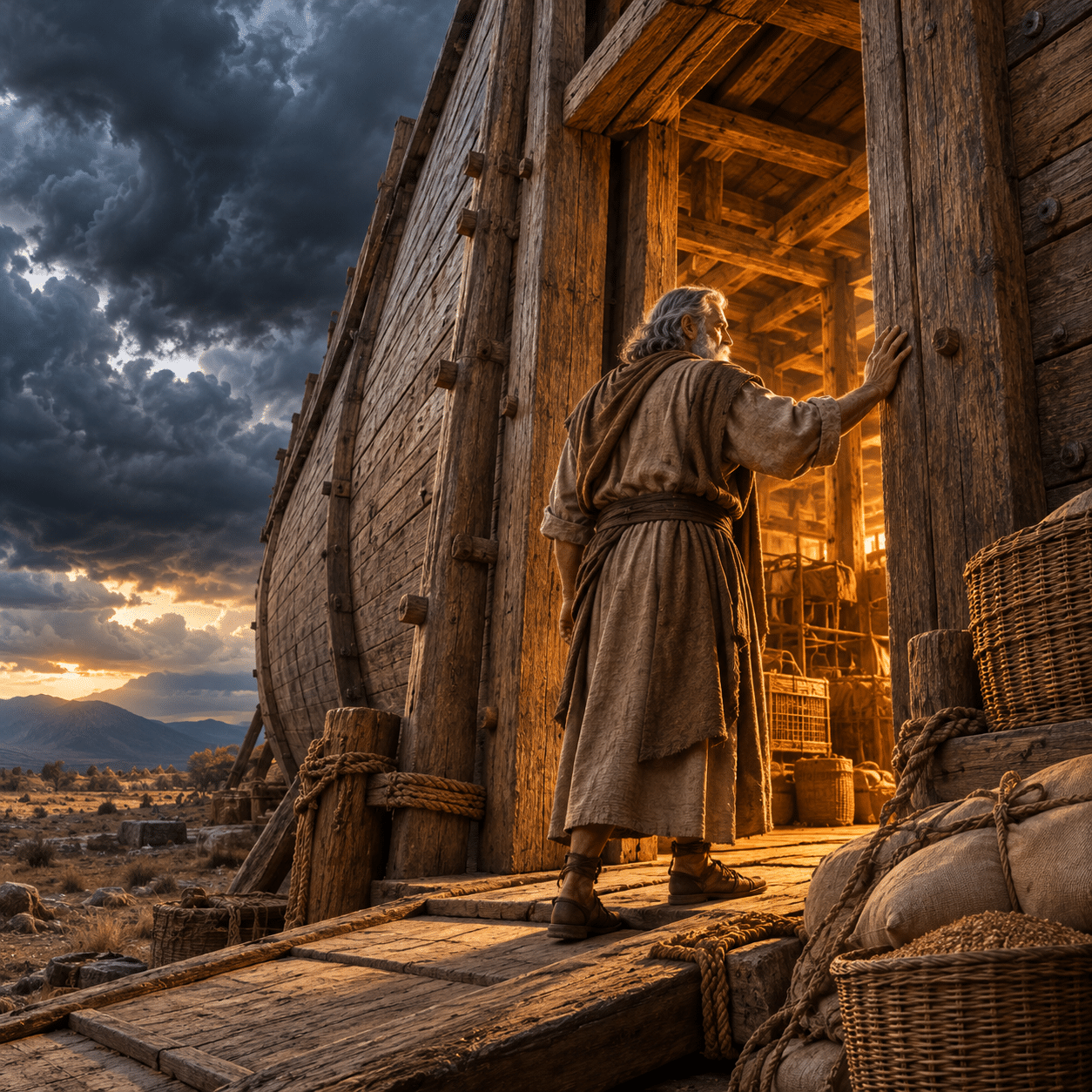
Consider the Egyptian example. In Plutarch’s account of Isis and Osiris, Osiris is trapped in a chest, which is sealed and thrown into the river. The story associates the event with the seventeenth day of Athyr.
That seventeenth day caught the attention of writers comparing pagan traditions with Genesis. Water, a chest, a death, and a numbered day make an arresting combination. You can see why somebody would reach for a pencil.
But Osiris’s chest functions as a coffin in a murder story. Noah’s ark carries a living family through divine judgment. Calling both objects an “ark” can make the resemblance sound closer than the actual narratives warrant.
Likewise, translating dates from ancient calendars into our October and November requires care. Calendars changed, months moved against the seasons, and a matching day number does not by itself prove a common event.
For another fascinating connection, turn to Berakhot 59a in the Babylonian Talmud. It preserves a rabbinic account in which God removes two stars from the Pleiades to bring the Flood.
That is a real connection between the star cluster and the Flood in later Jewish tradition. It is not a statement found in Genesis, nor does it establish where Halloween began. Keeping those distinctions clear lets the evidence remain interesting without turning it into a carnival act.
The Date Genesis Gives and the Date It Does Not
Now open Genesis 7:11. The text dates the outbreak of the Flood to Noah’s six hundredth year, the second month, and the seventeenth day.
Notice what it does not do. It does not say October 31, November 1, or Halloween. To place that second month in autumn, an interpreter must decide how the year was being reckoned.
There is old support for an autumn reading. In Antiquities of the Jews, Book One, Josephus identifies the month as Marcheshvan and explains a distinction between ordinary reckoning and the spring beginning associated with religious observances.
That puts the traditional month roughly in October and November. It gives the autumn argument a genuine historical foothold. It still does not turn a lunar month into a fixed date on today’s calendar.
Moreover, Jewish tradition itself preserves disagreement. Rosh Hashanah 11b discusses differing reckonings of the Flood’s timing. The confident claim that everybody agrees on an autumn anniversary simply outruns the evidence.
A farmer can certainly appreciate the image of Noah gathering provisions after harvest. Full bins, stacked fodder, and food under cover make sense to anybody preparing for a hard season. But that is an illustration of the proposed timing, not proof of it.
So the defensible conclusion is modest. Genesis supplies a precise date within its own chronology, and some ancient interpreters placed that date in autumn. The claim that worldwide festivals preserve that exact anniversary remains a theory.
The Bible does not need us to improve its case by pretending a theory is a verse.
What Halloween’s Name Actually Tells Us
Meanwhile, Halloween has a documented Christian name: All Hallows’ Eve, the evening before All Saints’ Day. “Hallows” refers to saints, which is a useful fact to remember when the front yard looks like a discount cemetery.
The Library of Congress discusses Samhain and the later development of Halloween customs. Yet the exact relationship between pre-Christian festivals and Christian observances is more complicated than the familiar claim that the Church simply painted over a pagan holiday.
The Open University’s account stresses that the observances had different origins and emphases. Over time, local customs, religious commemorations, migration, and commercial entertainment helped shape the October 31 we know.
Therefore, the Flood theory belongs alongside that discussion as a proposed deeper connection.
That distinction matters for Christians. We ought to be the people who can tell a compelling story without slipping an unsupported claim into the collection plate.
Rushdoony’s Question Still Has Teeth
The interpretation associated with Rushdoony takes the proposed Flood connection in a sharp theological direction. If ancient people were honoring the generation judged in the Flood, what did that remembrance mean? Were they mourning human loss, or giving their allegiance to a rebellious world?
That question can be explored without pretending the historical premise is settled. It also needs a distinction of its own: remembering a dead relative does not automatically mean approving everything that relative believed or did. Grief and worship are different things.
But the underlying warning still deserves a hearing. Human beings have a long habit of making rebellion look noble, and obedience look ridiculous. A culture can turn the man warning of danger into the villain, then build a monument to the people who ignored him.
Read Genesis 6:5–13. The world described there was filled with wickedness, corruption, and violence. The passage gives no encouragement to romanticize that generation as misunderstood free spirits whom God unfairly interrupted.
At the same time, Genesis does not explicitly describe crowds standing outside the ark mocking Noah. That familiar scene is an imaginative reconstruction. Scripture calls Noah a preacher of righteousness, which gives us plenty to consider without adding dialogue the text never records.
The uncomfortable question reaches beyond Halloween anyway. Which stories make us cheer for defiance simply because somebody has dressed it up attractively? Which sins become charming once the crowd starts laughing?
A guy can take every plastic skeleton off his porch and still give rebellion the best chair in the house.
When Death Becomes the Entertainment
There’s also something worth examining in our appetite for death as amusement. A culture that struggles to speak plainly about a real funeral can spend a small fortune putting imitation corpses on the lawn. Apparently, death becomes easier company when it comes with a price tag and an extension cord.
That observation does not prove that a child wearing a bedsheet secretly loves evil. Nor does it require the sweeping claim that all Halloween spirits are wicked. Plenty of costumes have more to do with superheroes, farm animals, and whatever was available at the store.
The stronger question concerns our habits of attention. What happens when cruelty becomes funny, the occult becomes glamorous, or suffering becomes a decoration we stop noticing?
In Proverbs 8:36, Wisdom warns that those who hate her love death. That verse concerns rejecting wisdom; it isn’t a direct ruling on pumpkin carving. Its warning reaches into the choices we make every month of the year.
Consequently, a Christian family can ask better questions than whether the neighbors approve of its late October plans. What are we teaching our children to admire? What are we making light of? Does our home make goodness seem sturdy and desirable, or dull enough to escape at the first opportunity?
Those questions will keep you occupied long after the candy is gone.
Keep the Truth Stronger Than the Scare Story
While we’re at it, accuracy matters when Christians warn about danger. The poisoned-candy panic is a good example of a frightening story that often traveled farther than its evidence.
Sociologist Joel Best’s research on Halloween sadism examines reports of strangers tampering with children’s treats. His work treats the familiar random-poisoner narrative as a contemporary legend, rather than an established pattern of children being murdered by strangers’ Halloween candy.
Parents can use ordinary care without repeating every newspaper scare as gospel. A warning loses force when people discover that the loudest part was built on rumor. We owe our children something better than trading one spooky tale for another.
The same principle applies to this article’s historical argument. Explore the proposed Flood connection. Read Rehwinkel. Look at the older reports. But let Scripture speak with its own authority, and let a historical hypothesis remain a historical hypothesis.
Faithfulness includes telling the truth about how much we know.
Tell the Story of the Door God Shut
Finally, the Flood gives us a warning that needs no disputed holiday genealogy. In Matthew 24:37–39, Jesus points to Noah’s days when speaking of His own coming. People went on eating, drinking, and marrying until judgment arrived.
Those are ordinary activities. That is what makes the warning land so hard. A person can have supper planned, a wedding on the calendar, and tomorrow’s chores lined up while remaining utterly unprepared to meet God.
Meanwhile, Hebrews 11:7 describes Noah preparing the ark by faith. He acted on God’s warning about things he had not yet seen. Any homesteader understands the practical side of that: you put the roof on before the rain starts running down the kitchen wall.
Yet the ark was more than a successful preparedness project. Noah’s safety depended on God’s provision and promise. Genesis 7:16 gives the detail that ought to stop a room cold: the Lord shut him in.
Then 1 Peter 3:20–21 recalls the eight people brought safely through the water and connects the account with baptism and Christ’s resurrection. The Christian story moves through judgment toward salvation and life.
So this October, take the children or grandchildren outside on a clear evening. Let their eyes adjust. Look for the Pleiades and talk about the old theory if you like, making clear which parts are known and which are proposed.
Then open Genesis and tell them what the text actually says. Tell them about a violent world, a man who believed God, a family carried through the waters, and a door the Lord closed Himself.
Whether Halloween preserves a distant echo of that catastrophe remains unproven. The warning Jesus drew from Noah is plain enough to carry home.
Get ready while the door is open.