Print


What Plato… Aristotle… And A Wealthy Man Who Met Jesus Reveal About Today’s Biggest Moral Problem
You Can’t Climb Your Way To Being Good If End Up On The Wrong Roof
You can barely get through breakfast without saying it. Good morning. Good coffee. Good dog. Good year for hay. We scatter that little word around like chicken feed, usually without stopping to ask what we mean.
Meanwhile, a child can use it before he can tie his shoes, and a philosopher can spend fifty years trying to nail it to the floor. Everybody wants the good life. Everybody wants good neighbors. And nearly everybody assumes he knows a good man when he sees one in the mirror.
But here comes the question that can knock the coffee cup sideways: Who gets to decide what makes anything good?
That is where this little word opens into two different worlds. One begins with man claiming the final say. The other begins with the God who made him, owns him, and has already spoken.
Now, that may sound like something best left to professors with elbow patches. It isn’t. The answer follows you into the voting booth, the feed store, the classroom, the church budget meeting, and the kitchen when your child asks why something is wrong.
Welcome to Off-Grid Theology. Today we’re checking the measuring stick.
The Greeks Built an Impressive Ladder

First, let’s clear away the fog. This isn’t a fistfight between the Greek alphabet and the Hebrew alphabet. The New Testament was written in Greek, and neither language carries a little switch that automatically makes its speakers faithful or rebellious.
The Greek word agathos means good; to agathon means the good. The Hebrew word tov also covers goodness, along with related ideas such as what is pleasant, beneficial, or fitting. But a dictionary cannot settle who has the authority to judge.
For that, we have to look beneath the word and see what is holding it up.
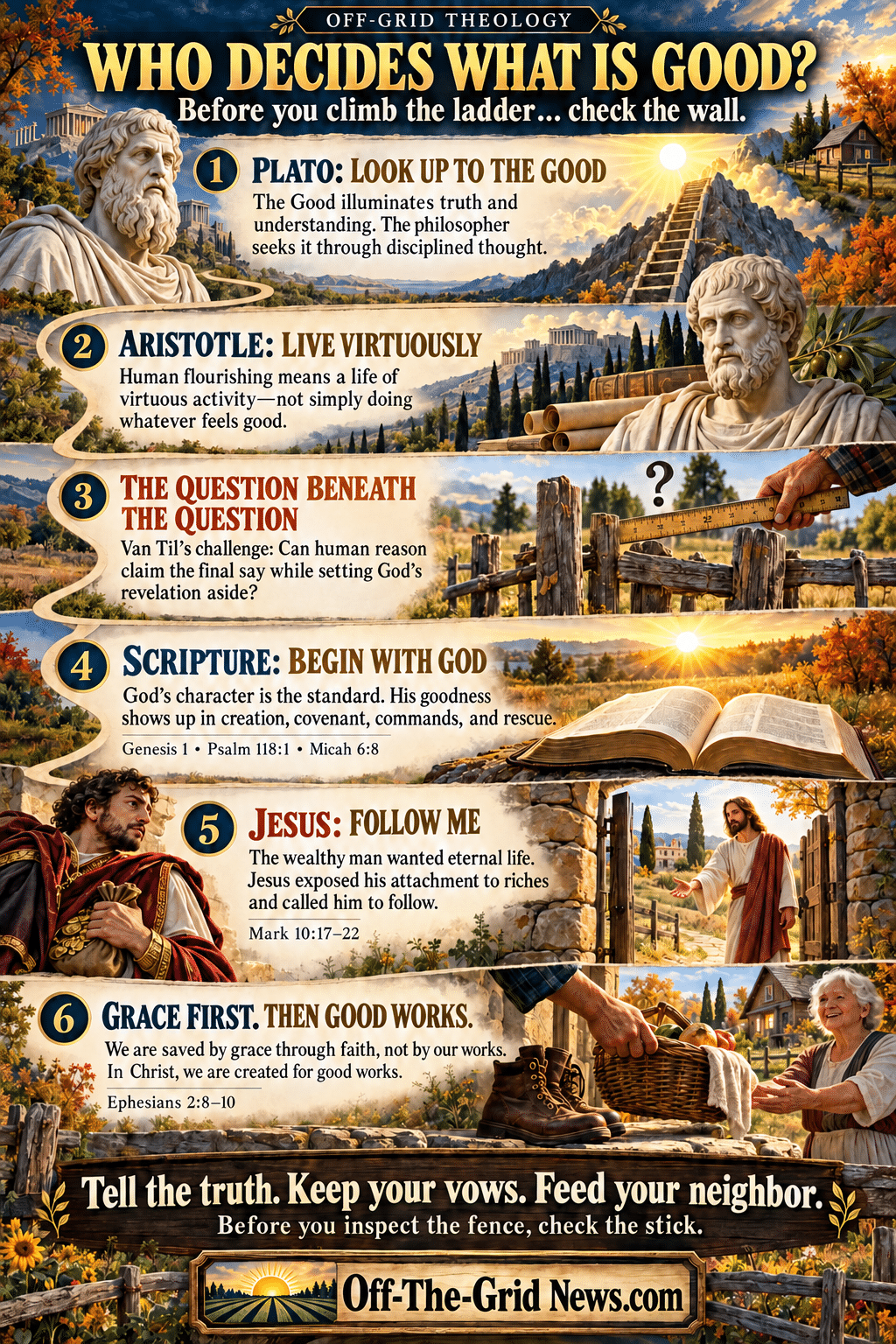
In Plato’s Republic, Books VI and VII, the Good stands at the summit of his account of knowledge and reality. Plato compares it to the sun: as sunlight makes sight possible, the Good makes understanding possible. The person who would act wisely must come to understand it.
Then, in the Philebus, he approaches goodness through beauty, proportion, and truth. These are serious attempts to explain an objective moral order. Plato wasn’t telling people to invent whatever morality happened to suit their appetite.
Still, picture the direction of travel. The philosopher works upward toward the Good through education, argument, and disciplined understanding. It is an ascent toward an intelligible principle, rather than obedience to the covenant Lord who speaks in Scripture.
Next comes Aristotle, who declines to climb his teacher’s particular ladder. In Book I of the Nicomachean Ethics, he challenges the usefulness of one universal Form of the Good and examines the ends toward which different activities aim. Human life’s highest good, he argues, is eudaimonia: flourishing through a life of virtuous activity.
In other words, he means something sturdier than a full belly and a pleasant afternoon. Character, judgment, and the habits of a whole life matter. But he develops that account through an examination of human nature and human purposes, rather than beginning with the biblical Creator’s revelation.
Frankly, those differences matter. Plato and Aristotle weren’t interchangeable, and neither was a modern fellow announcing that his feelings make the rules. You don’t improve a Christian argument by stuffing your opponent’s coat with straw.
Nevertheless, the Christian question remains: Can the creature give a final account of goodness while treating the Creator’s word as unnecessary?
A Crooked Stick Can Approve a Whole Crooked Fence
Here is where Cornelius Van Til walks into the yard. His objection wasn’t that unbelievers never recognize a good deed or reason carefully. It was that human thought has no right to declare itself the highest court, with God’s revelation waiting outside for permission to enter.
In The Biblical vs. the Kantian View of Man, Van Til argues that the final standard of truth and goodness cannot stand above God. He also connects the modern claim to moral independence with older philosophical efforts to define goodness without reference to the living God. That is his Christian criticism of those systems, rather than their own description of themselves.
Now bring that argument down to the fence line. Suppose you check every post with a crooked stick, then announce that the whole fence passes inspection. You’ve measured carefully. You’ve kept excellent records. You may even have hired a committee.
But who checked the stick?
That’s the problem with making your own judgment the final authority. More calculations don’t cure a faulty starting point, and a longer ladder doesn’t settle whether the ground beneath it can hold you.
Of course, Christians use reason too. We need it to read a sentence, mend a pump, spot a contradiction, and explain a passage of Scripture. The issue is whether reason serves under God or crowns itself king.
Scripture Starts With the Owner of the Field
Now open the Bible, and the landscape changes. Before a philosopher starts sorting out the universe, God makes it, orders it, and calls what he has made good. In Genesis 1, the Maker’s verdict comes first.
That is a rather different beginning from man sitting down to decide whether the Maker meets his requirements. The field already has an owner before we arrive with our clipboard.
Later, Psalm 118:1 puts the confession in plain language: “O give thanks unto the LORD; for he is good.” His goodness belongs to who he eternally is. It isn’t a borrowed badge or a favorable review from a committee somewhere above him.
Nor does that make goodness an unpredictable whim. The biblical God is faithful, righteous, and true; Titus 1:2 speaks of God as one who cannot lie. His commands express his holy character, rather than a changing appetite for whatever he happens to fancy today.
So when we say God is good, we aren’t holding a yardstick over his head. We are confessing where the yardstick gets its authority.
And when we say a person, a practice, or a policy is good, we are making a claim that ought to answer to him. That’s where the sermon can get uncomfortable. We are usually quite happy to have God bless our conclusions; having him correct them is another matter.
This Goodness Has Dust on Its Boots
Furthermore, God’s goodness doesn’t stay locked in a definition. Scripture shows it at work among actual people in actual trouble. Think of slaves leaving Egypt, frightened families crossing the sea, and hungry people receiving bread in the wilderness.
These are claims about things God did, with people and places attached. Biblical faith puts its boots in history. It does not offer merely a pleasant idea for people who enjoy spiritual conversations.
For instance, in Jeremiah 32:39–41, God promises his people one heart and one way, for their good and the good of their children. He joins that promise to an everlasting covenant and speaks of doing them good. The blessing reaches beyond a private feeling into the life of a people and their descendants.
Likewise, Isaiah 52:7 celebrates the messenger bringing good news of peace and salvation. Paul takes up that passage in Romans 10:15 as he describes the preaching of the gospel. The news announces what God has done and calls people to respond.
Then comes the law. God’s commands give goodness practical shape: honest dealings, justice, mercy, faithfulness, care for the weak. Micah 6:8 brings the matter down to walking humbly with God, doing justice, and loving mercy.
You can take that into the barn before daylight. Tell the truth about the animal you’re selling. Pay the man who worked for you. Quit treating your family like hired hands who never get to go home.
Yet Scripture doesn’t flatter us about our performance. Ecclesiastes 7:20 says there isn’t a just man on earth who does good and never sins. The same book teaches us to receive ordinary work, food, and enjoyment as God’s gifts, while its closing words call us to fear God and keep his commandments (Ecclesiastes 3:12–13; 12:13–14).
Bread on the table. Work in your hands. Gratitude in your heart. Accountability before God. There is more theology in that kitchen than some people manage to fit into a lifetime of religious small talk.
Then Jesus Questions the Man With the Good Reputation
Next, a wealthy man comes running to Jesus and addresses him as “Good Master.” Jesus answers with a question: “Why callest thou me good?” Then he says that none is good except God (Mark 10:17–22).
That exchange demands more than a quick nod. In a Christian reading, Jesus isn’t confessing some hidden moral defect. His question presses the man to reckon with the compliment he has just offered—and with the identity of the teacher standing in front of him.
The conversation then moves from respectable religious talk to the man’s treasure. Jesus tells him to sell what he has, give to the poor, and follow him. Suddenly, goodness reaches into his pocket, and the man walks away grieving.
It’s easy to admire a good teacher until he puts his finger on your favorite idol.
Meanwhile, Paul describes a struggle that makes a wreck of human boasting. In Romans 7:12–19, the commandment is holy, just, and good, but the man wrestling with sin fails to do the good he desires. Paul locates the trouble in himself, specifying his flesh, rather than blaming God’s law.
Christians debate precisely how to describe Paul’s experience in that chapter. But his distinction is plain enough: a good commandment cannot be blamed for the sin it exposes. A straight plumb line doesn’t make the barn lean.
And that is dreadful news for anybody hoping to polish himself into salvation. If the climber needs rescuing, handing him a taller ladder won’t solve the problem.
Grace Comes Before the Work Boots
Now here’s the best part: the gospel brings better news than “Try harder, and perhaps God will finally like you.” In Ephesians 2:8–10, salvation comes by grace through faith, rather than as the reward for our works. Then Paul immediately says that believers are created in Christ Jesus for good works, which God has prepared for them.
Check it out. Notice the order, because getting it backward can exhaust a person for forty years. Good works do not purchase the rescue. They belong to the life of the rescued.
You walk into a field where somebody else has already done the work you could never do. Then you get busy with the work you have actually been given. Grace puts gratitude into your hands and sends you toward your neighbor.
Consequently, goodness doesn’t end at winning an argument about goodness. In Romans 13:8–10, Paul explains love through commandments that protect the neighbor, and says love fulfills the law. Love has content; it cannot be used as a rubber stamp for whatever we want.
Feed the hungry neighbor. Keep your marriage vows. Return the borrowed tool. Refuse the profitable lie. There are days when the holiest thing you can do with your theology is put supper in somebody else’s refrigerator.
God Has a Claim on Monday Morning Too
Finally, this is where Off-Grid Theology walks out of the sanctuary and follows you home. If God’s goodness sets the standard, you cannot fence off the rest of life and hang a sign saying that he has no business there.
- J. Rushdoony pressed that conviction into education and public life. The Chalcedon Foundation’s account of his influence on Christian education describes his insistence that learning and institutions answer to God. Christians disagree over important details of his program, but the underlying question reaches every household: whose authority governs what we teach and how we live?
Start close to home. What makes an education good? What makes a business honest? Does a political policy become righteous because it benefits our side, or must our side answer to a standard it didn’t invent?
And here is the question churches need too: Does putting a Bible verse beside our preference turn it into God’s command? Of course it doesn’t. Pastors, politicians, parents, and popular Christian writers all need their measuring sticks checked against Scripture.
Face up to it: we can talk about God’s authority while quietly keeping the final vote for ourselves. A crooked stick doesn’t straighten up because somebody paints a cross on it.
So tomorrow morning, when you call the coffee good and the dog good, listen for the larger question hiding inside that ordinary word. Who decides what makes a harvest, a household, a nation, or a man good?
Somebody’s standard is doing the measuring. The only question is whether we will name it honestly—and submit our own lives to the answer.
Before you inspect the fence, check the stick.