 Print
Print
How To Plant Fruit Trees Today That Your Children And Grandchildren Can Still Be Picking Decades From Now
A Few Fruit Tree Mistakes That Can Haunt Your Homestead For Decades
Living off the grid changes the way you look at something as simple as an apple.
When most folks want a crisp apple, a juicy peach or a handful of cherries, they grab the car keys and head for the grocery store. But when you’re building a homestead meant to feed itself, sooner or later you start looking across that back pasture and thinking, There ought to be an orchard standing there.
And there should be.
The trouble is, an orchard isn’t like planting lettuce. Lettuce forgives you pretty quickly. Mess it up in April and you can probably try again before July.
A fruit tree is different.
Plant one correctly and it may feed children and grandchildren you haven’t even met yet. Plant one badly, though, and you can spend the next five, ten or fifteen years wondering why that miserable thing never seems to grow.
That’s why the most expensive orchard mistakes usually happen before the first apple ever appears.
Beginning homesteaders understandably want fruit yesterday. They see a big tree at the nursery, dig a hole, throw in some compost, dump in a little fertilizer, water it once and start dreaming about apple pie.
Easy there, Johnny Appleseed.
There are a handful of mistakes that can turn that dream orchard into a row of expensive sticks. Fortunately, most of them are easy to avoid if you know what you’re looking for.
So grab your shovel.
Let’s start where every good orchard starts…
With the dirt.
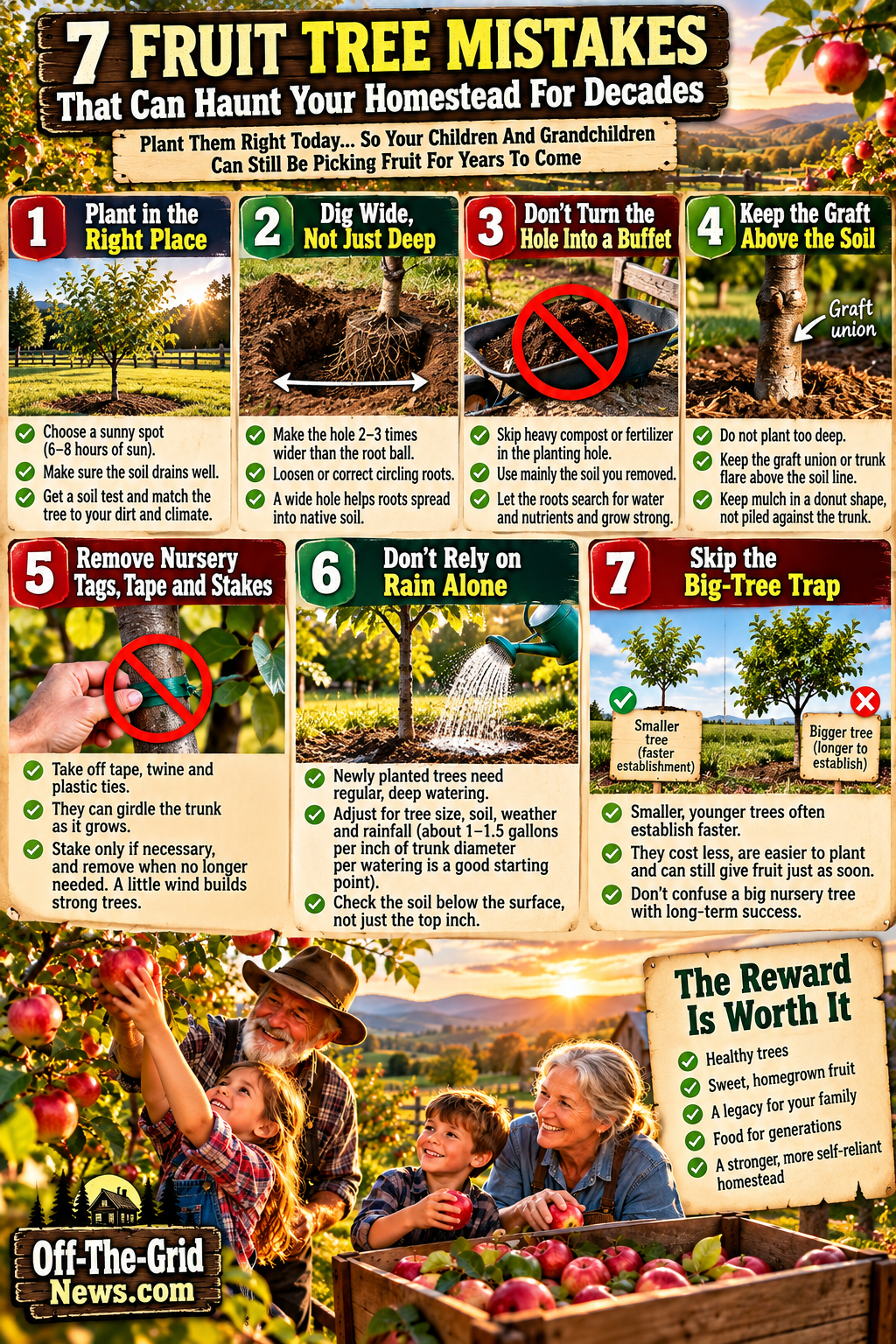
Mistake #1: Planting Where YOU Want The Tree Instead Of Where The TREE Wants To Grow
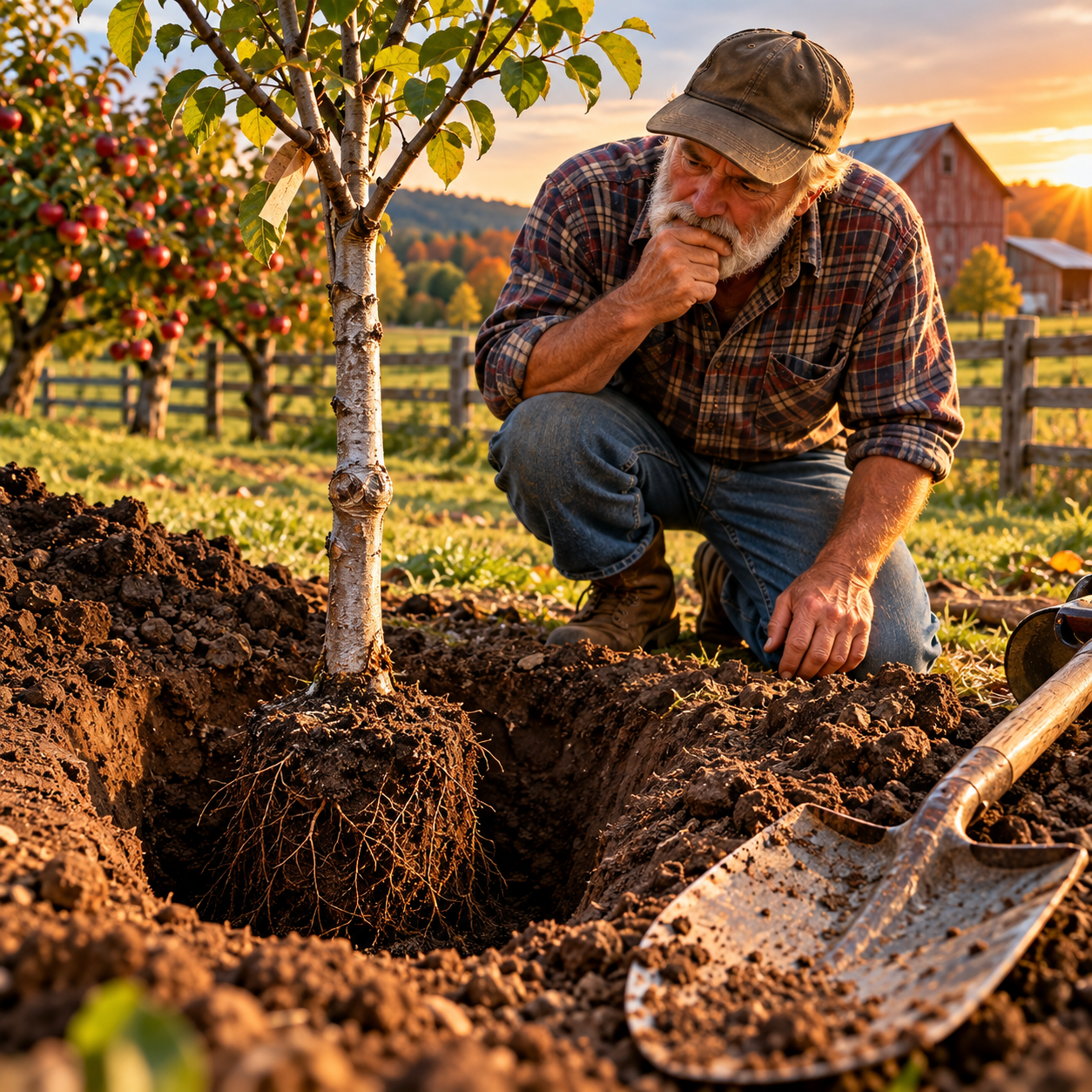
Most orchard problems don’t start when the apples appear. They start the afternoon you put the tree in the ground.
The easiest planting spot isn’t necessarily the best planting spot.
Maybe there’s a nice empty patch beside the barn. Maybe that corner of the yard would look pretty with three apple trees. Or maybe you’re simply tired of carrying the shovel and decide, “Yep, right here looks good.”
That’s not much of a soil test.
Fruit trees are going to spend decades standing in the spot you choose, so drainage, sunlight, soil conditions and climate matter enormously. Before planting, it’s worth getting a real soil test rather than trying to diagnose your dirt by squishing a handful between your fingers.
Around many homesteads, a good loamy soil is the dream. It crumbles in your hand, holds some moisture and nutrients, yet still allows excess water to drain away.
That’s important because tree roots need water…
But they need oxygen, too.
A soggy planting site can leave roots sitting in poorly aerated soil, while bone-dry sand may require much more attention to water and fertility. The goal isn’t necessarily to find “perfect dirt.” It’s to understand the dirt you’ve got and choose trees, rootstocks and planting locations accordingly.
The University of Minnesota Extension recommends preparing the site carefully and paying particular attention to drainage and planting depth.
In other words, don’t force a square peg into a round hole.
Pick the right tree for the right place.
Then dig the right hole.
Mistake #2: Digging A $5 Hole For A $50 Tree
Here’s one of the strangest things about planting trees:
The hole should usually be wider than you think… and shallower than you think.
A lot of beginners do exactly the opposite. They dig something resembling a post hole, drop the root ball into it and call it supper time.
Don’t.
The Colorado State University Extension recommends a broad, saucer-shaped planting area and explains that wider planting holes encourage roots to move outward into the surrounding soil. Depending upon conditions, a hole two to three times the diameter of the root ball may be appropriate.
That’s because nursery trees can arrive with roots circling around inside their containers. If those roots aren’t corrected and they’re dropped into another tight little hole, you’ve essentially traded a plastic flowerpot for a dirt flowerpot.
Instead, inspect the root ball.
If you find circling roots, loosen or correct them as appropriate, then give those roots room to head outward. You’re trying to convince that tree that its new home isn’t the little container it came from.
It’s the whole farm.
And while you’re standing there admiring that beautiful wide hole, you’ll probably feel another temptation coming on.
A wheelbarrow full of black compost.
Mistake #3: Turning The Planting Hole Into A Five-Star Restaurant
This one feels completely backward.
You love the tree, so naturally you want to spoil it. A shovel of compost goes in. Maybe some manure. Perhaps a fistful of fertilizer.
Pretty soon you’ve built the Ritz-Carlton for apple roots.
Unfortunately, that’s not necessarily doing the tree a favor.
Current Colorado State University planting guidance notes that heavily amending a planting hole with organic matter can actually hinder roots from moving into the surrounding native soil. Large amounts of organic matter may also hold too much water in some conditions.
That’s why simply backfilling primarily with the soil you removed is often the better approach.
You’re not trying to create one little pocket of paradise.
You’re trying to establish a tree in the soil where it will spend the rest of its life.
That distinction matters.
Likewise, don’t assume a newly planted tree automatically needs a fistful of fertilizer tossed against its roots. Soil-test recommendations, species, site conditions and local Extension advice are much better guides than the old “more fertilizer equals more growth” approach.
Your goal during establishment is roots.
Long roots. Wide roots. Healthy roots.
Build the underground tree first, and the above-ground tree has something worth standing on.
Which brings us to one of the easiest ways to wreck the whole project.
Mistake #4: Burying The Tree Like A Fence Post
Fruit trees aren’t fence posts.
You don’t plant them extra deep so they won’t blow over.
In fact, planting too deeply is one of the classic tree-planting mistakes. The trunk flare—the place where the trunk begins widening into the major roots—needs to remain at the proper level rather than disappearing beneath several inches of dirt.
The University of Minnesota Extension recommends keeping the graft or trunk flare above the soil surface. For grafted fruit trees, recommendations for the exact graft height can vary by fruit and rootstock; for example, Minnesota’s stone-fruit guidance advises keeping the graft union several inches above the soil line.
And you definitely want to know where that graft is.
Most modern fruit trees aren’t simply one tree from top to bottom. A desirable fruiting variety has been grafted onto a selected rootstock that may influence mature size, hardiness, disease resistance and other characteristics.
That swollen or crooked-looking spot near the bottom of the trunk is therefore important.
Keep it where it belongs.
And while you’re at it, watch the mulch.
Don’t build one of those giant mulch volcanoes around the trunk that looks like your apple tree erupted out of Mount Vesuvius. Keep mulch pulled away from direct contact with the trunk, forming more of a broad donut than a volcano.
Trees aren’t telephone poles.
Let that trunk breathe.
Mistake #5: Leaving The Nursery Attached To The Tree
Here’s a mistake you may not notice until the damage is already done.
Tags. Twine. Tape. Plastic ties. Shipping material. Stakes.
Nurseries need some of that stuff to transport and display trees. Your orchard doesn’t.
Anything tight around a growing trunk can eventually become a problem as the trunk expands. The University of Minnesota specifically recommends removing twine from around the trunk, while Colorado State’s planting instructions likewise call for removing wrapping materials from the appropriate portions of the root ball.
Then there’s staking.
A lot of folks assume every new tree needs to be tied down like it’s expecting a Category 5 hurricane.
Not necessarily.
Research-based guidance says staking isn’t required in many ordinary landscape situations. When it is necessary because of wind, instability or other conditions, the tree should still have some freedom to move.
Why?
Because trees aren’t supposed to stand perfectly rigid.
According to Colorado State University Extension, some trunk movement encourages root growth and trunk development. Stakes and straps should also be removed once they’re no longer needed rather than forgotten until they’ve started cutting into the tree.
A little wind isn’t your tree’s enemy.
It’s part of tree school.
Let that youngster learn how to stand on its own.
Mistake #6: Believing Mother Nature Has Joined Your Irrigation Crew
Spring looks wet.
Fall looks wet.
Therefore, somebody plants a fruit tree, gives it one ceremonial splash from the hose and announces:
“Rain’ll take care of the rest.”
Maybe.
Or maybe three dry, windy weeks arrive and turn your expensive new orchard into a collection of very fancy walking sticks.
Newly planted trees don’t have the enormous root systems established trees possess. Much of their working root system is still concentrated around that original root ball and newly disturbed soil.
So you’ve got to pay attention.
Rather than blindly dumping “several gallons every week,” adjust watering to tree size, soil, temperature, wind and rainfall. The University of Minnesota Extension’s watering guide gives a useful starting point of roughly 1 to 1.5 gallons per inch of trunk diameter per watering, with watering needs changing as the roots expand.
The important thing is to check the soil rather than the calendar.
Don’t glance at the top and assume everything underneath is fine. Soil can look damp at the surface while the root zone below is getting thirsty—or the reverse can happen, with saturated soil hiding beneath a dry-looking crust.
Get your fingers dirty.
Check what’s actually happening around the root ball.
Then water deeply enough to encourage roots outward without keeping the soil permanently soggy.
Your orchard doesn’t need a babysitter forever.
But during that first establishment period, it sure needs somebody paying attention.
Mistake #7: Buying The Biggest Tree Because You Want Apples NOW
And now we arrive at the mistake garden centers absolutely love.
You walk past a skinny young fruit tree.
Forty bucks.
Then you spot the monster.
Big trunk. Big branches. Maybe even blossoms hanging from it.
“Now THAT’S a tree!”
So you spend considerably more money, wrestle the brute into the pickup, throw your back out getting it home and dig a hole approximately the size of a livestock pond.
All because you’re convinced bigger means faster fruit.
Not always.
Smaller nursery stock can establish quickly because less top growth has to be supported while the transplanted root system gets established. Larger trees can certainly be planted successfully, but you’re buying more tree, moving more weight and dealing with a larger root system that has undergone transplant stress.
In other words, don’t confuse size at the nursery with long-term success on your homestead.
A healthy younger tree with a sound root system, appropriate rootstock and good structure may be a mighty smart buy.
Besides, an orchard teaches patience whether you like it or not.
You can throw money at it.
You can’t bribe September into arriving in May.
You’re Not Planting An Apple Tree… You’re Planting Shade For Somebody You May Never Meet
That’s the part I love about orchards.
A tomato patch belongs to this summer. Sweet corn belongs to this summer. Even that fat pumpkin sprawling across the garden is headed for the pantry before winter.
But an orchard works on another clock.
Plant an apple tree this spring and, Lord willing, somebody may still be picking apples from it decades from now.
Maybe it’ll be you.
Maybe it’ll be your children.
Maybe someday a grandkid will walk underneath those branches with a five-gallon bucket and never once think about the afternoon you stood there with a shovel, sweat running down your back, wondering whether you’d dug the hole wide enough.
That’s homesteading.
Some jobs feed you tonight.
Others feed people you’ll never meet.
So choose the site carefully. Test the dirt. Dig wide rather than unnecessarily deep. Don’t turn the planting hole into a compost bin. Keep the root flare and graft where they belong. Remove the nursery junk, stake only when necessary, and pay close attention to water while those roots establish.
And don’t be afraid to start small.
Because twenty years from now, nobody is going to care whether that tree looked impressive sitting outside the garden center.
They’re going to care whether it has strong roots, broad branches…
And enough apples hanging from them to make Grandma start hunting for the pie pans.