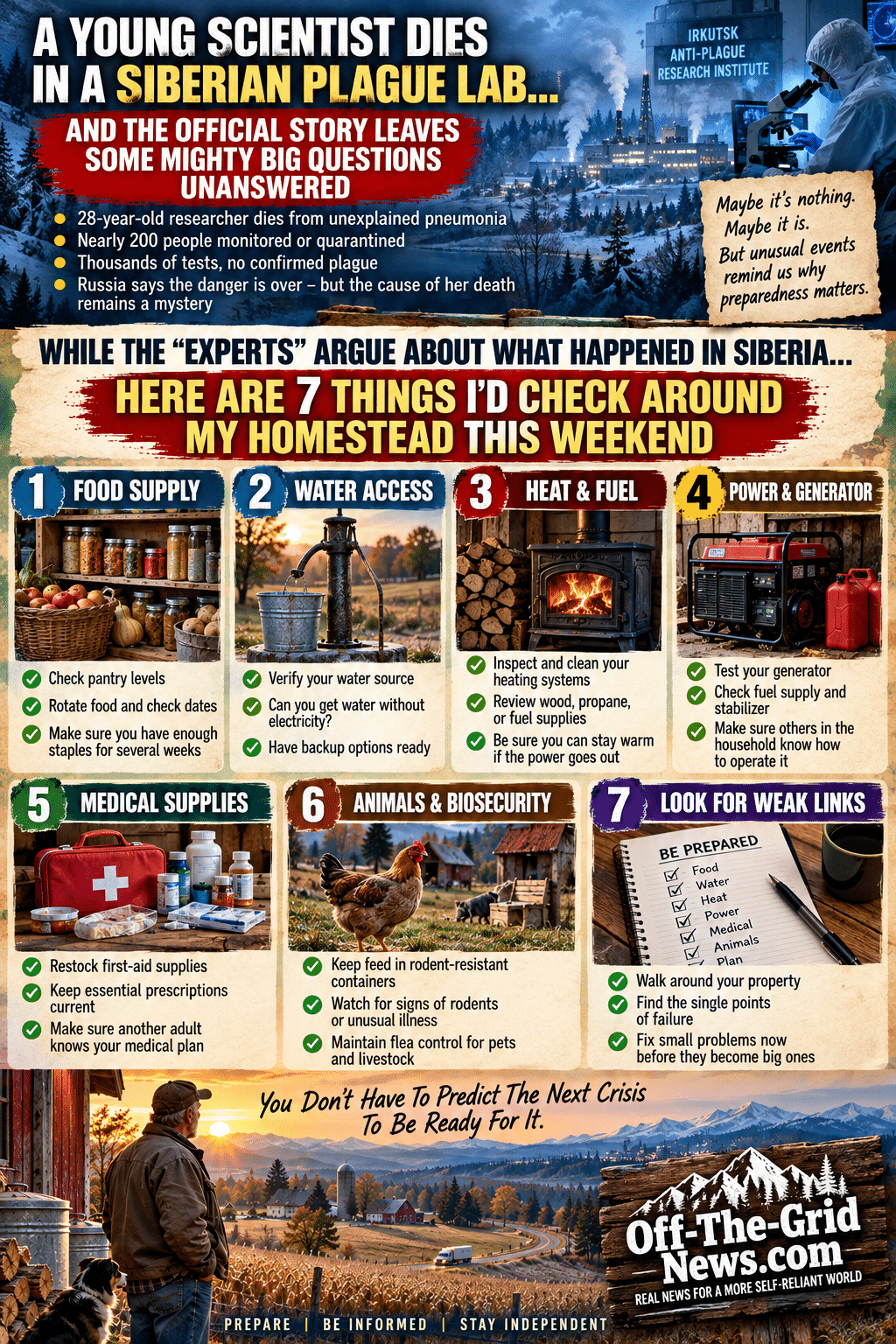
 Print
Print
A Young Scientist Dies in a Russian Plague Lab… And the Official Story Leaves Some Mighty Big Questions Unanswered
Nearly 200 People Quarantined… Thousands Of Tests… And A Mysterious Death Nobody Can Fully Explain. Here’s What We Know, What We DON’T Know, And Why Homesteaders Should Pay Attention.
A 28-year-old scientist working at a Russian laboratory that studies some of the world’s most dangerous diseases fell seriously ill in late September. A few days later, she was dead, nearly 200 people were being monitored or quarantined, and officials were scrambling to explain what had happened.
Now here’s where things get interesting.
The laboratory sits in Siberia, thousands of miles from the nearest American cornfield. But for folks who keep a root cellar stocked, a woodpile stacked, and a generator ready to fire up, the story raises a question worth asking: What happens when something dangerous starts spreading and the people responsible for warning everybody can’t—or won’t—tell us exactly what’s going on?
Because sometimes the biggest threat isn’t what you know is coming.
It’s what you don’t know until it’s already knocking on your door.
A Young Woman Dies… And Suddenly Everybody’s Asking About Plague
Let’s start with what we actually know. According to Reuters, 28-year-old Darya Shipilova worked at the Irkutsk Anti-Plague Research Institute of Siberia and the Far East and died October 2 after developing what Russian authorities described as pneumonia of undetermined origin.
Now, this wasn’t some ordinary office building where people shuffle paperwork and argue over whose turn it is to make coffee. The Irkutsk institute works with dangerous infectious diseases including plague, anthrax, and cholera, which is why the sudden death of one of its researchers immediately attracted international attention.
Early reports raised the possibility that Shipilova had somehow been exposed to a pathogen at work, with pneumonic plague quickly becoming the biggest concern. Russian authorities strongly denied that a laboratory accident involving plague had occurred and said testing had not connected her death to the dangerous organisms studied at the institute.
Meanwhile, rumors began circulating that a second person had become ill. Russia denied those reports, while the World Health Organization continued asking Moscow for more information about exactly what testing had been done and what killed Shipilova.
By October 8, Russian officials were winding down the extraordinary precautions surrounding the case. They said no dangerous pathogen had been detected among Shipilova’s contacts and declared the epidemiological situation stable.
There was just one stubborn problem.
They still hadn’t publicly explained what killed her.
Nearly 200 People Quarantined… But Officials Say There Was No Epidemic
Here’s where the story starts sounding like something out of a medical thriller. Following Shipilova’s death, roughly 200 people who had contact with her were monitored or quarantined while investigators tried to determine whether a dangerous pathogen might be involved.
Employees of the institute were among those isolated, and medical facilities adopted precautionary measures while testing continued. Reports of respirators, quarantines, and unusual restrictions naturally poured gasoline on rumors already spreading across social media.
Imagine looking out your farmhouse window one morning and seeing government vehicles rolling past the mailbox. Then imagine hearing that people connected to a research laboratory were being isolated while nobody could give you a firm answer about what killed one of its employees.
You’d probably start asking questions, too.
To be fair, aggressive precautions don’t prove authorities discovered something terrifying. When somebody working around dangerous pathogens suddenly dies from unexplained pneumonia, isolating contacts while investigators figure things out is exactly the sort of precaution responsible public-health authorities ought to take.
And the subsequent news was encouraging. Russian officials said nearly 5,000 samples were tested without finding plague or another dangerous pathogen among the people being monitored, and by October 8 all contacts were reportedly healthy.
The World Health Organization likewise said there were no signs of additional infections and assessed the risk to the general population as very low.
That’s genuinely reassuring.
But here’s the part that keeps scratching at the back of the mind: thousands of negative tests among contacts still don’t tell us what caused the original illness.
A wider outbreak can be ruled out while the original death remains unexplained. Both things can be true.
Before You Start Digging A Bunker… Here’s What Plague Actually Does
Before somebody starts boarding up the windows and buying enough canned beans to feed three generations, let’s get a little perspective. Plague is serious, but it isn’t the unstoppable medieval monster most folks picture when they hear the word.
Plague is caused by a bacterium called Yersinia pestis. It still circulates naturally among rodents and their fleas in parts of Africa and Asia, and cases continue to occur in the rural American West as well.
And yes, Americans still get it.
The United States averages about seven human plague cases a year, most of them in western rural or semirural areas. People generally become infected through flea bites or through contact with infected animals rather than because somebody with plague happened to walk through the grocery store.
There are three major forms of the disease. Bubonic plague typically attacks the lymph nodes, producing fever and the painful swollen glands historically known as buboes, while septicemic plague infects the bloodstream.
Pneumonic plague attacks the lungs and is the form capable of spreading from one person to another through infectious respiratory droplets during close contact. That’s the version that makes epidemiologists sit up straight.
Untreated pneumonic plague can progress rapidly and become fatal. But modern medicine has changed the equation considerably because plague is a bacterial infection that can be treated with commonly available antibiotics.
The trick is acting fast.
CDC guidance says appropriate treatment should begin as soon as plague is suspected and should not be delayed while doctors wait for laboratory confirmation.
The trouble isn’t that we have no weapons against plague. It’s that those weapons need to be used quickly—and correctly.
The Little-Known Study That Could Change How You Think About Plague
Here’s something worth knowing before getting carried away by frightening headlines. Back in 2006, researchers published a randomized clinical trial in Clinical Infectious Diseases comparing two relatively ordinary antibiotics against naturally occurring plague in Tanzania.
The study included 65 patients whose symptoms had begun no more than three days earlier. Thirty-five received gentamicin injections, while 30 received oral doxycycline.
The results were impressive.
Thirty-three of the 35 gentamicin patients survived, while 29 of the 30 patients receiving doxycycline survived. That worked out to favorable outcomes of roughly 94 percent and 97 percent.
The deaths occurred among patients who were already seriously ill when treatment began. In other words, doctors working in a rural African setting successfully treated most of the plague patients in the trial with medicines that were already familiar and relatively inexpensive.
The study is important enough that current CDC guidance still cites the randomized doxycycline trial when discussing plague treatment.
But don’t miss the fine print.
This was a small study, and most participants had bubonic rather than pneumonic plague. Everybody in the trial also received an antibiotic, so researchers weren’t comparing medicine against doing nothing.
So no, the results don’t mean a bottle of doxycycline sitting in your medicine cabinet makes you plague-proof.
Still, they demonstrated something encouraging: sometimes the medicine that saves your bacon isn’t brand-new, exotic, or eye-wateringly expensive.
Sometimes it’s an old tool used correctly.
Then Madagascar Put A Simpler Treatment To The Test
Nearly two decades later, researchers asked another practical question: Could bubonic plague be successfully treated with oral ciprofloxacin alone instead of starting with an injected antibiotic?
The answer came from a randomized trial conducted in Madagascar and published in the New England Journal of Medicine in August 2025. Researchers enrolled 450 people with suspected bubonic plague and compared 10 days of oral ciprofloxacin with three days of an injectable aminoglycoside followed by seven days of ciprofloxacin.
Among patients with confirmed or probable plague, the simpler oral treatment performed about as well as the injection-based regimen. Researchers concluded that ciprofloxacin alone was noninferior to the combination approach.
That could be tremendously useful in rural parts of the world where hospitals are distant, trained personnel are scarce, and injectable treatments are harder to administer.
But once again, keep both boots planted firmly on the ground.
The Madagascar study dealt with bubonic plague, not a mysterious pneumonic illness acquired inside a laboratory. Patients were medically evaluated and monitored; this wasn’t a bunch of people diagnosing themselves at the kitchen table.
Current CDC guidance makes the same distinction. Oral or intravenous antibiotics may be appropriate depending on the type and severity of illness, and doctors are advised to begin proper treatment immediately when plague is genuinely suspected.
So the lesson isn’t, “Buy antibiotics and become your own doctor.”
The lesson is that early recognition and proper treatment can make an enormous difference.
So Why Did This Young Scientist Die?
And now we come right back to Siberia. If plague is generally treatable with antibiotics, why did a 28-year-old woman working at an institute specializing in dangerous infectious diseases die from unexplained pneumonia?
That’s a fair question, but there’s an equally important warning: We don’t currently know enough to answer it.
Severe pneumonia can have many causes, and even infections that normally respond to treatment can become fatal if they progress rapidly, produce complications, or aren’t recognized early enough. Public reporting hasn’t established exactly what organism caused Shipilova’s illness or given outsiders a complete clinical timeline.
Without those facts, claims that ordinary antibiotics somehow “failed” are speculation.
Still, another question naturally follows: What if the organism involved—whatever it was—was resistant to standard treatment?
Antibiotic-resistant organisms occur naturally, and biodefense specialists have also considered the possibility of deliberately altered pathogens. CDC emergency planning for a hypothetical plague bioterrorism event specifically notes that an engineered strain could potentially resist one or more classes of antibiotics.
But possible isn’t the same thing as proven.
There is currently no publicly verified evidence showing that Shipilova was infected by an engineered pathogen, antibiotic-resistant plague, or a biological weapon.
A good skeptic asks hard questions.
A good skeptic also knows where the evidence stops.
Russia Has A Biological-Weapons History It Would Rather Forget
Of course, people aren’t suspicious in a vacuum. The Soviet Union operated one of the largest offensive biological-weapons programs ever assembled, involving numerous research and production sites and thousands of scientists.
Then there’s Sverdlovsk.
In April 1979, a mysterious anthrax outbreak swept through part of the Soviet city now known as Yekaterinburg. Soviet officials blamed contaminated meat, but the explanation eventually unraveled as evidence emerged that airborne anthrax spores had escaped from a military biological facility.
Dozens of people died.
The truth remained buried for years.
Then came Chernobyl in April 1986. Soviet authorities initially withheld information about the exploding nuclear disaster, and the world realized something enormous had happened only after elevated radiation set off alarms hundreds of miles away in Sweden.
None of that proves Moscow is lying about Irkutsk.
That distinction is important.
But history explains why international health officials and plenty of ordinary people aren’t content with a simple, “Everything’s fine. Nothing to see here.”
When a government has concealed dangerous accidents before, transparency matters even more the next time something strange happens.
The Internet Found Some Mighty Interesting Coincidences
Naturally, the online world has been having a field day. Commentators have pointed toward everything from infectious-disease exercises and plague information updates to fictional stories involving laboratory disasters.
Put enough of those things on one screen, add ominous music, and pretty soon you’ve got yourself a documentary.
But slow down.
Coincidences aren’t evidence. Public-health agencies routinely update disease information, governments conduct outbreak exercises precisely because outbreaks sometimes happen, and novelists have been blowing up laboratories and unleashing imaginary diseases since long before anybody had Wi-Fi.
That doesn’t mean unusual timing should never be noticed. It means we shouldn’t build the conclusion first and then go hunting for pieces that seem to fit it.
The real questions are considerably simpler: What killed Darya Shipilova? Was she exposed to something through her work? Exactly what tests were conducted on her, and can independent health authorities eventually evaluate enough of the underlying information to confirm the Russian explanation?
Those questions are worth asking.
Everything else is smoke until somebody finds the fire.
What Does A Mysterious Death In Siberia Have To Do With Your Homestead?
Now let’s bring this story back where it belongs.
Picture an October morning on your place. Frost is lying silver across the pasture, smoke is curling from the chimney, and a couple of hens are scratching underneath an apple tree. The coffee’s hot, the pantry shelves look good, and the woodpile is finally high enough that you can stop feeling guilty every time you walk past it.
Life is normal.
Then the headlines start rolling in. Maybe it’s a mysterious disease overseas, maybe borders tighten, or perhaps transportation slows, workers stay home, deliveries get delayed, and people clean out grocery-store shelves because somebody on television used the word “emergency.”
Would your household keep running?
That’s the useful question. Not, “Is Siberia about to start the next pandemic?” The available evidence right now says there is no wider outbreak, and the WHO has characterized the general risk as very low.
The better question is whether your family could comfortably handle several weeks of disruption if something unexpected happened anywhere.
Because trouble has an annoying habit of arriving without sending a save-the-date card.
Your First Line Of Defense May Already Be Sitting In Your Pantry
Every experienced homesteader already understands this instinctively. When everybody else suddenly decides they need three grocery carts filled with rice, toilet paper, hamburger, and bottled water, you don’t want to be standing in aisle seven arguing with somebody over the last bag of dried beans.
You want to be home.
A practical emergency pantry doesn’t require expensive buckets with tactical-looking labels. Rice, beans, oats, flour, canned vegetables, canned meat, cooking oil, salt, sugar, and ordinary foods your family already eats can carry a household through a surprising amount of trouble.
Then add what homesteaders do best: home-canned tomatoes, potatoes in the cellar, venison in the freezer, dried beans from the garden, and jars of applesauce lined up like soldiers on a basement shelf.
Now you’ve bought yourself something extremely valuable.
Time.
But there’s a trap hiding inside all that abundance. A freezer packed with hundreds of pounds of beef and venison isn’t necessarily preparedness if one dead generator can turn the whole thing into dog food.
Likewise, 100 pounds of dried beans become considerably less impressive if you don’t have enough water or fuel to cook them. That’s why preparedness isn’t simply about how much you own; it’s about whether the things you own still work when the systems underneath them quit working.
Water, Heat And Power: Three Ways A Comfortable House Can Get Uncomfortable Fast
Next, walk over to the well and ask yourself a very simple question: If the electricity stopped tonight, would water still come out of the faucet tomorrow morning?
Plenty of rural families have wonderful wells and absolutely no way to pull a gallon of water from them after the pump loses electricity. That’s a weakness worth discovering now rather than at 6:30 some January morning with shampoo in your hair.
Then look at the furnace. Does it require electricity, propane, heating oil, or a delivery truck that has to make it down your road after an ice storm?
Even a beautiful woodstove isn’t much comfort if the chimney hasn’t been cleaned and half the winter’s firewood is still standing upright wearing bark.
Then there’s the generator. Will it start, how much fuel do you actually have, and can somebody besides you operate it safely?
More importantly, how long can your household keep the essentials running before the fuel cans are empty?
These aren’t glamorous questions.
That’s exactly why they’re useful.
One Saturday spent walking around your place looking for hidden dependencies can uncover more genuine preparedness weaknesses than another thousand dollars worth of survival gadgets.
Your Medicine Cabinet Needs More Than Aspirin And Good Intentions
Medical preparedness deserves the same treatment. Most homes have a handful of bandages, some ibuprofen, a thermometer that may or may not still have batteries, and one mysterious tube of ointment nobody remembers buying.
That’s not really a medical plan.
Start with the boring stuff. Maintain a properly stocked first-aid kit, keep essential prescriptions current, and make sure somebody else in the household knows what medications family members take and where important medical information is stored.
If you live a long drive from emergency care, learning CPR and basic first aid is time mighty well spent. Keep necessary medicines available, maintain important medical information offline, and know where you’ll go if the local clinic suddenly isn’t an option.
Then there’s the antibiotic question. Some preparedness-minded families talk with physicians or licensed telehealth providers about whether keeping certain prescription medications available for emergencies makes sense for their individual circumstances.
That’s a conversation worth having before the emergency arrives.
Antibiotics aren’t magic beans. The fact that one drug works against one bacterium doesn’t make it the right choice for the next fever, cough, infected cut, or mysterious pneumonia that comes along.
Doxycycline, for example, is among the drugs used to treat certain forms of plague, while fluoroquinolones such as ciprofloxacin are also first-line options under current CDC guidance. Which medicine is appropriate depends on the form and severity of the illness, the person being treated, and other clinical circumstances.
That distinction becomes especially important with pneumonic plague because time matters. Current CDC instructions are unusually plain: if doctors genuinely suspect plague, collect appropriate samples if possible but do not wait for the test results before beginning treatment.
So having supplies on hand is useful.
Knowing when you need professional help is even more useful.
Preparedness means shortening the distance between trouble and the right treatment—not guessing which pills to swallow after trouble arrives.
For rural families, that may require more planning than it does for somebody living three blocks from a major hospital. Twenty miles to an emergency room feels considerably longer at two in the morning during an ice storm, especially when somebody in the passenger seat is struggling to breathe.
So build the first-aid kit, keep prescriptions squared away, learn CPR, and have the medical conversations you’ve been putting off. Then make sure another adult in the household knows the plan if you’re the one lying sick in bed.
Because the Siberian case illustrates something easy to forget.
A medicine cabinet can give you options.
It cannot tell you what made you sick.
There’s Another Disease Risk Hiding Right Outside Your Barn Door
And while you’re checking that medicine cabinet, don’t forget to look outside.
For homesteaders, some infectious-disease risks don’t arrive on an airplane or escape from a laboratory thousands of miles away. They’re already living along the fence rows, underneath the feed shed, and inside the woodpile behind the barn.
Plague is one of them.
Yersinia pestis naturally circulates among wild rodents and their fleas. People can become infected after a flea bite or through direct contact with an infected animal.
For homesteaders, that matters because barns, chicken coops, grain sheds, hay piles, wood stacks, and feed rooms can become cozy little neighborhoods for mice and rats. And when rodents move in, fleas often aren’t far behind.
So don’t give them free room and board.
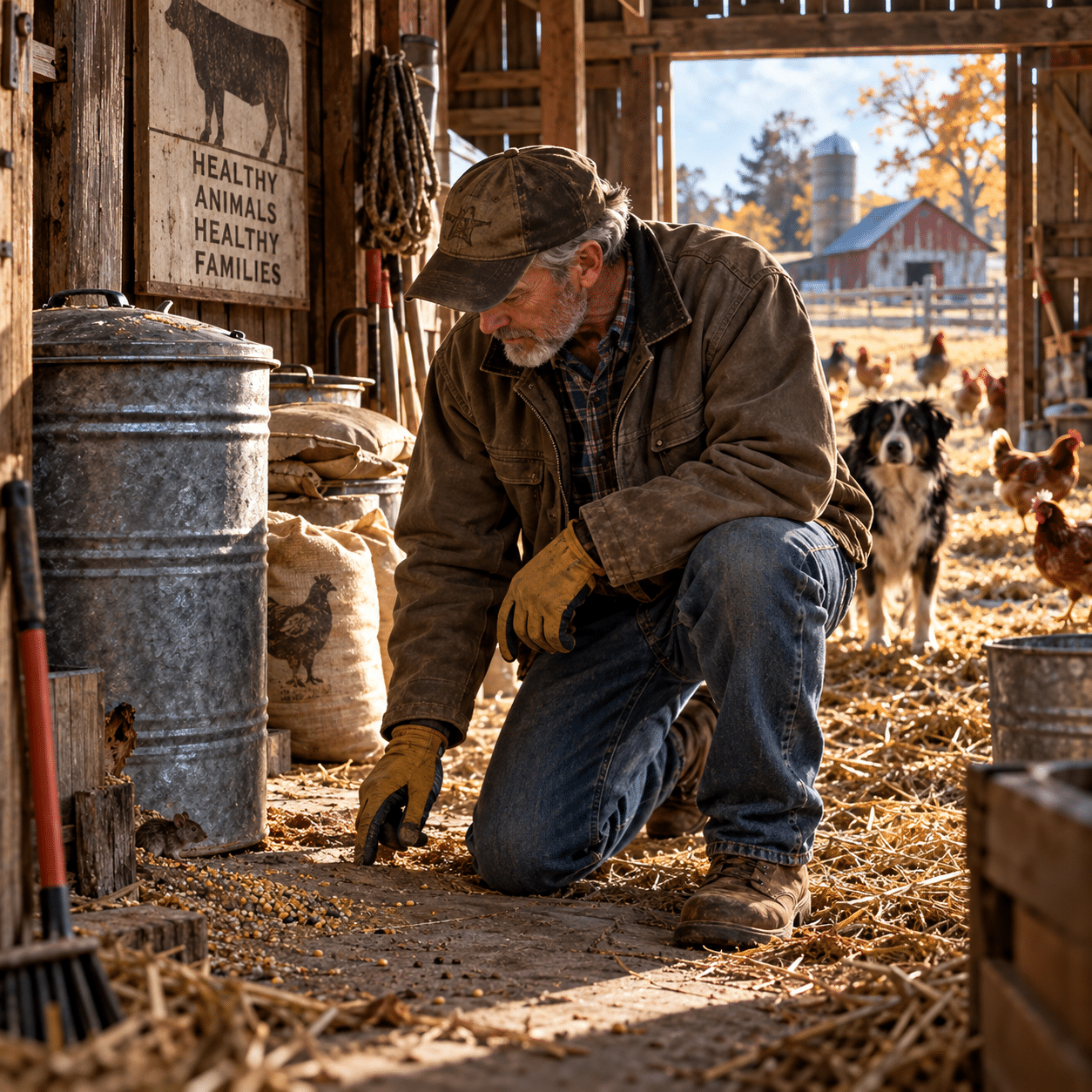
Keep livestock feed and grain in sturdy, rodent-resistant containers, sweep up spilled feed, and clean around barns and outbuildings. Trim brush and clutter around structures instead of providing rodents with a rent-free subdivision ten feet from your back door.
Pets deserve attention, too. Dogs and cats roam places we don’t, stick their noses into things we wouldn’t, and can encounter rodents and fleas around a rural property.
If an animal becomes suddenly sick after contact with wildlife, don’t automatically shrug it off. Call your veterinarian and explain what happened.
And don’t play country doctor with a mysteriously dead critter.
If you’re in an area where plague occurs, direct contact with sick or dead rodents is a recognized risk factor. CDC diagnostic guidance specifically tells clinicians to consider recent flea bites, rodent exposure, and contact with sick or dead animals when evaluating possible plague.
One dead mouse behind the feed bin isn’t exactly headline material. But when something around the property suddenly changes—multiple dead wild animals, unusual flea activity, or pets becoming ill after wildlife contact—it’s worth paying attention.
The good news is that plague remains rare in America. Roughly seven human cases occur in an average year, mostly in the rural West.
So no, you don’t need to stare at every field mouse like it just rode onto the property with the Four Horsemen.
You do need to keep the barn clean, the grain sealed, rodents under control, and fleas off your animals. More importantly, you need to notice when something around the place suddenly stops looking normal.
Preparedness usually isn’t dramatic.
It’s a tight lid on the grain barrel, a clean barn floor, flea control on the dog, gloves hanging beside the shed door, and somebody on the place who notices when three dead rodents show up where yesterday there were none.
Because sometimes the best biosecurity system on the homestead isn’t a hazmat suit.
It’s somebody paying attention.
And That Brings Us Right Back To Siberia
Whatever ultimately killed Darya Shipilova, somebody noticed something wasn’t normal.
A young scientist working at a laboratory that studies dangerous pathogens developed severe pneumonia and died. Roughly 200 contacts were monitored or quarantined, thousands of tests were performed, and international health authorities began asking questions.
Maybe those precautions worked exactly as intended.
In fact, the absence of additional illnesses and thousands of negative tests are very good news. Russia said on October 8 that all contacts were healthy and that no dangerous pathogens had been detected in the samples it examined.
Maybe the eventual explanation will have nothing whatsoever to do with a laboratory accident.
That would be even better.
But until the cause of Shipilova’s death is convincingly explained, there’s still a blank spot in the story.
And that’s where the homesteader’s mindset becomes useful.
You don’t have to know exactly why smoke is rolling over the ridge before you step outside and see which way the wind is blowing. You don’t need Washington, Moscow, Geneva, or anybody else to tell you when it’s time to count the canned goods, check the generator, look at the medicine cabinet, or make sure there’s enough feed in the barn.
That isn’t panic.
It’s prudence.
Keep Your Head… And Keep Your House In Order

Maybe we’ll eventually get a perfectly ordinary explanation for what happened in Irkutsk. Maybe investigators will establish that Shipilova’s death had nothing to do with a laboratory accident and that Russia’s aggressive precautions did exactly what they were supposed to do.
I hope that’s exactly what happens.
For now, the reassuring part is that officials found no wider outbreak among the people who were monitored. The WHO said there was no evidence of further infections, and Russia says thousands of tests failed to uncover a dangerous pathogen among Shipilova’s contacts.
Still, one stubborn question remains: What killed a 28-year-old scientist who worked around dangerous infectious diseases?
Until there’s a convincing answer, that question deserves to remain on the table. Not because every unanswered question proves a conspiracy, but because unanswered questions are exactly that—unanswered.
And there’s a bigger lesson here that has nothing to do with Russia.
We live in a world built around long supply chains, electric pumps, refrigerated food, prescription refills, overnight delivery, computer networks, fuel trucks, and stores that expect another tractor-trailer to pull behind the building tomorrow morning.
Most days, that complicated machine works so smoothly we barely notice it.
Until it doesn’t.
That’s where the homesteader has an advantage. Anybody who has watched a late frost kill tomato blossoms, hauled water because a pump quit, or split firewood while snow clouds piled up in the west already understands something modern life makes mighty easy to forget.
Security grows from the ground up.
A garden doesn’t care what the news anchor says. A pantry doesn’t need a press conference, and a stack of seasoned firewood doesn’t disappear because somebody thousands of miles away issued a contradictory statement.
Likewise, a working well, a pressure canner, a healthy flock of chickens, stored food, backup heat, clean water, basic medical supplies, and the knowledge to use them give a family something valuable when the rest of the world gets noisy.
They give you breathing room.
That’s also why preparedness shouldn’t begin with fear. It ought to begin with ordinary questions: Do we have enough food? Can we get water without electricity? Can we heat the house? Can somebody else run the generator? Do we have the medicines we regularly need?
Then come the questions most folks forget.
What happens if the freezer quits?
What happens if I’m the one who gets sick?
What happens if the pharmacy closes for a week?
What happens if the truck carrying the part I need never shows up?
Those questions aren’t nearly as exciting as arguing on the Internet about secret Russian laboratories.
They’re a whole lot more useful.
So keep watching Siberia. Ask reasonable questions, separate confirmed facts from rumors, and don’t turn every weird coincidence into evidence just because it makes a better story.
At the same time, don’t let official reassurance stop you from noticing when an important question still hasn’t been answered.
Then shut the laptop.
Walk downstairs and look at the pantry. Check the dates on the medications, put a wrench on that loose generator terminal, make sure the fuel is fresh, and figure out whether your well still gives you water when the electricity doesn’t.
After that, pull on your boots and walk out to the barn. Check the grain barrels for mouse sign, look over the animals, make sure the flea control is handled, and notice whether anything around the place looks different from yesterday.
Then glance at the woodpile.
If it’s getting skinny, you know what to do.
None of this requires panic, a bunker, or a pallet of freeze-dried stroganoff delivered by a fellow wearing camouflage. It requires something good homesteaders have practiced for generations: noticing small problems early and putting things in order before those little problems become big ones.
That may be the most useful lesson to carry home from a mysterious death in Siberia.
We may eventually learn exactly what happened inside that Russian research institute. Or, given the unanswered questions surrounding the case, the complete explanation may take considerably longer to emerge.
Either way, your job tomorrow morning remains pretty much the same.
Feed the animals, fill the pantry, keep the water running, stack the wood, and know what’s happening beyond your fence line without forgetting to take care of what’s inside it.
Because the people who generally make it through uncertain times aren’t the ones who correctly predict every strange thing coming over the horizon.
They’re the ones who were ready anyway.